Elliot Shoenman built an impressive career in television as a writer and producer. He served as executive producer and showrunner of “The Cosby Show,” and later became the executive producer and showrunner of “Home Improvement.” Yet neither of those accomplishments, nor the Emmy he won, were as personal or meaningful to him as the play he wrote about his own family.
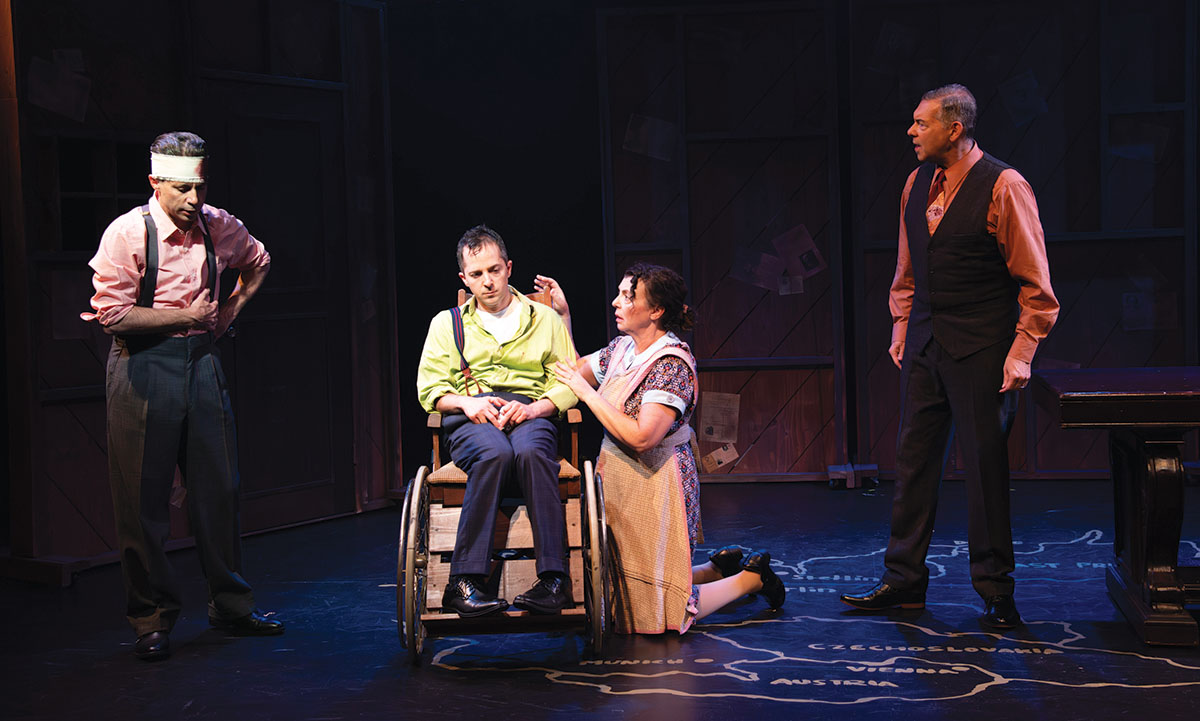
“Paper Walls,” produced by The Inkwell Theater and now playing at the Broadwater Main Stage in Hollywood, tells the story of the Goldman family. Sara (Dana Schwartz) and Herman (Warren Davis) Goldman and their two sons, Albert (Derek Manson) and Walter (Casey J. Adler), live a comfortable life in Berlin. But when Hitler rises to power, Albert tries to convince his parents they must flee. Like many other Jews at the time, they resist, caught between denial, hope that “this too shall pass,” and reluctance to abandon the home and life they know.
When they finally confront the reality that the Nazis are there to stay, their business is burned down and their life is in danger, they attempt to immigrate to the United States. However, restrictive U.S. immigration policies force them to wait. Quotas are in place, and they are painfully limited.
In the play, four actors portray 12 distinct characters, including a Nazi officer, a rabbi, a U.S. immigration official who makes it nearly impossible for Jews to obtain entry permits, and an Austrian gay baker who risks his life to help Albert. The transformations between characters happen quickly and convincingly. The actors also help move the set between scenes, turning props into everything from a German bakery to an American consulate room or a train. This understated staging keeps the focus exactly where it belongs — on the characters, their emotional journeys and the growing urgency of their situation.

The title “Paper Walls” refers to the bureaucratic restrictions, quotas and administrative barriers the U.S. government used to deter Jewish refugees from entering the country before and during World War II. Although the United States officially had immigration quotas that theoretically would have allowed many more refugees to enter, those quotas were deliberately left unfilled. The U.S. did not build physical walls — but it built barriers of paperwork.
These quotas were never revised, even as Nazi persecution escalated. In fact, during the height of World War II, the United States allowed in only about 10% of the number of visas permitted by law. Officials within the State Department, including Breckinridge Long, instructed consulates to delay and obstruct visa applications using excessive paperwork, financial requirements, affidavits, and arbitrary “security reviews.” These administrative barriers became the “paper walls” that effectively shut America’s doors to refugees.
Anti-immigrant and antisemitic sentiment in the U.S. fueled these policies. The era saw the rise of the America First movement, a powerful isolationist campaign that argued America should stay out of European affairs and protect American jobs from foreigners. Its rhetoric often masked xenophobia and antisemitism. Henry Ford used his newspaper, The Dearborn Independent, to spread conspiracy theories about Jewish control of the world. Meanwhile, radio commentator Father Charles Coughlin broadcast weekly antisemitic sermons to an audience of millions, blaming Jews for Communism, capitalism and the war.
Jewish leaders and rabbis in America pleaded with President Franklin D. Roosevelt to allow more refugees to enter. In 1943, a delegation of over 400 rabbis marched to Washington, urging FDR to take action to save European Jews. Roosevelt refused to meet them. Letters from desperate families flooded the White House, begging for help, but most went unanswered. Even after news of mass extermination reached U.S. officials in 1942, the priority remained winning the war, not rescuing Jews.
The play is based on Shoenman’s father’s life, though he did not hear it directly from him. Like many Holocaust survivors, his father didn’t speak about the past. It was only in adulthood, years after his father had passed away, that Shoenman began researching his family history. He traveled to Washington, D.C., Berlin, Vienna, Warsaw and Gdańsk, retracing his family’s footsteps. His search led him to an abundance of material: documents from the National Archives in Washington, the apartment where his family lived in Berlin and even his father’s hiding place in Vienna.
Shoenman believes the play is highly relevant today, particularly in the context of immigration laws. In an interview with Broadway World, he said: “My play, I believe, underlines the difference between an immigrant and a refugee. An immigrant chooses to leave his country, a refugee has to leave.”
But the play, directed by Darin Anthony, also resonates in another profound way. Once again, Jews in Europe are facing a rise in antisemitism. Synagogues are being attacked, Jews are murdered, children wearing kippot are harassed on their way home from school and Jewish businesses are vandalized. It is difficult not to draw parallels to the years leading up to World War II — the warning signs, the denial and the hopeful assumption among many Jews that it was only a temporary wave of hatred that would eventually fade away.
The Inkwell Theater was created by Shoenman and his son Daniel in 2004 and is dedicated to supporting new plays and playwrights in the Los Angeles community.
“Paper Walls” opened on Oct. 17 and will run until Nov. 9. Performances are on Thursday and Saturday at 8pm and Sunday at 3pm at the Broadwater Main Stage Theater, 1076 Lillian Way, Los Angeles, CA 90038. Tickets are $35 with PWYC tickets available for all performances. For reservations, call (310) 551-0918 or visit https://inkwelltheater.com/