In Los Angeles Jewish communities long built relationships with a range of faith groups — from Hispanic Christian congregations to Korean and African American churches. But ties between Jewish and Hindu communities have remained far less developed, with few sustained connections or shared initiatives.
That began to shift with an idea that took shape thousands of miles away. The seeds of a new interfaith alliance between Sinai Temple and the BAPS Hindu Temple in Chino Hills were first planted in Haifa, Israel. Speaking during a Shabbat sermon attended by 15 members of the BAPS community, Rabbi Erez Sherman traced how the relationship began with an unexpected assignment during a global gathering in March 2025, convened under the direction of Israeli President Isaac Herzog.
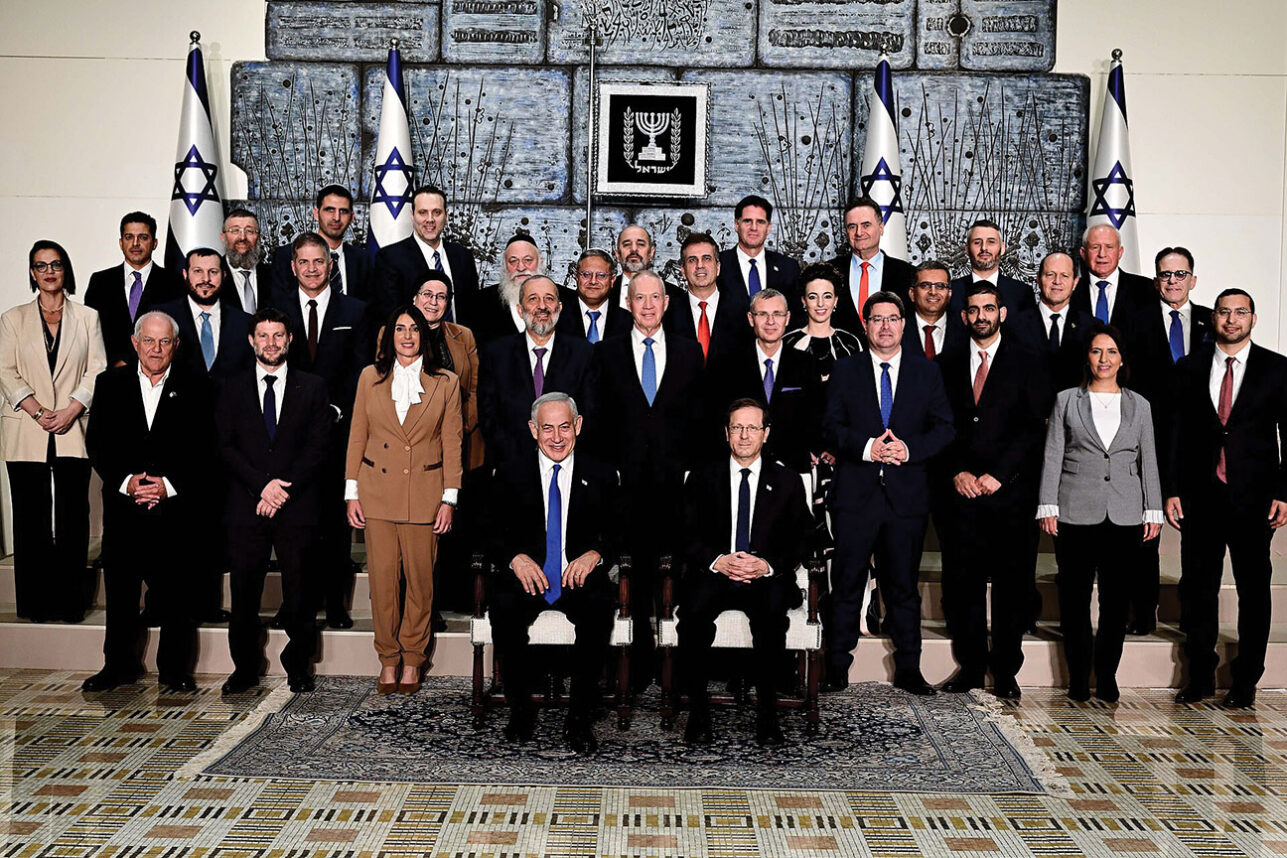
Sherman was among 150 Jewish leaders from around the world invited to what was called the “Voice of the People” council, a global initiative spearheaded by Herzog to unite and empower Jewish communities worldwide.
Sitting alongside rabbis and communal leaders from England, Israel, Mexico, Ethiopia, Sweden, Atlanta, Washington D.C., Philadelphia and beyond, Sherman said the group was given a central challenge: not to solve a problem, but to “fall in love with it, because when you fall in love with a problem, you create an opportunity you did not know existed before.”
Their chosen focus became how Jewish communities connect with their neighbors in an increasingly fragmented world.
As discussions unfolded, participants noted the extraordinary diplomatic progress between Israel and India — but also a gap at the grassroots level.
Rabbi Sherman noted that there are approximately 35 million Indians living in the diaspora, including about 5 million in North America, and roughly 7 million Jews in North America — yet the two communities have rarely crossed paths.
“That’s when it hit us,” he said. “When it came time to invite interfaith friends, BAPS was never even on our list.”
Sherman said what followed felt almost serendipitous. A few months ago, through what he described as a “wild divine intervention,” he was introduced to a leader at the BAPS Hindu Temple in Chino Hills. He seized the opportunity to ask if he could visit their community. Soon after, he and Dr. David Hallegua, a Sinai Temple member who is from India, took a field trip to BAPS, about an hour’s drive from Sinai Temple.
“When we talk about what it means to welcome a guest, we have a lot to learn from them. It was an unbelievably welcoming experience,” said Sherman.
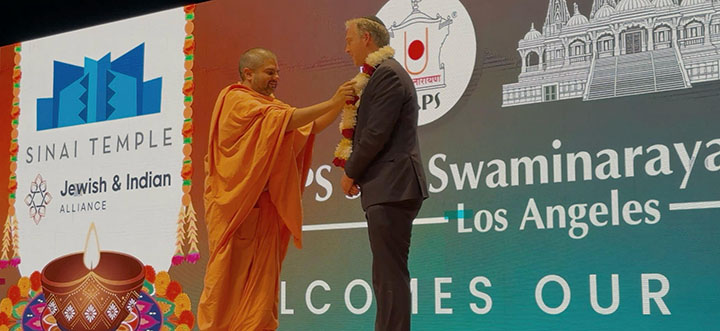
During the visit, Sherman was presented with a gift: a copy of “Transcendence,” written by former Indian President A.P.J. Abdul Kalam, which explores the spiritual teachings of Pramukh Swami Maharaj, the late guru of BAPS Hinduism. Sherman reflected on a passage from the book, saying, “In a world filled with polarization, how can we create and live a harmonious world together with a divine presence?”
“It gives four answers, number one, search in the right place, number two, remove the dust in front of you, number three, open your eyes and number four, you will see the destiny waiting for you to be realized.”
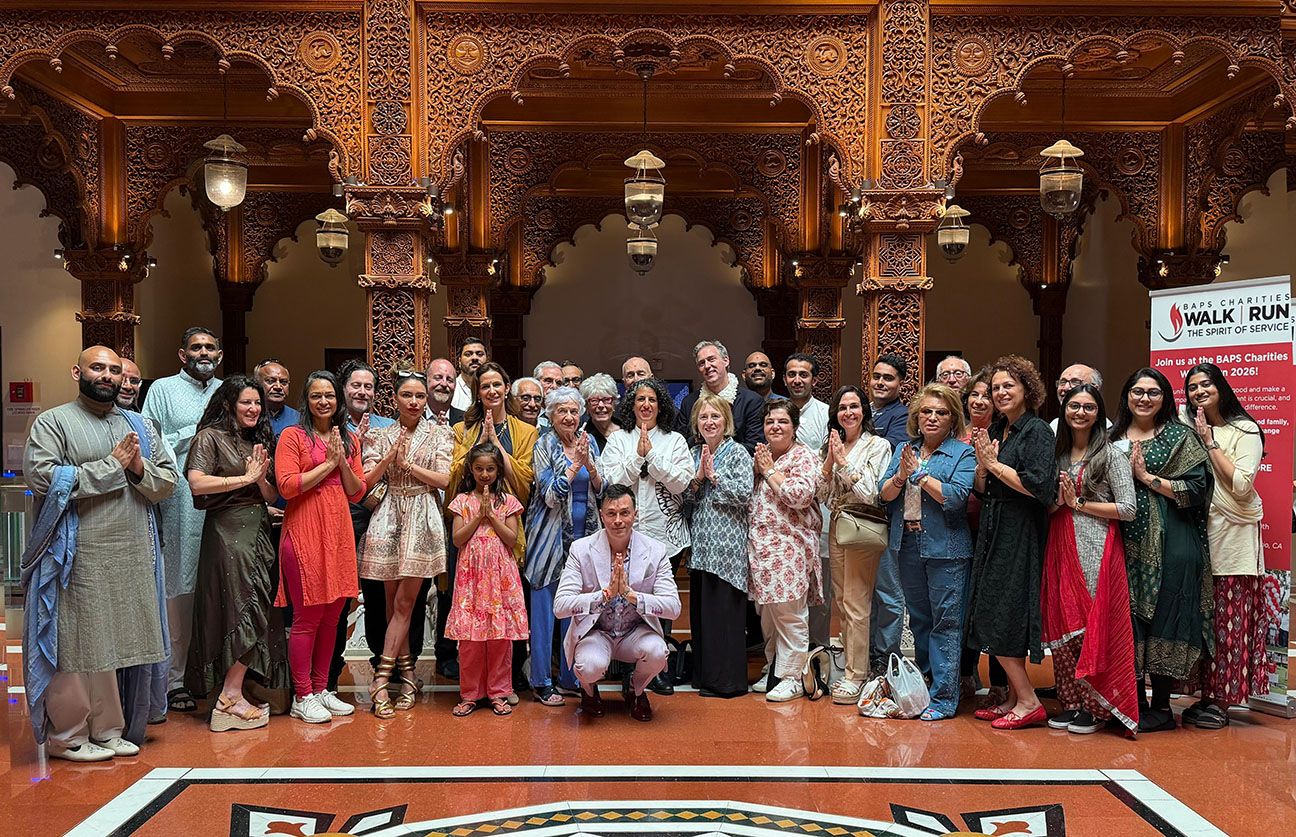
That visit was what helped lay the groundwork for what has now become the Jewish–Indian Alliance, a new interfaith partnership between the Flesh Family Sinai Temple Israel Center and the BAPS Hindu Tempe. On Saturday, April 18, members of BAPS Hindu Temple visited Sinai Temple and on Sunday, members of Sinai Temple visited BAPS Shri Swaminarayan Mandir, Chino Hills.
This striking Hindu temple is set on a 20-acre campus that draws tens of thousands of visitors each year. While deeply rooted in spiritual practice, the place has also become a destination for people of diverse backgrounds — attracting not only devotees but also visitors, photographers and architecture enthusiasts drawn to its craftsmanship and quiet beauty.
At its center is a meticulously crafted place of worship built from white marble and pink sandstone, with intricate carvings that reflect traditional Indian craftsmanship and classical Hindu architecture.
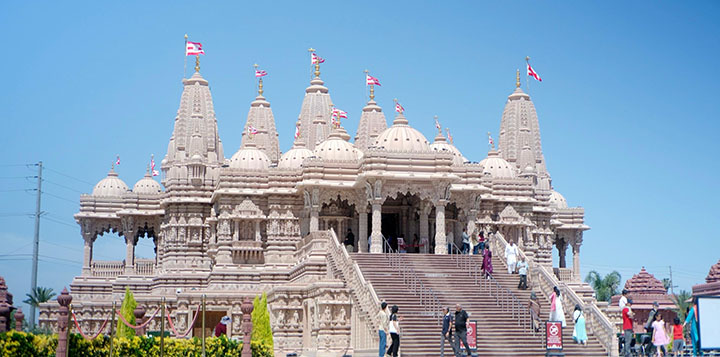
Beyond its architectural grandeur, the mandir is designed as a cultural and community hub. The broader complex includes a cultural center, classrooms and a gymnasium that hosts educational programs, workshops and community activities, reinforcing its role as a space for learning and cultural exchange.
One of its most distinctive features is a 91-foot lotus-shaped pond that surrounds the temple grounds, adding to the sense of tranquility. Visitors often describe the site as serene and contemplative, where flowing water, landscaped gardens, and detailed stonework create an atmosphere that encourages reflection and calm.
The Hindu temple wasn’t new to interfaith engagement. In recent years, the temple has built relationships with Christian, Muslim, Sikh and other faith communities, hosting visits, dialogues and shared learning experiences as part of its broader commitment to interfaith harmony.
“We’ve engaged with some local Jewish communities, but this is the first time we engaged with such a large congregation like Sinai Temple,” Mehul Patel, a volunteer with BAPS, told The Journal.
“Once we learned more about Rabbi Sherman and Sinai Temple, in the spirit of interfaith cooperation and interfaith harmony, it was really important for us to begin that conversation,” said Patel. “We are fortunate to have met him and his wonderful community and to learn about each other’s faiths. We really share a lot in common in terms of history.
For Patel, the focus of the emerging relationship is continued engagement between the communities and growing the friendship in years to come.
“We want to continue to visit each other’s spaces and be involved in each other’s events,” he said. “We want to increase dialogue between both communities. It’s important and it’s needed in today’s world.”