
The Israeli government has decided not to abide by a Supreme Court ruling. Or maybe it hasn’t. It depends on who you believe and which text you read. Confusing? That is not a bug. This week’s “Constitutional Crisis” is typical of the way the government operates. It issues a statement, or a tweet and then walks it back. Oops, we did not mean it. Or rather, we did, but we also meant to deny that we did. Communications Minister Shlomo Karhi will say one thing, while Cabinet Secretary Yossi Fuchs will say another. It is a deliberate tightrope walk. To push toward a crisis, only to step back right at the edge of the abyss.
Israel has a government that consistently pushes Israeli society to the brink. This has been the case almost since its inception, entirely independent of Oct. 7, 2023 and the resulting three-year war. In fact, it sometimes feels – and this is a truly chilling thought – that the war is merely a footnote to the coalition’s primary agenda.
In the U.S., which just marked its 250th year, there was one president who knowingly and explicitly violated a directive from the Chief Justice of the Supreme Court. A constitutional crisis? Yes, you could call it that. Let’s recall the circumstances: the primary crisis of those days was the American Civil War. President Lincoln suspended the writ of habeas corpus. Chief Justice Roger Taney ruled that this cannot be done. Lincoln ignored him. Hard times require hard decisions, he essentially argued. He believed his duty to suppress a rebellion empowered him to take extreme measures.
This is a comparison worth making. Lincoln violated a court order to win the Civil War. It was a nontrivial decision during nontrivial times and the cause was incredibly important. Karhi, Israel’s Communications Minister, declared earlier this week that he intends to defy a court order to do what, exactly? Go out and ask 100 citizens what Karhi’s dispute with the court is even about, and most will stare back at you with puzzled eyes. It has something to do with a bureaucratic council, some outdated regulator. Who even remembers what it is, what its job is, or why it exists, other than serving as a toy for politicians to assemble, dismantle, and squabble over to the point of a constitutional crisis? Lincoln got into a brawl to win a war. Karhi wants a war to win a brawl.
Lincoln defended his decision. The circumstances were undeniably unique and lent themselves to a constitutional crisis. After all, what was the worst that could happen? A civil war? One had already broken out! The Israeli government, conversely, does not defend its decisions; it dodges stating explicitly what those decisions even entail. What does it mean when the government officially declared that it will act with all legal tools at its disposal to cancel the court decision in the future? Does that mean it will comply with the decision in the present? Justice Minister Yariv Levin and Minister Karhi gave the distinct impression that it would not. They later launched into lengthy explanations about how the court itself is subject to the law.
The court is the ultimate interpreter of the law. The Justice Minister can of course say that, in his opinion, the court is not obeying the law. Anyone can say whatever they want. But Levin, Karhi, all the other dime-store Lincolns who have decided to take the law into their own hands do not have the authority to determine that the court is acting illegally. The authority to determine who is obeying the law belongs to the court. There is no alternative.
Did the court rule correctly regarding the broadcasting council? I do not know, and I do not care. It is simply not important enough to justify defiance that risks a constitutional crisis. Beyond headline-chasing and petty squabbling, there is nothing here. The court confiscated Karhi’s toy. He should get over his disappointment.
Consider another American precedent. When the U.S. Supreme Court outlawed racial segregation in public schools in the landmark 1954 Brown v. Board of Education decision, President Dwight D. Eisenhower was far from thrilled. For the next three years, he barely lifted a finger to enforce the ruling in Southern schools. But in 1957, when the Governor of Arkansas deployed the National Guard to block a court order, Eisenhower reacted. He could tolerate, perhaps even tacitly encourage, foot-dragging. But he could not tolerate a rebellion.
Israel does not yet have a rebelling government. It has a government that flaunts the possibility of it, some members embracing it, others denying it. It is a government on the abyss. Perhaps its frustration with the court is an authentic phnomenon. More likely, it is a calculated political strategy heading into the election. To call this a dangerous game is entirely trivial. To call it a dangerous strategy is stating the obvious. It is also clearly an ongoing distraction from Israel’s core challenges. Yes, the relationship between the government and the judiciary needs repairing, but there are far more critical issues currently going unaddressed. So, until the elections, we remain on the brink of the abyss. We can only hope that the results, whatever they may be, will pull us one step back, rather than pushing us one step forward.
Something I wrote in Hebrew
The attempt to pass a new Basic Law that elevates the status of Torah study, I argued, is not merely tactical — a dispute over how many people will serve in the IDF and from which sector. It is an ideological clash that cuts to the very root of the Zionist ethos. Here:
IDF service is a civic duty wrapped in a status of quasi-sanctity. This sanctity is special, and exclusive, to military service. In the eyes of Israeli Jews, no other civic duty compares to it. Now come the ultra-Orthodox, presenting a competing sanctity … their demand seeks to establish — in a constitutional Basic Law — that a legendary pioneer like Joseph Trumpeldor, who shed his blood defending the land a century ago, stands on the same plane of national mission as a hypothetical yeshiva student who chose to remain safely in the study halls of old Jerusalem.
A week’s numbers
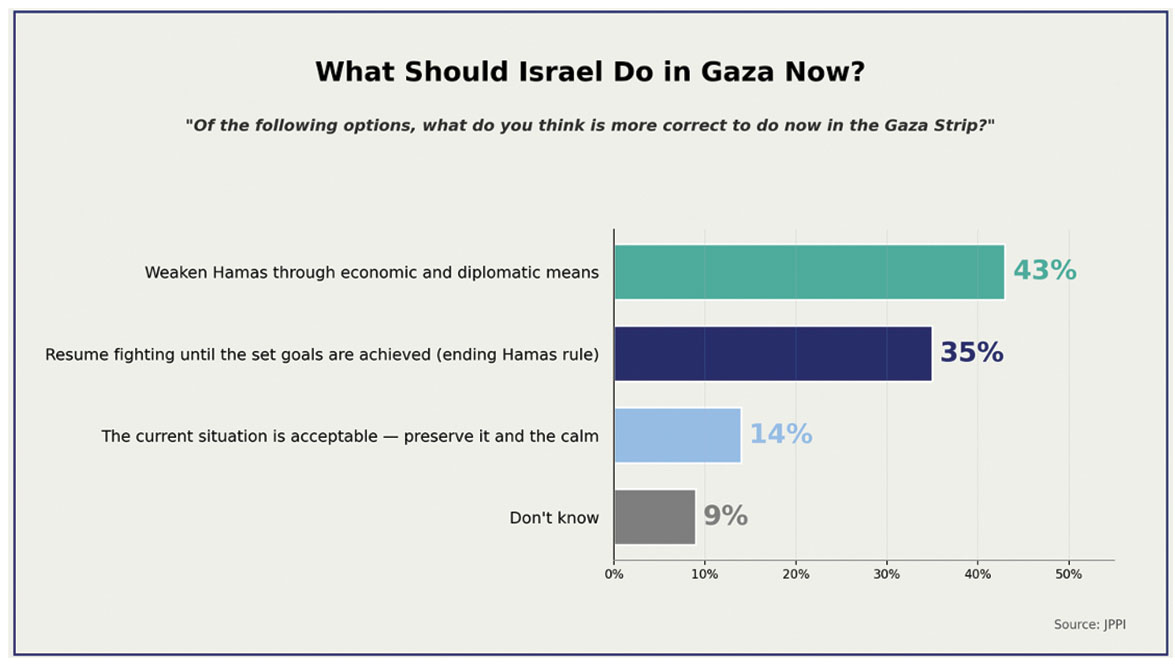
Israel is becoming impatient with the Gaza situation. Remember: Hamas is supposed to disarm. There’s no hint that this is about to happen. So what should Israel do?
A reader’s response
Marcia Elbaz writes: “Dear Shmuel, can Israelis trust leaders like Bennett and Eizenkot who don’t have Bibi’s experience?” My response: At some point, we’d have no choice — as far as I know, Netanyahu is not immortal.
Shmuel Rosner is senior political editor. For more analysis of Israeli and international politics, visit Rosner’s Domain at jewishjournal.com/rosnersdomain.