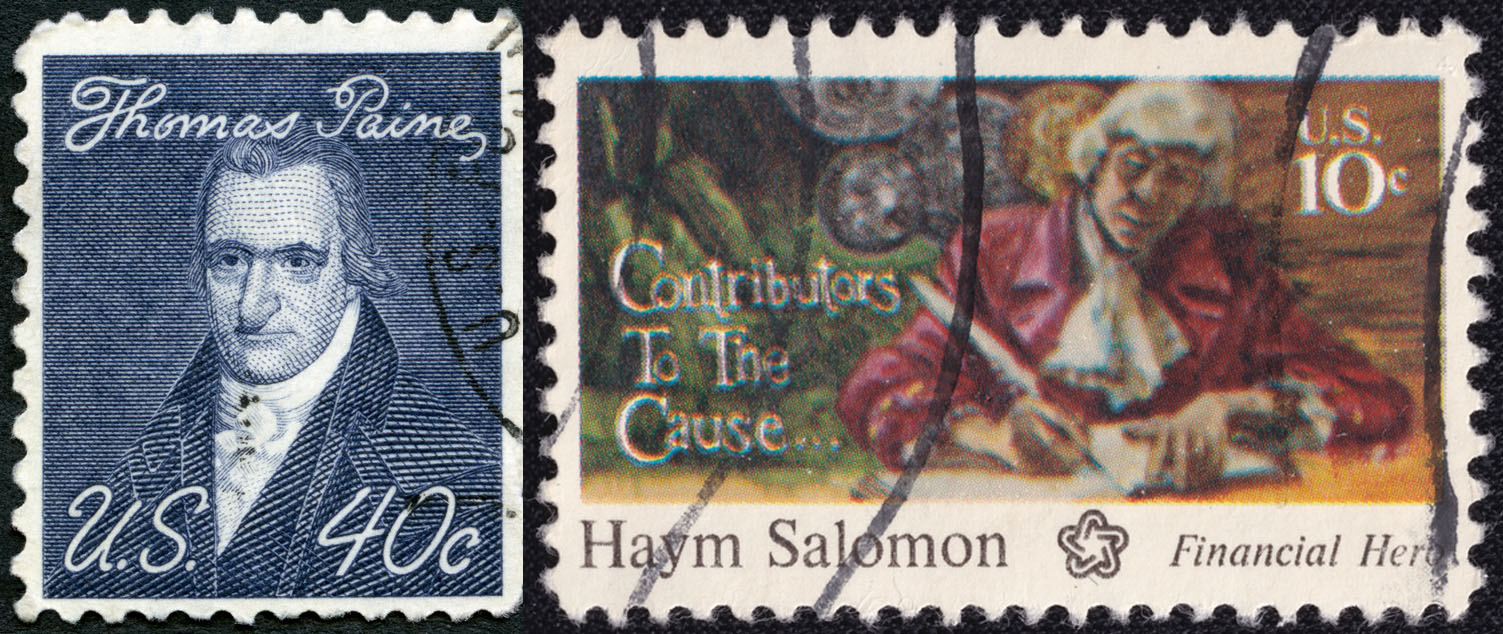
In the wake of celebrating the 250th anniversary of American independence, we should remember that the Revolution was not won exclusively by the “name brand” Founders, like George Washington and John Adams. We should also consider the role of lesser-known revolutionaries, like Thomas Paine and the great Jewish patriot Haym Salomon.
Salomon and Paine were both recent refugees from Europe. In the 1700s before our national safe harbor was created, few Jews sought refuge here. There were only an estimated two to three thousand Jews in the colonies at the time of the Revolution. Nevertheless, those relative few left their mark. Although never achieving fame, Colonels Salomon Bush and David Franks and Lieutenant Isaac Franks distinguished themselves in combat leadership roles. More famously—and more in the tradition of our tribe—the greatest Jewish revolutionary was financier Haym Salomon. One need go no farther than his statue in Los Angeles’s Pan Pacific Park to find recognition of Salomon’s importance. His role in financing the new government and its army proved critical, particularly supplying resources to the Continental army for the final decisive battle at Yorktown.
Like most colonial era Jews, Salomon was Sephardic, though he emigrated to New York from a brief refuge in Poland. He became a revolutionary shortly after his arrival, joining the local chapter of the Sons of Liberty. Salomon and his revolutionary brethren owed much to Paine whose landmark pamphlet “Common Sense” was published soon after Salomon’s arrival in New York.
Despite the 250 years since its publication, its roughly fifty pages remain surprisingly accessible to the modern reader. Paine’s clarity of speech and his willingness to criticize, satirize and even brutally caricature King George III fueled its success. A clever polemicist, Paine invoked every conceivable argument against the monarch and British rule. Turning to the Old Testament, he invoked the book of Samuel to portray royalty as contrary to divine will. He poked at the legitimacy of George III and the Hannover Kings, noting their descent from William I, “a French bastard.” He cited the unnatural condition of a small island like Britain holding sway over a large continent. Most importantly, Paine repeatedly asserted the inevitability of American independence and the need to avoid passing the pain of the struggle for liberty to future generations.
A modern reader, considering Paine’s appeal to generational responsibility, can only ponder what he might think of our current national debt, our budget deficit, and the failure to address the threat of global warming.
Given the outrageous political rhetoric of our time, a modern reader may struggle to appreciate Paine’s stark departure from the genteel and respectful tone more typical of his age. Still, we should appreciate the opportunity to read the very words that inspired the Founders as well as the rank and file to the cause of liberty. In a tribute to Paine’s ability to capture the revolutionary moment, his pamphlet “went viral” in colonial terms, selling over 120,000 copies in a few months.
Still, we should appreciate the opportunity to read the very words that inspired the Founders as well as the rank and file to the cause of liberty.
Though Common Sense contributed enough for a lifetime, Paine did not stop there. His set of essays, “The American Crisis,” boosted morale during some of the darkest hours of the Revolution. Essay number one began with the immortal line, “These are the times that try men’s souls.” The collection was published during the bitter winter of 1776, and Washington found Paine’s exhortation to overcome patriot sufferings so moving that he ordered it read to his troops. A few days later, early in the morning after Christmas, the impassioned troops crossed the icy Delaware river and overwhelmed the surprised Hessian mercenaries at the Battle of Trenton. It was the first decisive American military victory in our history and forever destroyed the myth of British invulnerability.
Paine left the newly formed nation not long after independence. Improbably, he was elected as a deputy to the French National Convention where he participated in the French Revolution, narrowly escaping the guillotine. Although he ultimately returned to the United States, Paine never regained his former prominence.
As we continue to celebrate these 250 years, Paine’s career should remind us of the power of words to change destiny. And, with Haym Salomon, we should recall that words often depend on the practical world of finance to help forge a new reality.
Dr. Daniel Stone is Regional Medical Director of Cedars-Sinai Valley Network and a practicing internist and geriatrician with Cedars Sinai Medical Group. The views expressed in this column do not necessarily reflect those of Cedars-Sinai.