

Well, I had an opportunity last summer to experience your future. Not just a future for next year or the year after that, but about 50 years down the road, and I want to share with you what I learned.
But to do that, I have to take a running leap. I want to start by recounting one of my favorite stories in the Talmud, involving Honi Ha-Me’agel, Honi the circle maker. He was a remarkable human because he had the capacity to convince God and people to do what he asked.
Honi sits in class one day, and hears the rabbi preach on a verse from Psalms 126: “A song of ascents. When the Holy One brought back those who returned from Zion, we were as in a dream.”
Honi knew that the Jews had been exiled from the land of Zion 70 years prior to their return. He hears this verse and thinks, how is it possible to sleep for 70 years? How can you wake up after such a nap?
The next day, walking down the road, he sees someone planting a carob tree.
Honi says to the planter, “this tree, how long does it take for it to produce fruit?” The guy responds, “About 70 years.” Honi snorts, “You think you’ll be around for any of those fruit?” “No,” says the planter, “I won’t. But people planted for me so there would be fruit for me to savor. I’m planting for those yet to come, so they will have fruit in turn.”
Honi ponders that message and a magical sleep envelops him. During his slumber, the plants grow so that nobody sees him sleeping there, and he rests uninterrupted for 70 years!
Honi isn’t aware of his sleep’s duration, and when he awakens, he sees someone picking carob fruit from the very same tree.He inquires, “Did you plant this tree?” The man says, “No, that was my grandfather, but now I am the one to harvest the fruit.”
Poor Honi is astonished and he enters his former home (70 years earlier!) trying to convince the current residents, his descendants, that he’s actually Honi Ha-Me’agel. But it’s been 70 years; no one believes him.
After the dust settles and the shock passes, they inform Honi that his spouse no longer lives, nor his children, but his grandson is still alive. So they go to the local synagogue. Honi hears the rabbi deliver a sermon in which he mentions a distant forebear, Honi. In his excitement to hear himself quoted, Honi leaps up and says, “Hey, I’m Honi!”
Still, none believe him.
Honi is so distraught that he perishes instantly. The Talmudic rabbis teach that’s where the phrase comes, “o chevruta o mituta, Give me fellowship or give me death.”
We cannot live isolated and alone. People require the care of other human beings. We are deeply social creatures; we need to be recognized, seen, appreciated.
All of which leads to the story I promised at this article’s opening about what it means to be human: social and embedded in the generations.
In the middle of last summer, I received a call from a very distant relative, so distant that I had to have her remind me how we were connected to each other. I couldn’t recall how the Artsons and the Moores were related. But my cousin tells me that later that summer, we would be marking 125 years of our common ancestor arriving in the United States. One hundred twenty-five years! David and Leah Komar immigrated to America from Ukraine at the very launch of the great Jewish migration, reshaping Jewish life globally and the culture of the United States.
That bold couple are my great-great-grandparents. They bore a daughter, Rebecca (my great-grandmother), who married my great-grandfather, Benjamin Aptheker. In turn, their daughter, Minna, married Matthew (my grandparents). They bore a son David, my father. Add me and my children, Jacob and Shira, to make six generations of my family living in America. Last year Shira and Asher brought a beautiful son into the world, my grandson. Seven generations in the United States!
How many of us are first generation? How many of us are second generation? How many third? Los Angeles is blessed with a wonderful harvest of more recent Jewish immigrants from Iran, Russia and around the world, so I want to share the relevant prognosis from the vantage point of someone whose people arrived on these shores long ago, a message of encouragement from my past, your future. There may be a lot to complain about these days: a lot of divisive politics. The countries that we adore, America and Israel, are going through brutal challenges. But what I want to remind you is that underneath it all, this country has been very good to us. We are blessed to be Americans.
In the middle of the summer, I joined a Zoom with 70 cousins who are scattered all over the northeast, the south, Chicago, a few in Canada, some in the Pacific Northwest, one in Hawaii. A handful have made Aliyah to Israel. Astonishingly, they’re all still connected to being Jewish. They’re not all observant, but in my family tree, I don’t think they were all observant even when they came over from Crimea. But they’re all still Jewish. In fact, the organizer asked me if I would open our gathering with a blessing for everybody.
I opened with the blessing recited when reunited with someone you haven’t seen for more than a year (mechayei ha-meitim) and then we sang Shehecheyanu. Over a century following the first immigration, my cousins could all join in the words and melody of that ancient blessing together.
One of them, sharing their life stories, couldn’t restrain themselves and exclaimed, “Oh my God, there’s a rabbi in our family! Do you know how much that would have meant to David Komar? He loved the Torah.” This is a family that has people doing all kinds of wonderful things, and they didn’t single out being a rabbi because they think that’s a profession any of them want their children to follow. They did it because what it meant was that in this family, that ancient Jewish blue thread has not been severed. The blue thread holds.
That’s my b’sorot tovot, good tidings: the blue thread binds us still. But that continuity requires effort on our part. We have to do what it takes to assure that we still grasp each other, our people, Torah, Israel, memories, and all the legacy that shape us as us.
There’s an ancient Midrash that says that when our ancestor Jacob was on his deathbed, he was worried that none of his children would continue the tradition. After all, they were in Egypt, a foreign land with an alien culture. As Jacob lay dying, his kids surrounded the bed and they blurted out, “Shema Yisrael, Hear O, Israel!” Israel was Jacob, remember? “Listen, Abba, your God is our God; we remain loyal.”
The Sages taught that Jacob responded by whispering the very phrase we whisper after reciting the Shema. That inserted quiet line is us quoting our ancient forefather who exults that the heritage won’t stop with him. It will live on in his children’s children, across the ages, including us.
So I write to you, all you first and second generations, and I assure you from generations five, six and seven that if we keep doing what we need to do, if we stand together, keep our traditions, educate ourselves in our ancient wisdom, keep Hebrew spoken and sung in our midst, we will not only endure. We Jews will thrive.
America is an imperfect democracy. It has endured a lot of bumps and bruises. It still needs a lot of fixing. And we can continue to yell at each other about how to do that. But God bless America for what it did for my family, and for yours, and for the future it holds out to each of us.
So let us make a promise to each other. When the more recent arrivals among us reach six and seven generations here, and my family gets to 10 or 12, let’s gather together again so that we can celebrate that, thanks to the lives that we committed ourselves to, our children’s childrens’ children still know what it means to be a Jew, and that blue thread still binds them — and us — to glory.
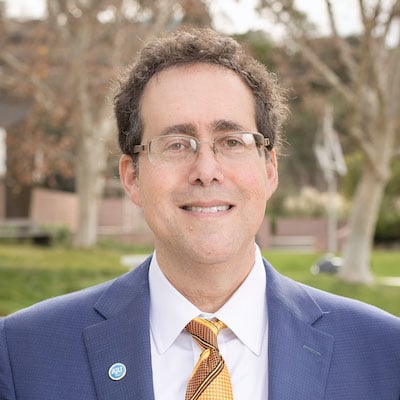
Rabbi Dr Bradley Shavit Artson, a Contributing Writer for the Jewish Journal of Greater Los Angeles is the American Jewish University’s Goldstine Distinguished Scholar. He is currently completing a new book, “Judaism Beyond Belief: Wisdom for People who Simply Want to Thrive” (Monkfish Book Publishing).
































