

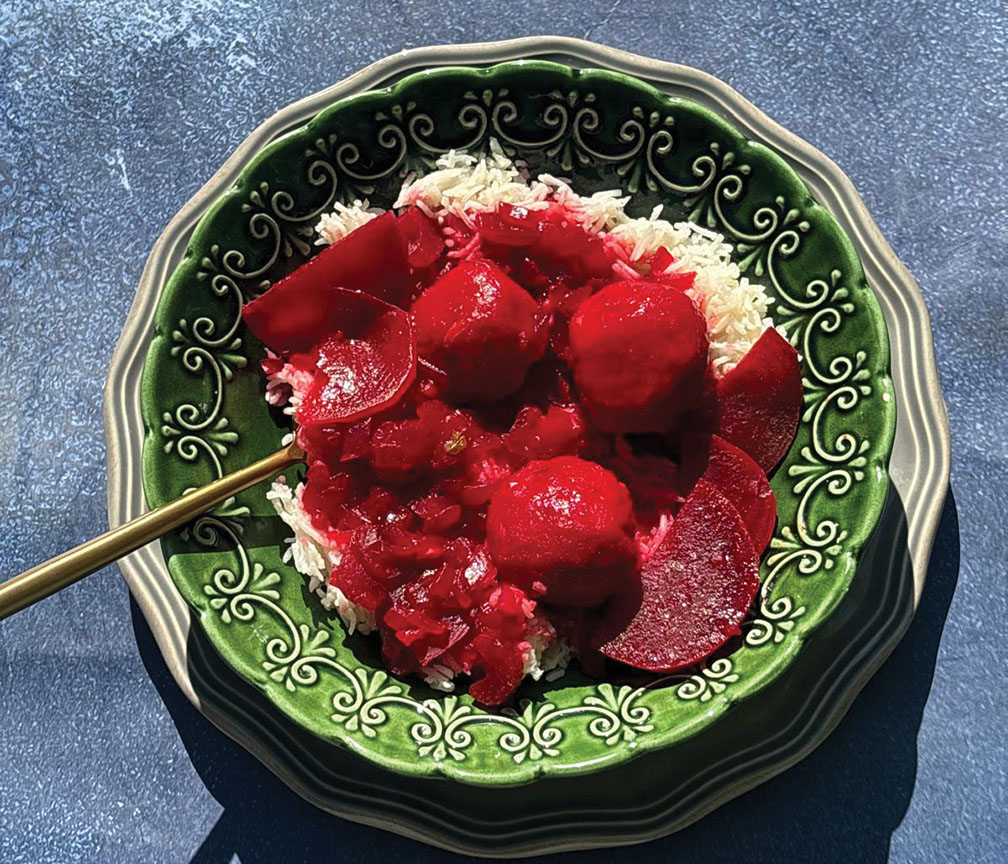
I love when my mother cooks a giant pot of “kubbah adom,” red kubbah, for her grandchildren. It’s heartwarming to watch their happiness when they are served a bowl of her sweet and tangy, vibrant ruby beet soup with beef kubbah over a bed of steaming rice.
It is especially wonderful because “kubbah shwandar,” beet kubbah, is a recipe that links generations. This is the same recipe that both my grandmothers Savta Rosa and Nana Aziza cooked for their children and grandchildren. Along with some precious black and white photos and family stories, this food is a reminder for these kids of our family’s unique Iraqi Jewish heritage.
Kubbah in Arabic means ball or lump, but in culinary terms, it refers to a traditional middle eastern dish of spiced beef, lamb or chicken, stuffed in a shell of semolina, rice or bulgur wheat (for Syrians it is kibbeh and for Egyptians it is keboba).
Beet kubbah soup is a classic dish of the Iraqi Babylonian Jewish kitchen and is typically served on Friday nights or Jewish holidays.
The rich and hearty beet broth is a tempting vibrant red, with a delicious sweet and tangy flavor studded with soft beets and delectable meat-filled soft semolina dumplings.
The soup is rather simple to make, starting with sautéed onions, celery and lots of sliced beets, then flavored with tomato paste, sugar, chicken stock and fresh lemon juice.
My grandmother Nana Aziza would always throw in beef neck bones, but I tried to streamline the recipe for you, dear reader. I hope you will be brave enough to make these semolina dumplings.
Making the actual kubbah balls requires a patient, delicate hand. I spent hours of my childhood in the kitchen watching my grandmother make kubbah. She would combine the semolina with a fraction of the ground beef. Then she would put it in the fridge, making it easier to work with. She would chop onions and parsley and mix in the meat and spices. Then she would roll the dough into balls, flatten them in the palm of her hand, stuff them with the meat filling and form them into perfect balls. Over and over and over.
My daughters have watched my mother, their Nana Sue, make kubbah too and I’m sure it is imprinted in their brains, as it is in mine. I hope one day my little granddaughter Noa will sit in the kitchen and make kubbah with me.
—Sharon
While kubbah is not a Moroccan tradition, I loved making this dish with Sharon.
There are all different kinds of kubbah — kubbah bamia, an okra stew and kubbah hamusta, a tangy sour soup. I became a huge fan of kubbah at the legendary Azura. This incredible family-run Sephardic Jewish home-style restaurant is located in the Iraqi market of Shuk Mach’ne Yehuda in Jerusalem. Founded in 1952 by Kurdish emigre Ezra Shrefler, affectionately nicknamed “Azura,” the restaurant is still run by his children. Bustling, rustic, open-air and very authentic, it is famous for their heavy-bottomed pots simmering with their incredibly rich and flavorful stews.
If you do go to Azura, make sure to get there early because they have a devoted following of locals and tourists.
And if you can’t get to Jerusalem, make a pot of this incredible red kubbah.
—Rachel
Semolina Kubbah
For the filling
3/4 lb ground beef
1/2 cup finely chopped Italian parsley
1 medium onion, grated
2 tsp baharat spice
1 tsp kosher salt
1/2 tsp pepper
For the dough
2 cups farina (or semolina)
1/4 lb ground beef
1 cup warm water
1 tsp kosher salt
1/2 tsp pepper
In a large bowl, combine the ground beef, parsley, onion, baharat, salt and pepper. Set aside.
In a large bowl, combine the farina, beef, salt and pepper and water and mix until incorporated. Cool in refrigerator for at least 30 minutes.
Wet palms with water and roll the dough mixture into 2 inch balls and place on a parchment paper lined baking tray.
Flatten each dough ball into the palm of your hand and place a large teaspoon of filling in the center. Gently gather the sides of the dough to cover the filling and delicately pinch closed and roll into a ball.
Place the stuffed kubbah balls on a tray, loosely cover and leave in the refrigerator for at least 4 hours.
Gently drop the kubbah into the pot of boiling beet soup and cook for about 25 to 35 minutes. Note: Raw kubbah can be frozen for up to 2 months.
Sweet and Sour Beet Soup
1/4 cup olive oil
1 large onion, finely diced
4 large garlic cloves, chopped
8 stalks celery, chopped
2 tsp kosher salt
1 tsp ground black pepper
2 tsp sweet paprika
1 6 oz can tomato paste
3 Tbsp sugar, or more to taste
2 cups chicken stock
3 cups water
8 medium beets, peeled and sliced into thin half moons
3/4 cup freshly squeezed lemon juice
Heat oil in a large stock pot over medium heat, then add the onion and sauté until soft and translucent, about 5 minutes. Add the garlic and celery and continue to sauté for about 2 to 3 minutes.
Sprinkle in the salt, pepper and paprika. Add the tomato paste and sugar and stir until the onions and celery are coated in the sauce.
Pour in the chicken stock and water and stir well. Add the the beets, then pour in the lemon juice. Bring to a boil, then allow to simmer for 15 minutes.
Gently place kubbah into the boiling soup and simmer in a covered pot for about 25 to 35 minutes.
Serve over hot basmati or jasmine rice.
Sharon Gomperts and Rachel Emquies Sheff have been friends since high school. Their cooking and storytelling project has grown into a devoted following on Instagram @sephardicspicegirls and on Facebook at Sephardic Spice SEC Food. sephardicspicegirls.com/full-recipes.

































