fbpx

October 28, 2026

A Bisl Torah ~ Are You Paying Attention?

Abraham sits at the entrance of his tent, God appears and then, Abraham is compelled to look up. Three strangers approach, supposedly angels of God. Abraham runs towards them.

However, later in the story, when Abraham is about to take his son’s life, it takes God shouting at Abraham: Not once, but twice for Abraham to stop and pay attention.

Why are we less likely to notice those who are most important? Whether it’s when our loved ones need our intervention or when they’re trying to guide us in a positive way, often, attention is reserved for moments that just matter less. Work, entertainment, and trivial distractions get more of our time than the human beings with whom we are deeply connected.

Perhaps we’re less mindful because we think there’s more time to offer. Or we’re less careful because we assume forgiveness is inherent in our close relationships. But why would we take any chances with those we cherish the most?

God wants us to pay attention to ways we’re meant to make an impact on their lives. Let’s not make our loved ones call our names twice.

Shabbat Shalom


Rabbi Nicole Guzik is senior rabbi at Sinai Temple. She can be reached at her Facebook page at Rabbi Nicole Guzik or on Instagram @rabbiguzik. For more writings, visit Rabbi Guzik’s blog section from Sinai Temple’s website.

A Bisl Torah ~ Are You Paying Attention? Read More »

A Moment in Time: The Israeli Election – Counting Votes, Building Bridges

Dear all,

As you read this, the results of Israel’s election remain uncertain. Unlike in the United States, Israel has a parliamentary system. To govern, a party leader must assemble a coalition that commands at least 61 of the Knesset’s 120 seats. At this writing, Netanyahu’s bloc holds 53 seats, while Eisenkot’s holds 48.

Neither has a majority, leaving both dependent on negotiations with other parties.

Nearly 78% of eligible Israelis cast ballots—the highest turnout in more than a quarter century.

I know people who traveled to Israel specifically to vote.

I know secular Jews and religious Jews.

I know a Palestinian man and his wife, who grew up Orthodox Jewish.

I know Christians with family in Jerusalem.

Different backgrounds. Different beliefs. Different visions for Israel’s future.

All Israeli citizens. All wanting their voices to count.

We do not yet know the outcome of this election. But we do know that Israelis are living through a moment in time of profound division, exhaustion, aspiration, and hope. They are yearning for security, stability, and a better future.

And perhaps the greatest challenge ahead will not be counting the votes.

It will be making the votes count.

Because democracy is not simply about who wins an election. It is about what those who win choose to do with the power entrusted to them.

May that power be used not to deepen divisions, but to bridge them. Not merely to govern, but to unite. And not simply to win the future, but to build one worthy of all Israel’s citizens.

With love, hope, and shalom,

Rabbi Zachary R. Shapiro

A Moment in Time: The Israeli Election – Counting Votes, Building Bridges Read More »

Rabbis of LA | Rabbi Rembaum on Life Without Fredi

Last April, Rabbi Joel Rembaum lost Fredi, his wife of 61 years, to cancer. How does one recover? “There’s no secret, no single answer,” the retired longtime leader of Temple Beth Am said. “Relationships take different forms, operate differently, according to individuals’ own characteristics. 

“It’s hard,” the rabbi said. “I can talk about elements that helped me. But that  doesn’t mean it will work for others.” In a soft voice, he explained, “we are talking about a real long marriage. One can assume with a long marriage that a relationship was very powerful. Otherwise, it doesn’t last that long.”

Rabbi Rembaum began this way “because people start drawing conclusions,” and he doesn’t pretend to speak for anyone. “We should be careful not to say ‘Here are the secrets for everybody.’  Having been a congregational rabbi for many decades, you learn.  Beyond myself, I have learned that many times when I meet with families before a funeral, and we would talk about the deceased, I would ask them to tell stories. I say to family members, ‘Remind yourself of times, of stories.’”

In such circumstances, people begin to open up, to remember stories, the rabbi said. “One will say ‘Oh, I forgot about that.’ The wonderful, the memorable things. That process of dialogue. In the end people are thankful for that because it reminds them of something they may have forgotten. And they were able to share memories. This cushions the shock of the loss. That is one good thing that this process brings out.”

“I would say, basically, that is what happened to us as a family,” the rabbi noted. “And with Fredi as an individual, the key thing here is, we are moving beyond the family. Fredi was a community person. She served the Jewish community in different ways for decades.” She worked for the Jewish Federation and she worked for Hebrew Union College. “These were long commitments. In both instances, she did amazing things. She worked with and she touched the lives of all different kinds of people. And they remembered these things.”

Rabbi Rembaum remembered the moment when their lives changed. “What happened was, when we heard of the cancer, it was out of the blue. It was a form of cancer that is very rare. It leaves few traces when it is developing. By the time Fredi had it, it was stage four. Liver cancer. We suddenly realized that we needed to be very careful.” This was late August, early September last year. “We realized we can’t shout to the whole world ‘Fredi has cancer’ because it would totally overwhelm us,” the rabbi said. “In the beginning, we kept it in the family. The circle of knowledge began to open up. It spread to the point Fredi said, ‘We need to organize this.’

“Turns out a dear friend of ours – the now-retired Miriam Prum Hess of the Bureau of Jewish Education – (along with Miriam Heller Stern of the Bureau) were uncommonly helpful. Prum Hess said, ‘Let me be your intermediary. I will organize this for you.’”

After Fredi Rembaum was diagnosed last year, “it happened that a lot of different people were able to come to the house and meet and call on the phone. Gradually, more people found out about it. By the time things began to turn, the amount of interaction Fredi had with people and people with her – and I am witness to all of this stuff – I am suddenly seeing the image of Fredi I had – a super one – of our children and grandchildren, the Federation from years ago and, more recently, from Hebrew Union College – the point is, she was a person who was able to move things along in a manner that people respected. That was one of Fredi’s big secrets. In terms of dealing with people, she was expert from a young age. Fredi was president of the student body in the eighth grade. 

“We also had the years we were in Germany from 2015 to 2020 for five or six months a year, where I was teaching rabbinical students. She got involved on a volunteer basis to be a mentor to the administrator and assistant administrator. She was deeply involved in the process while the Ziegler School here [the University of Judaism] was, too. All of these people were touched by her – our own personal friends here and elsewhere. 

“I was witnessing, verifying, my own image of her. It was unbelievable. Our relationship was beautiful because, basically, we were on the same page all of the time. We were on the same page all along. From the beginning. Literally, even before we were married.  Even during those years of our growing together, we had to start making decisions of great significance.

“Life-shaping experiences develop over a long period of time. We were on the same page constantly from the beginning. We shared our perspective on how to shape our lives – as Jews, as people, as parents and about children. All of these decisions. It was not a case of one imposing on the other.  It always was a consensus.”

What were the most important commonalities you shared?

“Everything – job-related, family-related, housing-related. Changing jobs. We both made major changes.” 

Fast Takes with Rabbi Rembaum

Jewish Journal: What was Fredi’s favorite meal?

Rabbi Rembaum: A complicated gourmet meal that she produces.

J.J.: Your favorite travel destination?

R.R.: One place on our bucket list – Israel. We loved going to Berlin, a great city. We loved to travel, to see the great trees up north. We just took a trip to the Northwest.

J.J.: Her favorite hobby?

R.R.: Baking sourdough bread.

Rabbis of LA | Rabbi Rembaum on Life Without Fredi Read More »

‘You Can See Everything’: Holmes on the Range

In 2026, you don’t expect an  American movie – even a documentary – to include an almost Talmudic discussion focusing on the meaning of the word “can.” But it’s a critical scene in “You Can See Everything,” the hit documentary (co-directed by Jewish filmmakers Nathan Fielder and Lance Oppenheim) that follows Elizabeth Holmes, the creator of Theranos – a machine she claimed could perform multiple tests using just a single drop of blood – and her family over the 36 days before she was to report to prison and serve an 11-year sentence for fraud.

Holmes and her husband, Billy Evans, decided to allow the filmmakers complete access to their lives as an exercise in “radical transparency.” Fielder, a writer and performer best known for his HBO shows “Nathan for You” and “The Rehearsal,” is both a strange and inspired choice to take on the project. His previous work marked him as the foremost practitioner of cringe reality. In “Nathan for You,” he offers to help troubled businesses turn themselves around, usually with suggestions so far “out of the box,” they’re either genius or idiotic; think “Kitchen Nightmares,” only with less cursing and food. As an observer, he’s the kind of kid who probably pulled the wings off of flies, not out of cruelty, but because he wanted to give them newer, prettier wings. If those new wings are too heavy and keep the fly grounded…

For “The Rehearsal,” he helps people who are in tough situations – an uncomfortable conversation,  breaking up with someone, a family intervention, etc. – by meticulously recreating the place they will have the conversation and gaming out all the possible (and some less than possible) variations. In season 2, he built a replica of Houston’s George W. Bush International Airport on a soundstage so precise and true-to-life, it was repurposed to help neurodivergent people navigate the stresses of air travel.

His superpower is his deadpan delivery; he can make even the most bonkers suggestion sound reasonable. He’s not a journalist; his questions can sometimes seem so blunt and haltingly asked his interlocutors can’t decide if he’s inept, or just dense. Don’t expect him to craft incisive follow-up questions, but he’s not afraid to ask the obvious question that’s on everyone’s mind. In one of his first meetings with Holmes and Evans, she’s beating eggs for breakfast. Evans brusquely grabs the bowl from her. Instead of letting it slide, he stops his line of questioning to ask why he grabbed the bowl. In “Everything,” he is low-key but persistent, repeatedly drilling down on a point until it throws off the person being asked, and they give up more information than they intended.  

Fielder takes the idea of “radical transparency” to its limit, even following Evans into the shower for some full-frontal nudity. It’s a very claustrophobic film; much of it is shot in extreme close-ups, a single face filling the screen. Shot in the old, squarish Academy aspect ratio of 1.375 to 1, the couple’s rented beach house feels uncomfortably close even when the camera pulls back. 

Holmes claims the reason they agreed to do the documentary (she confesses she had never heard of Fielder before they met) was to correct the way she’s been misrepresented in the press. She’s especially incensed over a New York Times profile where she was quoted saying, “They’re not playing me. They’re playing a character I created.” She never said that; Holmes and Evans claim they have a tape of the interview that proves their point, but never let Fielder hear it. (During post-production, Fielder interviewed the story’s author, who stood by their reporting, but could not produce any definitive proof.)

But Holmes remains an impenetrable figure. She is innocent, she repeatedly tells Fielder. She did nothing wrong and no one was defrauded. And about midway through the nearly three-hour movie, after being repeatedly told that Theranos can perform hundreds of tests, Fielder tries to pin down what exactly Holmes and Evans mean when they say “can.” Does that mean it can perform the tests now, or does it have the (as yet, still unfulfilled) potential of performing hundreds of tests? And do they see how people could be misled by their claim? 

To help make his point, Fielder turns, not to Hillel and Shammai, but Abbott and Costello … specifically their classic “Who’s on First?” routine. He plays the clip for Holmes and Evans, then asks Holmes why the skit is funny. It’s because they’re yelling past each other, she tells him. She doesn’t understand that the joke is that the names of the players could also be questions. Fielder looks perplexed; he can’t believe she missed the entire point of the gag. He won’t let the subject drop until Evans tells him that “her brain works different.”

That might very well be true, but not in the way Evans intended. With her saucer eyes and perma-grin, Holmes could be a cult member. 

Evans comes off as the villain of the story. It’s obvious from the start he did not have the same enthusiasm about inviting the filmmakers  as Holmes and doesn’t do much to mask his distaste. Aggressive, controlling and acting as if he’s the smartest guy in the room, he’s an almost stereotypical tech bro. You hear him on the phone trying to entice investors in what he calls “Theranos Two-point-oh” with vacuous Silicon Valley-talk. He even manages to get a rise from the usually even-keeled Fielder, telling the filmmaker “I know how you feel.” Fielder snaps back, “No, you don’t!”

Evans also sets off the film’s most audacious move. Before Holmes heads to jail, he insists on meeting Fielder and executives of producer A24 Films, demanding some compensation for their appearing in the film, even though he’s told it’s ethically dubious. (There’s an unanswered question of how much Holmes knew and if she approved his demand.) He also discovers that Evans has licensed Holmes’ image (the famous photo of her in a black turtleneck holding a small vial of blood, which Holmes hates), is creating an AI avatar of Holmes, and is posting as Holmes to her X account. He has, he tells Fielder, power of attorney.

Disturbed by this, he recruits Amanda Seyfried, who played Holmes in Hulu’s limited series about Theranos, “The Dropout,” to get her opinion. He then “casts” Seyfried to play Holmes in recreated conversations. In a brilliant coup de theatre, he shows Seyfried video of Holmes watching Seyfried as Holmes in “The Dropout.” They discuss Holmes’ and Evans’ relationship, asking if it’s a smart idea for a woman who blamed her previous business and romantic partner, Sunny Balwani, for the problems with Theranos, to trust a man like Evans. Seyfried asks Fielder if he’s falling for Holmes. He might have; he certainly became more protective of her, as she got closer to reporting to prison.

Is Holmes guilty of fraud? Did Evans act with her approval? And what is the meaning of “can”? None of the questions are definitively answered by “You Can See Everything” but the movie is a funny, disquieting  and, even with a three-hour running time, absorbing story that will leave you questioning if it is possible to ever know everything about anyone.

‘You Can See Everything’: Holmes on the Range Read More »

Ruby Red Beet Kubbah

I love when my mother cooks a giant pot of “kubbah adom,” red kubbah, for her grandchildren. It’s heartwarming to watch their happiness when they are served a bowl of her sweet and tangy, vibrant ruby beet soup with beef kubbah over a bed of steaming rice.

It is especially wonderful because “kubbah shwandar,” beet kubbah, is a recipe that links generations. This is the same recipe that both my grandmothers Savta Rosa and Nana Aziza cooked for their children and grandchildren. Along with some precious black and white photos and family stories, this food is a reminder for these kids of our family’s unique Iraqi Jewish heritage.

Kubbah in Arabic means ball or lump, but in culinary terms, it refers to a traditional middle eastern dish of spiced beef, lamb or chicken, stuffed in a shell of semolina, rice or bulgur wheat (for Syrians it is kibbeh and for Egyptians it is keboba).

Beet kubbah soup is a classic dish of the Iraqi Babylonian Jewish kitchen and is typically served on Friday nights or Jewish holidays.

The rich and hearty beet broth is a tempting vibrant red, with a delicious sweet and tangy flavor studded with soft beets and delectable meat-filled soft semolina dumplings.

The soup is rather simple to make, starting with sautéed onions, celery and lots of sliced beets, then flavored with tomato paste, sugar, chicken stock and fresh lemon juice.

My grandmother Nana Aziza would always throw in beef neck bones, but I tried to streamline the recipe for you, dear reader. I hope you will be brave enough to make these semolina dumplings.

Making the actual kubbah balls requires a patient, delicate hand. I spent hours of my childhood in the kitchen watching my grandmother make kubbah. She would combine the semolina with a fraction of the ground beef. Then she would put it in the fridge, making it easier to work with. She would chop onions and parsley and mix in the meat and spices. Then she would roll the dough into balls, flatten them in the palm of her hand, stuff them with the meat filling and form them into perfect balls. Over and over and over.

My daughters have watched my mother, their Nana Sue, make kubbah too and I’m sure it is imprinted in their brains, as it is in mine. I hope one day my little granddaughter Noa will sit in the kitchen and make kubbah with me.

—Sharon

While kubbah is not a Moroccan tradition, I loved making this dish with Sharon.

There are all different kinds of kubbah — kubbah bamia, an okra stew and kubbah hamusta, a tangy sour soup. I became a huge fan of kubbah at the legendary Azura. This incredible family-run Sephardic Jewish home-style restaurant is located in the Iraqi market of Shuk Mach’ne Yehuda in Jerusalem. Founded in 1952 by Kurdish emigre Ezra Shrefler, affectionately nicknamed “Azura,” the restaurant is still run by his children. Bustling, rustic, open-air and very authentic, it is famous for their heavy-bottomed pots simmering with their incredibly rich and flavorful stews.

If you do go to Azura, make sure to get there early because they have a devoted following of locals and tourists.

And if you can’t get to Jerusalem, make a pot of this incredible red kubbah.

—Rachel

Semolina Kubbah

For the filling

3/4 lb ground beef

1/2 cup finely chopped Italian parsley

1 medium onion, grated

2 tsp baharat spice 

1 tsp kosher salt

1/2 tsp pepper

For the dough

2 cups farina (or semolina)

1/4 lb ground beef 

1 cup warm water

1 tsp kosher salt

1/2 tsp pepper

In a large bowl, combine the ground beef, parsley, onion, baharat, salt and pepper. Set aside.

In a large bowl, combine the farina, beef, salt and pepper and water and mix until incorporated. Cool in refrigerator for at least 30 minutes.

Wet palms with water and roll the dough mixture into 2 inch balls and place on a parchment paper lined baking tray.

Flatten each dough ball into the palm of your hand and place a large teaspoon of filling in the center. Gently gather the sides of the dough to cover the filling and delicately pinch closed and roll into a ball.

Place the stuffed kubbah balls on a tray, loosely cover and leave in the refrigerator for at least 4 hours.

Gently drop the kubbah into the pot of boiling beet soup and cook for about 25 to 35 minutes. Note: Raw kubbah can be frozen for up to 2 months.

Sweet and Sour Beet Soup

1/4 cup olive oil

1 large onion, finely diced

4 large garlic cloves, chopped

8 stalks celery, chopped

2 tsp kosher salt

1 tsp ground black pepper

2 tsp sweet paprika

1 6 oz can tomato paste

3 Tbsp sugar, or more to taste

2 cups chicken stock

3 cups water

8 medium beets, peeled and sliced into thin half moons

3/4 cup freshly squeezed lemon juice

Heat oil in a large stock pot over medium heat, then add the onion and sauté until soft and translucent, about 5 minutes. Add the garlic and celery and continue to sauté for about 2 to 3 minutes.

Sprinkle in the salt, pepper and paprika. Add the tomato paste and sugar and stir until the onions and celery are coated in the sauce.

Pour in the chicken stock and water and stir well. Add the the beets, then pour in the lemon juice. Bring to a boil, then allow to simmer for 15 minutes.

Gently place kubbah into the boiling soup and simmer in a covered pot for about 25 to 35 minutes.

Serve over hot basmati or jasmine rice.


Sharon Gomperts and Rachel Emquies Sheff have been friends since high school. Their cooking and storytelling project has grown into a devoted following on Instagram @sephardicspicegirls and on Facebook at Sephardic Spice SEC Food. sephardicspicegirls.com/full-recipes.


Ruby Red Beet Kubbah Read More »

A Jewish Victory

Los Angeles just delivered an important victory for families concerned about growing political activism and anti-Israel and antisemitic conduct in public schools. Following a civil rights complaint initiated by my organization, the North American Values Institute (NAVI), the Los Angeles Unified School District (LAUSD) substantiated all 11 allegations concerning political advocacy at Canoga Park High School and ordered extensive corrective action. The LAUSD ruling will impact the entire school district and even set a precedent for the state.

For L.A.’s Jewish community, which has endured so many troubling incidents of antisemitism in education, this is welcome news. Teachers used instructional time and school resources to advance an anti-Israel political agenda. Parents and community organizations challenged their conduct and the district investigated and required changes.

For L.A.’s Jewish community, which has endured so many troubling incidents of antisemitism in education, this is welcome news. Teachers used instructional time and school resources to advance an anti-Israel political agenda. Parents and community organizations challenged their conduct and the district investigated and required changes.

We are proud to have helped bring about this outcome. We hope it encourages families across Los Angeles who have wondered whether raising concerns about their children’s schools can accomplish anything if they come forward.

It can. And LAUSD deserves credit for taking the evidence seriously.

Our investigation began with a CODEPINK teacher-training webinar called “Challenging Zionism in Schools.” We documented efforts to bring anti-Israel advocacy into classrooms under broadly worded state instructional standards. After publishing our findings, we partnered with JewTLA on a public records request and retained Emet Legal to prepare and file the complaint.

The evidence showed teachers using their authority to advance a political cause.

A dance teacher taught “Palestinian resistance,” dedicated performances to the “children of Gaza,” and required students to review a YouTube channel using “martyrs of Gaza” framing as part of a graded final exam. Teachers recruited students for Students for Justice in Palestine, including during class. Other instructional materials compared Gaza with the Holocaust and accused Israel of genocide. 

Emails obtained through our public records request showed at least six teachers involved in the club, writing its constitution, setting meeting agendas and planning protests. One teacher rejected presenting competing perspectives on the conflict, comparing that approach to giving the Nazi perspective a hearing when teaching the Holocaust. Teachers also consulted CODEPINK’s Marcy Winograd about school matters and involving students in political activities. 

How did a public school become so hospitable to political activism? In 2021, California enacted AB 101, establishing an ethnic studies graduation requirement. That same year, the state adopted a model curriculum whose guidelines encouraged students to analyze systems of oppression and whose sample courses included developing “critical consciousness.” Although the model curriculum was optional, its influence could extend beyond a dedicated ethnic studies course: state guidance explicitly envisioned integrating ethnic studies into existing subjects, including history, English and the arts. 

For educators who shared this worldview, that framework offered a rationale for bringing their political judgments about America, the West and Israel into the classroom. At Canoga Park, one teacher explicitly described developing students’ critical consciousness as a central educational goal. Once teachers understood their role as awakening students to oppression, it was a short step to presenting their own account of Palestinian oppression as an educational obligation. 

Groups like CODEPINK and activist networks within teachers unions knew how to exploit that opening. In the webinar we investigated, presenters advised educators to tie Palestine-related lessons to state standards to protect themselves against objections. They offered a ready justification for bringing their advocacy into multiple subjects. The door had been left wide open, and they were showing teachers how to walk through it. 

Schools should teach difficult subjects, including the Israeli-Palestinian conflict. Students should examine competing claims, confront uncomfortable facts and develop their own judgments. Teachers have an obligation to conduct classroom discussions fairly, present competing perspectives honestly and give students room to reach their own conclusions. They should never put their finger on the scale to steer students toward their own political views.

LAUSD’s determination established that boundaries had been crossed in Canoga Park. Its remedies included mandatory training on Title VI, preventing antisemitism and restrictions on employee political advocacy. The district required removal of unlawful political materials, administrative review of supplemental lessons and performances, curriculum changes, and limits on staff involvement in SJP to custodial supervision.

I imagine that well-meaning school officials in the LAUSD central office could see how out of control the situation had gotten in Canoga Park and other places where schools went along with radical teachers. These LAUSD officials took substantial steps to clamp down. We will follow their implementation and continue pressing for staff accountability and appropriate instruction to address what students were taught.

The outcome also offers two lessons that reach beyond Canoga Park.

First, we in the Jewish community can win in places where success might seem unlikely.

Los Angeles has influential activist networks and a political culture in which anti-Israel advocacy easily takes root. Families who encounter that advocacy in schools may reasonably wonder whether anyone will listen to their objections. This case gives them grounds to try.

It also challenges a tendency within the Jewish community of treating certain institutions, districts or states as lost causes. That judgment can sound realistic and cause us to aim low in our advocacy.

Evidence, capable partners and persistence, however, can create opportunities that defy our political assumptions. We should be willing to test those assumptions at every opportunity and not reconcile ourselves to school-endorsed politics in the classroom.

The second lesson concerns the people working inside school systems.

LAUSD officials examined the complaint, substantiated the allegations and ordered meaningful remedies. Their response suggests there is room for constructive engagement with people who share concerns about ideological excesses in education.

Many educators and administrators want schools to maintain professional standards and help students think independently. They may be uncomfortable with colleagues turning lessons, performances or student clubs into vehicles for political advocacy.

A documented complaint gives those concerns a concrete focus and tips the balance in favor of intervention. It identifies conduct that officials can investigate and rules they can enforce.

For L.A.’s Jewish community, this is a moment to rev up its engines.

Parents need help obtaining records and understanding their options. Community organizations need the expertise to turn troubling accounts into well-supported cases. District officials need to hear from families who expect consistent standards. And successful complaints need sustained attention so that promised changes reach classrooms.

The winds of change may be blowing in our direction. Jewish families across America now have an example of what organized, persistent engagement can accomplish. Other communities have a case they can study, learn from and replicate.

That should expand our sense of what is possible, and our determination to make it happen again. 


David Bernstein is the founder and CEO of the North American Values Institute (NAVI).

A Jewish Victory Read More »

Trusting G-d’s Plan ft. Elaine Chaya

Season 6 of Schmuckboys is back! Marla and Libby are back st it with somne exciting updates. Libby shares about fun upcoming travel plans, while Marla shares about getting back into the dating game.

For Episode 1 they are thrilled to bring on the newlywed queen herself, Elaine Chaya! She starts with updates on her name change plans and a birthday trip to New York for her husband, including a stop at the Portrait Bar at the Fifth Avenue Hotel.

Elaine tells the story of how she met her husband, Gersh, through Chabad of Upper East. She shares how they met years prior to dating, going into her belief that G-d doesn’t bring you to your partner until you’re both ready. She also talks about how they brought together Persian and Chabad wedding traditions into their ceremony, including dancing down the aisle, which Rabbi Yaya joined and went viral online.

The group then talks about Jewish identity and how Elaine’s has grown from her traditional Persian upbringing, including how keeping Shabbat became an anchor for her mental health and her dating life. They get into dating with a public social media presence, the six months she took off Instagram, and how social media has changed since she started, including the “Woke Up This Way Challenge.” Elaine also shares how becoming an Israel activist after October 7th changed her online community and the brands she could work with.

From there, they cover dating burnout, taking breaks, and not tying your worth to your relationship status. They also compare the Jewish scenes in New York and LA, and talk about why trusting G-d’s timeline matters more than comparing yourself to anyone else. The episode wraps with a rapid-fire round of dating and Jewish questions.

You can follow Elaine on Instagram @elainechaya and Schmuckboys @schmuckboysofficial, or send us your questions and stories at schmuckboys@jewishjournal.com.

Trusting G-d’s Plan ft. Elaine Chaya Read More »

Zion Ozeri’s Photographs Reveal the Many Faces of Jewish Identity

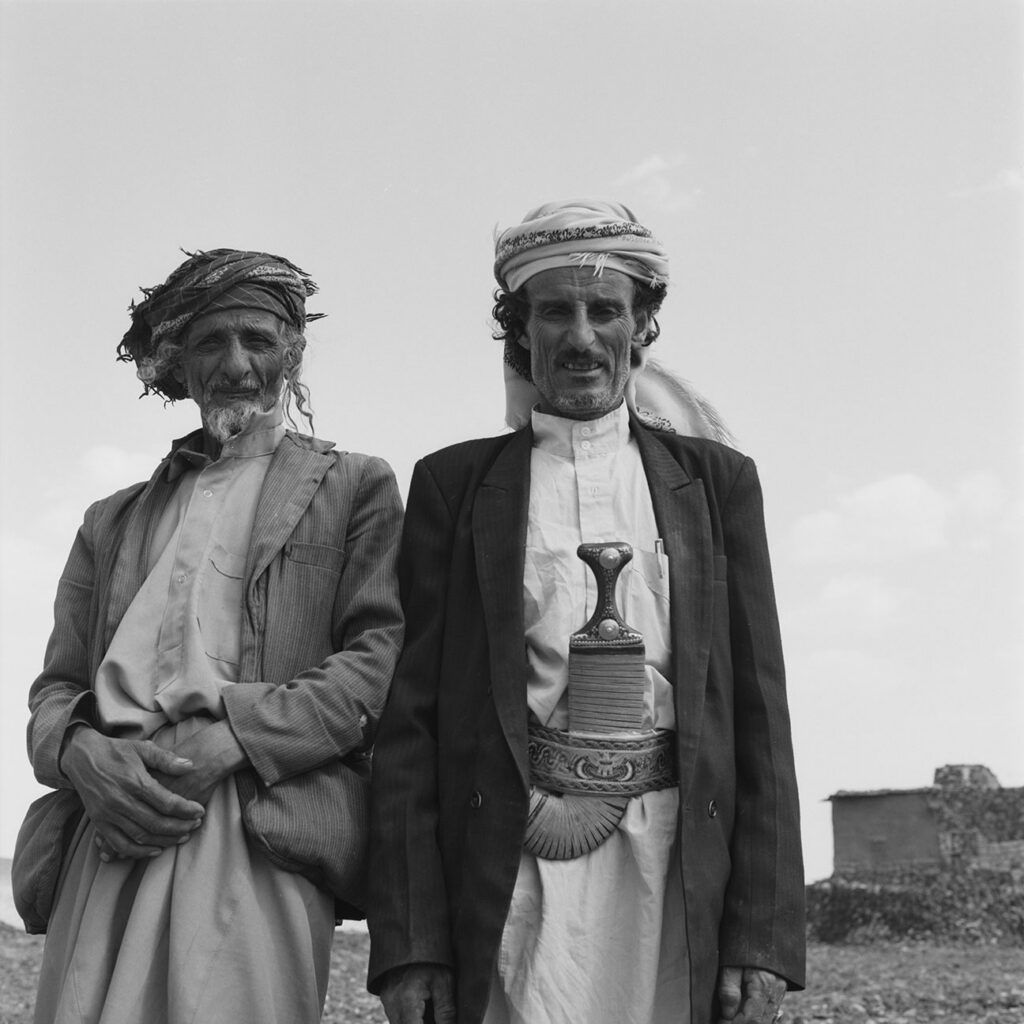
They say a picture is worth a thousand words, but in photographer Zion Ozeri’s case, his photographs tell entire stories. From Yemen and Tunisia to Russia, India and Uzbekistan, his images capture the many faces of Jewish identity, documenting communities around the world and challenging assumptions about what Jews look like.

Ozeri’s recent exhibition, “Jewish Identity/Jewish Diversity,” was displayed at the library of Loyola Marymount University, where he also delivered a lecture on Oct. 20. The exhibition invited students to look beyond familiar stereotypes and discover the richness of Jewish life around the world. His photographs portray Jews shaped by different cultures, histories and traditions while revealing the connections that unite them.

The idea of using photography to challenge misconceptions about Jews took shape during a Zoom lecture Ozeri gave to Columbia University students toward the end of the COVID-19 pandemic. Their professor had asked him to explain how photographers approach people they have never met and compose their shots. The students had also been assigned to document a social issue of their choice.

During his presentation, Ozeri realized that many students held stereotypical views of Jews.

“Many Americans of European descent think we’re all white, privileged and that we control the banks,” he said. “They think of Jews as businesspeople, bankers and professionals, but they don’t associate us with farmers and manual laborers.”

Ozeri showed the students photographs whose subjects challenged those assumptions.

His work spans communities from Uzbekistan to Tunisia and India to Argentina, exploring how Jews have absorbed elements of the cultures in which they live while maintaining their ancient traditions. The black-and-white photographs also convey more universal themes: the search for belonging, the experience of displacement and loss, and the human connections that cross cultural boundaries.

The Columbia presentation led to an exhibition at the university in 2023. Ozeri was invited by a professor who wanted him to speak about his work and have students write an assignment on a social issue of their choosing.

“She wanted me to speak about how I approach people I’ve never met before, from different backgrounds and cultures,” Ozeri said. “I showed them photographs of Jews who are farmers, American soldiers, and many other kinds of professionals they don’t usually associate with Jews.”

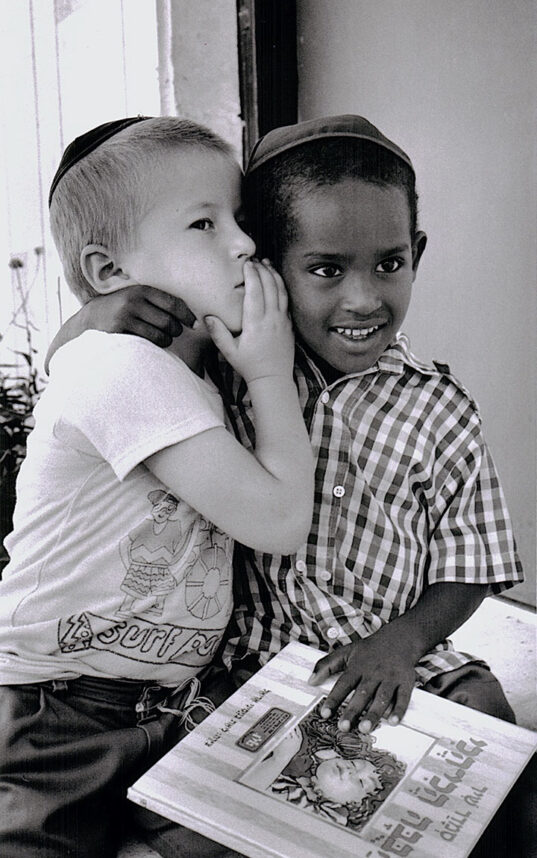
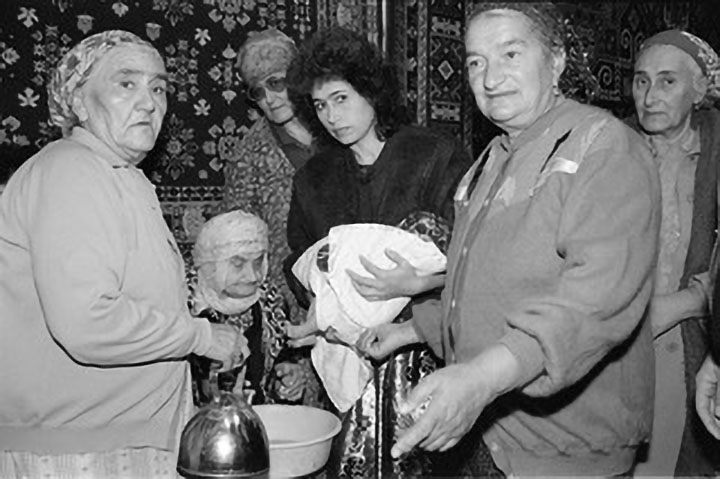
The photographs depicted Jews of different appearances and ethnic backgrounds, including an Indian woman lighting Shabbat candles, Bukharian Jews wearing traditional clothing, and an Ethiopian boy sharing a secret with a friend.

The Secret, Mevaseret Zion Absorption Center, Israel, 1990.
Photo by Zion Ozeri

The exhibition proved so successful that the professor asked the dean to extend its display so more students could see the photographs and learn about Jewish communities around the world. It remained at the university for nearly 15 months.

“It was only 10 days before Oct. 7 [2023]. If we had done it after the war started, they wouldn’t have allowed it because of all the ‘balagan’ and anti-Israel demonstrations that started afterward,” Ozeri said.

He recalled that when Jewish students began experiencing antisemitism on campus, some people at the university pointed to the exhibition as evidence that it could not be antisemitic. “We have this exhibition, how could we be antisemitic?” he said.

Ozeri was born in Israel to parents who immigrated from Yemen. The family initially lived in a ma’abara, a transit camp made up of rows of huts and tents, before moving to an apartment.

Growing up between mainstream Israeli society and the Sephardi margins he came from shaped Ozeri’s identity and became the foundation of his work.

After attending Bar-Ilan University and studying photography and art in New York, he began traveling the world to document Jewish communities in the Diaspora, often in small, remote villages. He also traveled to Yemen twice.

“I realized that it was not only my own close, ancient Yemenite family that needed to be cherished and documented, but also many other Jewish communities,” he said.

Ozeri eventually founded The Jewish Lens, an educational program that uses photography to help students explore Jewish identity, values and the diversity of Jewish communities around the world. Students examine his photographs, discuss the stories they tell and connect them to Jewish texts and traditions. They also use their own phones to take pictures expressing their personal connections to Jewish life.

Ozeri recognized that in an age when students are immersed in smartphones and social media, photography could offer a way to reach them. Rather than relying solely on traditional teaching methods, he sought to engage students through a medium they already understood and enjoyed.

Circumcision Ceremony, Bukhara, Uzbekistan, 1993. Photo by Zion Ozeri

Another exhibition, “The Jews of Yemen: The Last Generation,” was shown last year at ANU – Museum of the Jewish People in Tel Aviv. This fall, a new curriculum, “Picturing Israel: History, Heritage and Homeland,” is being introduced in schools across the United States.

For more information, email Zion Ozeri at zion@zionozeri.com 

Zion Ozeri’s Photographs Reveal the Many Faces of Jewish Identity Read More »

Milken School Opens Jan Koum Campus in Bel Air

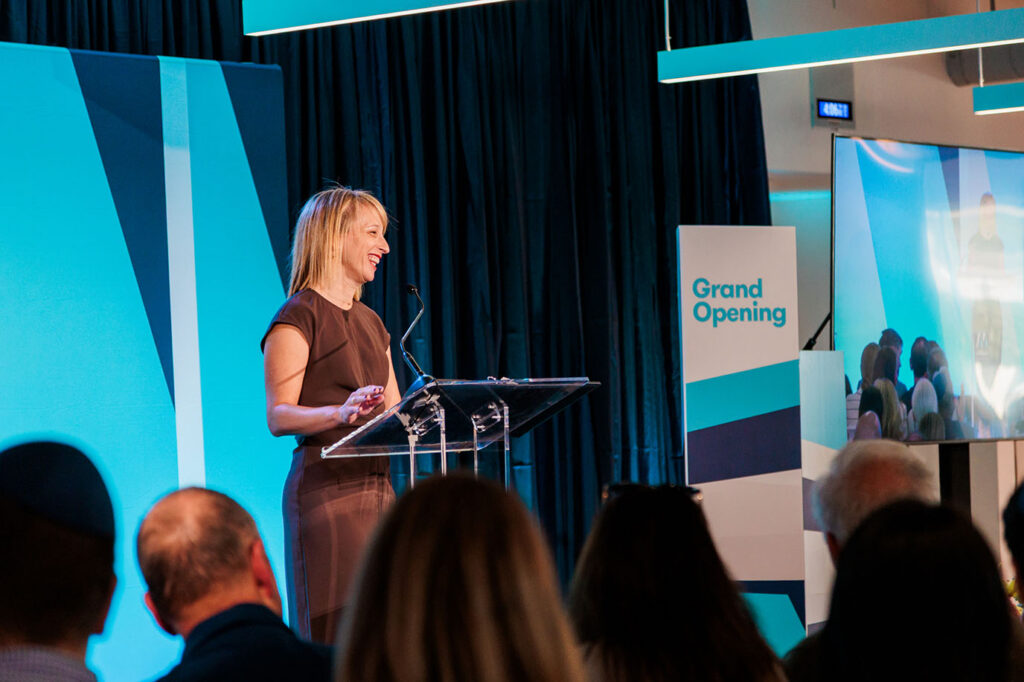
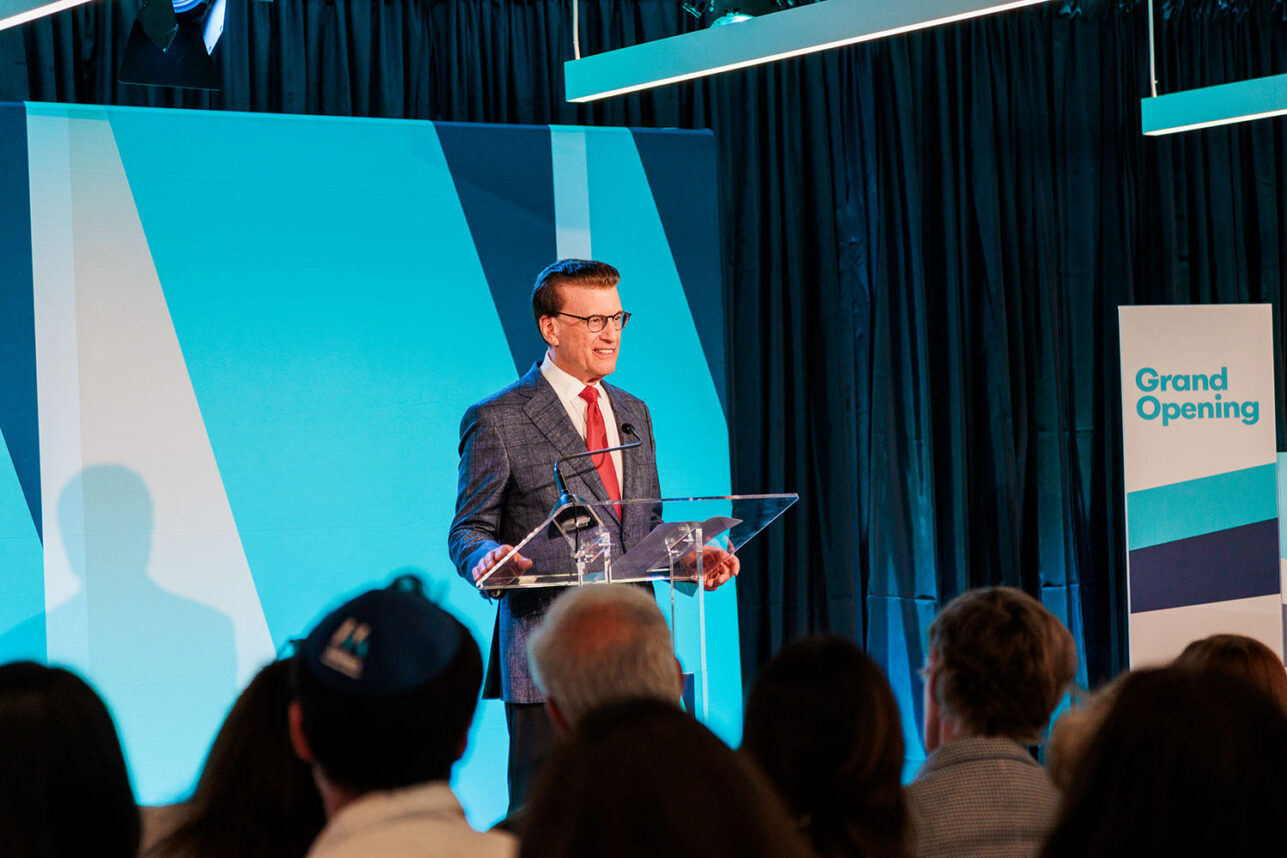
Milken Community School officially opened its Jan Koum Campus on Oct. 25, welcoming students, families, donors and community leaders to its newly acquired site at 15600 Mulholland Drive in Bel Air.

The campus, formerly part of American Jewish University (AJU), was made possible by a $36 million gift from WhatsApp co-founder Jan Koum. The site is now home to Milken’s Upper School, serving students in grades 9 through 12, and expands the school’s footprint across its three campuses to 28 acres.

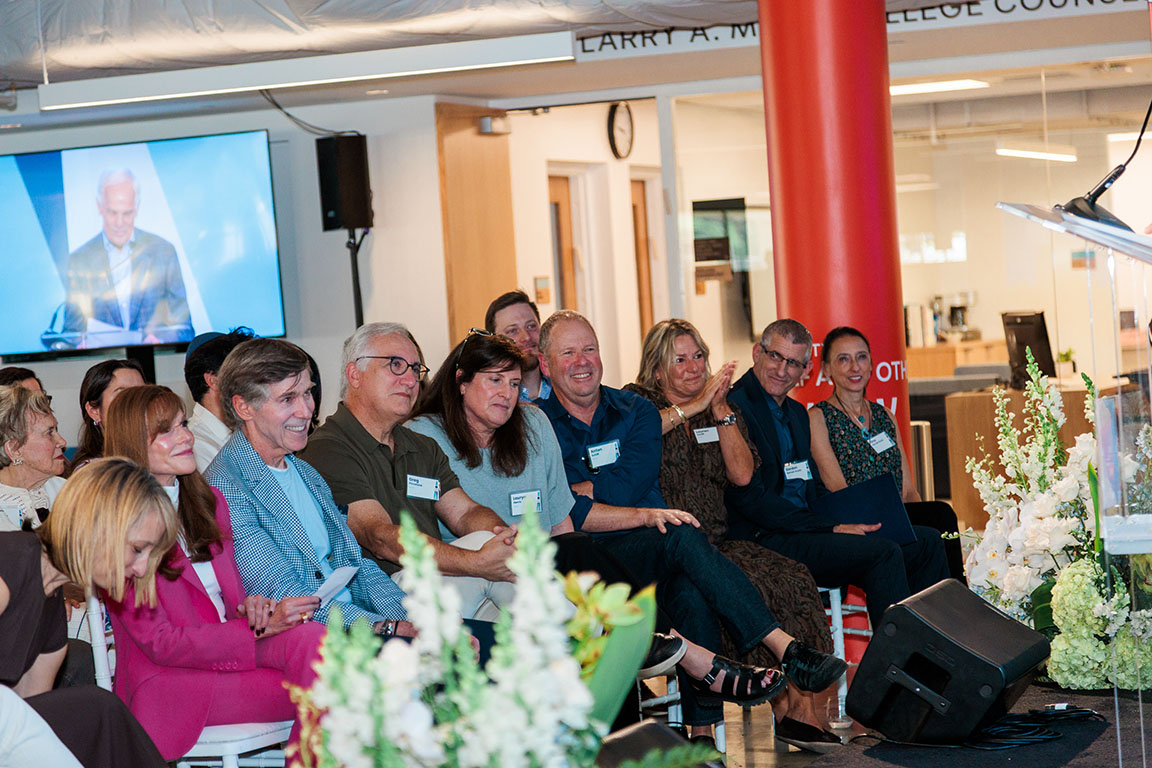
Among those attending the grand opening were Milken School co-founder and trustee Lowell Milken; Richard Sandler, chair of the school’s board of trustees; and trustee Leon Janks.

The celebration featured remarks from Head of School Sarah Shulkind, Sandler, Katie and Amnon Rodan, and Lowell Milken, along with a ribbon-cutting ceremony, campus tours and a concert by Israeli singer Ishay Ribo. Ribo made history as the first Israeli artist to headline Madison Square Garden. The performance marked his first appearance for the Milken community.

In her remarks, Shulkind said the campus reflects the school’s commitment to investing in Jewish education and preparing future generations of Jewish leaders. She also pointed to rising demand for a Milken education.

“Lowell Milken and our Board of Trustees advised that if you are not building, you are not growing. Together, we decided to build the preeminent campus of the Jewish future, and we assumed that more and more of the Jewish community will come,” Shulkind said. “This year, the very year that we opened the Rodan Academic Center, applications are up 40% from last year’s record year.”

Shulkind described the school’s newest home — located across the street from Stephen Wise Temple and about a half mile away from Milken’s two other campuses, the Ruby Family Campus and the Saperstein Campus — as a link between generations and a foundation for the Jewish future.

“This campus reminds us that we are both descendants and ancestors,” she said. “That we have received something precious from those who came before us, and now, with the blessings in our hands, we built the house for tomorrow.”

She concluded by expressing hope that the campus and its students would help shape the future of the Jewish community.

Milken Community School Co-Founder and Trustee Lowell Milken. Courtesy of Milken Community School

Lowell Milken, who was instrumental in the establishment of the Jewish middle school and high school, said the new campus comes at a time when Jewish day schools play an increasingly important role amid rising antisemitism.

“When we gathered for the groundbreaking a year ago, I spoke about the extraordinary opportunity that is before us. About how this opportunity is more than just creating a state-of-the-art facility,” he said. “For we, as Jews, are living in a time of great challenge, when antisemitism has risen in the nation and the world. Where the safety, civil rights and identity of Jewish students and Jewish faculty are called into question.”

He also cited the spread of blood libels and conspiracy theories targeting Jews and Israel.

“Milken’s vision is not optional — it is essential and critical,” Milken said. “To be a beacon for Jewish continuity here and abroad.”

The opening of Milken Community School’s Jan Koum Campus draws Milken donors, leaders and families. Courtesy of Milken Community School

The program included a performance of the national anthem and “Hatikvah” by Milken freshman Daliya Eigler, as well as a performance by Makelat Hakehillah, a community choir, which sang an arrangement of “Sibat Hasibot.” Videos highlighted students’ perspectives on the campus and recognized those supporting the school’s vision for Jewish education.

Milken also welcomed guests to tour the newly renovated Rodan Family Academic Center, a modern learning space for Milken’s upper school students that has been described as a hub of learning, identity and connection.

The site, previously referred to as the “Milken East Campus” following its acquisition from AJU, was renamed the Jan Koum Campus in June in recognition of the gift from the Koum Family Foundation, which works to support Jewish education and identity-building. At the time, school leadership said the gift brought the total raised through its capital campaign to $152 million, which it described as a record for Jewish education.

Milken Community School is an independent, coeducational Jewish day school serving students in grades 6 through 12. The school currently serves more than 800 students, according to its website. 

Milken School Opens Jan Koum Campus in Bel Air Read More »

For Teens, Israel Travel Is Not the End Goal. Jewish Peoplehood Is.

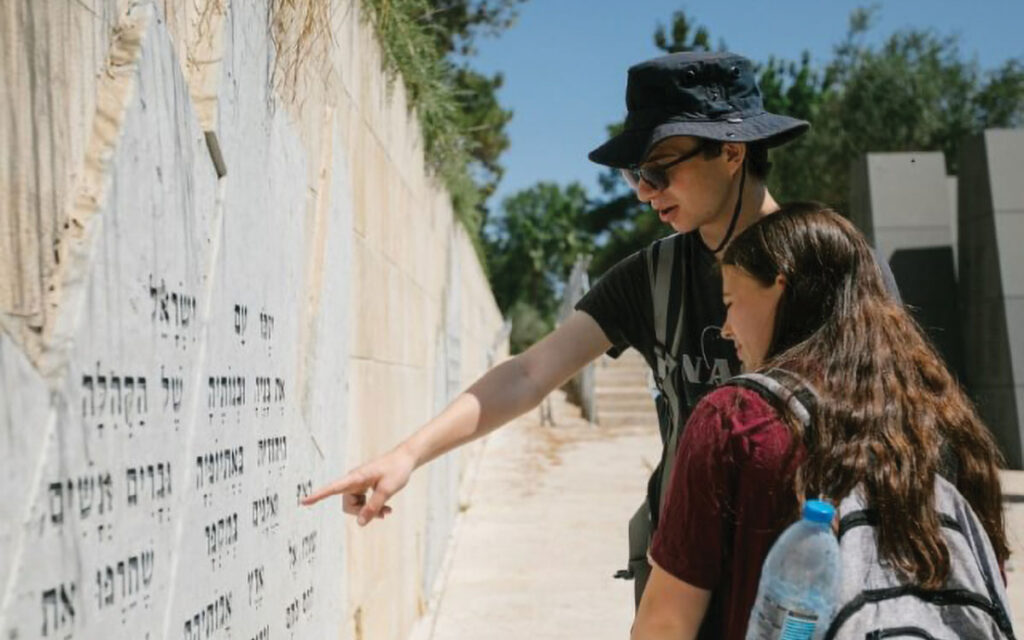
Since October 7, 2023, RootOne, like every organization committed to immersive teen travel in Israel, has faced the challenge of helping teens and their families feel able and willing to make the journey. This past summer, RootOne again supported travel at scale, with 4,000 teens participating in programs that criss-crossed Israel. That created the welcome opportunity to focus less on whether teens would get on the plane and more on what Israel travel can make possible once they arrive. During two weeks visiting RootOne-supported programs across the country, I watched North American Jewish teens navigate Hezekiah’s Tunnel, linger in the aisles of Machane Yehuda before Shabbat, and wrestle, sometimes aloud, sometimes quietly, with the complexity of the place they were encountering. I saw moments of joy, reflection, and connection that reinforced a central lesson: Israel travel can be profoundly formative, but travel alone is not enough.

If the Jewish community wants teen trips to Israel to foster enduring connection — to Israel, to Jewish life, and to one another — we must stop thinking of them primarily as summer experiences. We must design them as educational journeys: prepared for before departure, shaped by meaningful encounters on the ground, and sustained after participants return home. This is especially urgent at a moment when Jewish teens are coming of age amid rising antisemitism, deep polarization, and hard questions about Israel. A well-designed Israel experience cannot resolve every question. But it can give young people context, relationships, language, and a sense that they belong to a people and a story larger than themselves.

Begin Before the Plane Takes Off

The educational value of an Israel trip begins well before a teen reaches Ben-Gurion Airport. Pre-trip learning gives participants historical context, Jewish vocabulary, and emotional readiness for what they will encounter. It helps transform a visit to a site from an entertaining stop on an itinerary into an opportunity to ask: What happened here? Why does it matter? And what, if anything, does it ask of me?

Preparation is particularly important when teens will confront subjects that are emotionally and politically complex. Young people deserve more than slogans or carefully curated certainties. They need a foundation that enables them to encounter Israel with curiosity, empathy, confidence, and intellectual honesty. The goal is not to predetermine what participants will think. It is to ensure they have the tools to think, and to keep thinking, once the trip is over.

Make Relationships Central

The most memorable moments of youth travel are often not the monuments, museums, or meals. They are the encounters.

On this summer’s programs, North American teens met Israeli peers, shared music and stories, and found moments of recognition across differences in geography, religious practice, and communal affiliation. At one gathering, teens from a wide range of movements and organizations came together around Israeli music and an unmistakable feeling of collective joy. Elsewhere, groups who did not know one another found themselves sharing Shabbat in Jerusalem. These encounters matter because Jewish peoplehood is not an abstraction. It is experienced through relationships.

For many North American teens, meeting Israeli peers replaces a distant or idealized image of Israel with human connection. It makes room for affection, difference, disagreement, and solidarity. It also invites teens to recognize that Jewish life is larger and more diverse than their own school, synagogue, camp, or neighborhood. Programs should treat teen-to-teen encounters not as an optional add-on, but as a core educational design principle. The same is true of the adults leading these trips. Counselors, guides, and educators must be prepared not merely to manage logistics, but to facilitate reflection, ask difficult questions, and help teens make meaning from what they see.

Build a Bridge Home

The field should also resist measuring success at the airport gate on the flight home. A powerful trip may be a catalyst, but it cannot be the entirety of a teen’s Israel or Jewish education. Its impact depends on what follows: conversations with family, continued learning, relationships with peers, opportunities for leadership, and institutions ready to welcome teens back into communal life with seriousness and purpose. That requires an ecosystem approach. Families, educators, synagogues, schools, youth movements, camps, trip providers, and communal organizations each have a role in helping young people integrate what they experienced. When those partners reinforce one another, a three-week journey can become part of a much longer process of identity formation and belonging.

This is not simply an argument for better programming. It is an argument for a different measure of success.

The question is not only whether a teen enjoyed Israel, though joy matters. Nor is it only whether a teen returns with stronger feelings about the country, though connection matters as well. The deeper question is whether the experience has helped that young person locate themselves within the ongoing story of the Jewish people: connected to Israel, connected to other Jews, and equipped to participate in Jewish life with greater confidence and commitment.

Israel travel can offer a rare and powerful opening for that work. But only if we understand that the destination is not the end of the journey. 


Jonathan Fass is a Senior Managing Director at RootOne. RootOne, seeded by a generous gift from The Marcus Foundation and incubated at The Jewish Education Project, aims to maximize teen participation in immersive Israel travel and maximize the lifelong impact and connection of the experience. Learn more at RootOne.org. 

For Teens, Israel Travel Is Not the End Goal. Jewish Peoplehood Is. Read More »