

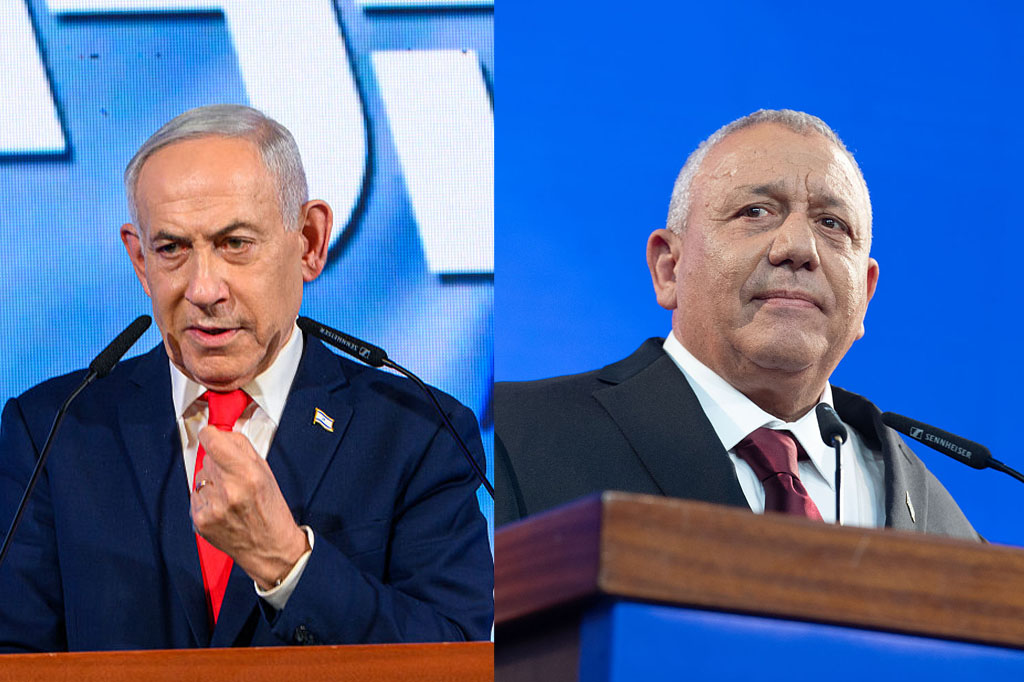
No Israeli political party has ever won a majority in the Knesset in a national election. So while it is always possible that the unprecedented might occur and Benjamin Netanyahu or Gadi Eisenkot might have made history by the time you read this, it is much more likely that one of them will be just beginning the struggle of fashioning a 61-seat coalition that may allow him to become the Jewish state’s next prime minister. Or not.
In fact, we might be at this for awhile. So let’s consider how Netanyahu and Eisenkot would govern differently given their many similarities on international and security matters. As I have written before, most 21st-century Israeli elections have come down to the now-familiar options of Bibi or “Bibi-ism without Bibi,” given the steady procession of former Likud leaders whose approaches to the Palestinians, to Iran and its clients, to the threats of terrorism and other externally-based violence largely mirror Netanyahu’s approach.
Eisenkot uses more nuanced language than Netanyahu in describing these security challenges, so it’s difficult to see the broader question of Middle Eastern geopolitics changing much regardless of who ultimately succeeds in building a tenuous majority. But there are issues on which the two men differ greatly, and life within Israel’s borders may change significantly if the occupant of Balfour does change. Netanyahu’s reliance on the most conservative members of the Knesset for his majority have severely limited his governing options, and he has already promised National Security Minister Itamar Ben-Gvir a senior cabinet position.
That leaves Eisenkot potential for greater flexibility, although the divisions within his more fractious coalition may impose unpredictable constraints on his governance. But it is highly likely that he will reverse, or at least dramatically soften, longtime Netanyahu priorities in several critical areas. The first is the obligation of the ultra-Orthodox Haredi Jews to serve in Israel’s military. When David Ben-Gurion first agreed to grant this exemption in 1948, there were only 400 Haredis in the entire country and the political benefits and post-Holocaust cultural and religious necessities made this a fairly straightforward calculation for modern Israel’s first leader.
Today, there are between 60,000 and 80,000 Haredi who claim this exemption and those numbers will undoubtedly continue to grow at an even faster rate in the coming years. The strain of years of non-stop warfare has put extraordinary strains on Israel’s economy and mainstream society and the growing resentments from the non-Orthodox majority has created significant resentments and divisions within a country that has neither the size nor security to allow for such discord without immense consequence. Netanyahu’s shrunken coalition relies heavily on ultra-Orthodox parties for his governing majority and so he has found a number of ways to avoid any meaningful shifts in the policy.
Eisenkot is not a secularist. He clearly understands and respects the historical and religious imperatives at play in this debate. But he would impose a limit on the number of Haredi who can devote themselves so completely to Torah study that they would not also be obligated to some type of public service like the country’s other young people. He has also signaled his interest in an expanded definition of public service, that would allow not only for military conscription but other types of mandatory civic engagement as well. This would allow those young Israelis, Haredi and otherwise, to fulfill their commitment to their country in a broader range of ways.
Netanyahu’s supporters correctly point to the wrenching societal debate that would result in such a change, and it’s clear that both options will involve painful and potentially unresolvable domestic conflict. But public opinion is strongly with Eisenkot on this matter, and while the Haredis’ future is not the determinant issue in this election, the campaign’s outcome will clearly define one of two very different versions of a Jewish state.
More familiar issues like Iran and Gaza, settlements and terrorism will continue to dominate the international discussion surrounding Israel. But once the country does settle on its next leader, life inside its borders may change in many ways.
Dan Schnur is the U.S. Politics Editor for the Jewish Journal. He teaches courses in politics, communications, and leadership at UC Berkeley, USC and Pepperdine. He hosts the monthly webinar “The Dan Schnur Political Report” for the Los Angeles World Affairs Council & Town Hall. Follow Dan’s work at www.danschnurpolitics.com.

































