

The parsha begins on a hot, lazy afternoon in Mamre, which if you want to locate it on a map, is roughly the fifth oak tree south of Hebron in Canaan.
Abraham looks up and finds three men standing outside his tent. Ever the gracious host, he hurries to Sarah, imploring her to whip up some cakes while he starts his unexpected guests off with a cheese plate.
When one of the men suddenly announces that Sarah is going to have a son within the year, the nonagenarian laughs to herself, perhaps wondering what her husband put in their feta.
But God, presumably speaking through one of his three angels, is not amused by her expression of doubt.
“A son I promised, a son you shall have,” He tells the patriarch. Sarah, who realizes now that the presence of God is among the angels, is too frightened even to say, “thank you.”
But the conception of a new heir is only one item on the agenda. Sodom and Gomorrah, two nearby cities, have so offended God with their sinfulness that He is compelled to destroy them.
In what seems like another test of Abraham’s character — this parsha is full of tests — the Almighty lets the patriarch in on his plan.
Abraham finds it too harsh and, in a very gutsy move given his interlocutor, starts to negotiate.
If God can find 50 innocent people, will He still destroy the cities? God says no, He won’t destroy them if He can find 50 such people.
Abraham presses his case: How about 45, 40, 30, 20, 10. No, God, agrees, He will not destroy Sodom and Gomorrah if He can find 10 innocent people. But, as we shall see, even that number is too high.
One righteous man does live in Sodom, Abraham’s lovable loser nephew, Lot. Two angels in human form arrive to retrieve him and move his family to safety.
Word quickly spreads that there are strangers in town. Lot’s house is surrounded by a mob. The Sodomites make a hideous demand: Give us these strangers, so that we can “be intimate” with them.
Lot slips outside, closing the door behind him, and makes the mob an equally perverse counteroffer. “How ‘bout this?” he says. “Leave my guests alone and take my two virgin daughters instead.”
But the mob — they’re not called Sodomites for nothing — are not interested in virgins. The angels grab Lot and pull him back into the house, sending out a bright light to cover their retreat.
Blinded by the light, the crowd disperses. Inside the house, the angels give Abraham’s dazed and confused nephew the straight story: “In twelve hours this place is going to be a pile of ash. Get your family and get out.”
Lot races across town to his married daughters and their husbands, blurts out the bad news, and urges them to flee. They think he’s gone loony and laugh in his face.
At dawn, the angels inform Lot that it’s time to go. He delays and then delays some more, hoping his married daughters will join him, but they never come.
Finally, he takes off with Mrs. Lot and his two unmarried daughters. As the sun rises, fire falls from the sky and the twin cities are erased from the face of the earth.
Lot’s wife, despite the angels’ warning — maybe because she hoped to see her married daughters escaping — looks back and turns into a pillar of salt, frozen solid, as it were, by the horror of such total destruction.
Lot and his daughters flee into the hills.
Believing themselves to be the last remnant of humanity, the daughters concoct a plan to sleep with their father to keep the human race alive.
The plan — get the old man so drunk he doesn’t know what’s happening — works and the Moabites and Ammonites are eventually the result.
Meanwhile, Abraham takes off on another of his sojourns. While in Gerar (if you’re interested, that’s 10 miles south of Mamre, turn right at the seventh acacia tree, then left at the camel crossing) he and Sarah pull their old “no, she’s my sister” gag where Sarah pretends to be his sister and not his wife in order that Abraham can be shielded from another murderously lustful monarch.
Before the king of this kingdom, Abimelech, can have his way with Sarah — it’s true her Biblical age is 90 but Abimelech might be 120, for all we know, and at 120, 90 might look pretty good — God visits him in a dream.
He tells Abimelech that knowing Sarah, in the Biblical sense, would be a fatal mistake. The king takes the hint and sends the Hebrew couple on their way with a whole new set of sheep, oxen, and tent ware.
A year has now passed since the angels visited Abraham and, lo and behold, just as promised, Sarah conceives and delivers a son whom she names Isaac.
Eight days after he’s born, in the first and oldest ritual of the Jewish religion, he’s circumcised. But all is not well in the household. Sarah’s enmity for Hagar, always on simmer, boils over.
Sarah demands that Abraham expel Hagar and her son, Abraham’s first son, Ishmael, from the camp. This distresses the patriarch greatly, but God gives him some advice that has saved many a husband over the millennia: listen to your wife.
Abraham sends the boy and his mother away with a skin of water and some bread. Hagar gets lost, runs out of water, and fears that she and her child will surely perish. God hears the cry of the boy and saves them.
Ishmael grows up to be a hunter, marries an Egyptian, and becomes, as God had promised, the progenitor of a great nation… great, at least, in number.
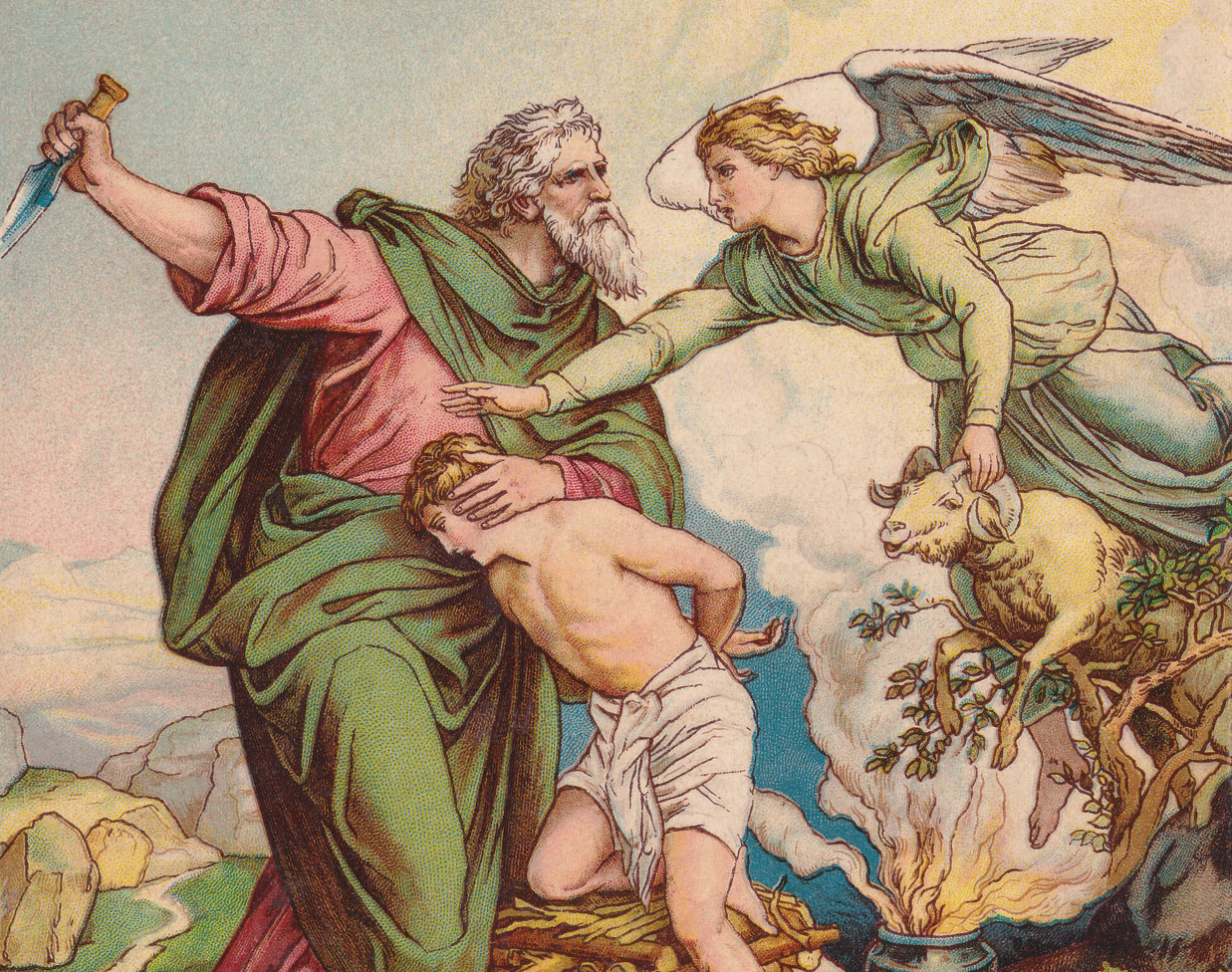
The parsha ends with the binding of Isaac, the Akeida, probably the darkest chapter in the entire Torah. God clearly states at the opening that he’s putting Abraham to another test, but this doesn’t make what happens any less harrowing.
The test is this: Is Abraham willing to sacrifice his son, if God demands it? We never find out, because God ultimately orders Abraham to stop before he can complete the deed.
A ram, not the boy, is sacrificed. So impressed is God by this display of faith that he restates his pledge to make Abraham’s heirs “as numerous as the stars in the heaven and sands on the seashore.”
Furthermore, “all the nations of the earth shall bless themselves by your descendants because you have obeyed My command.”
To which I can only add cain yah hi rahtsone. Would that it be so.
And that is a brief summary of Torah portion Vayera.
Allen Estrin is the Executive Director and Co-Founder of PragerU.

































