
In this parsha, we meet the first hire —employee #1 — of Jew, Inc. a new God-created enterprise that will change everything.
It starts suddenly. Kinda of like the creation of the universe.
“The Lord said to Avram – Go forth from your native land and from your father’s house to the land that I will show you.”
We can only imagine Avram’s response. “What land are we talking about? … Is there any danger involved? … Do you pay moving expenses?”
But God doesn’t let the first Jew get a word in edgewise.
He promises that Avram will be the father of a great nation.
Not only that — God will make Avram’s name great.
Not only that — He will bless those who bless Avram and curse those who curse him. And finally … “All the families of the earth shall bless themselves by you.”
It might be the greatest job offer ever.
Parenthetically, this passage explains why Evangelical Christians are so loyal to Israel and the Jewish people. To their everlasting credit, they take God’s prescription seriously.
While critics often claim that this devotion is based exclusively on the idea that Israel must exist for Jesus to return, this is a reductive argument. It cynically ignores the fact that Evangelical support is rooted in a literal, present-day reverence for the eternal Abrahamic covenant.
Back to our story:
We know nothing about Avram at this point except his genealogy, but we will learn a lot about him in coming chapters.
We will learn that he is a man of deep faith.
Fearless in battle.
Honorable in business.
Fiercely protective of his family.
Unafraid to challenge the Creator of the Universe.
And more than a little bit sneaky when he finds himself in a tight corner – qualities that might explain — to the extent we can ever know — why he was chosen by God to carry His name into the world.
So, Avram, with nary an objection, but fortified with a divine promise, sets out for Canaan with Sarai and his nephew, Lot, and settles there.
It doesn’t start out well. A famine soon overtakes the land, and the future patriarch is forced to travel to Egypt to survive.
This creates a new problem.
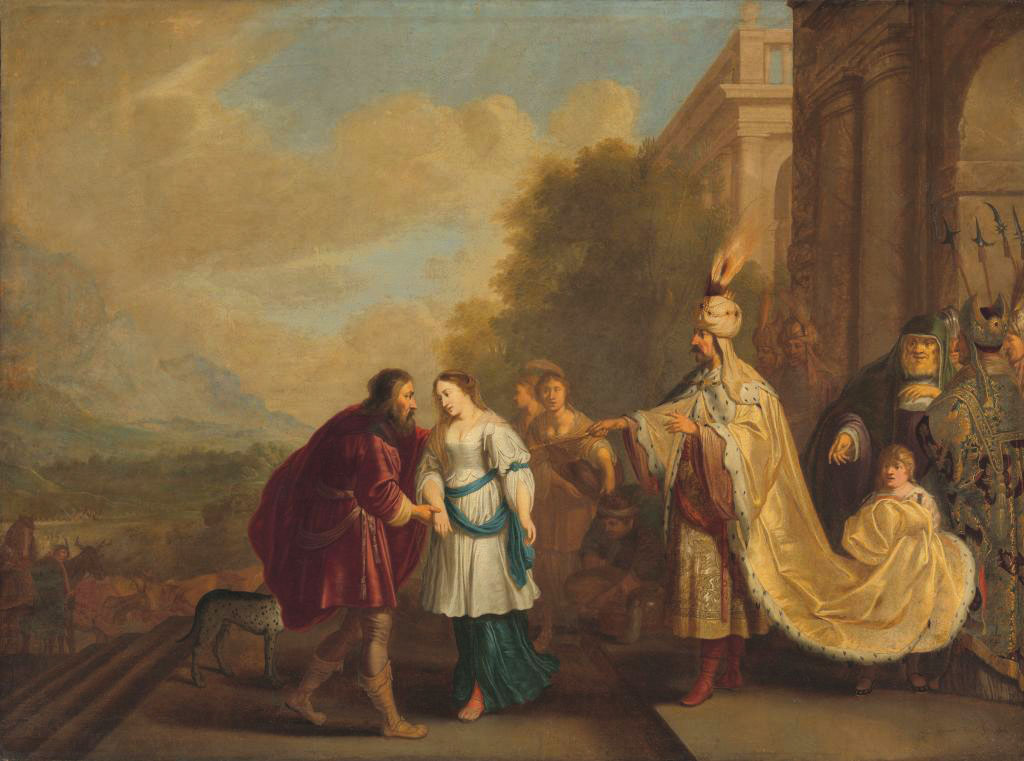
Avram’s wife, Sarai, is so fetching — imagine the great British actress Deborah Kerr — that he’s convinced that the Pharaoh will take her for himself and kill him in the process.
This passage is usually glossed over, but I find it to be one of the most touching, if not romantic moments in the Torah.
What Avram essentially says to his wife is, “I know what a beautiful woman you are. Of course, Pharaoh will want you for himself. We need to figure something out or we’re both doomed.”
It’s not like they’re honeymooners. They’ve been together for a long time. But the heat is still there.
So, they work out a little deception – Sarai will tell everyone that she is Avram’s sister.
Let it be noted that Avram doesn’t order her to follow this plan, he asks her permission. “Please say that you are my sister, that it may go well with me because of you, and that I may remain alive thanks to you.”
The plan works.
Pharaoh does indeed take the newly arrived beauty into his harem and also spares her putative brother.
While his wife presumably fends off the monarch’s advances, Avram makes hay – literally. His business ventures thrive.
Just the opposite happens to Pharaoh and his court.
The king, obviously no fool, puts the pieces together and figures out that all his misfortune has been caused by the fact that Sarai really belongs to Avram.
So, in the nicest way possible, he tells Avram, Sarai, and Avram’s nephew, Lot, to get the hell out of Dodge. The trio takes the hint and skedaddle back to Canaan.
Avram and his nephew have amassed so much livestock by this point that the land can’t support them both. So, uncle tells nephew to take the half of the land he wants and he, Avram, will take the other half.
Lot, who is the original Schlemiel, a very sweet guy, but — to use the vernacular — a total loser, makes his choice. Uncle and nephew split up, but not, as we will soon see, for long.
Sometime later, a war erupts in Avram’s neighborhood. Nine kings are involved – five against four. In the war, Lot is captured. This draws Avram into the fray.
The patriarch gathers his men and goes into battle, defeating the forces holding his hapless kinsman. He frees Lot and wins the gratitude of the kings on whose side he has fought, including the King of Sodom.
But when the Sodomite ruler offers Avram the lion’s share of the captured loot, Avram turns him down, perhaps — this is only a guess; the text doesn’t say — because he already knows that Sodom is a tainted place.
Avram returns to his flocks and is approached by God in a vision. God again makes promises of nationhood. But the dubious Patriarch poses the obvious question.
“You keep telling me that my offspring are going to become a great nation, but how do you start a nation without a son?” The Creator of All Things tells him to take a chill pill. He, God, doesn’t renege on His promises.
Sarai has her own solution to the question. She proposes that her husband take her maidservant, Hagar, as a concubine and have a son through her. Avram agrees. Hagar soon conceives.
But this happy event does not please Sarai. Never mind it was her idea, she thinks – rightly or wrongly – that Hagar, now that she is pregnant, considers herself superior to her mistress.
Hagar can’t handle the abuse and runs away. An angel orders her to return and promises that the son she is carrying will be the source of a populous nation, too.
The narrative then jumps 13 years. Avram is now, according to the text, a spry 99. God, once again, reaffirms his covenant, promising Avram that he will be the father of a multitude of nations.
God, then orders a name change – Avram will now be called Abraham. The change in name, a spiritual change, is to be accompanied by a physical change – circumcision.
God commands that every Hebrew male child henceforth is to be circumcised at the age of eight days.
This is to be a seal of the covenant – an everlasting symbol of the connection between God and the Jewish people.
Sarai’s name is changed to Sarah and God promises, as improbable, indeed laughable, as it may seem, that she and her newly renamed husband will soon have a son of their own.
And that is a brief summary of Torah portion Lech Lecha.
Allen Estrin is the Executive Director and Co-Founder of PragerU.