Jewish actress Mikey Madison, who won the Best Actress Oscar for starring in “Anora,” shows great versatility. A sex worker in that film, in “The Social Reckoning,” she’s a socially conscious employee willing to blow the whistle on Facebook (now called Meta) because she believes it is harming people, especially the youth of America.
Madison plays Frances Haugen, the Facebook whistle-blower. The movie opens with one of her friends being racist and sharing the video. Frances realizes the algorithms radicalize people and the company makes money from getting people angry and spending more time on the site.
Wall Street Journal reporter Jeff Horwitz, who won the Pulitzer Prize for reporting on the media giant, is played by Jeremy Allen White as a by-the-book guy who wants all the info he can get from Frances. There is no romantic tension between the two characters. While that may have been true to the story, if done in a way that wasn’t shlocky, it could have added something.
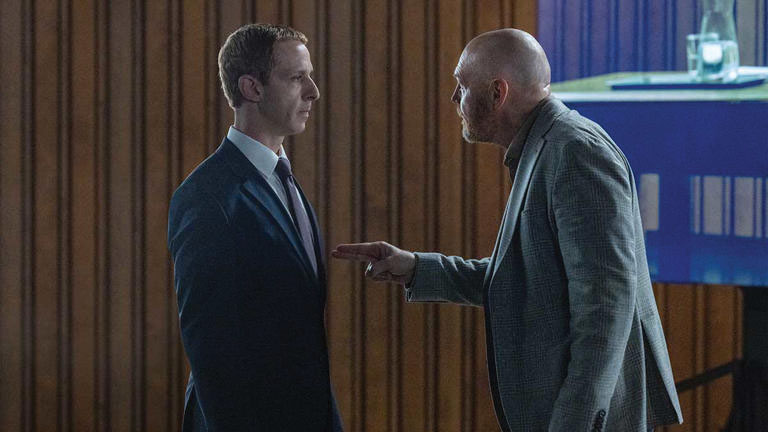
Jeremy Strong is excellent as Mark Zuckerberg, who is written as a one-note, totally evil person who only cares about making more money. We see him prepping for a congressional hearing with a guy brought in to challenge him, played by comedian Bill Burr. Burr is decent, but not believable.
If you watch this movie expecting it to come anywhere close to the heights of “The Social Network,” you will be disappointed. The 2010 film was directed by David Fincher, with a screenplay by Aaron Sorkin, and it’s in the top 100 movies I’ve ever seen.
Sorkin, a writing and directing genius, had a much harder job in this film, which he both wrote and directed. The first film featured a perfect Jesse Eisenberg as Zuckerberg. Though he didn’t look or sound like Zuckerberg, he oozed tension, and along with Andrew Garfield as Eduardo Savaerin, Justin Timberlake as Napster founder Sean Parker and Armie Hammer playing the Winklevoss twins, Cameron and Tyler, there was tension in every scene and the arc of Zuckerberg going from a college student to a start at the top of the mountain. Even for the greatly gifted Sorkin, there’s no way to match that with a film about a guy who’s now a billionaire at the top of the mountain with nobody who can really challenge him. Strong nails the cadence of Zuckerberg but the movie villainizes him to the extent that he is no longer human. It would have been a smart move to show some lighter scenes with his wife or doing martial arts. Unfortunately, viewers will look at Strong in scenes with big TVs around and think of nothing but his role on “Succession.” White has an understated role and viewers will see him as the same chef from “The Bear,” but out of the kitchen and perhaps moving on to a new venture = out of the frying pan and into the fire.
Madison deserves praise for doing her best to make the film great. It wants you to be concerned with social issues, but a movie has to stand alone, create tensions and have gravitas. This film doesn’t sufficiently do so, though it is still worth a watch due to Madison and Strong.

To get us to care about bullying online, we should see someone get bullied. Instead, there is a throw-away scene of Madison overhearing a teenage girl complain to her parents. It goes without saying that social media poses challenges top society, especially youth, and there can be harmful effects. For one thing, bots should be banned. The film raises the issue of Facebook/Meta posting political ads without factchecking. This is one of many good points.
But the film mostly leaves out that individuals have agency. People can see an ad and still have the ability to do their own factchecking. Bullying online or in real life is terrible, but parents must also teach their children how to handle it. The movie doesn’t delve into racism or antisemitism online, but every company can have their own guidelines for free speech and speech that violates its policies, and it should be enforced on a consistent basis, not only if a few people complain about one person or group.
This film isn’t about a power struggle, but shows that powerful companies are reluctant to change unless there is pain. The fact is each person might have their own moral values, but unless there is a law that is enforced, few things change.
Strong’s Zuckerberg says his company is a “corkboard” and should not be required to attest to the truth of anything. Others believe that since so many get their news content from the site, it should be treated like legacy media, and be sued if it knowingly publishes something false. Zuckerberg and other social media companies argue they are the platform and not creating the content, so they are not liable.
Sorkin gives us an interesting film, but it doesn’t envelop you. It’s not memorable and doesn’t stick to you. The result is that “The Social Reckoning” doesn’t make us feel like there is any reckoning to be done. Madison’s character doesn’t seem to be in much danger, and White is non-plussed. And Strong’s Zuckerberg is like an evil robot. The result is we don’t feel anything real, even though we know there are problems in real life. So, the film writes a check to our brains that our hearts can’t cash.