Last week my wife and I dined at our favorite local Italian restaurant. As often happens in Los Angeles, we sat adjacent to a gentleman who seemed unaware that his speech decibel level was double what was needed for a small table. So, we learned about his business affairs and imbibed complaints about employees along with our pasta. Intermingled in the booming soliloquy were numerous “f-bombs,” as many as two to a sentence.
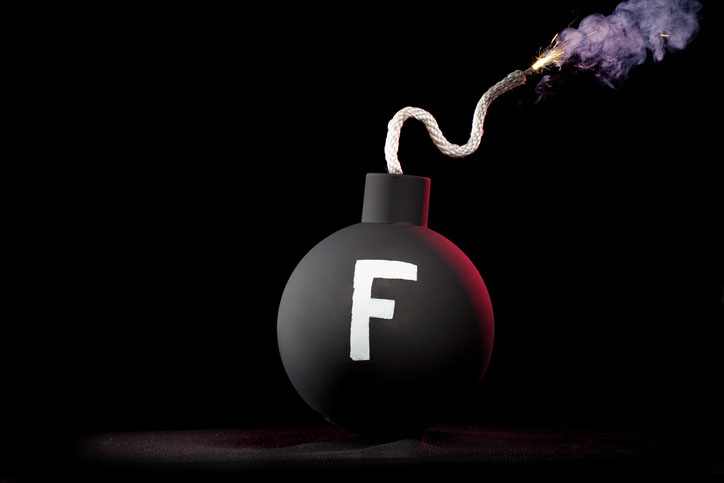
The term “f-bomb” has become obsolete. The one-time shocker is so common that it’s more of an f-firecracker. I’m not partial to it and would ask your indulgence even for using the sanitized version. Unfortunately, the topic cannot be considered without a means of reference.
As many of us know from childhood, the word hearkens to the medieval Anglo-Saxon roots of English. Its ascent to the apex of obscenity is more recent. It disappeared from dictionaries and became shunned only in the last two hundred years. The “f-word” euphemism was created only in roughly the last 50 years. And WTF? Part of common parlance only for about 35 years.
Originally a verb, the word’s usefulness for shock value allowed it to morph, depending on circumstances, into a noun or adjective. It’s meaning becomes more nuanced when paired with a variety of adverbs including “up” the notably British “off,” “over,” but strangely not (yet) down.
The notion of objectionable speech long pre-dates the term. Although the prohibition on profanity goes back to the Ten Commandments, the Bible is silent on obscenity. There are passages that approach obscenity, notably Saul’s verbal attack on Jonathan (Samuel 20:30). Yet, a biblical notion of obscenity or vulgarity as offensive in the modern sense is largely absent.
Since “shock value” has usefulness in speech, why bother avoiding f-crackers? One reason is that the term is objectively crude, which led to its original ostracism from polite speech. But worse than crudity is the overuse that destroys whatever legitimate value it might offer in communication.
If people cannot muster creativity in their language, then WTF, they can solve the problem by tossing a few f-crackers. Plus, the term probably also appeals to the American “more is better” aesthetic that leads to mansions and McMansions, Mack truck sized utility vehicles, painfully loud movies, mega-desserts and so on. If seeking to grab the listener’s attention, why not go straight to the ultimate?
If seeking to grab the listener’s attention, why not go straight to the ultimate?
We have seen f-creep in the speech of public figures. Here in Los Angeles, Councilman Paul Koretz, an otherwise mild-mannered and public-spirited local politician, used it publicly at his 2022 farewell City Council meeting to express frustration over the rude and overbearing attendees at the Council’s public meetings. I understand his frustration, but did giving them a taste of their own medicine really help the process?
President Trump also recently used the word in a social media post, calling on the Iranian leadership to “open the f-ing Strait you bastards or you’ll be living in Hell.” Politics aside, vulgarity in government communication seems adolescent and probably counter-productive.
Who really wants to deal with someone who seems out of control?
And if the language strains American ears one can only imagine how it lands in a conservative, religious society like Iran. Perhaps the shock value was tactical. Regardless, the post represents either a concerning outlier or a further decrement in the already low standard for propriety of public speech. In 250 years no American leader ever intentionally unleashed an f-cracker on the American people. Trump barely missed setting an international standard as well. Philippine President Duterte beat him to it in a 2016 speech expressing anger toward the European Union leadership.
If pushed, I will reluctantly admit to a rare f-drop, but almost never in mixed company. Still, it’s a useful word when you drop an anvil on your foot or suffer an equivalent occurrence. It just does not need to be the same word employed in casual restaurant discussions.
Attention to proper public speech may have already gone the way of formal restaurant attire and correspondence by letter. An occasional raised eyebrow may help, although a lot of eyebrow bouncing may ensue. Those of us who still care should try to enforce some self-discipline while being gosh darn careful about what we say ourselves.
Dr. Daniel Stone is Regional Medical Director of Cedars-Sinai Valley Network and a practicing internist and geriatrician with Cedars Sinai Medical Group. The views expressed in this column do not necessarily reflect those of Cedars-Sinai.