fbpx

November 11, 2026

Who Are the Jewish Winners in the 2026 Elections?

Jewish candidates won dozens of elections across the United States on Nov. 3, including races for governor, U.S. Senate, U.S. House of Representatives and mayor of some of the nation’s largest cities.

Five Jewish candidates won gubernatorial elections, including two who will take office for the first time. One Jewish U.S. senator won reelection, while there were 28 Jewish winners in the U.S. House: 25 Democrats and three Republicans.

The results will bring the number of Jewish governors to seven in January 2027. The incoming U.S. Senate will have 10 Jewish members, including nine Democrats and one independent. There are zero Jewish Republicans in the U.S. Senate and none serving as Governors. 

Here’s a breakdown of Jewish winners from Tuesday’s elections:

NEWLY-ELECTED JEWISH GOVERNORS

Amy Acton (D-Ohio) defeated Republican Vivek Ramaswamy to become Ohio’s first Jewish governor and the first woman elected to lead the state. Acton, a physician and former director of the Ohio Department of Health, received approximately 52% of the vote. She is the first Democrat to win an Ohio gubernatorial election since 2006. President Donald Trump carried Ohio by approximately 11% in 2024.

Phil Weiser (D-Colo.) defeated Republican Victor Marx with approximately 61% of the vote to succeed Jewish Governor Jared Polis. Weiser is the son and grandson of Holocaust survivors. 

JEWISH GOVERNORS RE-ELECTED

Pennsylvania Governor Josh Shapiro (D) won his second term, defeating Republican State Treasurer Stacy Garrity by approximately 22%. Shapiro, who previously served as Pennsylvania’s attorney general, was first elected governor in 2022.

Illinois Governor J.B. Pritzker (D) won his third term, defeating Republican Darren Bailey for the second consecutive gubernatorial election. Pritzker became the first Democrat elected to three terms as Illinois governor.

Hawaii Governor Josh Green (D) won his second term, defeating Republican Gary Cordery with approximately 73% of the vote. Green, a physician, previously served as Hawaii’s lieutenant governor.

U.S. SENATE

U.S. Senator Jon Ossoff (D-Ga.) won his second six-year term, defeating Republican U.S. Rep. Mike Collins. Ossoff, 39, was first elected in a January 2021 runoff election and became Georgia’s first Jewish U.S. senator. He was the only Jewish incumbent U.S. senator whose seat was up for election in 2026.

NEWLY-ELECTED JEWISH U.S. REPRESENTATIVES

U.S. Rep.-elect Scott Wiener (D-San Francisco.) won California’s 11th Congressional District, succeeding retiring U.S. Rep. Nancy Pelosi. Wiener has served in the California State Senate since 2016 and previously served on the San Francisco Board of Supervisors. Wiener became the first openly gay person elected to represent San Francisco in Congress. 

U.S. Rep.-elect Daniel Biss (D) won Illinois’ 9th Congressional District, succeeding retiring Jewish U.S. Rep. Jan Schakowsky. 

U.S. Rep.-elect Zach Dembo (D) defeated Republican Ralph Alvarado to win Kentucky’s 6th Congressional District. Dembo, a former federal prosecutor and Navy judge advocate, won the open seat previously held by Republican Andy Barr, who ran for the U.S. Senate. Dembo received approximately 53% of the vote. President Donald Trump carried the district by approximately 16% in 2024.

U.S. Rep.-elect Jeremy Moss (D) won Michigan’s 11th Congressional District. Moss has served in the Michigan State Senate since 2019 and previously served in the Michigan House of Representatives and on the Southfield City Council.

U.S. Rep.-elect Sam Forstag (D) defeated Republican Aaron Flint in Montana’s 1st Congressional District, flipping a Republican-held seat. Forstag, 31, is a former U.S. Forest Service smokejumper and union leader. He became the first Democrat elected to the U.S. House from Montana since 1994. Montana’s Jewish population is estimated at approximately 5,000 to 6,200 residents, less than 1% of the state’s population. 

U.S. Rep.-elect Brad Lander (D) won New York’s 10th Congressional District after defeating incumbent Jewish U.S. Rep. Dan Goldman (D) in the June Democratic primary. U.S. Rep.-elect Micah Lasher (D) won New York’s 12th Congressional District, succeeding retiring Jewish U.S. Rep. Jerry Nadler (D). 

U.S. Rep.-elect Elaine Luria (D) defeated Republican incumbent Jen Kiggans to win Virginia’s 2nd Congressional District. Luria, a retired U.S. Navy commander, previously represented the district from 2019 to 2023 before losing reelection to Kiggans in 2022. She served on the House select committee investigating the Jan. 6, 2021 attack on the U.S. Capitol.

JEWISH U.S. REPRESENTATIVES RE-ELECTED

In California, four Democratic Jewish U.S. House members won reelection: Laura Friedman, Mike Levin, Brad Sherman  and Sara Jacobs.

Elsewhere, Jewish U.S. House members reelected include Randy Fine (R-Fla.), Lois Frankel (D-Fla.), Jared Moskowitz (D-Fla.), Debbie Wasserman Schultz (D-Fla.), Brad Schneider (D-Ill.), Jamie Raskin (D-Md.), Jake Auchincloss (D-Mass.), Josh Gottheimer (D-N.J.), Greg Landsman (D-Ohio), Suzanne Bonamici (D-Ore.), Seth Magaziner (D-R.I.), David Kustoff (R-Tenn.), Craig Goldman (R-Texas), Becca Balint (D-Vt.), Eugene Vindman (D-Va.) and Kim Schrier (D-Wash.).

MAYORS OF MAJOR CITIES

Irvine Mayor Larry Agran (D) holds a commanding lead over challenger Maksim Egorov, 69.7% to 30.3%, as of Nov. 9. Agran previously served as mayor from 1982–84, 1986–90 and 2000–04, before returning to office in 2024. Louisville Mayor Craig Greenberg (D-Ky.) won his second term, defeating Metro Council member Shameka Parrish-Wright with approximately 58% of the vote. 

JEWISH OFFICEHOLDERS NOT UP FOR REELECTION

Current Jewish Governors: 

North Carolina Governor Josh Stein (D) is serving his first term (next election in 2028). Delaware Governor Matt Meyer (D) is serving his first term (next election in 2028). 

Jewish U.S. Senators in-cycle in 2028: 

U.S. Senator Michael Bennet (D-Colo.) and U.S. Senator Richard Blumenthal (D-Conn.) are currently serving their third terms. U.S. Senator Brian Schatz (D-Hawaii) has served since his appointment in 2012 and won his second full term in 2022. U.S. Senator Chuck Schumer (D-N.Y.) is serving his fifth term. U.S. Senator Ron Wyden (D-Ore.) is serving his fifth full term after first taking office in 1996.

Jewish U.S. Senators in-cycle in 2030:

U.S. Senator Adam Schiff (D-Calif.) and U.S. Senator Elissa Slotkin (D-Mich.) are serving their first terms. U.S. Senator Jacky Rosen (D-Nev.) is serving her second term. U.S. Senator Bernie Sanders (I-Vt.) is serving his fourth term and caucuses with Democrats.

Current Jewish Mayors of major U.S. Cities:

Phoenix Mayor Kate Gallego (D.) has served since 2019 and won reelection in 2024. Phoenix is the fifth-largest U.S. city by population. San Francisco Mayor Daniel Lurie (D) is serving his first term after defeating incumbent London Breed in the 2024 election. Las Vegas Mayor Shelley Berkley (D) is serving her first term after winning the 2024 election. Berkley previously represented Nevada in the U.S. House for seven terms. Minneapolis Mayor Jacob Frey (D) won his third term in November 2025, defeating state Sen. Omar Fateh in a ranked-choice election.

Election results are based on race calls and unofficial returns available as of November 9, 2026. Results remain subject to certification.

Who Are the Jewish Winners in the 2026 Elections? Read More »

Congratulations – and Candor – for L.A.’s Next Mayor

In 1790, George Washington promised the Jews of Newport, Rhode Island a government that “gives to bigotry no sanction, to persecution no assistance.” Jewish life has flourished in America because in this country, power changes hands peacefully, and from its founding, we have been assured by our elected leaders that our rights and interests would be protected. That democratic inheritance, which we all share regardless of background, deserves our respect most in a season when so many Americans have begun to doubt it.

Angelenos have chosen Nithya Raman to be our next mayor. As a rabbi and the leader of Jewish Federation Los Angeles, I honor their choice and congratulate her. And I welcome the chance to build a new relationship with City Hall, one that can begin with the work the mayor-elect and our community already share.

Homelessness brought the mayor-elect into public life. Before she ran for office, she co-founded the SELAH Neighborhood Homeless Coalition. In 2014, as a congregational rabbi at Valley Beth Shalom, I organized our county’s largest faith coalition, and we pressed Los Angeles County to act. I later joined the Los Angeles Homeless Services Authority Commission, which I went on to chair, as voters approved Measures H and HHH, the largest investments the region had ever made to end homelessness.

We have both spent years trying to build a system that delivers for Angelenos. Yet the data shows where we have failed. This year’s homeless count found 45,194 unhoused people in the City of Los Angeles, and the number living on the street rose almost 8%. The agency whose commission I once chaired now faces critical audits while the city builds a homeless response of its own to replace it. 

As chair of the council’s housing and homelessness committee, Raman fought for stronger renter protections and more homes. Our community needs both. Young families, older adults on fixed incomes and the people our agencies serve are being priced out of the neighborhoods where Jewish life in Los Angeles took root. 

At the same time, our social safety net is fraying. About 260,000 county residents could lose CalFresh benefits under federal work rules that took effect in June, and the county estimates that as many as 1.5 million could lose Medi-Cal when new requirements begin in January. Contrary to the canard that all Jews are wealthy and powerful, our data shows unequivocally that one-in-three Jewish Angelenos needs a social service intervention. Poverty in our community is often hidden among Holocaust survivors, older adults, refugees from the former Soviet Union and Iran and young families just getting by. Our Federation will invest nearly $9 million in social services for them in the coming year.

I also owe the mayor-elect candor about a fraught moment in Jewish history and what it means for Jews in Los Angeles. Los Angeles County recorded 202 anti-Jewish hate crimes in 2024, the second-highest total in the 44 years the county has kept count. Jews were the targets of 80% of the county’s religiously-motivated crimes. Our Community Security Initiative, which watches over synagogues, schools and community centers every day, will cost our Federation close to $3 million this year. A partner at City Hall makes each of those dollars go further. Many Jewish institutions are now spending 20% of their annual budgets on security walls, guards and cameras so that children can go to school and worshipers can attend services. This is a tax on Jews for exercising the same freedoms as every other American. 

We ask the mayor-elect to make three commitments to our safety. First, keep LAPD working closely with our institutions, especially during the holidays and after attacks abroad. Second, direct LAPD to enforce the new Safe Worship Zone Act, which our Federation helped pass, so that no one has to walk through a wall of harassment to reach a synagogue, church or a mosque. Third, when Jews in Los Angeles are attacked, as the past three years leave little doubt we will be, speak quickly and without qualification, and call it antisemitism. And when investigators classify it as such, call it a hate crime.

The mayor-elect has a record here worth acknowledging. She condemned the Oct. 7, 2023 attack early, supported a 2022 council resolution against antisemitism and has affirmed Israel’s right to exist. But we also disagree, and I won’t pretend otherwise. She has called Israel’s war in Gaza a genocide. I believe that charge is false and misuses a legal term with a specific meaning. She has called BDS a legitimate form of protest, while her campaign says a boycott of Israel will not be part of her agenda as mayor. I take her at her word, and I will hold her to it. Her words and choices during the campaign stung many in our community and strained our trust. Our Federation and 35 Jewish organizations and congregations will say so in a forthcoming statement. I hope she reads it as I mean this letter, as an invitation to rebuild that trust, and I will do my part to help.

Los Angeles has no foreign policy. Its mayor’s words still speak for the whole city, and Jewish Angelenos have learned that words about Israel rarely stay overseas. They turn up as graffiti on a synagogue wall and as a crowd shouting at its doors. We will listen closely to how our mayor talks about the only Jewish state. 

As this new era for our city begins, our Federation and I will engage with the mayor honestly. When we disagree, we will use the opportunity to privately dialogue. When she acts to keep our community safe, we will thank her by name and in public.

Each Shabbat, synagogues across America pray for our country and for the State of Israel, asking God to bless their leaders and inhabitants. The prophet Jeremiah told the exiles in Babylon to seek the welfare of the city where they lived, because in its peace they would find their own. He was speaking to a people far from home, in a place that was not theirs. Los Angeles is ours. We will pray for its welfare, and for its mayor’s, as she leads it.


Rabbi Noah Farkas is President and CEO, Jewish Federation Los Angeles

Congratulations – and Candor – for L.A.’s Next Mayor Read More »

The Background Has Been Painted: Kristallnacht, 88 Years On

On the 88th anniversary of Kristallnacht, it’s important to remember. But remember what exactly? That Jewish shops were burned and looted? That Jews were beaten and murdered? That this was done in an organized fashion, that it represented a strategic dismantling of Jewish safety? That it rhymes too well with what we’re seeing today? Let’s have a look at one example that can be fairly used as a stand-in for countless other examples: the bike ride against Israel in Philly.

On Sunday, Nov. 8, the eve of the 88th anniversary of Kristallnacht, a group calling itself Philly Bike On Your Left organized a bicycle ride and boycott. Its targets were six Jewish-owned restaurants in Philadelphia’s Rittenhouse Square neighborhood: Goldie, K’Far Cafe, Dizengoff, Huda, Mac Mart and Schlesinger’s Deli. Cool-looking flyers (what else) were hung everywhere: “No business for Zionists!” and “These Zionist establishments must go! Not in our city!” As is common, the organizers insisted that their objections were not to Jews, but only to the owners’ support for Israel.

They denied that the timing was connected to Kristallnacht.

Peter, we had no idea!

According to Philadelphia police, some 300 pro-Palestinian demonstrators participated, including 200 cyclists. Meanwhile, hundreds of customers lined up outside some of the targeted restaurants in a show of solidarity. People were said to have waited hours just to get a seat. The event was condemned by Philadelphia Mayor Cherelle Parker, Pennsylvania Governor Josh Shapiro’s office and numerous Jewish and civic organizations.

What’s most troubling is that, much like what happened in Germany on that horrible night, the participants in the bike ride were normal people, your friends and neighbors. Those you’d see at the garden store looking for petunias to plant in pots on their doorsteps. Nice folks too. Not monsters. Not fanged, hairy werewolves. Just regular men and women who wake up in the morning, make coffee and head off to work.

Now, it might seem reasonable to say that even these regular people don’t represent the totality of Americans. True, it was a small event, which, according to reports, was hardly successful, given the number of Jews and others who turned out to support the Jewish-owned restaurants that the bicyclists had intended to shut down.

But it happened, just as similar things have been happening in America and around the world.

I don’t intend to change the minds of the bike riders, wherever they are, and in whatever shape or form they appear. I am writing for people who feel, as I do, that hatred against the Jewish people — no matter the weight of the caveats used to say it’s only about Israel — is indicative of a moral collapse that is overtaking societies around the globe. This hatred, and the ideas that feed it, must be challenged.

Remember this too: we all have a voice.

I like to think of all this in terms of painting. What’s often misunderstood is how much time and consideration goes into the background of any painting. The setting upon which the figures lie. The depth of color, the way light is brought out or made dim, the mood that’s created. It’s not unlike the social environment we exist in. What are the things people talk about, what things are acceptable? What things become unacceptable?

Back to the bikers.

Can anyone imagine this happening, say, just six years ago? Would these normies, with their helmets and their backpacks, even have considered a mass protest against Jewish-owned businesses? Would this — and this is where I drill down to the core of my idea — even have been a consideration?

“Okay, guys. Gather ‘round. I’ve got this great idea. We all know, based on the ‘facts’ streaming off our social media feeds, that Israel, that Jewish state, which was from the get-go an illegal, illegitimate colonial enterprise, is responsible for the world’s ills. That’s a given, right? And let’s make clear that we’re not against Jews, per se, just against Israelis. And, of course, any Jew who supports the Zionist entity. So, whaddaya say? Who’s ready to ride!”

Satire? Not by much. The organizers’ own Instagram post invited riders to “show these zio business owners that we see them for the disgusting humans they are.”

I don’t think it would have been considered anything but beyond the pale. To be fair, as if in a Lincoln–Douglas style debate, let me play the devil’s advocate for a moment.

Peter, the reason it wouldn’t have been considered is that five years ago the Israelis hadn’t perpetrated a mass genocide. There wasn’t sufficient justification for such things back then. Now there is.

Now there is what, I ask?

I’ll answer that hypothetical. Now there is a background. The “painters” have created the circumstances for such things by coloring the background of normal discourse with words like genocide.

In December 2023, protesters stood outside Goldie, on this same square, chanting, “Goldie, Goldie, you can’t hide, we charge you with genocide.” The painters were already at work. The word itself has been deconstructed. The words can be used now because we have allowed them to become malleable. To be pulled and twisted into any shape we desire. You can’t accuse someone of using the word genocide because, like smoke between the fingers, it disappears, it escapes examination. And when it’s examined, it falls to pieces.

But the one thing that doesn’t escape is the damage it does when cast on an entire people. It allows for things like the bike ride. And for things a thousand times worse.

The gas chambers hadn’t been considered at the time of Kristallnacht. Wannsee hadn’t taken place. But you can bet the painters, skillful as they were, were already preparing the background for just that eventuality.

When a newly elected senator, Michigan’s Abdul El-Sayed to be clear, can use that word without any trouble at all — it might well have helped him get into the Senate — would it be wrong to feel the painting could now be ready for its subject to appear?


Peter Himmelman is a Grammy and Emmy nominated performer, songwriter, film composer, visual artist and award-winning author. This piece was published in his Substack.

The Background Has Been Painted: Kristallnacht, 88 Years On Read More »

When Touched by Evil

I’ve attended many “Take Back the Night” vigils on college campuses over the years. Most of the speakers are survivors of sexual assault, and their stories are heart wrenching.

There is one in particular that I will never forget. A date rape victim turned to the men in the audience and said: “If you want a woman to think of you every week for the rest of her life, when she says ‘no,’ ignore her.” 

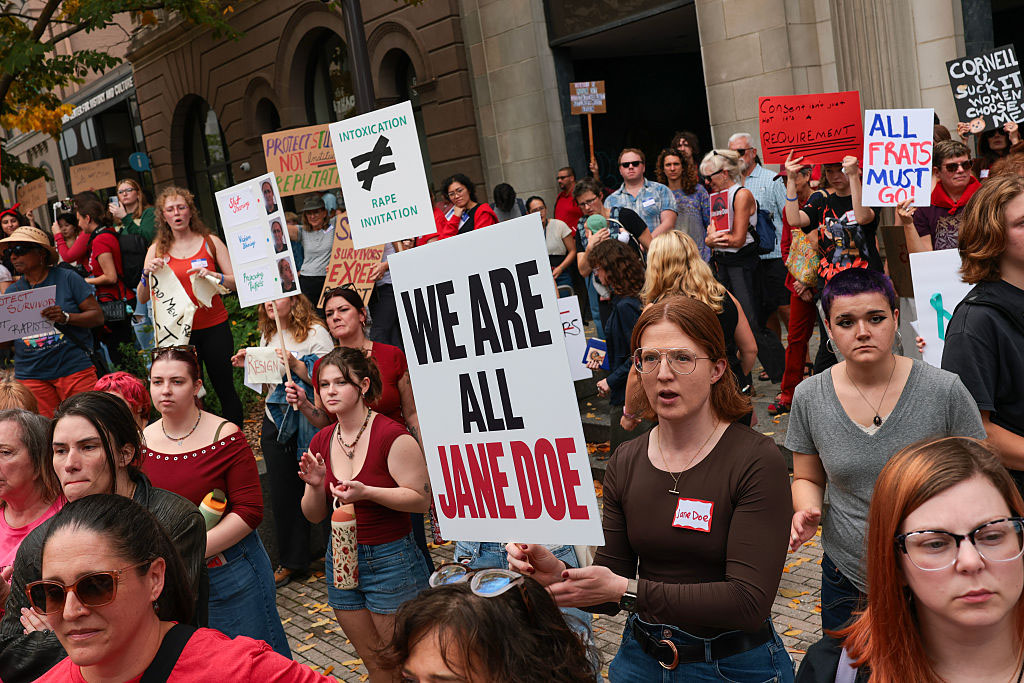
Those words came to mind when I first heard about the horrific events that transpired at a Cornell University fraternity house.

Much has been written in the aftermath, even though there are conflicting accounts of exactly what happened that night.

Many have blamed the Greek system for perpetuating an “Animal House”-type atmosphere on campus; a number demanded that college administrators who are unable to foster a safe environment should be replaced; more than a few pointed to problems with this generation of young men, whom they argue have been raised without learning to take responsibility for their actions.

But seemingly lost in those commentaries is the fact that while some made the decision to partake in the activities, others did not.

It appears that dozens of fraternity brothers participated in a group chat the night of the assault. The least revolting of the texts they received was one asking, “Shop still open?” When the answer came back “yes,” several of the men decided to take part. 

I would love to hear from those who chose to reject the invitation, and ask them why they didn’t intervene. 

Shabbat morning blessings include a line about yetzer hara, the inclination to do evil. “Do not let the inclination to evil control us,” we read. The prayer goes further, asking God to “distance us … from friends who commit evil.”

That night at the fraternity some did exactly that – by not entering that room, they distanced themselves from their friends who were committing evil. But that wasn’t nearly enough. Someone should have tried to stop it. Were they afraid to betray the “brotherhood”?

Defense attorneys hired by the seven fraternity brothers charged in the civil lawsuit are reported to have argued that since New York State doesn’t have a “Bad Samaritan Law,” witnesses were not legally required to intervene. Without such a “duty to rescue,” some of those who ignored the messages in the group chat seem to be off the hook. Yet, Cornell, like many universities, has a code of conduct under which the failure to intervene has consequences, and they apparently relied on that code in imposing academic sanctions.

Let’s not allow the legal issues to obscure the moral ones. Doesn’t distancing yourself “from friends who commit evil” imply more than simply turning your head and pretending that something terrible wasn’t occurring? There is a moral imperative to have the courage to act. 

Finally, there is the question of taking responsibility for one’s misdeeds. Do any of those Cornell men feel regret? I’m not talking about regretting having to face the ramifications of getting caught. I’m sure they are stunned how their lives have been upended. But do they agree that they did something wrong? If they don’t, is it because their family and friends have encouraged them to think that they are the true victims?

When I was a college president, I met with the mother of a student who was facing expulsion over a sexual misconduct allegation. While the student claimed that the conduct was consensual, the investigation indicated otherwise. I told the mom that I was disappointed that her son seemed to show zero remorse for his actions. She screamed that of course he felt no remorse – “He did nothing wrong … he was the victim, not her.” That outburst helped me understand why, despite all the evidence to the contrary, her son steadfastly refused to acknowledge any wrongdoing.

We might vow to distance ourselves from those who do evil, but when it involves friends and family, it can be excruciating to do so.

As for the Cornell case, however it is eventually adjudicated, it is clear that there is a great deal of blame to go around.


Morton Schapiro served for more than 22 years as President of Northwestern University and Williams College. He taught almost 7,000 undergraduates over his more than 40 years as an economics professor.

When Touched by Evil Read More »

The F-Bomb

Last week my wife and I dined at our favorite local Italian restaurant. As often happens in Los Angeles, we sat adjacent to a gentleman who seemed unaware that his speech decibel level was double what was needed for a small table. So, we learned about his business affairs and imbibed complaints about employees along with our pasta. Intermingled in the booming soliloquy were numerous “f-bombs,” as many as two to a sentence.

The term “f-bomb” has become obsolete. The one-time shocker is so common that it’s more of an f-firecracker. I’m not partial to it and would ask your indulgence even for using the sanitized version. Unfortunately, the topic cannot be considered without a means of reference.

As many of us know from childhood, the word hearkens to the medieval Anglo-Saxon roots of English. Its ascent to the apex of obscenity is more recent. It disappeared from dictionaries and became shunned only in the last two hundred years. The “f-word” euphemism was created only in roughly the last 50 years. And WTF? Part of common parlance only for about 35 years.

Originally a verb, the word’s usefulness for shock value allowed it to morph, depending on circumstances, into a noun or adjective. It’s meaning becomes more nuanced when paired with a variety of adverbs including “up” the notably British “off,” “over,” but strangely not (yet) down.

The notion of objectionable speech long pre-dates the term. Although the prohibition on profanity goes back to the Ten Commandments, the Bible is silent on obscenity. There are passages that approach obscenity, notably Saul’s verbal attack on Jonathan (Samuel 20:30). Yet, a biblical notion of obscenity or vulgarity as offensive in the modern sense is largely absent.

Since “shock value” has usefulness in speech, why bother avoiding f-crackers? One reason is that the term is objectively crude, which led to its original ostracism from polite speech. But worse than crudity is the overuse that destroys whatever legitimate value it might offer in communication.

If people cannot muster creativity in their language, then WTF, they can solve the problem by tossing a few f-crackers. Plus, the term probably also appeals to the American “more is better” aesthetic that leads to mansions and McMansions, Mack truck sized utility vehicles, painfully loud movies, mega-desserts and so on. If seeking to grab the listener’s attention, why not go straight to the ultimate?

If seeking to grab the listener’s attention, why not go straight to the ultimate?

We have seen f-creep in the speech of public figures. Here in Los Angeles, Councilman Paul Koretz, an otherwise mild-mannered and public-spirited local politician, used it publicly at his 2022 farewell City Council meeting to express frustration over the rude and overbearing attendees at the Council’s public meetings. I understand his frustration, but did giving them a taste of their own medicine really help the process?

President Trump also recently used the word in a social media post, calling on the Iranian leadership to “open the f-ing Strait you bastards or you’ll be living in Hell.” Politics aside, vulgarity in government communication seems adolescent and probably counter-productive.

Who really wants to deal with someone who seems out of control?

And if the language strains American ears one can only imagine how it lands in a conservative, religious society like Iran. Perhaps the shock value was tactical. Regardless, the post represents either a concerning outlier or a further decrement in the already low standard for propriety of public speech. In 250 years no American leader ever intentionally unleashed an f-cracker on the American people. Trump barely missed setting an international standard as well. Philippine President Duterte beat him to it in a 2016 speech expressing anger toward the European Union leadership.

If pushed, I will reluctantly admit to a rare f-drop, but almost never in mixed company. Still, it’s a useful word when you drop an anvil on your foot or suffer an equivalent occurrence.  It just does not need to be the same word employed in casual restaurant discussions.

Attention to proper public speech may have already gone the way of formal restaurant attire and correspondence by letter. An occasional raised eyebrow may help, although a lot of eyebrow bouncing may ensue. Those of us who still care should try to enforce some self-discipline while being gosh darn careful about what we say ourselves.


Dr. Daniel Stone is Regional Medical Director of Cedars-Sinai Valley Network and a practicing internist and geriatrician with Cedars Sinai Medical Group. The views expressed in this column do not necessarily reflect those of Cedars-Sinai.

The F-Bomb Read More »

The Reunion

Recently, I asked my rabbi two questions: whether souls reunite and what questions to ask God. He said traditional Jewish theology teaches us that souls do reunite, and that God is constantly bombarded with questions like “Why are vacuum cleaner bags so hard to change?” “If you whack a mosquito on the wall, how do you get the blood out?” “How will I recognize my family?”

So, when I reunite with my parents, I imagine it will go something like this:

Mother: The way you always ran across the street without looking, we expected you much sooner.

Mark: I would have been, but I had a stop to make first.

Mom: The hot place?

(Mark nods.)

Mother: Oy. Why?

Mark: Something about not enjoying all his gifts.

Mom: Fooey. Gifts, shmifts. We went to the Catskills every summer. No gift beats the Catskills. Was it like hot yoga?

Mark: Worse. More like Florida’s terrible humidity. You look good, Mom.

Mom: Aaah. For a dead person. There’s always a slight breeze here, so my hair is constantly messy.  The best part about being here is not having to go to the supermarket four days a week. Fruit never gets mushy, and you never have to sniff milk. And even 1,000-year-old people smell like newborn babies.

Mark: Where’s Dad?

Mom: Napping as usual.

Mark: Let’s surprise him.

Mom: Not allowed to wake. Here, you get up when you get up. Could be 10 minutes, could be a year.

Mark: Have you seen God?

Mom: I have my first appointment next August.

Mark: August? You’ve been here 30 years.

Mom: Remember how long it took to get someone to look at my swollen knee? Here it’s worse. The ones that didn’t see it coming go in first.

Mark: Who just walked by?

Mom: Paul Newman. So good-looking.

Mark: How did he get into the Jewish section?

Mom: Fake news. There’s no Jewish section. It’s like the Bronx; everyone’s mushed together. We were very excited; we heard Barbra Streisand was coming — but fake news.

(Mark’s father enters. Mark and Father hug.)

Mom: He had to stop at the hot place first.

Father: I hear the humidity is awful. Did you bring bagels?

Mark: I forgot.

Father: Too bad. Even here, the bagels are not like the New York ones.

Mark: I’ll go back to get some.

Father: No going back.

Mother: He knows — still a smart-ass.

Mark: What song keeps playing?

Father: It’s “God Only Knows.” He loves that song. Hates “Imagine” by Lennon.

Mark: I really miss my family.

Father: If they’re dressed, you can peek in on them. We peeked on you. You had a very good life. One thing here you never seem to get over is missing friends and family. They become a real part of you forever. I even miss Sandy, our Cocker Spaniel.

Mother: That dog pished everywhere.

Father: You know what I miss? Kindness. Here, everyone is so kind; it’s not so special. During life, kindness meant so much. When I got sick, you sat with me and held my hand. Kindness.

Mark: I heard you can help people from here.

Father: If it has nothing to do with their free will. He’s a stickler on the free will thing.

Mother: Free will is like Social Security; you can’t touch it.

Mark: I keep thinking about things I regret.

Father: Like what?

Mark: I regret not paying more attention to the family. I regret not being a better son.

Father: You were a wonderful husband, father and son. Right, honey?

Mother: I guess.

Father: Now rest; we have forever to catch up.

Mother: I have my book club tonight. You get to read all the books you wanted to read but never made time for. How about breakfast tomorrow? I’ll make your favorite.

Mark: Cinnamon waffles? I haven’t had those since I was…

Mother: Sixteen.

Mark: You know, I just realized how we all recognize each other.

Father: How?

Mark: We’re all the same now as then. It’s amazing. If you were any different, I’d have been disappointed. Mom, Dad, I love you and I missed you.

Father: We missed you, and we love you.

(Mother nods.)

Mother: We are who we are.


Mark Schiff is a comedian, actor and writer and hosts, along with Danny Lobell, the “We Think It’s Funny” podcast. His new book is “Why Not? Lessons on Comedy, Courage and Chutzpah.”

The Reunion Read More »

Declaring Our Independence

If you are upset with JD Vance for scapegoating Israel for his party’s midterm election losses and trying to connect convicted sex offender Jeffrey Epstein to Israeli military intelligence, you can always vote for his opponent.

If you object to Abdul El-Sayed’s refusal to publicly support the existence of a Jewish state or to say whether he believes that Israel or Iran represents a greater threat, you can vote for the other party.

But if you find both Vance and El-Sayed to be unacceptable as elected representatives in our democracy, given these odious examples and countless others, then you are literally a person without a party. And that’s just fine. Because as American Jews, we do have other options. If we are willing to take advantage of them.

The goal here today is not to establish a hierarchy of hate. El-Sayed‘s beliefs are more extreme and therefore of greater immediate danger. Vance seems to arrive at his opinions based more on calculation than conviction, which may make them more insidious. Most of us will decide which of these two men is the slightly lesser of these two evils based on their feelings about abortion, immigration and Donald Trump rather than Iran, Hamas or the West Bank.

Last week, I wrote about the outcome of the midterm elections and about the challenges that Jewish Americans and other supporters of Israel face on this current inhospitable political landscape. I concluded that piece by promising to provide a path forward for a community that is facing increasingly hostile challenges from the ideological extremes of both parties. The answer is a simple and straightforward one: if neither of the nation’s two dominant political parties is willing to commit to us, then we are under no obligation to commit to them. Just as we did in May of 1948 and at countless other times in our history as a people, we must declare our independence.

When a voter group is taken for granted by one party or the other, their voices are no longer heard. Many Latino voters shifted from longtime Democratic allegiance in 2024 to instead supporting Trump. Rural and small-town Americans abandoned their longtime GOP home in this month’s elections. The Democrats have since successfully renewed their efforts to win back Latinos. Republicans are already scrambling to bring rural America back to their side. The lesson for the Jewish community: a little independence goes a long way.

Many Jews, like many other Americans, find the other party to be so objectionable that they decide to tolerate the bigots in their own ranks rather than join with those with whom they disagree on many other policy and cultural matters. But rather than switching sides, the better answer is to instead reject both. We can embrace pro-Israel candidates in both parties without also assuming an obligation to defend the antizionists and antisemites in either. 

As independents, we no longer will have to swallow our pride in the interests of a partisan outcome that no longer serves our needs. We can instead pick and choose individual women and men who will stand with us rather than stand under the banner of a party that makes room for our enemies as a matter of political convenience. Jewish voters have a decision to make: do we continue to place habitual partisan allegiance over our safety and welfare? Or do we begin to explore other alternatives altogether?

It’s been said that the worst number of political parties to have in a country is one. But the second worst number of parties to have is two. As we see every day, the unnatural binary nature of a two-party system forces false choices, extremism, tribalism and a growing necessity for both parties to kowtow to their most ideologically extreme members.

El-Sayed spreads hatred for the most fanatical extremists on one side of the aisle. Vance contorts himself to appeal to the equally prejudiced zealots on the other side. Rather than pretending that we can tolerate one or the other, perhaps it is time to reject both and create something better.


Dan Schnur is the U.S. Politics Editor for the Jewish Journal. He teaches courses in politics, communications, and leadership at UC Berkeley, USC and Pepperdine. He hosts the monthly webinar “The Dan Schnur Political Report” for the Los Angeles World Affairs Council & Town Hall. Follow Dan’s work at www.danschnurpolitics.com.

Declaring Our Independence Read More »