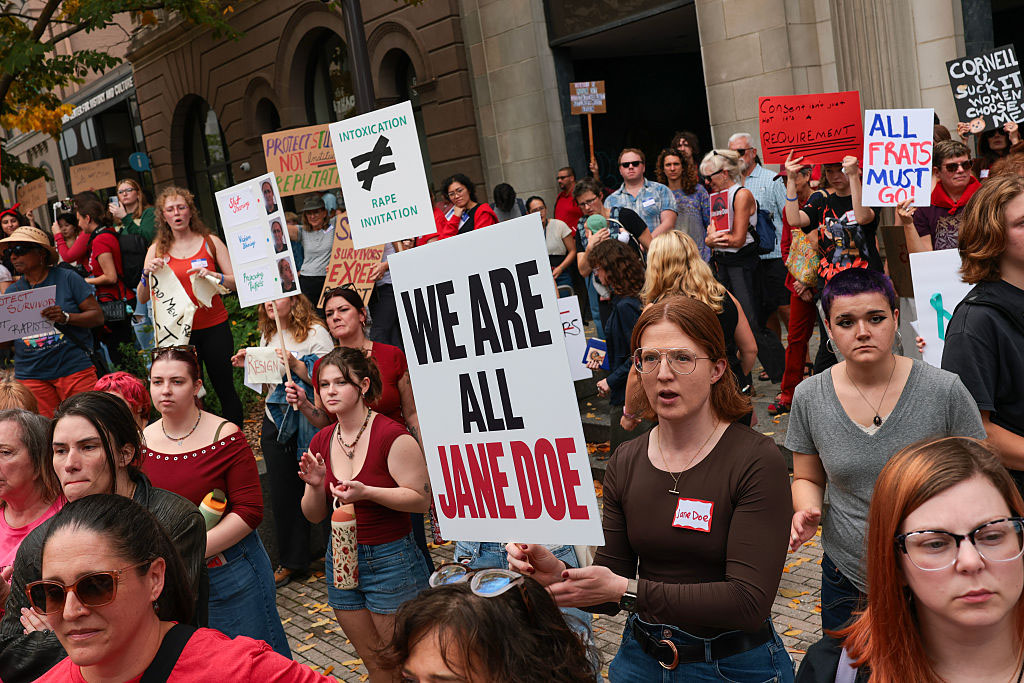
I’ve attended many “Take Back the Night” vigils on college campuses over the years. Most of the speakers are survivors of sexual assault, and their stories are heart wrenching.
There is one in particular that I will never forget. A date rape victim turned to the men in the audience and said: “If you want a woman to think of you every week for the rest of her life, when she says ‘no,’ ignore her.”
Those words came to mind when I first heard about the horrific events that transpired at a Cornell University fraternity house.
Much has been written in the aftermath, even though there are conflicting accounts of exactly what happened that night.
Many have blamed the Greek system for perpetuating an “Animal House”-type atmosphere on campus; a number demanded that college administrators who are unable to foster a safe environment should be replaced; more than a few pointed to problems with this generation of young men, whom they argue have been raised without learning to take responsibility for their actions.
But seemingly lost in those commentaries is the fact that while some made the decision to partake in the activities, others did not.
It appears that dozens of fraternity brothers participated in a group chat the night of the assault. The least revolting of the texts they received was one asking, “Shop still open?” When the answer came back “yes,” several of the men decided to take part.
I would love to hear from those who chose to reject the invitation, and ask them why they didn’t intervene.
Shabbat morning blessings include a line about yetzer hara, the inclination to do evil. “Do not let the inclination to evil control us,” we read. The prayer goes further, asking God to “distance us … from friends who commit evil.”
That night at the fraternity some did exactly that – by not entering that room, they distanced themselves from their friends who were committing evil. But that wasn’t nearly enough. Someone should have tried to stop it. Were they afraid to betray the “brotherhood”?
Defense attorneys hired by the seven fraternity brothers charged in the civil lawsuit are reported to have argued that since New York State doesn’t have a “Bad Samaritan Law,” witnesses were not legally required to intervene. Without such a “duty to rescue,” some of those who ignored the messages in the group chat seem to be off the hook. Yet, Cornell, like many universities, has a code of conduct under which the failure to intervene has consequences, and they apparently relied on that code in imposing academic sanctions.
Let’s not allow the legal issues to obscure the moral ones. Doesn’t distancing yourself “from friends who commit evil” imply more than simply turning your head and pretending that something terrible wasn’t occurring? There is a moral imperative to have the courage to act.
Finally, there is the question of taking responsibility for one’s misdeeds. Do any of those Cornell men feel regret? I’m not talking about regretting having to face the ramifications of getting caught. I’m sure they are stunned how their lives have been upended. But do they agree that they did something wrong? If they don’t, is it because their family and friends have encouraged them to think that they are the true victims?
When I was a college president, I met with the mother of a student who was facing expulsion over a sexual misconduct allegation. While the student claimed that the conduct was consensual, the investigation indicated otherwise. I told the mom that I was disappointed that her son seemed to show zero remorse for his actions. She screamed that of course he felt no remorse – “He did nothing wrong … he was the victim, not her.” That outburst helped me understand why, despite all the evidence to the contrary, her son steadfastly refused to acknowledge any wrongdoing.
We might vow to distance ourselves from those who do evil, but when it involves friends and family, it can be excruciating to do so.
As for the Cornell case, however it is eventually adjudicated, it is clear that there is a great deal of blame to go around.
Morton Schapiro served for more than 22 years as President of Northwestern University and Williams College. He taught almost 7,000 undergraduates over his more than 40 years as an economics professor.