fbpx

October 21, 2026

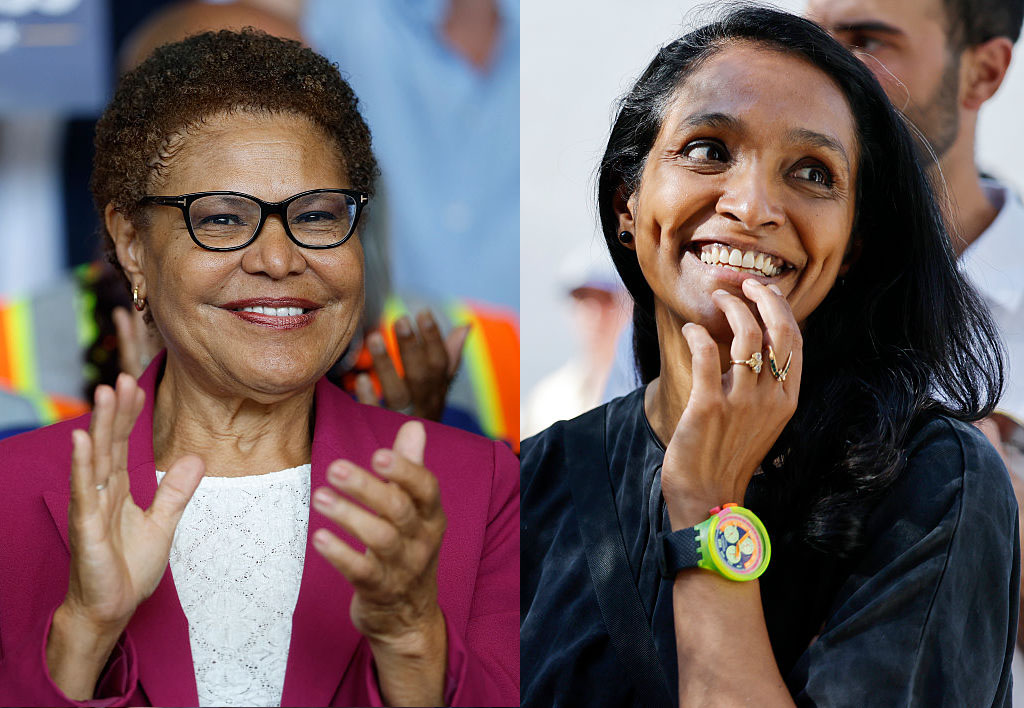
Mayoral Election Preview: Mayor Karen Bass vs. Councilmember Nithya Raman

Los Angeles Mayor Karen Bass and and City Councilmember Nithya Raman face off in the Nov. 3 election, four years after Bass became the city’s first female mayor. It is the first time two women are running against each other in the general election for Los Angeles Mayor.

Bass, a former congresswoman and California Assembly Speaker, is seeking a second term. Raman was first elected to the City Council in 2020 and represents Council District 4, which runs from portions of Reseda and Encino through Sherman Oaks and the Hollywood Hills to Los Feliz and Silver Lake. Bass endorsed Raman for City Council in 2024, and Raman endorsed Bass earlier in 2026 before entering the race. Both candidates are Democrats. 

Both Bass and Raman were in office on Oct. 7, 2023, and both issued statements. Bass said, “I join voices across the nation condemning this horrific attack on Israel. The Los Angeles region has the second largest Jewish population outside of Israel and many families are anxiously awaiting developments as they unfold. My thoughts are with those families this morning. Angelenos stand with those under siege mourning loss. May their memories be a blessing.”

Raman also issued a statement that day: “Our district is home to beautiful Israeli and Jewish-American communities, and so many who have family in Israel. I cannot imagine the terror they are experiencing. I stand with them in condemning the horrific violence by Hamas and praying for a peaceful end to this conflict.” 

Three years later, Bass and Raman each separately took questions on issues facing Los Angeles and its Jewish community in a Sept. 29 Jewish Los Angeles Mayoral Forum at the Skirball Cultural Center. 

Here is an overview of their responses on several issues. 

“Genocide” designation: 

The candidates disagreed over the use of the word “genocide” to describe Israel’s military actions in Gaza. Raman had used the term to describe Gaza. Asked why, Raman said, “I have used that term and I’m not an expert on these issues. And so I have looked to experts on these issues, international experts, Israeli experts … that is what guided me in using that term in describing what’s happening in Gaza.”

Antisemitism and Jewish Community Security: 

The Los Angeles County Commission on Human Relations documented 202 anti-Jewish hate crimes in 2024, about 80% of religiously motivated hate crimes reported in the county. 

Bass pointed to LAPD patrols near houses of worship during holidays and periods when protests could affect access and safety. “I formed a Jewish community safety working group. I’ve established an interfaith task force. We meet regularly,” Bass said. Raman said antisemitism came from the political left and right, adding, “I never want progressive politics to be conflated with antisemitism.” Raman said she would work with Jewish organizations and expressed concern that the city’s security practices depended too much on the officer involved.

Safe Worship Zone Act:

Both candidates discussed AB 2664, which Gov. Gavin Newsom signed at Wilshire Boulevard Temple on Sept. 25. Effective Jan. 1, 2027, the law restricts certain nonconsensual approaches within eight feet of worshippers in a 100-foot zone around house-of-worship entrances and exits, with misdemeanor penalties.

Bass said her administration had considered local legislation before deferring to the state effort. She pledged to bring the Jewish Community Safety Working Group and Interfaith Council together to plan LAPD implementation. Raman said, “So right now we have, I believe, one individual within LAPD who is the coordinator for a lot of issues relating to the Jewish community.” 

Boycott, Divestment and Sanctions (BDS): 

Raman said the BDS movement was “a legitimate form of peaceful protest” and defended the right to demonstrate even when she disagreed with protesters. Raman qualified that position, saying, “this issue is not part of my policy platform.” Raman also raised legal and fiduciary limits on how city investments can be used. Bass was asked whether she would support city divestment from companies doing business in Israel or with ties to Israel. “I would oppose that.”

Police staffing: 

Bass said Los Angeles has roughly 8,500 to 8,600 sworn LAPD officers and that the number is insufficient for a city preparing for the 2028 Olympics. Raman supports maintaining the department’s current size while improving hiring and expanding unarmed response teams to handle calls involving homelessness or mental-health crises. 

Homelessness and Inside Safe: 

The Los Angeles Homeless Services Authority (LAHSA) estimated 45,194 people are homeless in the city in 2026, an increase of 3.4% from 2025. Unsheltered homelessness rose 7.9%; LAHSA said the year-over-year changes were not statistically significant. 

Bass credits Inside Safe, which moves people from encampments into temporary accommodations, with reducing street homelessness over parts of her administration. Raman alleged that Inside Safe cost $80,000 to $100,000 per person per year and said, “There has been no adaptation.”

Bass challenged Raman’s account and her former role as chair of the City Council’s Housing and Homelessness Committee, saying, “every dollar that was spent on Inside Safe was approved by you.” 

Housing and Affordability: 

Both candidates support additional housing construction but disagree over how effective city policy has been. Bass said her Executive Directive 1 had fast-tracked 47,000 housing units through the approval process. Those units are not necessarily completed homes. 

Raman proposed deadlines for city responses to multifamily housing applications and supports changing Measure ULA, the transfer tax on high-value property sales used for housing, and tenant protections. Raman supported the tax when it passed but said she reconsidered its effect on building after reviewing data. “We need to reform it because this issue matters too much to voters,” Raman said.

2025 Los Angeles Fires and Emergency Management: 

Bass was in Ghana when the January 2025 Palisades fire began, and was severely criticized for her absence as the fires broke out. The wildfires killed 30 people and destroyed over 16,000 structures. “I am so profoundly sorry that I was not in my city when my city needed me,” Bass said at the Oct. 13 debate. Bass cited expedited rebuilding procedures and said approximately 1,000 homes were under construction. 

Raman criticized fire preparations and the administration’s response. Raman said that roughly 60,000 people in her district were evacuated during the Palisades and Sunset fires and that residents had repeatedly asked, “Where is our mayor? Where is our mayor?” Raman proposed a dedicated leader in the mayor’s office to advocate for Palisades rebuilding. 

Bass said the city could now respond to another catastrophic wildfire; Raman was less certain: “I hope we are ready.” Moderators said nearly 100 fire engines were overdue for replacement. Both candidates support Measure FD, a proposed sales-tax increase to fund fire prevention and suppression. 

Recent Polls: 

A UC Berkeley Institute of Governmental Studies/Los Angeles Times poll conducted Sept.15–20 found 39% of likely voters supporting Raman and 28% supporting Bass, with 33% undecided. A Manhattan Institute survey released Oct. 9 found Raman at 38%, Bass at 32% and 30% undecided. 

In the June primary, Bass received 34.27% of the vote, followed by Raman with 29.02%. Spencer Pratt finished third with 25.53%. With no candidate receiving a majority, Bass and Raman advanced to the general election.

Mayoral Election Preview: Mayor Karen Bass vs. Councilmember Nithya Raman Read More »
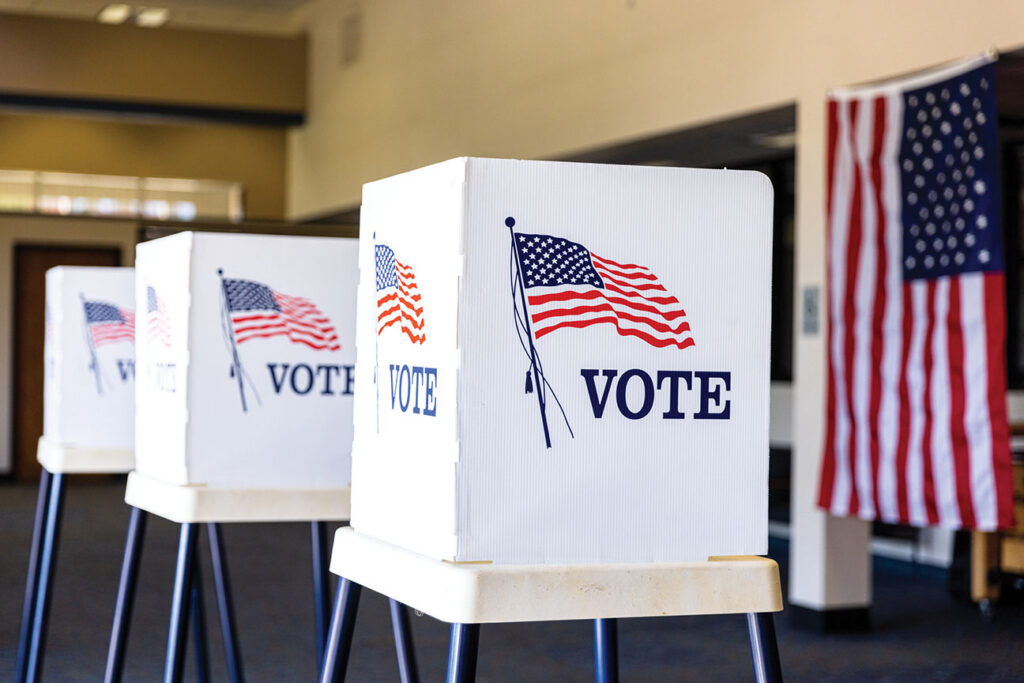
Voting Down Party Lines This Midterm Election Will Hurt Jews

When my family fled Iran, we never imagined that one day I would question whether my children could live openly and safely as Jews in Los Angeles. I believed I was building a life where their Jewish identity would be a source of pride, without the fear that had shaped so many Jewish lives before theirs.

Raising four daughters, I held on to that confidence. Now, I find myself questioning something I once took for granted.

When my eldest was little, school drop-off meant ordinary worries: friendships, homework, a forgotten lunch. With my youngest, my thoughts turn to emergency plans. What happens if there is a shooter? What happens if someone calls in a bomb threat? How will I know she is safe?

My children no longer attend a Jewish day school. But leaving Jewish day school did not mean leaving those concerns behind.

On Oct. 12, Milken Community School in Los Angeles went into lockdown following a reported bomb threat. Police found no threat, and LAPD described the incident as an apparent swatting call. Thank God. But “hoax” is a word families get to use afterward. Until the all-clear comes, nobody has the comfort of knowing that the danger is imaginary.

We do not yet know who was responsible or what motivated the threat. But I do not need those answers to understand why news of a lockdown at a Jewish school shakes a Jewish mother.

I want my daughters to feel comfortable in Jewish spaces. I want them to embrace their traditions without wondering whether being visibly Jewish makes them vulnerable. I never expected that this would feel like something I had to fight to preserve in Los Angeles.

Public leadership matters in creating that confidence. So does the way leaders speak about issues that touch our community.

At the Sept. 29 mayoral forum at the Skirball Cultural Center, before an audience of Jewish Angelenos, Nithya Raman defended her use of “genocide” to describe Israel’s actions in Gaza. Karen Bass rejected that characterization. Experts have made it clear that there was not a genocide. 

Raman’s position should be a red flag for all Jews. I want leaders to understand why this language carries such weight for families like mine. Disagreement with Israeli policy is not inherently antisemitic. But Jewish Angelenos must never be treated as representatives of a foreign government or held responsible for its decisions.

The DSA’s published program also concerns me. It calls for ending all U.S. military and economic aid to Israel and for prosecuting American and Israeli leaders it holds responsible for “genocide” in Gaza. Those are concrete anti-Israel positions that were formed from the “red green alliance” of Marxists and Islamists. 

I will not give any candidate my vote simply because of the letter beside their name. As a Jew and an American, I don’t have the privilege to vote down party lines. DSA candidates are running with a D next to their names, but they are not from the Clinton era moderate Dems.The DSA’s stated goals of abolishing police and replacing capitalism are radical gambles that would undermine public safety and deepen the homelessness crisis families need leaders to solve.

Life-long Dems, like myself, just need to read the open letter from the Islamic Republic to Americans urging us to vote DSA this midterm election. The biggest enemy of the United States is spending money to elect people like Mamdani to spread their ideology.  Believe them when they chant “Death to America. Death to Israel.” They don’t want America to prosper and neither do their candidates. 

My Jewish identity and my daughters’ future shape the questions I ask. I want clear answers about protecting Jewish life, confronting antisemitism and keeping schools and public spaces safe. This November, my vote must be earned through actions, not assurances.

As an Iranian-born Jewish American, I cherish the right to participate in choosing our leaders. I consider exercising that right a privilege and a responsibility. I want my daughters to see me approach it thoughtfully.

That means researching candidates, understanding the powers of each office and expecting promises to be matched by follow-through. It means remaining engaged after Election Day, when campaign language becomes the responsibility of governing.

I cannot personally investigate every threat or secure every campus. But I can refuse to become indifferent. I can ask questions and expect answers.

When I watch my youngest daughter walk into school, I want to think about the future she is building. When she enters a Jewish space, I want her to feel belonging and joy.

That is the life I believed I was building when I came to Los Angeles. I still believe my daughters deserve it.


Shirin Yadegar is the founder of LA Mom Magazine and a political commentator.

Voting Down Party Lines This Midterm Election Will Hurt Jews Read More »

The Missing Years

An open letter to Jewish parents of teenagers.

This fall I read more than 2,000 posts by Jewish parents.

They came from two online groups I belong to: a large national group of Jewish parents focused on campus antisemitism, and a large Jewish parenting group for families of older teens and young adults. I sorted every post by topic and noted which ones drew the longest, most anguished threads.

I have spent fifteen years working with Jewish teenagers. I wanted to know whether what I see in them matches what their parents are thinking about. It doesn’t. And that gap is the most important problem in Jewish parenting that almost no one is discussing.

Here is what parents are worried about.

Safety, first. They trade reports of encampments, vandalism, professors who teach that Israel should not exist, and commencement speeches turned into rallies. They organize letter campaigns and track lawsuits.

Above all, they worry about picking the right college. The most common question in the larger group was some version of “How is Jewish life at this school?” It was asked about roughly 150 campuses. Is there a Hillel? Is Chabad active? How did the administration handle the protests?

These are reasonable worries. But they begin in junior year of high school, when the college list is built. They peak senior spring, when deposits are due.

Here is what is missing.

In the parenting group, I sorted every post from a recent ten-week stretch. About one in seven was about admissions: test scores, tutors, essay coaches. Posts about shaping a high schooler’s Jewish identity came to roughly two in a hundred. And that’s counting generously: I included logistics posts — packing lists, flights, registration glitches — on the assumption that those teens were headed to programs that would strengthen their identity.

Jewish identity shows up at two moments. At 17, as a filter on the college list: “a decent Jewish presence.” And in the twenties, as a social network: where can my daughter meet Jewish friends in a new city?

The years in between, 13 to 17, are nearly empty. Those are precisely the years when a young person decides who they are.

One post captured it better than any statistic. A mother wrote that her son, freshly bar mitzvahed, was done with Hebrew school. She suggested a popular, purely social Jewish youth group; he said no. She was fine with his choice, she wrote, but didn’t want him to lose his Jewish identity. What should she do?

The question tells the story. For many families, the bar mitzvah has become a graduation. Jewish education is something you complete at 13, like a vaccine schedule, before moving on to what “counts”: grades, sports, the résumé.

The cost of those empty years shows up later.

In both groups, parents asked whether their children should leave Judaism off their college applications. One senior who had written her essay about Israel feared it would be held against her. Another parent asked how to “position” a near-perfect applicant’s identity. A third wondered whether her daughter should even take a Jewish history elective in high school, for fear it would show up on her transcript: “…we are scared some vile antisemite in admissions will reject her just because she took that class.” A Jewish teenager’s identity is now treated as a liability to manage, not a strength to stand on.

Then come the harder posts. A high school senior suddenly playing down being Jewish around new friends. A college graduate with no interest in ever visiting Israel. Young adults so hostile to Israel that their mother doesn’t know where to begin. These threads ran past a hundred comments, full of parents saying the same thing: me too.

None of this started in college. A child who reaches 18 without knowing why being Jewish matters, without the words to answer a classmate, and without Jewish friends of their own was vulnerable all along. Campus is simply where it shows.

Underneath it all is a quiet assumption: someone else will handle it. The rabbi until 13. Hillel at 18. Birthright at 22.

I deeply respect Hillel and Chabad professionals; several answered parents’ questions in these groups with real generosity. But Hillel can only host a student who walks through its door. It cannot give an 18-year-old the reason to walk in. By the time a freshman is choosing between Shabbat dinner and everything else college offers, the decision has largely been made.

This month, Michigan’s Hillel said it would end formal ties with student groups engaged in Israel advocacy. Whatever you think of that decision, it makes the point: no campus institution can be counted on to do this work for your child.

I have seen what a prepared student looks like. For years, UC Berkeley has offered a student-led course for credit called “Palestine: A Settler Colonial Analysis,” which teaches Zionism as colonialism and asks what “decolonization” might mean. Campaigns to shut it down went nowhere. So Avi, a Club Z graduate, did something better. Four years in our program, four national conferences and an Israel trip had given him the knowledge to answer it. He put together a course of his own. For four springs now, Berkeley students have earned credit in “Israeli Military History,” reading Herzl, Jabotinsky and primary sources, and tracing Israel’s history from the ancient time to today. Avi didn’t wait for the administration to protect him. He knew the material well enough to teach it.

I grew up in the Soviet Union, where the state understood something many American Jewish families have forgotten. Identity is not inherited. It is formed, deliberately, in adolescence, by whoever bothers to shape it. The Soviets bothered. Today TikTok, a charismatic classmate and a first-year seminar are all bothering. The question is whether we will.

So here is my ask to every parent of a 13-, 14- or 15-year-old: treat your child’s Jewish identity as seriously as you will soon treat the college list. You would not wait until senior year to think about math. Don’t wait to think about this.

1. Don’t let the bar mitzvah be the finish line. Decide now what comes next, and make it as non-negotiable as piano, soccer, or SAT prep.

2. Give them Jewish friends, not just Jewish programs. Teenagers stay where their people are. 

3. Give them knowledge, not just feelings. Pride without facts collapses at the first hostile question. Teach them their people’s history, and Israel’s, well enough to answer a classmate or a professor.

4. Get them to Israel before 18. Let them form their own relationship with the country before someone else describes it to them.

5. Let them write it on the application. A college that would hold your child’s Jewishness against them tells you everything about that college and nothing about your child.

Right now our energy goes into vetting campuses, rating Hillels and writing to university presidents. Some of that is necessary. But we can’t Jew-proof the campus. We must campus-proof our kids. And that kind of preparation is not a one-time workshop. It is years in the making.

The question is not only which campus will be safe for our children. It is who our children will be when they arrive.


Masha Merkulova is the founder and CEO of Club Z, a national nonprofit that builds Jewish identity and Zionist grounding in teens.

The Missing Years Read More »

Silence of the Jews: How Antizionist Mobs on College Campuses Are Assaulting the Freedom of Jewish Students to Disagree with Them

Historical comparisons have become too commonplace when describing the toxicity of the antizionist movement in higher education. Student activists intimidate peers suspected of “Zionism” like the fascist Blackshirts and Brownshirts, while professors and their young sycophantic followers recycle long discredited Czarist and Stalinist conspiracies about sinister Jewish power. I’ve made such analogies myself. Yet these warnings seem to continue falling on deaf ears. Reminding people of modern and ancient Jewish history to generate empathy also seems to produce the opposite effect. 

But when everyone invokes history to justify their actions, how do you reach people who seem to have vaccinated themselves against any historical truths that complicate their own? More importantly, what happens when the very act of Jews voicing disagreement is treated as reason enough to be disregarded?

I want to try a slightly different approach.

Recently, I started listening to Liu Cixin’s “The Three-Body Problem,” an epic, multigenerational Chinese science fiction tale exploring how civilizations survive or perish through the breadth and quality of their scientific knowledge. It also served as my introduction to post-WWII Marxist China, where the story opens with physics professor, Ye Zhetai, facing a public struggle session in Beijing during the early days of Mao’s oppressive Cultural Revolution.

Students and even his wife, herself a physicist, condemn him for teaching theories that fail to conform to Marxist revolutionary doctrine. At one point, his wife denounces him for teaching Einstein’s theory of relativity and the Copenhagen interpretation of quantum mechanics, dismissing them as “reactionary idealism.” He responds that they are the explanations most consistent with experimental results, then challenges the premise of the interrogation: “Should philosophy guide experiments, or should experiments guide philosophy?”

“Of course, it should be the Correct philosophy of Marxism that guides scientific experiments!” a student declares.

“That’s equivalent to saying that the ‘correct philosophy’ falls out of the sky,” the professor responds.  “This is against the idea that the truth emerges from experience. It’s counter to the principles of how Marxism seeks to understand nature.”

Frustrated and unable to answer him, one of the students strikes him with her belt, and others join in. The older Red Guard students initially stand by, afraid that intervening would make them appear insufficiently loyal to the cause. One quietly pleads with the professor to submit, who refuses, and is subsequently beaten to death in front of his daughter as the crowd of academics shouts slogans and cheers. 

His murderers consider themselves moral agents of progress, entitled by the righteousness of their cause to punish the reasoning that their understanding of the world cannot accommodate. This is how brittle and intellectually insecure ideologies maintain power: by making disagreement dangerous.

I thought about that scene while considering what happened to two Israeli veterans who came to speak to students at California Polytechnic State University, San Luis Obispo, last month. The Mustangs United for Israel (MUFI) student group and the local Chabad organized a CAMERA/ZOA co-sponsored event with Belev Echad to discuss coping with Post Traumatic Stress Disorder in the aftermath of the Oct. 7 Gaza war. 

Ariel Saat developed PTSD after fighting Hamas terrorists near Kibbutz Kfar Aza and rescuing his wounded commander. Eliyahu Green suffered injuries when shrapnel entered his ear and skull while serving in Gaza. 

They weren’t there to deliver political arguments, but that distinction didn’t interest the antizionist protesters affiliated with the Muslim Student Association (MSA) and Students for Justice in Palestine (SJP). These Muslim Brotherhood-affiliated clubs made clear their demand was for all Israelis and Zionists to be kicked off campus. 

Nine masked student activists arrived with an Israeli flag covered in red paint and filled the room with easy-to-remember chants about genocide.

The organizers had, of course, anticipated a disruption and arranged for police to be present, because episodes like this have become so commonplace that CAMERA trains all of our students on how to organize security and coordinate with law enforcement.

Thankfully, police removed them quickly, the event continued, and the school’s administrators supported the MUFI students. Cal Poly deserves credit, because there are still plenty of schools making less-than-friendly choices.  

Near the end of the event, some protesters returned to ask questions; “97% of the schools in Gaza have been completely obliterated. What about the kids? Don’t the kids deserve an education?” The speakers reminded them that Hamas uses those buildings for military purposes, often building tunnels directly underneath, storing and firing rockets within and even holding hostages captive, and that nobody should blindly rely on data provided by the U.N. because it has repeatedly promoted fraudulent reports produced by Hamas. Such facts didn’t penetrate. The slogan shouting restarted immediately after the speakers had had enough. 

While asking questions is preferable to shouting down the speakers, the act alone does not necessarily signal a willingness to honestly consider its answer. 

A few days later, those two activists were interviewed in an unapologetically sympathetic student news report complaining that while they were able to get the Jews there to acknowledge atrocities and children being killed, they remained “stuck in the weeds” over facts, figures and the number harmed. In other words, the Jews will continue to be harassed and threatened until they adopt the “correct” philosophy of antizionism regardless of any inconvenient observable data.

But those “weeds” are where disagreement actually happens. Facts, definitions, competing evidence and questions of causation are not distractions from a moral argument. They are what allow us to determine whether the accusation is justified in the first place. Once the conclusion becomes morally compulsory, asking for evidence can itself be treated as evidence of guilt. A student is no longer merely wrong for rejecting the accusation; the refusal to agree becomes proof that something is wrong with them which then makes it easier to justify inflicting harm.

In this case, the intimidation continued online. 

An Instagram account reportedly operated by one of the anonymous activists circulated heavily edited clips to tens of thousands of followers. The predominantly Jewish student organizers and associated organizations received messages comparing them to cancer and vermin, wishing them dead and calling them “child raping demons.” One sender even threatened to find them if they brought another Israeli soldier to campus. 

The threats made clear that the consequences extended beyond the people in the room. Other students watching learn what it can cost to organize or attend the next event.

That distinction is why “free speech” does not quite describe the problem. The Cal Poly students and their speakers were allowed to continue. But the freedom to disagree requires more than the absence of official censorship. If expressing the wrong view predictably brings threats, ostracism or fears about one’s future, students may remain legally free to speak while becoming increasingly unwilling to exercise that freedom.

The freedom to disagree requires more than the absence of official censorship. If expressing the wrong view predictably brings threats, ostracism or fears about one’s future, students may remain legally free to speak while becoming increasingly unwilling to exercise that freedom. 

The danger in the Chinese professor’s persecution likewise extends beyond the fate of one academic or the study of physics. His attackers claim the authority to decide what everyone else must accept as true. 

This is why Shao Lin, Ye Zhetai’s Marxist wife in the novel, is also such a tragic character. She represents what happens when people learn to anticipate and internalize the accusation before it comes. In their final exchange, she shouts: “You covered my eyes with your reactionary view of the world and science! But now I am awake and alert. With the help of the revolutionary youths, I want to stand on the side of the revolution, the side of the people!” 

It’s never explained whether her denunciation of her husband was genuine or political theater, but by then it doesn’t really matter. “You are truly too smart,” he tells her. “Even a few years ago, you could feel the political winds shifting in academia and prepared yourself.” Yet even teaching students “that all scientific accomplishments resulted from the wisdom of the working masses, and those capitalist academic authorities only stole these fruits and put their names on them” was not enough. 

Her prominent pre-revolutionary family and famous scholar parents still left her outside the “revolutionary mainstream,” unable to prove that she truly belonged. Desperate to survive, she performs her loyalty more aggressively, only to watch helplessly as her husband is murdered in front of her and her daughter is eventually imprisoned for refusing to sign a fraudulent report. 

That is the more enduring consequence of making disagreement dangerous: eventually silence is not enough. People learn that they must demonstrate their own correctness by helping force everyone else to conform, especially when some part of their identity leaves their loyalty permanently suspect. 

We are not in Maoist China, and the differences in violence and state power are enormous. But the demand for intellectual conformity is recognizable: repeat the approved condemnation, or have your refusal treated as evidence against you.

That is why defending pro-Israel students should matter to people unmoved by appeals to Jewish and Israeli history. The accusation may concern Israel, and the immediate targets may be “Zionists,” but the permission to bully people into agreement threatens everyone. Accept it here, and you help establish a standard under which the freedom to disagree depends on the crowd’s approval.

That attack on the freedom to disagree was stated with unusual clarity during an Oxford Union debate earlier this year over Islam’s compatibility with the West. Rather than respond directly to her opponent’s assertions, the self-identified antizionist student participant repeatedly accused him of bigotry and joked that “there is a crowd outside rioting against you tonight. And without the protection and generosity of this Muslim Palestinian President and the mostly South Asian executive committee, you would be quite literally cooked.” 

Facing potential mob violence, silence can become a kind of rational, albeit disappointing, response.

The brave and hopeful continue organizing events and CAMERA fellows will continue writing articles that challenge these morally vacuous bullies. But even those determined to speak out have started to worry more about their safety and future careers. 

Courage does not make consequences disappear, and no undergraduate owes their personal safety to a political cause. 

Unfortunately, when too many make this calculation, it means antizionism’s intimidation is working. Prolonged silence allows a critical mass of enforced conformity to look like consensus, freeing whatever local Free Palestine/Globalize the Intifada brigades there are to truly start promoting their beliefs as they promise, “by any means necessary.”

Cal Poly showed what institutions should do: the university enforced its rules, and Hillel stood by its students. But these are relatively easy steps. The most impactful improvement lies with individuals. Each of us needs to lead by example and reject the assumption that the righteousness of any cause exempts its beliefs from scrutiny. Deigning to speak with “the opposition” means little if every answer that challenges our beliefs is dismissed as an evasion, made in bad faith, or outright ignored. 

If people really want Zionists to rethink our beliefs, they must be willing to rethink theirs. We all need to ask questions whose answers could change our minds, consider what evidence would make us revise an accusation, and condemn threats without demanding political agreement from those targeted. 

The next time an antizionist student confronts me, I’ll have a question of my own: If your movement teaches you to question everything except itself, how do you know you’re not a pawn in someone else’s game?

When these kinds of interactions are no longer encouraged or even taught, we might as well admit that civil discourse has become an empty ritual that has left a vacuum for something truly evil to fill. 


Seth B. Mendel is the Campus Editor for the Committee for Accuracy in Middle East Reporting and Analysis. 

Silence of the Jews: How Antizionist Mobs on College Campuses Are Assaulting the Freedom of Jewish Students to Disagree with Them Read More »

A Rose by Any Other Name Is Probably Jewish

At first I was just The Baby, as in The Baby’s up, The Baby’s crying, The Baby’s wet, The Baby’s hungry.

Soon I had a name, a short one because my sister had bungled Elizabeth. I was Amy, just three letters, seemingly easy enough that no one could ever get it wrong 

I had a middle name that was prettier than my first, Elaine. That name sounds like lace and refinement, polish and class, while Amy is a silly, clownish little girl name. I would have been a different kind of person if they’d named me Elaine, but I was Amy Elaine Weisz.

Can we talk about the name Weisz, in a world of Smith, Wagner and Green? Weisz is, to begin with, at the end of the alphabet, so that a student placed alphabetically always sits in the far right back end of a classroom, which is a place to daydream and cause trouble. Second, no one knows how to pronounce this name. How many times was I called Amy Wizz? Suffice it to say that I happily moved this name to middle-name status when I got married.

Now, when I was 14, I discovered that Jewish people usually have something called a Jewish name, whose purpose is murky. Is it a name by which God calls you? A secret handshake name? A pass to the world beyond? And the problem was that my parents did not remember my Hebrew name and had not bothered to document it. My mother would frequently say we were too Jewish to do something (like celebrate Christmas); or she might say we were not Jewish enough to do something else (abstain from pork). But there were gray areas: We were Jewish enough for me to have a Jewish name, but not Jewish enough to remember it. My mother fretted and called her elderly aunt to find out; she came back with two possibilities: Esther Golde (that would be my sister Elizabeth Grace) or Chaya Chenya … which has nothing at all to do with the name Amy Elaine. And is difficult to pronounce and to explain. Chaya means life, and Chenya is apparently related to grace. Had anyone really bothered to give me a Jewish name at all? If so, why such an ugly one?

I went with that, though my ketuba is written for Chaya Hannah. Because I just couldn’t imagine that Chenya is an actual name (though it is).

Later, when Jim and I had children, one of our criteria for names was that the name had to be simultaneously English and Jewish, which worked out completely except for our youngest, who is Yonatan and goes by Yoni, and when he goes into a professional office and they call Jonathan, I sort of don’t hear it.

Anyway, I married a Leserman, which is a real blessing. First, this name is easy to pronounce (though also easy to misspell), and blessedly in the middle of the alphabet, so my kids sat in the middle of the classroom, which is a good thing. I don’t have people asking me, “Leserman, where does that name come from?”

In one of the last conversations I overheard between my parents, they were talking about “The Baby” … and I was pregnant with my fourth child.

Then I became a grandmother, and had to choose a grandma name, and it was critical because the first grandchild chose the grandma name you have for the rest of your life. The name I chose was Safta, but as luck would have it, my first grandchild was slow to talk, and I was getting desperate to be called something, anything.

Safta? No.

Grandma? No.

Granny? No.

Bubbe? No.

Baba? No.

Meemaw? No.

I grew angsty.

Finally: Mamie?

Yes!

So now I’m The Baby Mamie Chaya Chenya Amy Elaine Weisz Leserman. My parents called me The Baby until the end. They’re gone now, and so are the voices that called me that. But somewhere along the way, a little boy who couldn’t say Safta gave me another name that I’ll be happy to carry to my grave.


Amy Leserman is a 25-year veteran English and social studies teacher, union member, founder of Jewish Teachers Los Angeles (JewTLA).  She serves on the California Board of Israeli American Civic Action Network, and has been vice president of the Association of Jewish Educators, and of the NEA Jewish Affairs Caucus.

A Rose by Any Other Name Is Probably Jewish Read More »

Whatever Happens, We’re Here to Stay

As the October 27 election approaches, some opponents of the current government say, “If another government like this takes office, I’m leaving.” I understand the impulse. I reject the conclusion. Our Zionist forebears fought for this land and made the wilderness bloom, forgoing comfort to do so. Today, Zionism means fighting for Israel’s soul – even when the horizon looks bleak.

According to the Jewish People Policy Institute’s (JPPI) Israeli Society Index, 40% of Israelis believe the coming election will be the most important in the country’s history. Another 40% consider it especially important. That urgency is most acute on the left: 69% of left-wing voters and 59% of center-left voters call it Israel’s most consequential election ever.

Anyone listening around Shabbat tables, in offices or on WhatsApp knows the mood. Many Israelis see this election as their last chance to change the country’s course. They now say, with a seriousness unheard of just a few years ago, that if a similar government returns to power, they will leave Israel.

Most have built good lives here. Their ties run deep – through work, family, friends, community, military service and reserve duty. They have not turned against Israel. They love it – which is precisely why they fear losing it. They see the horizon darkening and fear that if a right-wing and ultra-Orthodox coalition stays in power, any hope of a better future will vanish. As a friend put it, “On the Titanic, even the luxury suites sank.”

I, too, believe Israel is heading in the wrong direction. On several fronts, government policy is steering us toward an iceberg. If we continue to fund the rapidly expanding Haredi ghetto without insisting on a full core curriculum, military service and workforce participation, we will struggle to sustain Israel – economically and militarily. If we continue acting in the West Bank as though the outside world did not exist – even as it views this government’s policies as an affront and grows more willing to impose sanctions – we put our ability to prosper, perhaps even survive, at risk. Israel already faces 93 sanctions from 53 countries, with more measures on the way. Many other challenges remain unaddressed.

Still, I am staying. I urge my friends to stop talking about leaving and declare instead: “We are here, and we will fight for our future.”

The Zionist enterprise was never easy. Its pioneers fought to gain a foothold in a harsh, impoverished land with an Arab majority. In its early decades, Israel fought to survive and secure its foundations. None of those generations saw a bright future ahead. They persevered anyway.

Now the fight is for Israel’s soul. Can it remain a Western, liberal state, committed to the rule of law and equal citizenship, while remaining a Jewish state? Such an Israel is vital to our economy, social resilience, ties with Diaspora Jewry and standing in the world.

The election will not settle this struggle in a day. Its outcome will be decided in the years that follow – in classrooms, the Knesset, our streets and public squares.

Zionism, to me, begins with a decision: to stay and refuse to give up – even when election results disappoint us, even when the government pursues a course we fiercely oppose.

To stay is to keep arguing, organizing, writing and persuading – patiently building a new majority and a better future. Those who leave take their power to change the country with them.

This takes strength, patience and perseverance. I do not make light of the exhaustion and frustration – sometimes bordering on despair. But fleeing this challenge means giving up on the Zionist dream. The day after the election, whatever the outcome, I will be here. I hope you will be, too. 


Dr. Shuki Friedman is Director-General of JPPI – the Jewish People Policy Institute – and a senior lecturer in law at Peres Academic Center.

Whatever Happens, We’re Here to Stay Read More »

Will Israel’s Critics Repent?

As Jews, we primarily use Yom Kippur as a time for fasting and repenting.  Nothing stops Jews from repenting other days; in fact, it is encouraged for people to do it daily. There is a special need for the critics of Israel to repent for their false charges against Israel of starving Gazans.  

The assertion that Israel is not starving Gazans did not come from the Israelis, though they have been claiming that since their military operations in Gaza to counter the murderous attacks of Oct. 7, 2023. The statement that Israel was providing proper nutrition came from a source not particularly friendly to Jews – UNICEF.  

A report titled Gaza Nutrition SMART Survey Result addresses the issue from an analysis done between May 15 to June 15, 2026. The report found that since the ceasefire malnutrition has plummeted in the area. Medical admissions for treatment of acute malnutrition that had peaked at 17,000 children in October of 2025 had fallen to 3,000 by March 2026.  

One cannot analyze how every aspect of nutrition is being handled just by looking at Gaza. To get a better barometer you must compare it to other areas in the region.  For example, when comparing data from the World Bank and U.N. affiliated hunger monitoring program to other countries in the area, the Free Press found Gaza has one of the lowest rates of acute malnutrition at 0.5%.   

There is another concern. It is what is called stunting. That refers to impaired growth and development due to malnutrition. The report states the region’s average percentage is 26%.  In Gaza it is 12%.  

Not only has the issue of malnutrition been mitigated, but a new issue has cropped up in the eyes of UNICEF – obesity. They say 4% of children under the age of five show signs of being overweight.

One might think how did the population go from surviving malnutrition to being obese in such a short period. One might perceive that the charges of malnutrition in the first place were significantly overstated.  All you had to do was observe the pictures of overweight women and children coming out of Gaza.  

That might be because this study relied on the accepted standard for analyzing malnutrition. That standard is weight for height z-scores. Researchers stated previously because of the conflict they could not properly collect information on the population.  

Let me translate this for you. There were no proper analyses being done of the population, so the press accepted ad hominem attacks against Israel that they were starving the people of Gaza.  That is while Hamas was stealing the delivery of caravans of trucks full of food staples, starving the people of Gaza and pointing their fingers across the border at Israelis. And a willing international press corps eat up the horse manure being fed them creating another blood libel against Jews.

If we had real people with some integrity in our press you would think two things would occur. They would first report the truth about the current dietary condition as documented by an independent international agency they give credence to on the occasion it is useful to their cause.  And second, they would recant their prior erroneous reports. As the expression goes, don’t hold your breath.  

What they will do is report the likes or Hasan Piker, Abdul El-Sayed and Senator Bernie Sanders (I-Vt.) continuing their false charges against Israel and never questioning the validity of the charges. In fact, we will be lucky if they even report the results of the study because that would let their readers in on the truth that they have been lying about Israel for a long time and they certainly would not want that.

Once the left creates a lie, they keep repeating that lie undaunted by facts. If it serves the cause of their political purposes it is justified to carry the lie on into perpetuity. You now know the truth. The Gazans are being well-fed by Israel and international organizations. They have been well-fed only intervened by the actions by Hamas. 

Don’t expect these people to be repenting soon. 


Bruce L. Bialosky is a former presidential appointee to the U.S. Holocaust Memorial Council.

Will Israel’s Critics Repent? Read More »

Who Is Your Provider?

Our home has three TVs. For those under 22, three flat screens. In the last century, where I hail from, we had a TV set. It wasn’t a set like a set of silverware; it was just one TV, but people called it a set.

And to watch this set, which was just one, you only needed a wall. The set came with a plug with prongs attached to a power cord that you stuck into a wall socket. Back then, we didn’t shove our TV cords and wires into the wall. Only mobsters hid things in walls. If you didn’t pay your local mob guy the “vig,” into the wall you went.

TV was free to watch; we had no providers. Now AT&T and DirecTV say they are our providers. Really, my wife and I are their providers. We provide them with hundreds of dollars a month so they can make us go through hell trying to find something decent to watch. We are bundled with AT&T; supposedly, this saves us money. If we opt out and unbundle, our bill goes from a few hundred to a kidney donation. 

We have Netflix, Hulu, Disney+, Amazon and Apple. Once in a blue moon, I land on something watchable. I am now at an age where I can’t watch unmarried young people in horrible relationships complaining about their horrid sex lives or what scum the opposite sex is. I’ve tried watching a few of these shows, and if I last 10 minutes, it’s a miracle. 

Many new shows portray a dark, bleak, Kafkaesque world where the lead actors are sad, broken people who never find a way out of misery. If you believe what they espouse, life seems to have less meaning than it used to. Bring on Bob Newhart, “The Golden Girls” or “McHale’s Navy.” I was always guaranteed to walk away smiling. 

I’ve come very close to tossing a brick through my flat screen when they keep asking me to scan a QR code that I just scanned the night before. Then they send six numbers for me to enter that usually don’t work, so they send another six. When I enter my password, unbeknownst to me, I find out my wife changed it.

These six-number codes are only valid for 10 minutes, so if you’re too slow, you’ll have to scan again. I called my wife about the password she changed and realized I was the one who changed it and hadn’t written it down. I’m also never sure whose email the different sites are under. Sometimes I text my family chat to ask whoever gets a code to send it to me. That means more QR scans, more codes and a new password. 

If I try watching on my phone, I might need facial recognition, which is hit-or-miss, depending on how many salted pretzels I ate the day before. If I ate too many and my face is puffed up, it may ask for the password I changed and didn’t write down. 

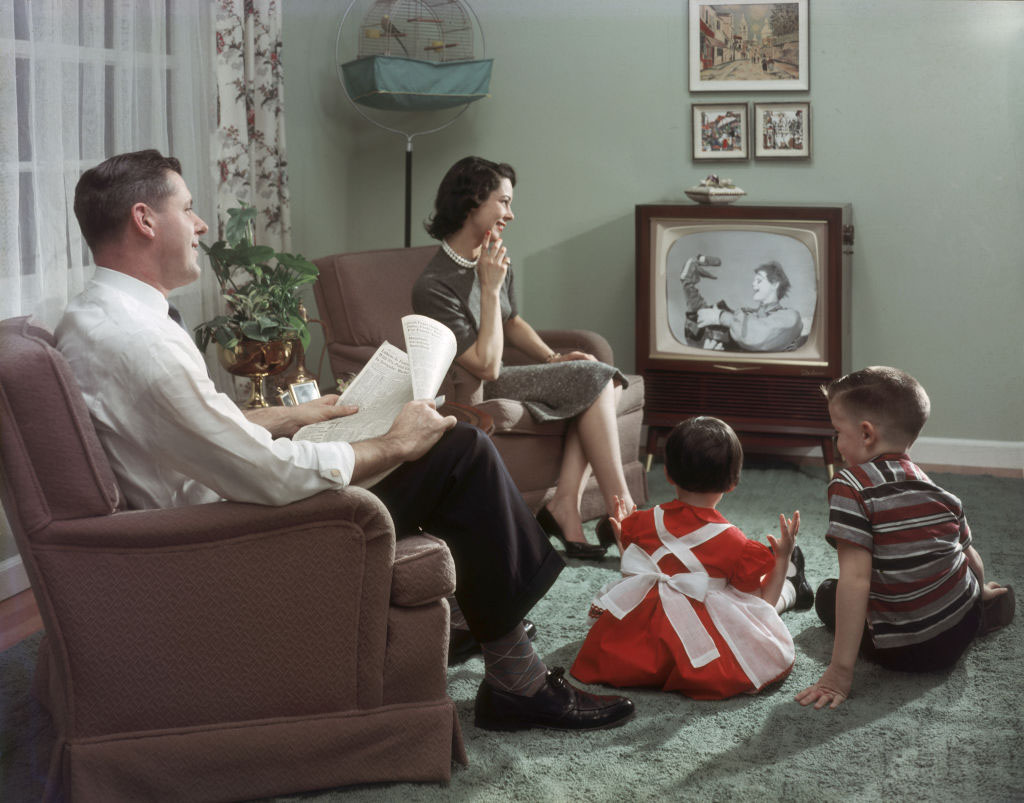
When TV was free, somehow there was always something to watch. It was a very Norman Rockwell experience. The whole family would gather in the living room. The dog was asleep on the woven rug. The goldfish bowl had one live one swimming and one dead one floating. We all watched the same show together. We sat down, waited for the TV to warm up, and there it was. If my mother did not like the show, she would sit with us and knit. If the phone rang in the kitchen, someone would say, “Let it ring; they’ll call back.” Even the bad shows seemed interesting and fun. Parents didn’t have to worry that we’d be exposed to someone who was completely exposed.  Mary Tyler Moore never took her top off, and Andy Griffith never took his pants off in front of Aunt Bee.  Though unrealistic, the old shows were happy families that always found solutions.  

Like us, the TV back then went to sleep. Between midnight and one, the stations would play the Star-Spangled Banner, wave the American flag, then go to black ’til 5 a.m. There was nothing on, and very much like today, nothing to watch.


Mark Schiff is a comedian, actor and writer and hosts, along with Danny Lobell, the “We Think It’s Funny” podcast. His new book is “Why Not? Lessons on Comedy, Courage and Chutzpah.”

Who Is Your Provider? Read More »

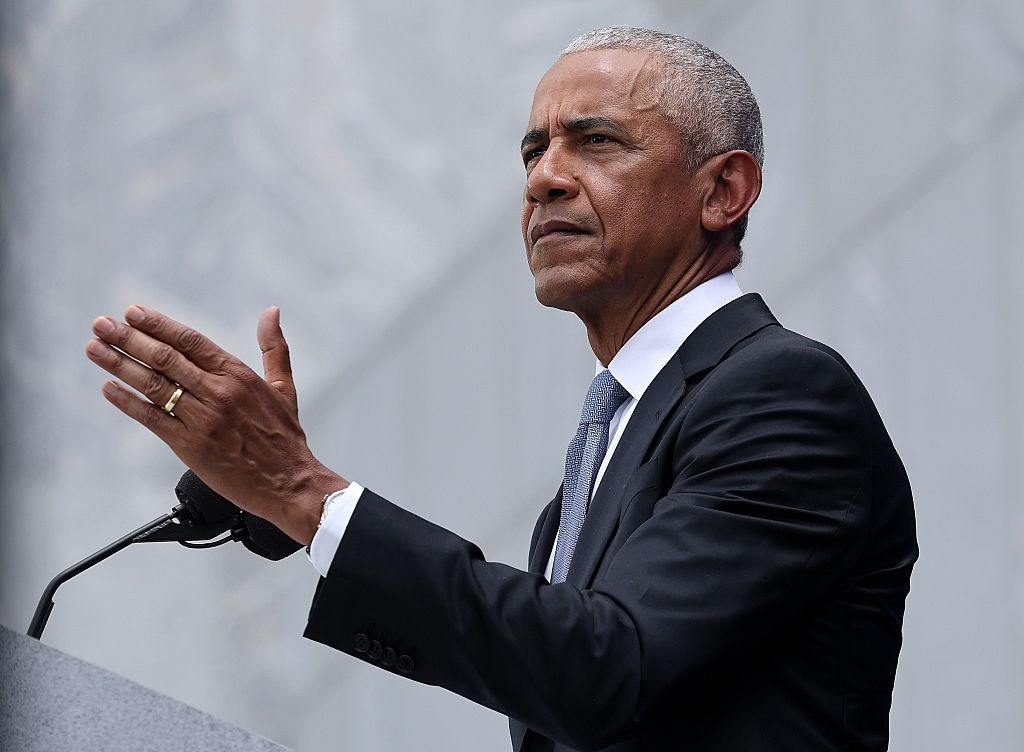
Obama’s Turn on Israel

With notable exceptions like Jimmy Carter, Herbert Hoover and William Howard Taft (and Donald Trump), former U.S. presidents tend to stay away from controversy. They make policy pronouncements that largely track with their work in office without overtly criticizing their successors, they campaign for their own party’s most conventional candidates and they engage in bipartisan philanthropic efforts for disaster relief and other similarly unobjectionable projects.

So why is Barack Obama revising almost eight decades of U.S. policy toward Israel in a way that libels Israelis as intruders on a Palestinian homeland? In a dismaying interview in Northern Ireland last week, the former U.S. president, who had been largely though not perpetually supportive of Israel during his time in office, fundamentally questioned the core premise of a Jewish state, suggesting that the territory on which Israel exists rightfully belongs to the Palestinian people.

“The fact is that the Jewish people for millennia were oppressed, discriminated against, killed. Europe was responsible for much of that. They understandably sought a refuge in a place where they had historic ties. That is undeniable,” Obama began, oddly limiting his criticism of the historic mistreatment of Jews only to Europeans. By overlooking the long history of Arab violence against the Jewish people, Obama implicitly absolved Israel’s longtime antagonists of any responsibility for the ongoing turmoil in the Middle East. This lay the groundwork for his most objectionable remarks. 

“What is also undeniable is that they took the land of people and they were expelled,” Obama continued, using the ‘land of the people’ formulation to unilaterally award ownership of the territory that became the state of Israel to the Palestinians. “And those people, understandably, said, ‘This is an injustice, and I want my land back.’”

“I want my land back.” Let’s deconstruct that deceptively simple sentence. The former president of the United States accepted without question the most controversial assertion in modern Middle Eastern history, conceding rights to the contested territory over which Israel has fought 22 wars in its 78 years of existence. He also ignored decades of Israeli proposals – and Arab refusals – to share the land over which both peoples have credible historical claims.

Accepting the Palestinians’ demand for “my land” dismisses Israelis as interlopers and invaders, and despite his offhand reference to the Jewish people’s age-old home in Israel as “a place where they had historic ties,” Obama blithely cast aside any legitimacy for Jews’ right to our homeland. 

Obama went on to criticize Israel’s current Gaza strategy, offering a more familiar but equally objectionable assessment that the Jewish state had “ceded moral ground” by defending its people against terrorist attack. He then directed some disapproval toward Hamas but framed his evaluation in an unsettlingly practical and strategic context.

“You could not have designed something that was less likely to produce meaningful change. In fact, it created the opposite,” Obama said, seemingly suggesting that his problem with the mass kidnappings, rapes and murders was tactical rather than moral.

Finally, the former president chided the Jewish state and its people for not being more creative in defending their homeland and their population from this violence. Israel must “rethink, reimagine” how to “live in this region — are you just going to be behind walls and wipe out everybody around here, or are you going to find some just way of defending yourself while still acting in an ethical, moral way?”

But Obama neglected to explain how to protect a civilian population against this type of terrorism that would meet his unexplained standard of ethics and morality. Nor did he indicate whether “reimagining” a nation’s survival meant doing so without the use of military weaponry to defend against its invaders. 

Obama’s career has been marked by a cautious respect for political convention, combined with a well-honed political radar as to what voters will tolerate at any given moment. The fact that he thinks such a once-radical message will be accepted by the American people speaks volumes as to the challenges that the winner of next week’s Israeli elections will face in the court of American public opinion.


Dan Schnur is the U.S. Politics Editor for the Jewish Journal. He teaches courses in politics, communications, and leadership at UC Berkeley, USC and Pepperdine. He hosts the monthly webinar “The Dan Schnur Political Report” for the Los Angeles World Affairs Council & Town Hall. Follow Dan’s work at www.danschnurpolitics.com

Obama’s Turn on Israel Read More »