1. Most of the public no longer views Benjamin Netanyahu as the most suitable candidate to be Israel’s prime minister. This is a fixed data point, consistent for several months now. And it is not a data point whose significance should be dismissed. For many years, Netanyahu enjoyed a distinct advantage on the question of suitability for the premiership. In this current election cycle, even though the opposition lacks a clear, universally agreed-upon leader, Netanyahu consistently trails behind Gadi Eisenkot.
This data point, among others, leads to an almost self-evident conclusion: most of the Israeli public is tired of Netanyahu. On the other hand, there is no alternative candidate who commands majority support as his worthy successor. Eisenkot is preferred by a large group, but its size doesn’t reach the 50% mark. So Israel is still seaching for a leader of a majority.
2. What we refer to as the “blocs” essentially crystallized into their current proportions around March of 2023. Meaning – they have maintained their current size despite massive, seismic shocks like Oct. 7, the war in Gaza and two rounds against Iran. One can always assume – or hope, depending on one’s preference – that Election Day will bring a major shift. That Likud defectors will suddenly “come home.” In elections, anything can happen. That is why they are held.
But on the flip side: waves of bombings in Iran didn’t bring about a shift. Long months of grueling combat in Gaza didn’t bring about a shift. Protracted brawls over the Supreme Court’s authority, Haredi draft evasion, Netanyahu’s trial, dubious ties with Qatar and all the other dramas – big and small, real and fabricated – none of these have meaningfully moved voters from one bloc to another. This, too, must be taken into account. Because sometimes, the biggest election surprise is that everyone expects a surprise – and there isn’t one.
3. It’s worth paying attention to what is – or isn’t – happening to our “large” parties. They are quite small, or at least that’s how they appear in the polls even as Election Day draws near. Perhaps they will still manage to siphon off the mandates of the other parties within their respective blocs. If not, it could bring Israel to a situation where its two largest parties, combined, do not reach 40 seats out of 120.
In other words, it is entirely possible that the next Knesset will be more a parliament of medium-sized parties than a parliament of large parties flanked by satellite factions. Likud, Yashar and Beyachad will likely get more than 10 seats. But we cannot rule out the possibility that The Democrats, Otzma Yehudit, Yisrael Beiteinu and the Joint List will also secure over 10 seats. We might end up with a balance of power far more egalitarian – and far more complicated – than what we are used to.
4. The question of Arab sector turnout remains constantly on the agenda. Will 60% show up? Sixty-five percent? Seventy percent? Picture a Knesset with, say, 17 seats for Arab parties. That is not what current polling shows, but it is an entirely plausible surprise worth considering. Its impact would manifest in the following ways: A) It would make it exceedingly difficult for the blocs to reach 61 seats. B) It would make it very hard to forget or obscure the fact that the Arab public is an integral part of the State of Israel, one that must be taken into account when shaping its government and its policies. C) It would enable the Arabs to assist in executing a determined decision by the leaders of the Change Bloc – should such a decision be made – to evict Netanyahu from the Prime Minister’s Office. D) It would serve as the ultimate launching pad for the right-wing campaign ahead of the subsequent elections.
5. The Haredi sector is in distress. It is evident in the election campaign; it is evident in the streets. One could say, “They brought this distress upon themselves” – which is true. But one can also empathize with the profound difficulty of a large public forced to abruptly alter its way of life, and to suddenly accept a demand that will upend its routines. The Haredi politicians are massive cynics, undeserving of any special empathy. The masses of Haredi youth, however, are not cynics. They are young people who were raised and educated on a very specific path, who are now discovering that this path is blocked and who are hoping it might yet be opened again.
The elections will signal one of two possibilities to the Haredi sector. The first: hope that the path will indeed be reopened, whether because the coalition camp wins, or because it loses but the loss appears temporary until another imminent election. The second: an acknowledgment that the path will not be reopened, and that there is an absolute necessity to find an alternative route. The Haredi public and its leadership have demonstrated an impressive capacity for pragmatism in the past. If they understand that the world has fundamentally changed they will find a way to adapt to it. But this will only happen if the elections conclude not just with a victory, but with a governing coalition that projects stability.
Something I wrote in Hebrew
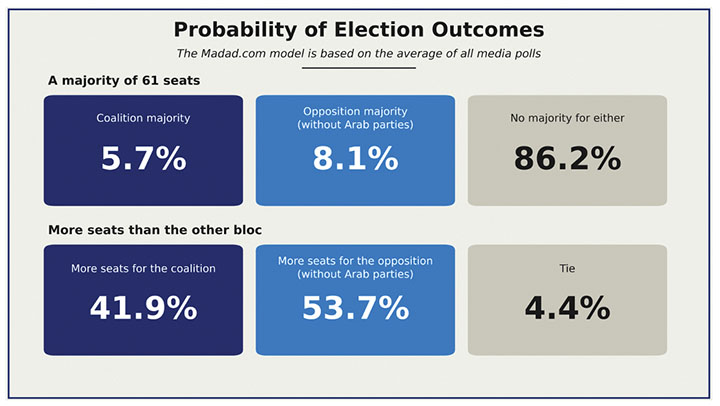
A decisive outcome at the ballot box might make us forget one crucial thing: the nation remains the same nation, the challenges remain the same challenges, the difficulty of getting along remains the same difficulty and the tribalism remains the same tribalism. Israeli society is struggling to break free from fundamental structural problems – some due to unavoidable circumstances, others due to leadership that has preferred to sharpen divides and foster polarization rather than bridge gaps and promote calm. If there is a winning camp – and it is by no means certain that there will be – it would do well to remember that an election victory is a means, not an end. It is the beginning of a process, not its conclusion. It is an opportunity to succeed – not success itself.
A week’s numbers
By next Friday, you’d know.
 A reader’s response
Doris Azulay asks: “Does the Trump endorsement change anything?” My response: Less than Trump would like to think it does.
Shmuel Rosner is senior political editor. For more analysis of Israeli and international politics, visit Rosner’s Domain at jewishjournal.com/rosnersdomain.