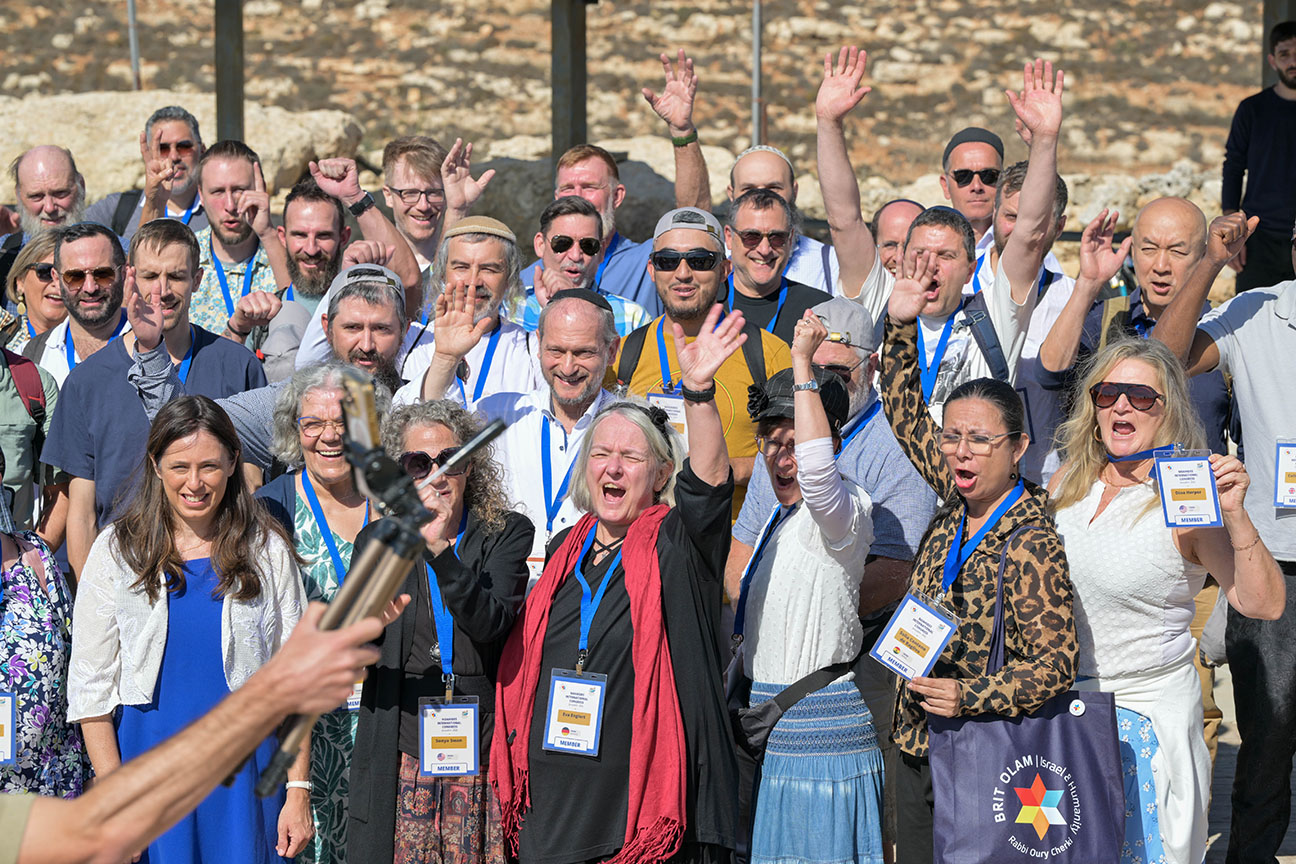
More than 60 Noahide followers from 22 countries gathered in Jerusalem the week of Nov. 2-6 for the First International Congress of Noahides, under the auspices of Brit Olam – The Noahide World Center.
Noahides, or “b’nei Noah” as they are called in Hebrew, are those who accept the first covenant God made with humanity, through the Noah family. “God speaks to Noah and his children as they exit the ark: ‘I now establish My covenant with you and your offspring to come’”(Genesis 9:9).
Noahides are not Jews, or converts to Judaism, and they are certainly not Christians, though many of them began as Christians. But, full disclosure, it gained new meaning for me when in 2004 our Raise Your Spirits Theatre troupe in Israel wrote and performed the musical “Noah! Ride the Wave!” My co-lyricists were Arlene Chertoff and Sharon Katz, and the composer-arranger was Mitch Clyman.
And what are the seven Noahide commandments? They are listed in the Babylonian Talmud (Sanhedrin 56a): “Belief in one God, establishment of a court of justice, and prohibitions against idolatry, murder, theft, sexual immorality and eating the flesh of a live animal.” They are also mentioned in Bereshith Rabba (34:8) and in Tosefta (Avodah Zarah 9:4).
In our song “Riding a Wave,” I describe them poetically, thus: ” A world with no more robbery, A world with laws and justice, A world with no idolatry, A world with no more sin, But with fidelity, integrity and kindness to all creatures, Where no one harms another, Where everyone fits in.”
Fast forward 22 years and I had the opportunity to join, as a journalist, the first global Noahide Congress in Jerusalem.
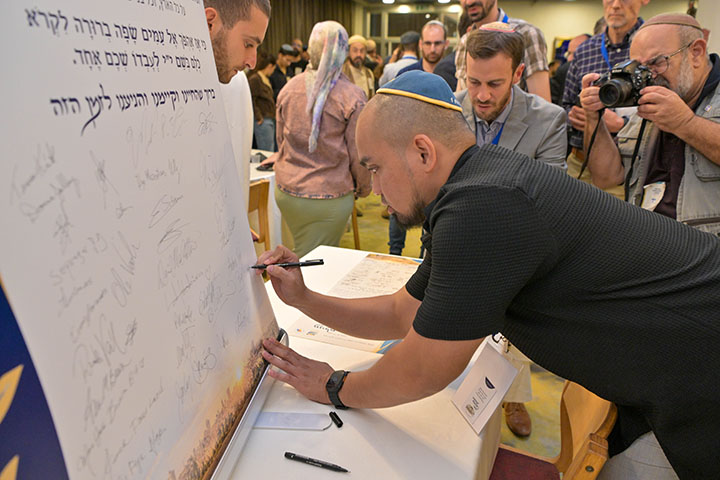
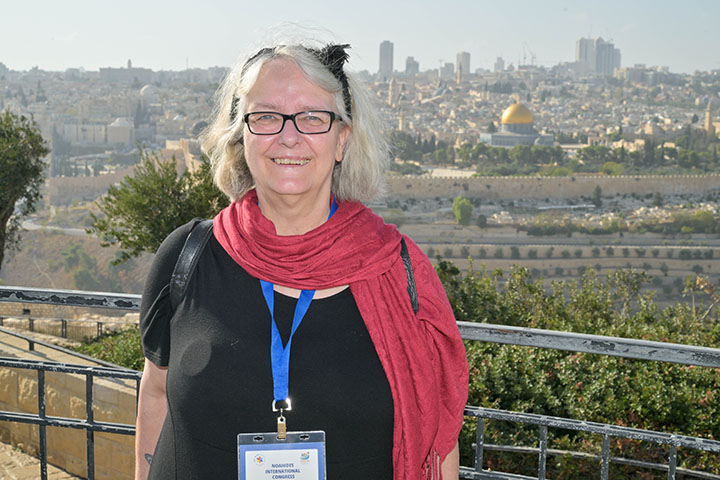
From the top of the Mount of Olives, in the Seven Arches Hotel (kosher catering was brought in), arrived at by driving up a frightenly narrow and steep road, with a magnificent view of the Temple Mount and the Old City, more than 60 men and women, Noahide followers from 22 countries, gathered to learn, connect, sing, tour meaningful religious sites,and sign a historic document, Megillat Bnei Noach (Scroll of the Noahide Covenant), before Jerusalem Mayor Moshe Lion and Rabbi Oury Cherki.
The Congress was convened under the spiritual leadership of Rabbi Cherki — President of Brit Olam, founder of the School for the Wisdom of Faith, and a direct disciple of Rabbi Zvi Yehuda Kook, Rabbi Yehuda Léon Ashkenazi (Manitou) , and Rabbi Shlomo Benjamin Ashlag. Among those rabbis who encouraged the Noahide movement was the late Lubavitcher Rebbe.
The gathering also included many religious Israeli volunteers and who support the work of Rabbi Cherki and who were there to interact with the Noahides.
Brit Olam was founded in 2011. The idea for the Congress was first raised about eight years ago by Rabbi Cherki. It was delayed in part by the COVID-19 pandemic and the war.
The five-day congress brought together a global community of Noahides who share a common identity and practice. The program included lectures and study sessions with learned Noahides, and with Jewish rabbis and teachers. They toured the City of David, prayed at the Western Wall and visited the biblical sites of Shiloh and Beit El.
The first woman I met as I entered the congress area was Sonya Swan, a resident of Des Moines, Iowa, and I was immediately captivated by her. For more than 26 years she’s been “a homeschooling mom of four children, teaching holistic health and Biblical principles.”
I asked when she became a Noahide.
“I actually have not really called myself Noahide until now. I just say, I’m as close to Jewish as one can get without converting. I don’t have an exact date, it was a process of learning and unlearning that started about 15 years ago.
“I was led to it by my mother, of blessed memory, who could have been considered a bible scholar. She found Rabbi Tovia Singer’s books and we began studying together.”
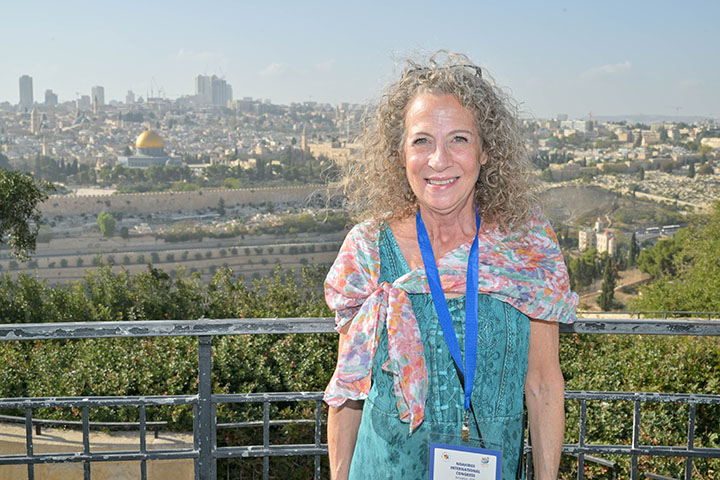
Swan was also one of those chosen for the smaller closed door meeting with President Herzog that took place before he met with the whole group. She addressed the president, referencing Zechariah 8:23:
“There is a Scripture that says there will come a time when 10 gentiles will grab the robe of a Jew and say take us with you (plural) for we know that God is with you (plural).”
[The exact quote from Zechariah: “Thus says the Lord of hosts: In those days, when ten men of all the languages of the nations shall take hold of the skirt of a Jewish man, saying, ‘Let us go with you, for we have heard that God is with you.'”]
Swan continued: “We are those nations, we are those people. We feel and we know that there is wisdom and great blessing in what God has blessed the Jewish people with, and we are asking please, it is time to teach all the nations the beauty of what God has given you so that we can join you.”
President Herzog said, addressing the larger group, “May this congress inspire you all to carry the spirit of Jerusalem back to your homes.”
How has being a Noahide changed her life?
“It’s been the most freeing experience, and the most challenging experience.” And being at the congress in Jerusalem, Swan said, was, “Absolutely incredible! I came as a stranger to the group, just wanting to support Israel and meet others who had the same faith. I left having gained a big family full of encouragement and wisdom.”
Rabbi Cherki, who addressed the congress on opening night, said (excerpts), “Tonight we’re really living the reality of the verse, From Zion will go forth Torah and the word of God from Jerusalem. This is a historic event. Today we in Israel are fulfilling a mission … That job is what was promised to Abraham, to be the source of blessing to all of the nations of the world.
“The covenant that God made with Noah and his children predates Judaism by many, many years. And so we can really understand Judaism as a reminder to the rest of the nations of their covenant with their God.
“The Noahide Torah wasn’t given to individuals as a path for individuals to live as private citizens, but rather for societies, that should build themselves around the Noahide way.
” For years to come, you’ll be able to tell your families, your communities that you were here today and that you were there when we started to change the world.
“Together we are making history.”
“Israel is the focus of the world’s attention, for better or worse,” said Rabbi Chaim Goldberg, CEO of Brit Olam. “Noahides see the children of Israel, the people of the Bible, coming back to life in the modern age. They see purpose in that and want to stand with Israel.”
Members signed the movement’s founding scroll, Megillat Bnei Noach, during an emotional evening ceremony before Mayor Lion and Rabbi Cherki. Written in Hebrew, the scroll opens with the verse from Zechariah that was quoted to President Herzog by Swan. The Scroll was signed to the exquisite background music of one of Jerusalem’s premiere ensembles, with Rabbi Lior Kaminetsky as violinist, and his children Yehonatan, a pianist, and Ofri, a flautist. They also accompanied the gathering as the signing of the Scroll was followed by exuberant song and dance.
The Congress also established an international Beit Din for Noahide affairs, a rabbinical court offering guidance to Noahides who seek it. Participation in the Beit Din, the Congress, and all of Brit Olam’s work is voluntary.
Many of the B’nei Noah have been following the podcasts of Rabbi Tovia Singer, who also spoke on the opening evening. Rabbi Singer also shared with us the fact that this hotel, whose construction was completed in 1964, including access roads over the desecrated Jewish cemetery on the Mount of Olives, was the location of the founding of the PLO in 1964, in the same room where the main congress events were held.
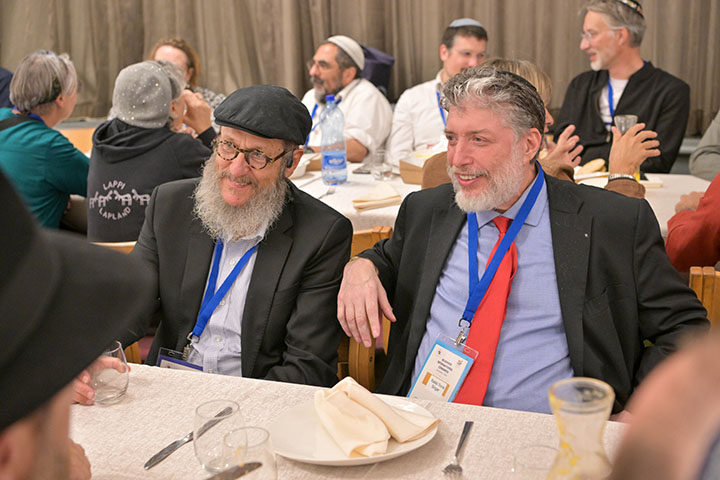
Rod Bryant, born in Baton Rouge, Louisiana, was an evangelical pastor in the United States for 33 years. He also served as a major in the U.S. Army in Iraq during the Gulf War as a Christian chaplain. He left Christianity for Torah Judaism and is founder of NETIV Virtual Torah Learning for Noahides based in Houston, Texas, which has, he says, at least four classes a week. “All of them are online. And we have rabbis that teach a class. Back in the day, I used to teach them all.
“Since I was a seven-year-old boy, I always wanted to connect to God. And I had some amazing experiences growing up, and I went through the church and I was doing the best I could. I become an army chaplain, which was an amazing experience. I was a Houston police officer for 13 years.” During this process his church started and it grew.
“But I’m so busy pastoring people and shepherding people. But what about my soul? What about me?”
There was a time when he was still in the church when he was preaching what Rashi said, though the congregants didn’t know it. After a very long and mesmerizing journey, beyond the scope of this article, and after a great deal of study, he decided to leave the church. He had the support of his wife. “She’s a beautiful wife. She has my back. But she’s seen my spiritual struggle. The days of fasting and bombarding Shemaim [Heaven].” They lost all their friends, all their associates.
“Nobody would have anything to do with us. But I had family. My children knew their father. Today my children are Noahides. They’re good people. My daughter and son-in-law are converts, they’re Jews. And they plan on, God willing, making Aliyah in the next few years.”
He describes a meeting he had with a rabbi. “He said, ‘Far be it from me to tell you that you shouldn’t convert. You really should think about that, right? Because you’d be much more effective in this world. If you didn’t convert.'”
Rabbi Nachman’s writings about meditation inspired him.
“That is where the shift happened. And when I shifted and found when I finally hit that connection, I’m like, oh, this is what I’ve always wanted.
“That’s why I didn’t convert, because I found I found the secret connection, and that I feel like now I understand enough that I can share it with others.”
He told The Journal, “Every human being is a descendant of Noah. We’re hoping to call every human being back to the ancient connection with God … When redemption unfolds, we’ll have redemption. The Jewish people and the Bnei Noah have somehow been able to preserve Hashem’s judgment in the world, preserve us until redemption comes.”
Bryant says, ” What the Bnei Noah are in this world right now, we’re getting ready to infuse the world with goodness, to be the influencers. So where the descendants of Abraham are the preservers of the covenant and the light of the nations, we as Bnei Noah become like the moon.
“We reflect the light into our communities. And if you know what it’s like going out into the desert at night and seeing that beautiful moon, it illuminates everything. So in a very dark place, we the Bnei Noah are going to start illuminating the world.
“We already are. But it’s more and more and more. Redemption is coming.”
Shannon Nuszen, who spoke at the congress, is a convert to Judaism. Originally from Houston, Texas, she was born into a fundamentalist Evangelical Christian home. “My father was an Assemblies of God minister, and I was trained from a young age to be a missionary. And I took that responsibility very seriously. There was a world that needed saving. And in my particular religious world, the Jewish people were a priority. And I committed my life to that mission. I lived it. I breathed it. Christianity wasn’t simply a religion that I practiced. It was my entire world.”
To that end, she became close to people in the Jewish community. “But the more I studied, the more questions I had.”
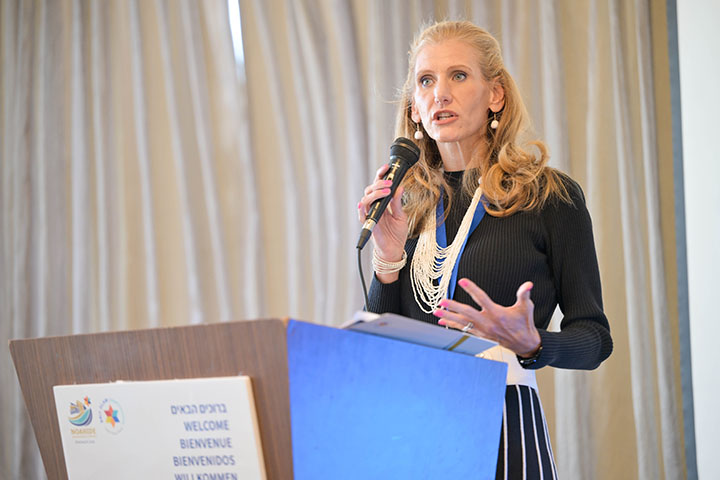
Her own journey eventually led her to convert to Orthodox Judaism.
“But my father’s story took a different turn. Initially, he began examining my discoveries because he wanted to bring me back into Christianity. Instead, he eventually came to recognize the God of Israel and embraced his identity as a Ben Noach.
“Here we were — a former Christian missionary and an Evangelical minister. I had become an Orthodox Jew. He had become a Noahide.
“Being a Noahide isn’t simply about what we no longer believe. It’s about the freedom to build meaningful lives around what we now understand. And that is where the nations have such an extraordinary role to play. Not by abandoning their identities. Not by trying to become Jewish.
“But by bringing the recognition of God and the values of Torah into the places where they already live. Into their families. Their neighborhoods. Their workplaces. Their communities.”
More of Shannon’s journey and her current activism can be found on YouTube under: “A Christian Missionary’s Journey to Judaism” – Shannon Nuszen.
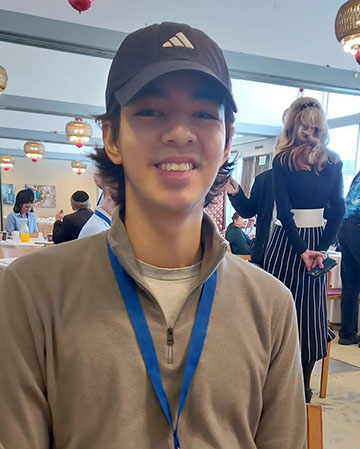
Nicholas Pascal is 31, lives in Manilla, the Philippines, and is an audio and video editor and a graphic artist. He was one of five people attending from the Philippines. He came to be a Noahide, he says, as part of his journey from Christianity.
At first, he said, “I thought it was watered-down Judaism…like when you want to convert and the Jews tell you no, three times. So I thought that Noahides are like the denied people, Judaism-lite'” he laughs. “Like, if you can’t make it through conversion and you fail, then you can be a Noahide.
“That was unfortunately my understanding but before all of that I was a Christian and on fire!”
On his journey he discovered that “The Torah is the foundation.” For a while he became involved in Messianic Judaism. “I think that’s a stage that most people who come from Christianity go through. And then you find out that their wisdom is actually from the Orthodox rabbis or from the Jewish traditions. So why not just go straight to the source?”
He started listening to Rabbi Daniel Lapin online. “He just used what we called at the time the Old Testament, the Tanakh, and gave so much wisdom that I was blown away and wanted to know more about this.”
He went through a long journey.
“I started changing my perspective, from being helpless and needing somebody else to save me, and starting to realize the Jewish perspective – that you already have a connection with God. You just need to recognize it and connect with Him directly.”
How did he get from there to the Noahide movement?
“Wanting to convert to Judaism, I was introduced to the Noahide idea, by rabbis, and I was hearing it online.”
Eventually he found a mentor. “I reached out to Rod Bryant from Netiv. I still wanted to convert, but he let me join the Zoom classes [on Noahides]. This was during the pandemic, and that’s where I started to learn, and to better understand that in the Torah, there are two major covenants.
“You have one with the Jewish people, and you have one big one with the rest of the world. That’s the covenant of Noah. Forever … The Jews have their purpose, we have our purpose … But without one or the other, heaven coming here on Earth and God dwelling here on Earth, doesn’t happen. In other words, you need both of them.”
Eva Englert, from the village Alxing in Bavaria, a retired marital and family therapist, was born Catholic.
“My father loved to read me the Bible. We called it the Old Testament, but also read the New of course. But we both loved the Old Testament; it was our favorite part of the Bible.”
She became an evangelical Christian after some time together with her husband and was in that movement for about 20 years. “But I always had questions to Christianity. I couldn’t understand why God needs a human offering. It made no sense to me.”
She had conversations with theologians, and with the leaders of her parish, spanning three years.
“And then came COVID, and our services were always online.” It was then that she discovered Outreach Judaism with Rabbi Tovia Singer and Jews for Judaism with Rabbi Michael Skobac in Canada.
“And I said, maybe they know something. And I watched them, and after a while I figured out, very quickly there is no Jewish answer to why God needs a human sacrifice, because He doesn’t need it.”
She also could not accept that Jesus was God. She knew then she was no longer a Christian.
“I already knew about Noahides, and that was a very quick decision for me to, to go on the Noahide path.”
One can see Eva in one of the videos made of the Noahide trip to Shiloh, as she stands before a sign that says, “Hannah’s Prayer” – “I feel connected to God everywhere, but here it is very, very special, and yesterday, as we prayed in the City of David, I was crying, because it goes so to my heart; that’s the most important thing – to be here.”
Eva was not the only one who shed tears in the course of the five days. Many of the Noahides did, and so did some of us observing from the side, feeling privileged to be present to witness this landmark occasion.
The writer is an award-winning journalist, theater director, and editor-in-chief of WholeFamily.com