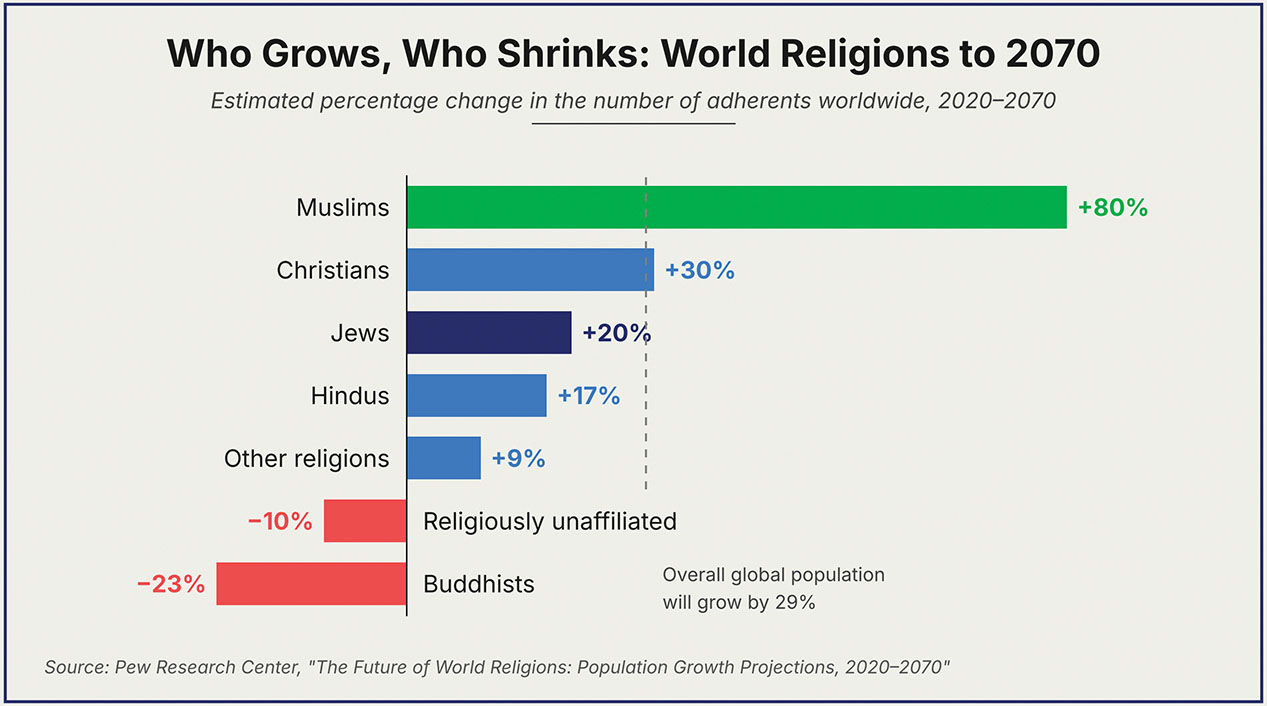
1. Here is an exercise in proportion. According to a new Pew Research Center report on The Future of World Religions, in the 50 years between 2020 and 2070 the Jewish people will grow by three million – from 14.8 million to 17.8 million. The number of Muslims will grow in those same years from 2 billion to 3.6 billion. Divide the numerical addition of Muslims by 50, and you get about 32 million a year. And if you keep calculating, you’ll discover that what the Jews will add in an entire half-century, the Muslims add in five weeks.
2. What do we do with such math? Jews today make up 0.19% of the world’s population, and in 2070 they will be 0.17%. Whoever manages to get worked up over that difference is welcome to do so. We will grow by 20%, the world by 29%. In other words, regarding our relative size, nothing will happen. We’ll remain half a pin on the world map.
3. The big change awaiting the Jews won’t be demographic, it will be geographic. Today, 46% of world Jewry lives in Israel. In 2070, according to the forecast, 62% will live there. The U.S. share of world Jewry will drop from 39% to 26%, which numerically means 1.2 million fewer people. In Europe, there will be a 29% decline. In France, from 460,000 to 180,000. The median age of European Jews is 53. This is the oldest religious group on the continent (for Muslims there, it is 34). A community with a median age of 53 doesn’t need antisemitism to shrink. A calendar is enough.
3a. An important note on this specific study, so that those familiar with other numbers don’t get confused. This study counts Jews the way it counts everyone else: by religion. Those who answer “Jewish” when asked “What is your religion?” are in. “Jews of no religion,” who identify as Jewish only on a different question, are out. America has many Jews of this second type, which is why the U.S. figure in this study is lower than the familiar one (which, under the broader count, is similar to the number of Jews in Israel).
4. The geographic shift has nothing to do with Aliyah (immigration to Israel). If a sudden wave of hundreds of thousands or millions were to immigrate, this forecast doesn’t include it. That would be a surprising event, driven by reasons we currently cannot predict. What can be predicted, based on the current migration balance, shows that Aliyah’s impact on Israel in the coming decades will be negligible, especially when looking at the overall balance – inbound minus outbound. Over 50 years, this balance will add about 110,000 Jews to Israel. That’s it. A drop in the ocean compared to natural growth – births minus deaths – which will add 4.2 million.
5. The full report, in which the chapter on the Jewish people takes up only a small space (which is still relatively large given the size of the Jewish people), tells of the following trend. In the world of 2070, the populations that grow are those that are young, having children and sticking with their culture. The average Muslim woman has 3.1 children, the median age of a Muslim is 24 and 99% of those raised Muslim remain Muslim. Therefore, around 2035, there will be more Muslims than Christians in the world. Buddhists will drop from 324 million to 250 million. The unaffiliated, whom so many people are joining, will drop from 24% of the world to 17%. Why? Because those without a religion have 1.3 children. Secularism may be winning an argument, but it’s losing in the delivery room.
The fertility rate for a Jewish woman is 2.3 children, exactly the global average. Except this average doesn’t describe anyone. In Israel: three children, median age 31 and nearly everyone raised Jewish stays Jewish. In the United States: 1.5 children, median age (in North America) 44, and only three out of four stay. In this report’s terms, Israeli Jews behave demographically more like Muslims, and American Jews more like Buddhists. What is happening globally between religions is happening to us within the family.
6. Let’s add another layer: even three children per woman in Israel is an average that hides a stratified reality. The Pew report mentions this in a footnote, but Israelis know this reality well: the highest Jewish fertility rate belongs to the Haredim (ultra-Orthodox), and the study Pew cites points to 6.5 children per woman. Meaning, the center of gravity of the Jewish people is shifting to Israel, and the center of gravity of Israel’s growth is Haredi society. I wrote a whole book on this (“The Haredi Challenge”), and I won’t repeat its contents here. I will only state the obvious: anyone pleased to read that in 2070 there will be 11 million Jews in Israel must also ask who among them will work, and who will serve in the army (Haredis don’t).
7. What changes when a Diaspora people becomes a people attached to a state? Here is a story I mentioned in my book “Why Am I a Jew”: In the year 922, the Jews of the Land of Israel celebrated Passover on Sunday, and the Jews of Babylonia on Tuesday. Aharon Ben Meir of Tiberias calculated one calendar; Rav Saadia Gaon of Babylonia calculated another. Ostensibly, this was a debate about astronomy. In reality, it was a debate over who gets to decide. Babylonia won, because while the Land of Israel had the holiness, Babylonia had most of the important Jewish centers.
Eleven hundred years later, Israel will have both the holiness and the Jewish centers. Israel will be the center.
8. Israel as the center, including demographically, poses a challenge to Jewish security for two reasons. Firstly – because geographic dispersion was the insurance policy of a weak people: one center is destroyed, another carries on. A situation where 62% of the Jewish people is concentrated in one small country is a type of gamble the Jews haven’t taken in a very long time. And as we know, the neighborhood in which they live is not the friendliest.
The second reason concentration is a challenge: Israel has always relied, in part, on Jews who do not live there. American Jewry in 2070 will be smaller, older and living in a different America. According to the forecast, no religion will be a majority there anymore. And true, political influence isn’t only measured by headcount (even today American Jews are quite few), but it is also measured by headcount. This means that Israel will be responsible for more Jews, and will have fewer Jews to lean on.
Most of the Jewish people will soon be us, the Israelis. With that comes responsibility, and a need for caution.
Shmuel Rosner is senior political editor. For more analysis of Israeli and international politics, visit Rosner’s Domain at jewishjournal.com/rosnersdomain.