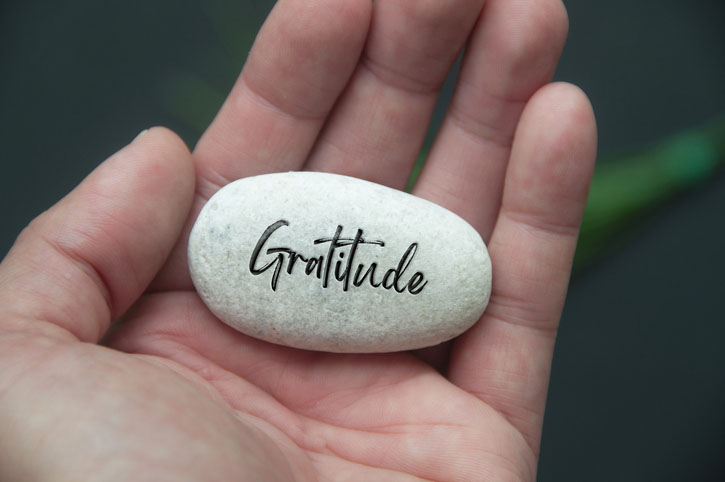

“Modim Anachnu Lach,” We Thank You G-d are words we say in the Amidah, the essential core prayer of our services. Three times a day the rabbis inserted this phrase and inscribed it as a mindful moment. After pouring out our hearts, praising the Holy One, and acknowledging all the many Divine qualities and gifts we receive, we must say “Thank You.”
When we wake our first words are “Modeh Ani …” I thank you; each individual acknowledges the gift of another day. This prayer ends with the words “Emunatecha,” Your faithfulness. Each morning, we freely receive the gift of G-d’s faith. At bedtime we end our prayers with “B’yado afkidruchi …” “I place my spirit in Your hands … when I sleep and when I wake G-d is with me … I shall not fear,” acknowledging our deep gratitude before we close our eyes.
At every turn Judaism is a religion that is held up by gratitude. Even our name, Jew, comes from the Hebrew Y’hudim, sharing the same root letters as Modim. Our identity is linked with this most remarkable value, to be grateful. Talmud teaches “… we are grateful to You … that we are able to give thanks.” The awareness and ability to say thank you is a spiritual practice nurtured by every blessing we say. It is why tradition teaches we are to say 100 blessings a day, so we can find holiness in every moment of engagement with life – moving, eating, seeing, learning, loving and being open to moments of awe and wonder, opportunities to cherish what matters and strengthen a sense of wholeness in our life. Talmud also reminds us, “If we miss the opportunity to express gratitude it is as if we have stolen from the world.” We must cultivate the ability to savor the good in all we receive.
One of the most basic and essential gifts is the breath. Torah teaches, “G-d formed the human out of the particles of dust…then blew into the nostrils ‘Ruach Elohim’ …” the “wind/spirit” of the Holy One. Each time we breathe in we tap into the gift of G-d’s spirit that reenlivens us. We don’t take a breath we “receive” it giving us multiple opportunities to feel grateful. Imagine the extraordinary awareness of the blessing and good fortune of being sustained and alive. Gratitude not only feels good, but it brings higher levels of optimism and greater life satisfaction.
Yet, how do we say thank you when we experience loss, pain, suffering or the overabundance of chaos that exists in the world and in our country? Isn’t it a paradox to say thank you to G-d when experiencing difficulty in our lives? For the rabbis this was not a problem. Mishneh teaches “we are obligated to bless the bad just as we bless the good,” for G-d is the source of both good and evil, as Isaiah reminds us, “I form the light and create darkness, I make peace and create evil; I YHVH do all these things.” G-d owns it all and we are reminded in the prayer we say twice a day, the Viahavtah, “To love G-d with all of our heart …” This means both with the inclination – for good and the inclination for bad, Yetzer Tov and Yezer haRah. Both are essential for the human endeavor. The sages further demonstrate that one word in the beginning of Torah is their proof text; “Vayitzer Adonai Elohim et haAdam …” “And HaShem Adonai formed the human …” The word “vayitzer,” “formed,” has the unusual spelling of two Yuds, when normally it has one. One representing good and other representing evil. The sages understood that all things come from G-d and we must be grateful for the fulness of our lives, both the ugly and the beautiful. “We enter G-d’s gates with Thanksgiving.” (Psalm 100)
As Thanksgiving approaches, we remember that in 1621 a harvest feast between the Wampanoag people and the Pilgrims ignited celebrating Thanksgiving inspired by their reading of Sukkot in the Bible. As Jews we too celebrate Thanksgiving and hold gratitude for our cherished tradition and its teaching to value and express these precious words, “Thank you.” Share them with family, friends, colleagues, and always with our treasured Creator, Adonai; “Modim Anachnu Lach.”
Rabbi/Cantor Eva Robbins is Faculty, Academy for Jewish Religion and co-Rabbi, Nvay Shalom.