

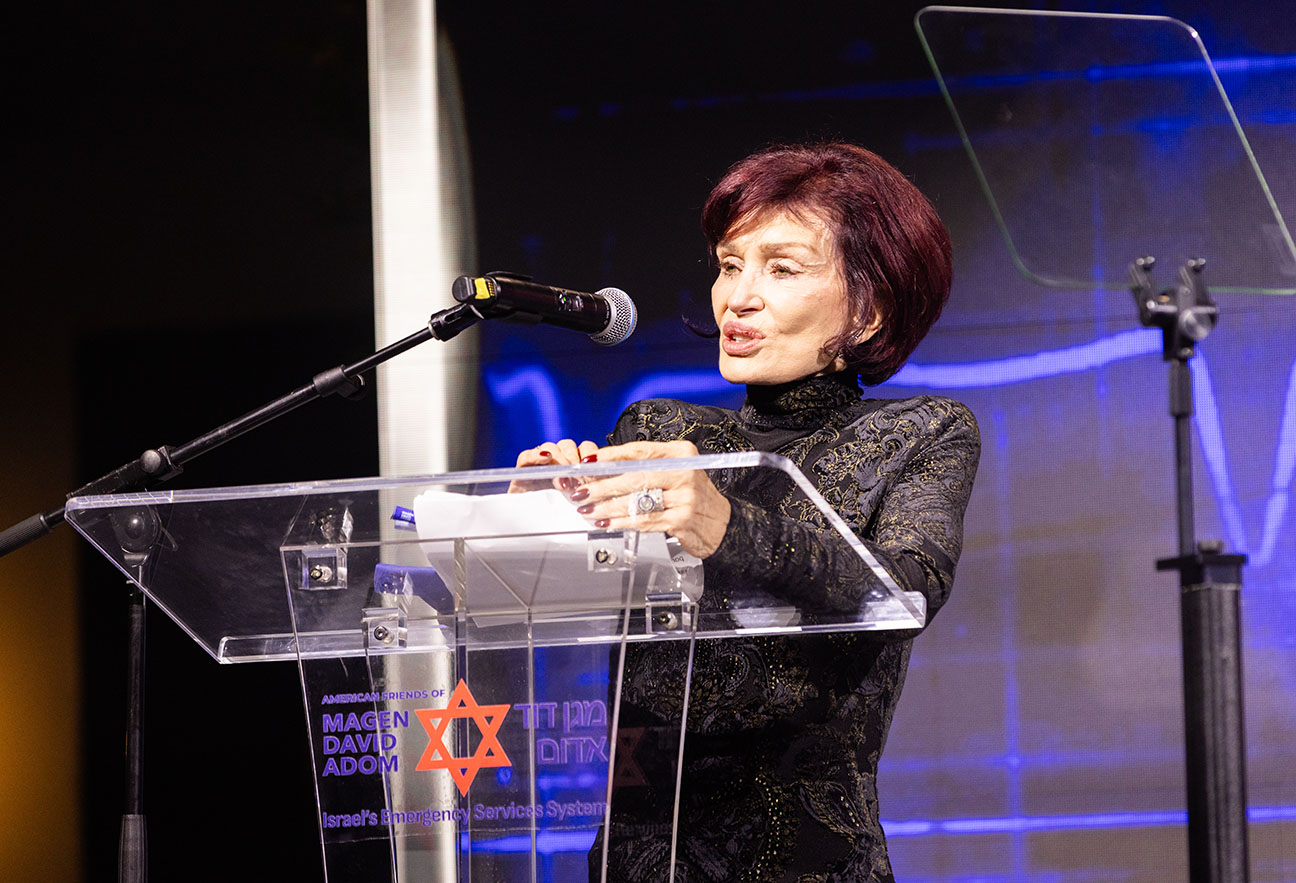
Against the backdrop of Jordana and Hezi Yechiel’s magnificent Beverly Hills estate, guests at the American Friends of Magen David Adom (AFMDA) Los Angeles Gala enjoyed an evening of extraordinary elegance, with elaborate food stations, an open bar and an almost unbelievable assortment of desserts. But beyond the glamorous setting, the purpose of the evening was a serious one: supporting Magen David Adom, Israel’s national emergency medical service and blood-services organization, which provides ambulance and lifesaving medical care to anyone in need, regardless of religion, ethnicity or background. AFMDA is the American fundraising and advocacy organization supporting its work in Israel.
Among those attending was former Israeli ambassador to the United Nations Gilad Erdan, who now serves as MDA’s global president. The evening honored television personality Sharon Osbourne with the Champion for Israel Award and Wilshire Boulevard Temple with the L’Dor V’Dor Legacy Award.
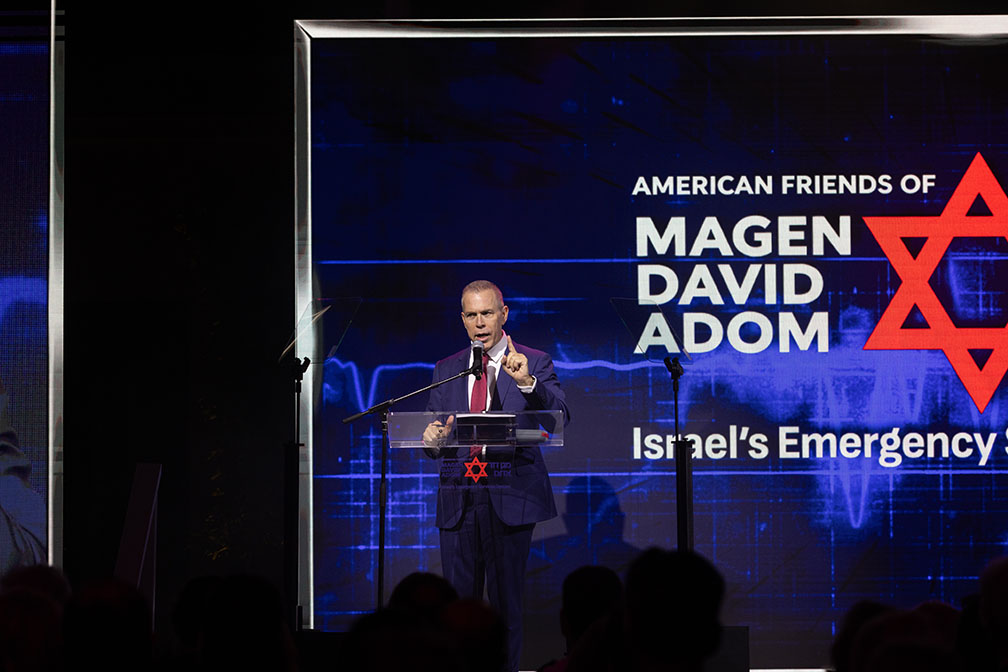
Osbourne received her award from Yechiel and Australian journalist and television personality Erin Molan, a former Channel Nine presenter who has become an outspoken advocate for Israel and the Jewish community.
The widow of Ozzy Osbourne, the beloved Black Sabbath frontman who died in July 2025, recalled that she and her late husband had visited Israel several times. “Ozzy was overwhelmed by Israel, and he said it’s definitely the land of milk and honey. He loved Israel,” she said, her voice breaking with emotion.
Osbourne spoke candidly about antisemitism, her own Jewish roots and what she sees as an increasingly hostile world for Jews. “People often say to me, ‘I don’t understand why people have a problem with Jews,’” she began. “And it always makes me laugh, because they say it so innocently. You can see they genuinely don’t understand what’s the matter. It’s very fashionable to hate Jews and Israel right now.”
Osbourne attributed much of the hostility toward Jews to ignorance, misinformation and people adopting the views of those around them, including what they hear in the media. She was particularly incredulous at the recurring conspiracy theory that Jews control the press. “What moron would say that Jews run the press?” she asked, before adding, “The BBC are scum! They’re scumbags. Poor England is in a dreadful state, like so many other countries around the world.”
Osbourne also spoke about her childhood in London, where she was born Sharon Rachel Levy to a Jewish father with Russian-Polish roots and an Irish Catholic mother.
Growing up in a household that brought together two different religious traditions was sometimes confusing, she recalled, but she ultimately felt most at home with her father’s Jewish family. “I’m very proud of my heritage,” she said. She remembered her father returning home, sometimes disheveled, after going out with friends to confront neo-Nazi groups in England. “My father and his friends would go out and have Israeli flags, and then they would be beaten up and they would beat the other ones up, and they would all have a good time,” she said.
Even years after World War II had ended, antisemitism remained part of everyday life. As a schoolgirl, Osbourne wore earrings bearing the Star of David. On her way home, other children would call her a “dirty Jew” and accuse her of having killed Jesus. It did not initially upset her because of the way her father had taught her to respond. “He would say to me, ‘Don’t worry, they are ignorant. Basically, they are schmucks,’” she said.
But as she grew older, she encountered a more subtle form of prejudice. When she went to visit her first boyfriend’s home, she remembered hearing his mother speaking in the kitchen, saying “she’s all right for a Jew.” It always surprised her when people referred to each other by their religion. “They never said, ‘She’s all right for a Christian’ or ‘She’s all right for a Catholic,’ but ‘She’s all right for a Jew.’”
Looking back, Osbourne said she was grateful to have grown up in a mixed-religion household because it taught her to understand different people and cultures. She moved to Los Angeles in the 1970s, and at the time, she said, life was good. But by the mid-1990s, she began noticing a change. “Now the world is such a different place. It’s dark and divided. People don’t want to debate anymore. There is no compromise, there is no middle ground.”
She lamented what she sees as the growing intrusion of politics into everyday life, with people increasingly defined by whom they vote for rather than whether they are decent human beings. She also expressed alarm about the spread of antisemitism in schools and universities, the rewriting of history and the growing reluctance of people to speak publicly in support of Jews and Israel. “Antisemitism is rife. It’s running around the world, it’s like COVID,” she said. “People can go to a concert and shout the name of a terrorist group, and it’s acceptable. All we can do is speak out and be proud.”
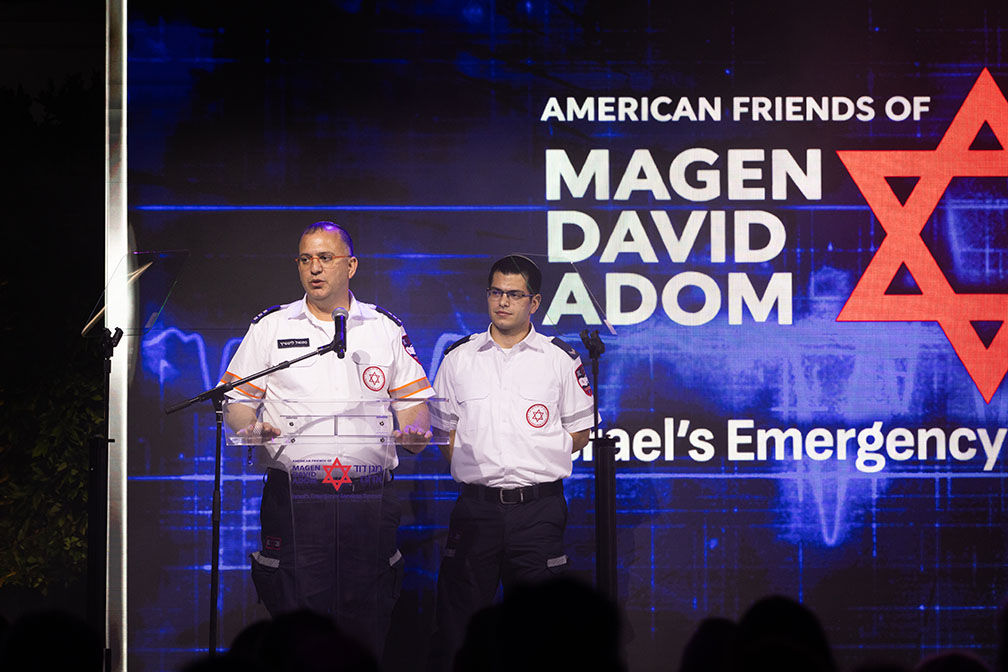
One of the most moving stories of the evening belonged to two special guests who had traveled from Israel for the gala: Netanel Lipschitz and his son, Yair.
Netanel has been volunteering with MDA for 32 years, and his oldest son, Yair, 25, followed in his footsteps, beginning to volunteer with the organization while still in high school. On Nov. 3, 2023, Yair was critically wounded while serving as a commander in the Paratroopers Brigade in Gaza.
His injuries were so severe that, for a time, fellow soldiers feared he had not survived. He was evacuated for treatment and faced a long and difficult recovery. Yet even while undergoing rehabilitation, Yair was determined to return to MDA.
During his rehabilitation, he obtained his ambulance driver’s license. His wife, the mother of their two young children, also volunteers with MDA, making the family’s commitment to the organization a shared one. “We’ve been doing shifts together,” said his proud father. “He’s driving the intensive care unit and I’m the paramedic. We also did shifts with my wife, so it’s a totally family shift.”
AFMDA CEO Catherine Reed and MDA Director-General Eli Bin presented Wilshire Boulevard Temple with the L’Dor V’Dor Legacy Award, which Rabbi Joel Nickerson accepted on behalf of the congregation. In his remarks, Nickerson spoke about the congregation’s generous response to MDA following Oct. 7, describing it through the Hebrew word Hineni — “Here I am,” the response Abraham gives when God calls him.
Nickerson explained that Hineni represents a willingness to answer the call even before knowing exactly what will be asked.
“When the news came on Oct.7, our people didn’t ask why. They asked, ‘What now?’” he said. That response translated into action. Within just one week of Oct. 7, more than 435 Wilshire Boulevard Temple families and individual congregants contributed to a campaign that, with matching gifts, ultimately funded seven Life Support Ambulances for Israel, along with additional funding for their maintenance.
“The Torah teaches us that whoever saves a single life is as if he saved an entire world,” said Nickerson. “We might not know the number of worlds we’ve been saving, but the families we’ve reached know.”

































