Torah Portion: Vayetzei
Jacob, on the run from his brother, Esau, stops for the night, pulls up a rock for a pillow, and has a very famous dream.
In the dream, he sees angels going up and down a stairway to heaven. This is interesting. If they’re going up the stairway — from earth to heaven — that means angels are among us. A thought worth contemplating.
God Himself then appears in Jacob’s dream and reaffirms the covenant He made with Jacob’s father, Isaac, and grandfather, Abraham.
The next morning, still vibrating from the power of this vision, Jacob makes a very chutzpadik vow.
“If I get out of this jam alive and God does all the stuff he says he’ll do for me, then, I’m totally down for this One-True-God-thing.”
Note that Jacob puts all the obligations on God and none on himself. Our young hero has much to learn.
The School of Hard Knocks awaits him.
On the outskirts of the town of Haran, he spies some shepherds standing by a well. “Do any of you know my Uncle Laban?” he asks. It turns out that they do. In fact, his daughter Rachel is approaching this very moment to water her sheep.
Jacob rushes to greet her. She matches his excitement with her own. Before long they’re back at the house, everyone trading gifts and kisses.
Jacob stays for a month, making himself useful in the family sheep business. “You’ve been here for a while,“ Uncle Laban tells him. “I really should pay you. What’s your price?”
“My price is your daughter,” Jacob responds. “Her hand for seven years labor.” Laban agrees.
So in love with Rachel is Jacob that the seven years seem like seven days. The night of the promised wedding arrives, a feast is thrown, and a good time is had by all.
Maybe too good.
When Jacob wakes up the next morning, he finds not the comely Rachel beside him, but her homely sister, Leah. He’s married the wrong woman!
“You tricked me!” Jacob shouts, interrupting his uncle’s feta cheese omelet breakfast. “I was supposed to marry Rachel, not Leah.”
“Well, you see, Jacob,” Uncle Sneaky responds calmly. “It’s not our minhag here to marry the youngest before the eldest. But I’ll tell you what I’ll do: wait seven days, then you can marry Rachel. Two for one. But, in order for me to agree to this,” the conniving uncle concludes, “you have to work for me for another seven years.”
Checkmated, Jacob agrees.
There’s a Torah lesson here: Just because someone is a member of the tribe doesn’t mean you can trust them — even a close relative. They might still stab you in the back.
So, Jacob will take Leah as a wife, but what he can’t do is to love Leah the way he loves Rachel. In fact, he doesn’t love Leah at all.
God takes note of this and, as if in compensation, blesses Leah with four pregnancies and four sons: Reuben, Simeon, Levi and Judah.
Meanwhile, Rachel is barren. She makes no effort to hide her bitterness. Desperate, she suggests to her husband — much like Sarah suggested to Abraham — that he cohabitate with her maid servant, Bilhah. She will be, in effect, Rachel’s surrogate.
Jacob does and another son results, Dan, and then a second son, Nephtali.
Not to be outdone, Leah counters with her maid servant. This maid servant bears two sons: Gad and Asher.
Then, with the help of a mandrake, Leah becomes fertile again. Two more sons are born: Issachar and Zebulun and a daughter, Dina.
Finally, Rachel’s moment arrives. She becomes pregnant and Joseph is born.
By this point, Jacob is ready to return to Canaan. He’s worked for his uncle for 20 years and in that time, under his stewardship, Laban has grown wealthy. Jacob wants to venture off on his own.
He proposes a novel way of dividing the herd. Laban agrees, thinking he will get the better of the deal. But it doesn’t turn out that way.
Laban is shrewd. Jacob is shrewder.
While Jacob prospers, Laban struggles. The uncle and his sons grow envious and angry.
Jacob gathers his household and informs them that they’re moving out: lock, stock and camels. Everything. The sister-wives sign off.
Three days pass before Laban finds out that they’ve flown the coop.
With his sons as his posse, he makes hot pursuit. It takes him seven days to catch up and when does he blasts Jacob with both barrels.
“You take off in the middle of night. You don’t let me say good-bye to my daughters or my grandchildren. What kind of son-in-law are you?”
“You got a lot of nerve, old man, lecturing me,” Jacob counters. “I worked like a slave for you, baking during the day, freezing at night. I made you a rich man. And for this I get no thanks, no share of the profits, nothing. Anybody else would have left you years ago.”
Laban backs down but wonders why Jacob had to add insult to injury by stealing his household gods.
Jacob doesn’t know what he’s talking about. “But go ahead. Search the tent,” he says.
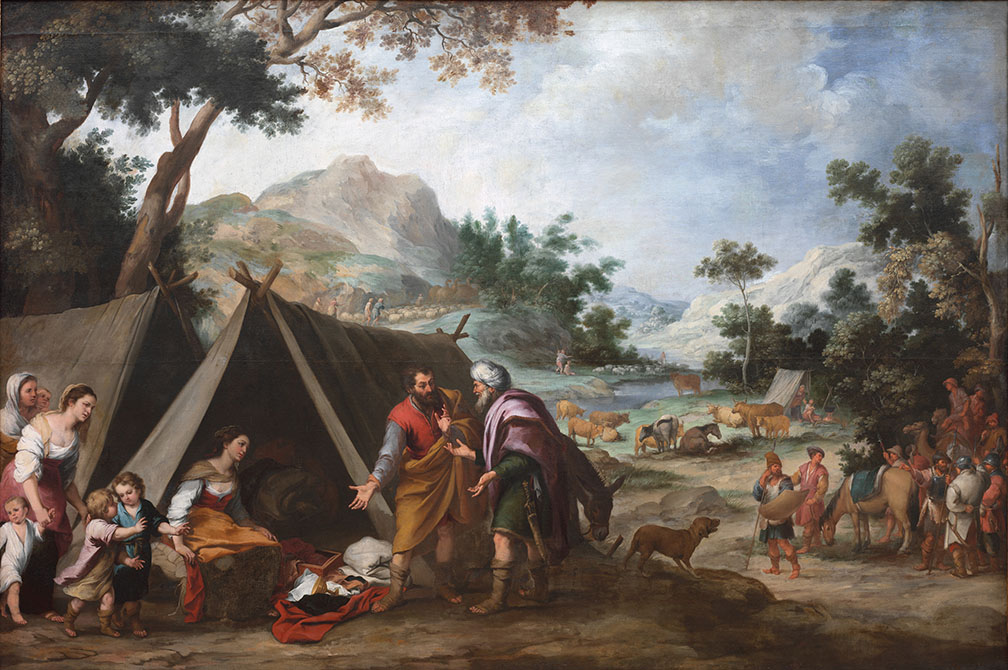
We know, even if Jacob doesn’t, that Rachel is hiding her father’s ornaments beneath the cushions of her chair.
Why she felt compelled to take these idols isn’t explained, but we can guess that her grasp of the one-True-God concept is, shall we say, immature.
Laban looks around and finds nothing. But it’s the last straw for Jacob. He wants total separation.
The two men strike an uneasy truce, and Jacob and his family resume their trek, not knowing that even greater danger lies around the next bend.
And that is a brief summary of Torah Portion Vayetzei.
Allen Estrin is the Executive Director and Co-Founder of PragerU. He is also the President of the Torah Minyan in Valley Village. TorahMinyan.org
Torah Portion: Vayetzei Read More »