
One verse, five voices. Edited by Nina Litvak and Salvador Litvak, the Accidental Talmudist
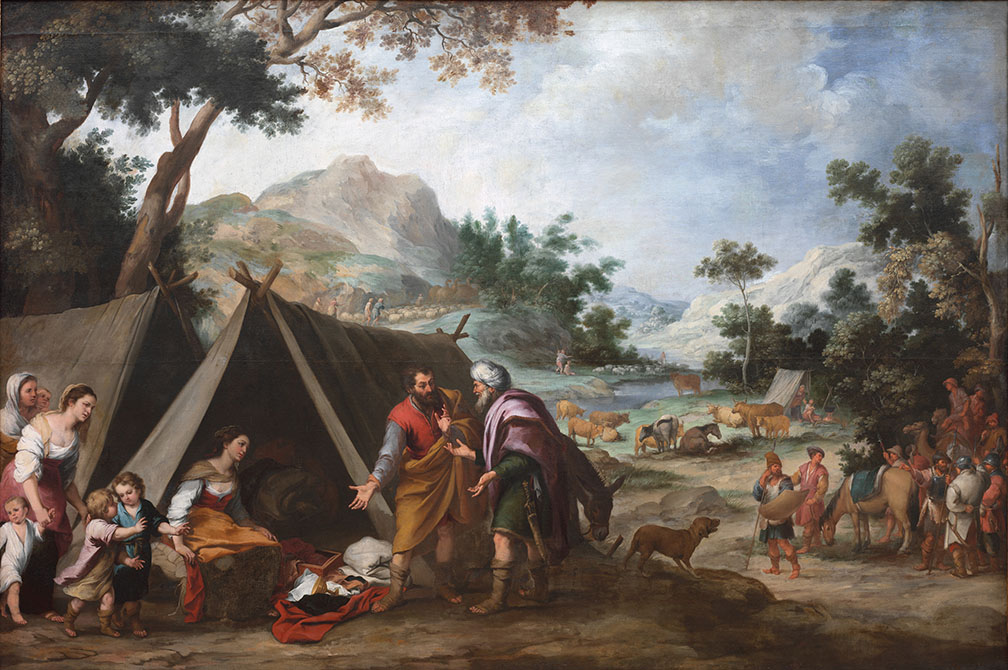
And behold, the Lord was standing over [Jacob], and He said, “I am the Lord, the God of Abraham your father, and the God of Isaac; the land upon which you are lying to you I will give it and to your seed.
– Genesis 28:13
Yehudit Garmaise
AMFT, who works with children and adults with neurodivergence and PTSD
Hashem was standing over Jacob “to guard him,” Rashi says. Hashem folded up the entire land of Israel to be used as Jacob’s holy pillow, writes Rabbi Yaakov Moshe Charlap, so that Jacob would internalize that “Jews who are connected to the spiritual narratives of their soul stand above the constraints of time and space.” For instance, Hashem significantly shortened the journeys of both Jacob and Eliezer, Rabbi Charlap reminds us.
The Divine Help Hashem promised Jacob further amplified the deep, rich and calming benefits of the relationship with Hashem that Jacob had inherited from his holy father Isaac. What Isaac Avinu passed down to Jacob and to all of K’lal Yisroel, Rabbi Joey Rosenfeld teaches, in addition to the land, was “a way of coping with difficulty in this world that not only alleviates the mental burdens of suffering but also alleviates the experience of suffering itself.”
What Isaac developed was the ability “to sweeten all harsh decrees.”
In his terror, bitachon and holiness, Isaac Avinu cultivated a relationship with Hashem that is referred to as Nochacht: Present. Right here. Right now. Always. No Matter What. “Isaac Avinu related to Hashem through the lens of ‘Ata’ of Hashem as ‘You’: Face to face.” At the very site at which Isaac cultivated his ability to tune in to his intuition to perceive Hashem’s nearness, Hashem folded up the land of Israel to make a pillow for Jacob so he could also experience how Divine help surpasses logic, time and space.
Denise Berger
Freelance Writer
This verse doesn’t just promise Jacob that the Land of Israel will belong to his descendants. The manner in which Hashem shares the promise sets forth central aspects of the Jewish approach to life. In this pasuk, and in the verses that immediately follow, there aren’t long descriptions of greatness, status or glory. The relatively small area of land is given to us simply as a space to live, to be our Jewish selves. Throughout our history, the Jewish people have been focused on the acts of living. It’s both humble and bold, no matter what happens to us, no matter what hardships befall us, we continue to work hard, build families and remain connected to each other Keep on keeping on, as the saying goes.
The land isn’t promised immediately. In fact, there isn’t even a timeframe given. Jacob’s grandfather Abraham knew his descendants would be enslaved for hundreds of years. Judaism plays the long game; we don’t get bogged down by our immediate circumstances. Additionally, the promise is given to Jacob in a dream – the famous dream with angels going up and down a ladder. We embrace spirituality and the realm of the unseen/intangible even as we engage with the most mundane and practical tasks. In the Jewish worldview, these are not separate domains. Taken together, these are not only a promise for the future but a set of guidelines. These guidelines, the manifestation of Hashem in our lives, are intrinsic to Judaism, as is Israel.
Rabbi Shmuel Reichman
Bestselling Author and Inspirational Speaker (ShmuelReichman.com)
“I want the very best.” That’s what we tell ourselves, isn’t it? As human beings, we understand that there is a spectrum of quality for everything, and we want only the best. We desire the best relationships, teachers, friends, experiences … the best of everything.
The Torah tells us that Hashem promised our forefathers the land of Eretz Yisrael (the Land of Israel). However, we must ask: what makes this land so special? On the surface, the answer is simple: Eretz Yisrael is the home of the Jewish People. However, to understand its true value, we must delve even deeper. On a fundamental level, the land of Eretz Yisrael has a unique spiritual nature. The Torah is replete with mentions of Eretz Yisrael’s greatness, holiness and uniqueness. Strikingly, there are a number of mitzvot that can be performed only in Eretz Yisrael: this special treatment is not practical, it is indicative of the objective transcendent status of the land. This is why the Beis Ha’Mikdash – the spiritual center of the universe – was located at the center of Eretz Yisrael.
And this is why Hashem promised our forefathers Eretz Yisrael as a sign of their eternal covenant. While the entire world is infinitely spiritual, Eretz Yisrael possesses a fundamentally higher spiritual quality. Eretz Yisrael has no equal, there is nothing that can be compared to it. May we be inspired to continuously deepen our connection with Hashem and Eretz Yisrael, and may we become the ultimate vessels for Hashem in this world.
Rabbi Ari Averbach
Temple Etz Chaim, Thousand Oaks
Last year, during a Torah study, I asked congregants to summarize the Torah on one foot, a la Hillel’s line in Mishnah, “Don’t do to others what you wouldn’t want done to you.” Some agreed with Hillel that the Torah is about being a good person. Some saw the Torah as a way to make our lives holy through mitzvot. Other beautiful ideas were shared.
One congregant disagreed. The whole Torah, he said, is about our connection to the Land of Israel. It is stated repeatedly, to each patriarch in Genesis, and seems to be the main thrust of the next four books – trekking to get back to Eretz Israel. This sparked a wonderful conversation about the role of Israel in Judaism. A reminder that we get to live in a time where Israel, the land spoken of since our earliest writings, is in existence.
For most of Jewish history – the times of Rashi and Rambam and Besht, great luminaries over centuries – Israel was an impossible dream, a direction to face when praying from under authoritarian rule thousands of miles away. In his commentary on Genesis, Ibn Ezra (12th century Spain) explains the geography of the land, since no one in his circles would have been there or even found its geographical features on a map. Israel has always been part of the conversation, but never a given. Let’s not forget that. Hillel’s summary of Torah concludes: “Now go and learn.” There is always another perspective to study.
Rabbi Michael Barclay
Senior Rabbi Temple Ner Simcha & Host of “The Rabbi’s Table” – TheRabbisTable.com
There may be no more perfect verse to study in these challenging times: right after this nation voted in a slew of candidates who believe that Israel has no right to exist. This verse teaches the exact opposite: not only does Israel have a right to exist as a Jewish state, it is ordained as such by God.
Jacob approaches this experience in fear, as he has just fled from his family after his life was threatened by Esau. But in the midst of his fear, God visits him and promises the land to Jacob and his descendants. God is extremely specific. He mentions Abraham and Isaac, but not Ishmael. He promises the land exclusively to Jacob’s descendants, with no mention of Esau. God makes it clear that the land is to be in the specific lineage of Abraham, Isaac and Jacob: the land is to be a Jewish nation. By God’s commandments, it is ours and is always to be the Jewish homeland.
Only a few verses later (28:15), God reiterates the promise and adds that even though He may take the Jewish people out of the land, he will return them to it. This is not said to the descendants of Ishmael or Esau but is a Divine commitment to the line of Abraham, Isaac and Jacob: the Jews.
This verse reminds us that Israel as the Jewish state was promised to us by God; there has been a continuous Jewish presence in Israel since that promise to Jacob over 3,000 years ago; and we should remember that it will always be our home.