

In the last Torah portion, Jacob finally frees himself from the yoke of his avaricious Uncle Laban. But Jacob knows that he’s only jumping out of the frying pan into the fire.
In order to get back to Canaan, he has to travel through the land of his brother, Esau, who, the last he’s heard – admittedly 20 years ago – hates his guts and wants him dead.
To deal with this contingency, Jacob puts a clever and complex plan into action.
First, he divides his family and property into two separate camps, and then sets them off on two separate paths; each camp to be preceded by a king’s ransom of livestock.
Ever the pragmatist, the idea is that the gifts will soften any anger Esau may still be feeling, but if that doesn’t work, the two-camp strategy will at least save half of his family and assets.
The patriarch sends everybody on ahead and spends the night in solitude.
Or so he thinks.
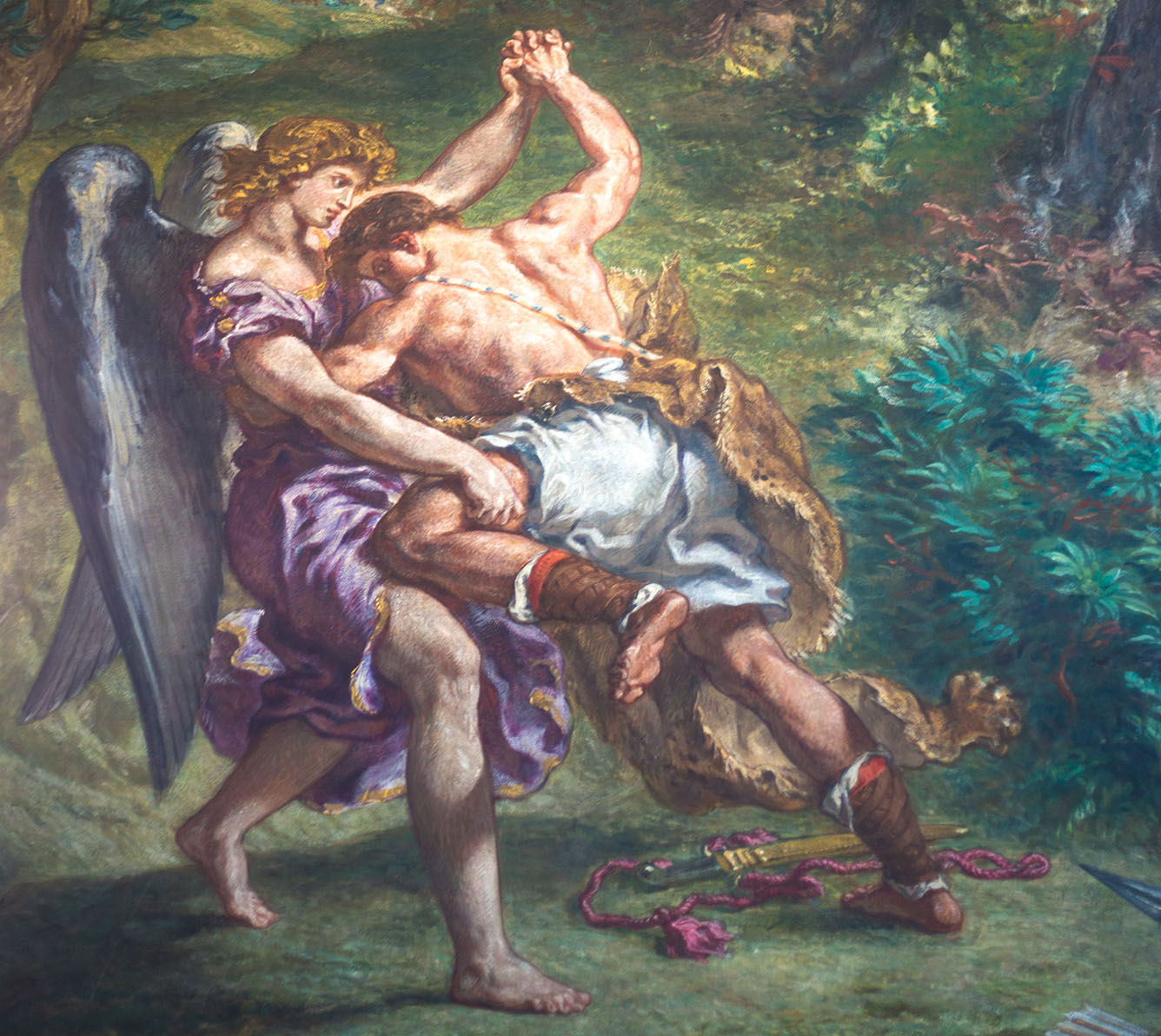
Late in the evening, one of the most famous and enigmatic incidents in the Torah takes place – Jacob wrestles with an angel. They fight to a draw, neither Jacob nor the strange interloper giving quarter.
By dawn Jacob seems to have the upper hand and the patriarch, the great collector of blessings, demands one from his opponent.
The angel obliges, renaming Jacob, Israel, which means “struggle with God,” truly a divinely inspired appellation for the Jewish nation.
Following his confrontation with the angel, Jacob moves almost immediately into a confrontation with his brother.
But Esau seems to have forgiven him and the reunion goes well — so well, that Esau proposes that they travel together. But Jacob, cautious to the point of paranoia, begs off and they go their separate ways.
Jacob and his family travel on to Shechem, a town inside the borders of Canaan. While there, Dinah, his only daughter, is raped.
But, in a fateful twist, the rapist falls in love with his victim and asks his father, who happens to be the village chieftain, to make a deal with Jacob to get Dinah for his wife.
When Dinah’s brothers, Jacob’s sons, hear what has happened to their sister, they explode in anger. But they quickly suppress it, at least for the moment.
The rapist’s father, unaware of their outrage, makes the following proposal to his in-laws-to-be: “Give your daughter to my son and you can stay in this land. We’ll all live and work together, intermarry and be one big happy family. I’ll even throw in a good chunk of my own fortune as the bride price.”
The brothers – these boys have obviously learned a few tricks from Dad – agree, with one caveat: they can’t allow their sister to marry a man who is uncircumcised.
If the groom and all the men in the town agree to submit themselves to this little operation, the sons will do the deal. Anxious for the merger, so that they can get their hands on Jacob’s considerable wealth, the men of the town sign off.
On day three, following the mass circumcision, two of Jacob’s sons, Simeon and Levi burst into town, swords at the ready; and slice and dice all the weakened Shechemite males.
The other brothers then swoop in and carry off everything that’s portable, including women and children.
When Jacob finds out what they’ve done, he’s appalled and frightened. He’s frightened because he figures that when the other Canaanite tribes hear what his sons have done, they’ll unite and come after them. But Simeon and Levi brush him off.
In one of the great toppers of the Torah, they have this to say to their father after he berates them for endangering the tribe. “Should our sister be treated like a whore?” To this the patriarch has no answer.
Jacob’s fears of attack prove unwarranted. Fearful of God’s wrath, the other cities in Canaan leave the Hebrews alone.
Returning to Bethel, the place where Jacob had his Stairway to Heaven dream and first encountered the Almighty, the patriarch builds an altar.
But before he does, he insists that everyone in his entourage ditch their household deities and associated trinkets.
Does this mean that everyone in Jacob’s orbit is not a monotheist? Apparently so.
But that will now change. Jacob has another God-infused dream and whatever lingering doubts he may have harbored about the Master of the Universe are now well and truly gone.
He tells the family — just as Moses will tell the Israelites far in the future — to purify themselves and change their clothes.
The one true God has shown himself and they need to show their acknowledgment of this fact.
The trinkets are buried in a simple ceremony and so is paganism.
Soon after, the Almighty renews the covenant with the man he has renamed Israel.
But nothing is ever easy for Jacob. As his family moves on toward a final reunion with his father, Isaac, Jacob’s favorite wife, Rachel, who is pregnant with their second son, Benjamin, dies in childbirth.
In the midst of this sadness, Jacob’s son Reuven, a true troublemaker, adds to his father’s misery by sleeping with one of his concubines.
Still, Jacob perseveres, finally reaching his father who is now 180 years old. The old patriarch dies, and Jacob and Esau, literally enemies since birth, now finally brothers, bury him together in Hebron.
And that is a brief summary of Torah portion Vayishlach.
Allen Estrin is the Executive Director and Co-Founder of PragerU. He is also the President of the Torah Minyan in Valley Village. TorahMinyan.org
































