fbpx

November 24, 2026

Being the V’

After a school week spent with my best friends, I look forward to spending a few hours each Saturday at shul with my other best friends — the ones who are at least quadruple my age. The time I spend with these friends at synagogue is the highlight of my week. It’s an oasis of unbridled joy, enthusiasm and lots of “puh, puh, puh”s to avoid drawing the evil eye. It’s a much-needed break from the rat race that is 10th grade, two solid hours of spiritual respite and renewal, and I’m lucky to get to experience it with the most passionate and joyous Jews around.

Some Saturdays, I engage with the other end of the spectrum. Through working with my synagogue’s youngest congregants at the Shabbat childcare, I get to see the delight on each kid’s face as they exclaim the lyrics to Bim Bam and gallivant around with stuffed torahs. A girl excitedly tells me about the challah she made the previous day in preschool. A boy loudly asks another volunteer to read him “Sammy Spider’s First Passover” over and over. 

These two groups are both unabashedly, and proudly, Jewish. For the latter, it’s because they haven’t been taught not to live that way yet. But for the former, it’s because they’ve finally stopped listening to those who teach them not to Jew out loud, so to speak. 

You’re almost certainly familiar with the concept of “L’dor V’dor,” from generation to generation. Almost every week since birth I’ve sung those words, but only recently did their pertinence to my life dawn on me. I, my sisters, my friends at school—we’re the “V’”. We are the bridge between two joyous generations. Preventing said bridge from sinking into the mud of assimilation and despair hasn’t been easy these past few years, so we definitely have our work cut out for us.

But how? How can we keep living joyously in our Judaism in a time where society tells us to do the opposite? The answer to this is shockingly simple: community. To witness joy is to experience joy, so by spending time with these two incredibly happy groups, we multiply our own happiness. This is possible through so many ways, like shmoozing over bagels with the Deborahs and Davids in your own community, or reading PJ Library books to little Elijahs and Mayas.

At my local nursing home this summer, I taught Jewish seniors how to journal. I grew extremely close with my group of residents, and began looking forward to telling them all about my week and in turn hearing about theirs. All of our regulars were deeply happy Jews, possessing a kind of happiness that can only be experienced once you let go of the unofficial edicts of our society that tell us to be solemn and secret Jews. I came out of that experience changed, having born witness to the purest nachas out there.

During the school year, I serve as an assistant teacher at my alma mater Hebrew school. I work with kids ranging from ages 5 to 12, and I see the excitement on their faces before shira (song session), tefillah (prayers), and even before the tzedakah (charity) box is passed around every week. Primary Jewish education like this cultivates the inherent joy found in kids into the basis of a strong, lifelong Jewish identity — and one rooted in elation.

The Jewish spirit thrives in those too young or too old to be affected by the antisemitic ways of our world, those that try and quash the multigenerational soul that our tradition carries. Simply put, we start joyous and end joyous, but may stray from the path along the way. By amplifying the happiness these two discrete generations receive from being Jewish, we can be the bridge. As we serve as the v’, we ensure dor will become dor will become dor, for as long as time extends. 

Being the v’ isn’t easy. Frankly, being Jewish isn’t exactly an easy lift. But, with the right mindset and some help from friends across all ages, we can do it. We can carry on the Jewish joy of our parents and of our children. We can, and we will. 


Judith Wachs is a tenth grade student at de Toledo High School who spends her time writing, volunteering, and being involved in her local Jewish community. 

Being the V’ Read More »

Eisenkot’s Hard Choices

The most important question in Israel is no longer whether Gadi Eisenkot will break a campaign promise to become prime minister. The question now is which promise he will break to get the job. 

Don’t take my word for it. Eisenkot himself made it clear last week that he saw three realistic options to form a government. But each of the three requires him to at least partially violate a campaign pledge. With only a little more than a week before his deadline to present a governing coalition before Benjamin Netanyahu gets his turn, Eisenkot’s three alternatives – and the tradeoffs necessary to achieve any of them – have become increasingly stark. None of them are ideal, but one will be necessary for him to take over as Israel’s next leader.

The first is the most controversial and most politically dangerous. Israel’s two Arab parties could provide him with the votes he needs to assemble a majority coalition in the Knesset. But Eisenkot promised as a candidate that no party could join his government unless they were willing to publicly designate Hamas as a terrorist organization. The more mainstream Ra’am party could conceivably agree to language that would pass muster, but the extreme members of the Joint List would almost certainly not. Eisenkot was careful to refer to this option as a “national emergency government” and would likely involve the two Arab parties as unofficial members of a governing coalition that would not include their official endorsement. Such an arrangement would technically meet Eisenkot’s conditions for inclusion, but it is a verbal sleight-of-hand that would enrage many of his existing allies and threaten their support. This is a last resort for his Yashar party, but the fact that he includes it as a possible option indicates his concern about the likelihood of achieving either of the less risky paths forward.

The second possibility would be for Eisenkot to recruit some of the ultra-Orthodox parties that have been at the core of Netanyahu’s government. While they are leery of Eisenkot, they may also see being part of his coalition as a way of making sure at least some of their policy priorities are included as part of the next government’s agenda. The problem is that the most important of those priorities, allowing the Haredi to continue to avoid military service so as not to interfere with their religious studies, also violates one of Eisenkot’s campaign promises. This commitment from Eisenkot represents perhaps the most essential domestic policy distinction between him and Netanyahu, and while it is plausible that he could create a compromise involving nonmilitary national service for some Haredi youth, such an agreement could also undermine his ability to lead from the outset.

The third choice would be the least enjoyable for Eisenkot, but possibly the most politically achievable. Forming a centrist coalition with Netanyahu contains many pitfalls, most notably Netanyahu’s insistence that he serve as Prime Minister first in a rotation arrangement. This alternative is also one that Eisenkot explicitly ruled out during the campaign, but as his deadline approaches, it may be a path that he will be forced to consider. 

The red-letter decision is whether he or Netanyahu would lead first, and it’s difficult to see Eisenkot’s supporters being willing to stomach a stated agreement that keeps the current prime minister in place even temporarily. Eisenkot’s language about Netanyahu during the campaign made it clear that he not only sees important policy differences separating the two men but fundamental character disagreements as well. This would be an excruciating personal decision for Eisenkot, but it would keep him on the path toward his goal without the political fallout of the other two alternatives.

The other potential outcome is a deadlock in which neither leader can form a government. This would require a new election sometime next spring and would allow Netanyahu to remain in place until that election takes place. That would be the worst of all possible worlds for Eisenkot and his party. But it could also make potential Haredi or Arab partners slightly more tolerable to them.


Dan Schnur is the U.S. Politics Editor for the Jewish Journal. He teaches courses in politics, communications, and leadership at UC Berkeley, USC and Pepperdine. He hosts the monthly webinar “The Dan Schnur Political Report” for the Los Angeles World Affairs Council & Town Hall. Follow Dan’s work at www.danschnurpolitics.com.

Eisenkot’s Hard Choices Read More »

Torah Portion: Vayishlach

In the last Torah portion, Jacob finally frees himself from the yoke of his avaricious Uncle Laban. But Jacob knows that he’s only jumping out of the frying pan into the fire. 

In order to get back to Canaan, he has to travel through the land of his brother, Esau, who, the last he’s heard – admittedly 20 years ago – hates his guts and wants him dead.  

To deal with this contingency, Jacob puts a clever and complex plan into action. 

First, he divides his family and property into two separate camps, and then sets them off on two separate paths; each camp to be preceded by a king’s ransom of livestock.  

Ever the pragmatist, the idea is that the gifts will soften any anger Esau may still be feeling, but if that doesn’t work, the two-camp strategy will at least save half of his family and assets. 

The patriarch sends everybody on ahead and spends the night in solitude. 

Or so he thinks. 

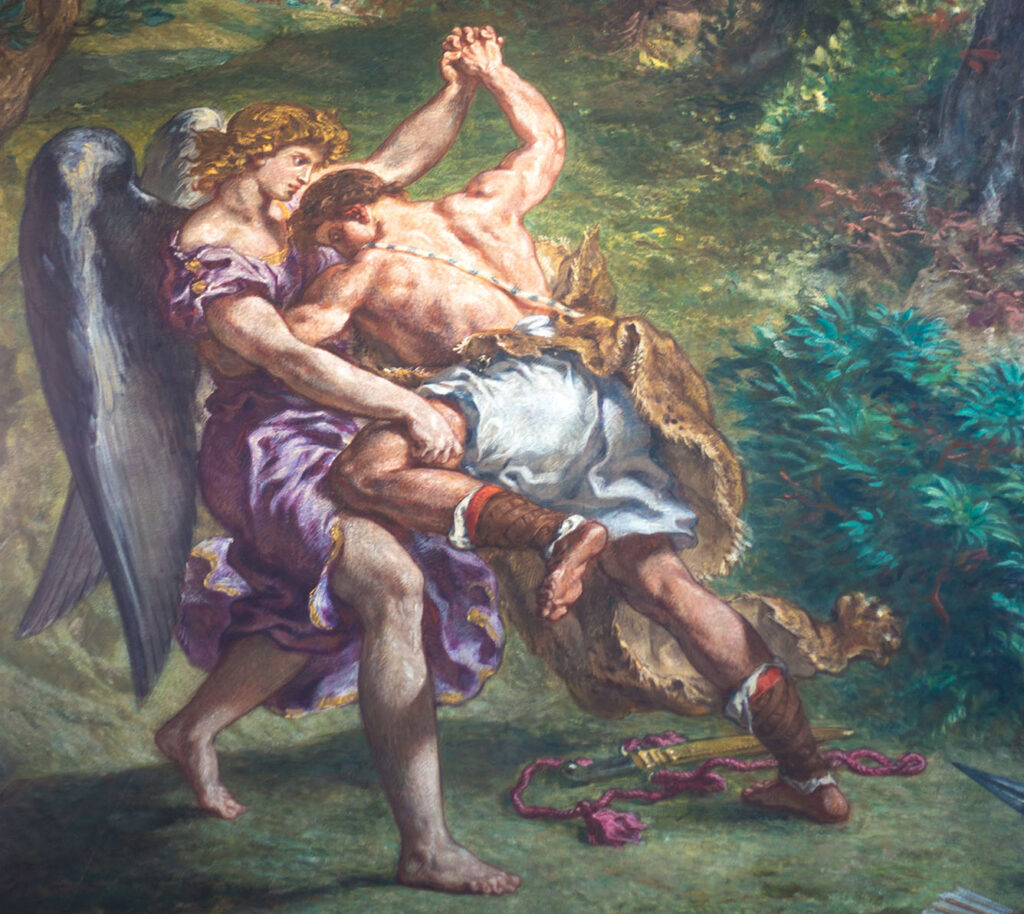
Late in the evening, one of the most famous and enigmatic incidents in the Torah takes place – Jacob wrestles with an angel.  They fight to a draw, neither Jacob nor the strange interloper giving quarter.  

By dawn Jacob seems to have the upper hand and the patriarch, the great collector of blessings, demands one from his opponent. 

The angel obliges, renaming Jacob, Israel, which means “struggle with God,” truly a divinely inspired appellation for the Jewish nation.   

Following his confrontation with the angel, Jacob moves almost immediately into a confrontation with his brother. 

But Esau seems to have forgiven him and the reunion goes well — so well, that Esau proposes that they travel together. But Jacob, cautious to the point of paranoia, begs off and they go their separate ways.

Jacob and his family travel on to Shechem, a town inside the borders of Canaan. While there, Dinah, his only daughter, is raped. 

But, in a fateful twist, the rapist falls in love with his victim and asks his father, who happens to be the village chieftain, to make a deal with Jacob to get Dinah for his wife. 

When Dinah’s brothers, Jacob’s sons, hear what has happened to their sister, they explode in anger. But they quickly suppress it, at least for the moment. 

The rapist’s father, unaware of their outrage, makes the following proposal to his in-laws-to-be: “Give your daughter to my son and you can stay in this land. We’ll all live and work together, intermarry and be one big happy family. I’ll even throw in a good chunk of my own fortune as the bride price.” 

The brothers – these boys have obviously learned a few tricks from Dad – agree, with one caveat: they can’t allow their sister to marry a man who is uncircumcised. 

If the groom and all the men in the town agree to submit themselves to this little operation, the sons will do the deal. Anxious for the merger, so that they can get their hands on Jacob’s considerable wealth, the men of the town sign off.

On day three, following the mass circumcision, two of Jacob’s sons, Simeon and Levi burst into town, swords at the ready; and slice and dice all the weakened Shechemite males. 

The other brothers then swoop in and carry off everything that’s portable, including women and children.

When Jacob finds out what they’ve done, he’s appalled and frightened. He’s frightened because he figures that when the other Canaanite tribes hear what his sons have done, they’ll unite and come after them. But Simeon and Levi brush him off. 

In one of the great toppers of the Torah, they have this to say to their father after he berates them for endangering the tribe.  “Should our sister be treated like a whore?”  To this the patriarch has no answer. 

Jacob’s fears of attack prove unwarranted. Fearful of God’s wrath, the other cities in Canaan leave the Hebrews alone. 

Returning to Bethel, the place where Jacob had his Stairway to Heaven dream and first encountered the Almighty, the patriarch builds an altar. 

But before he does, he insists that everyone in his entourage ditch their household deities and associated trinkets.  

Does this mean that everyone in Jacob’s orbit is not a monotheist? Apparently so. 

But that will now change. Jacob has another God-infused dream and whatever lingering doubts he may have harbored about the Master of the Universe are now well and truly gone. 

He tells the family — just as Moses will tell the Israelites far in the future — to purify themselves and change their clothes. 

The one true God has shown himself and they need to show their acknowledgment of this fact. 

The trinkets are buried in a simple ceremony and so is paganism. 

Soon after, the Almighty renews the covenant with the man he has renamed Israel. 

But nothing is ever easy for Jacob. As his family moves on toward a final reunion with his father, Isaac, Jacob’s favorite wife, Rachel, who is pregnant with their second son, Benjamin, dies in childbirth. 

In the midst of this sadness, Jacob’s son Reuven, a true troublemaker, adds to his father’s misery by sleeping with one of his concubines.  

Still, Jacob perseveres, finally reaching his father who is now 180 years old.  The old patriarch dies, and Jacob and Esau, literally enemies since birth, now finally brothers, bury him together in Hebron.  

And that is a brief summary of Torah portion Vayishlach.


Allen Estrin is the Executive Director and Co-Founder of PragerU. He is also the President of the Torah Minyan in Valley Village. TorahMinyan.org

Torah Portion: Vayishlach Read More »