


New York’s 8th Congressional District is one of the most Jewish districts in America: roughly one-in-10 voters, who show up at the polls at a much higher rate than their neighbors. This is the district of Hakeem Jeffries, who in January will become Speaker of the House. For the next two years, Jeffries will be a very powerful man in his party and in setting America’s agenda.
Jeffries always treated Israel the way you would expect the representative of such a Brooklyn district to treat it. He visited here more than any other country. He said, only half joking, that Jerusalem is New York’s “sixth borough.” He called Israel a miracle. He came with AIPAC delegations. He met with Benjamin Netanyahu and was criticized for it. Last week, in a long and very cautious interview with the New York Times, he declined to endorse the initiatives of fellow Democrats who want to restrict the sale of offensive weapons to Israel. He did announce his intention to target Israel by prioritizing other law. Within his first 100 days, he said, “the most decisive step that we can take” is to pass the West Bank Settler Violence Protection and Prevention Act. He expects strong support for it in his caucus.
The interview was published on Saturday. On Saturday night, as if on cue, groups of Jews went out to make his case for him. Cars were torched in Palestinian villages near Ramallah and elsewhere. An agricultural structure was set on fire. “Revenge” was sprayed on walls, in Hebrew. Opposition leader Gadi Eisenkot called it Jewish terrorism. The foreign minister condemned it. The army complained, not for the first time, that soldiers needed elsewhere are busy chasing Israelis. Condemnations we have in abundance. What we do not have is a state that makes it stop.
Which brings us back to the bill. It is not new. U.S. Rep. Jerry Nadler (D-N.Y.) introduced it in April 2025, to greet Minister Itamar Ben-Gvir on his visit to the United States. It declares that the situation in the West Bank “in particular high levels of extremist settler violence, forced displacement of people and villages and property destruction” – has reached intolerable levels. It says that the president “shall impose” sanctions – frozen assets, no visa – on any foreigner he determines to be responsible for, or complicit in, “actions, including directing, enacting, implementing, enforcing or failing to enforce policies,” that threaten the peace, security or stability of the West Bank.
“Failing to enforce.” Read these three words with Saturday night in mind, and then consider an easy case. Defense Minister Israel Katz decided to stop the administrative detention of radical settlers. Is that a failure to enforce? If the answer is yes, and if the bill passes, and if the president does not veto it, or if Congress finds a majority to override the veto, Katz is in trouble. And not only Katz. The bill also covers whoever is, or was, “a leader or official” of an entity – “including any government entity” – whose members did such things. A strict reading could apply the sanctions to the entire security cabinet.
And there is a harder case. The bill’s list of forbidden actions includes “property destruction” and making civilians fear violence, and it reaches not only those who do these things but also those who are “complicit” in them, or engaged in them “directly or indirectly.” Now picture the following situation: IDF soldiers protecting a group of Jews who are damaging an olive grove from a crowd that is trying to drive them away. Is this complicity in property destruction? Some will say no. Some will say yes. If those who say yes are in power, the implications could be far reaching.
Still, this is an easy law for Israel. Everything in it depends on what the president “determines.” The bill lets the secretary of state waive the entry ban, when a visit “would not be contrary to the interests of the United States.” Marco Rubio can decide that Americans simply must meet with Katz. But when someone else sits in the White House, the pressure to apply the law broadly could grow.
So what does Jeffries’ support for Israel mean? It means recognition of reality. A Democratic legislator can no longer block every initiative that seeks to restrain Israeli policy. He can, in the best case – and Jeffries is more or less the best case – prefer laws that are softer, more targeted, more open to interpretation and hope that Israel takes the hint. He can use such laws to delay, or prevent, the passage of much harsher and more dangerous ones.
On the day Congress adopts this bill – and one should assume that it will, perhaps with the support of a few Republicans, though none has signed on so far – the usual cries will rise from Israel. It is antisemitism. It is antizionism. It is an assault on our sovereignty. It is proof of an ancient hatred. The truth is different: this will be an act of friendship. Jeffries, who wishes us well, is merely asking us to pay attention. To fix what must be fixed before it is too late, before it gets worse, before those who truly want to hurt Israel are able to pass laws that truly hurt.
Something I wrote in Hebrew
Israel is trying to form a coalition. Using a post-election survey, I tried to explain why almost no one is going to be satisfied:
We asked every respondent two things: which of the 11 parties in the new Knesset he would not accept in the coalition under any circumstances, even at the price of another election, and which principles a party must accept in order to be in it. Then, for each respondent, we removed the parties he vetoed, removed the parties that do not meet his principles, and counted the seats that were left. If 61 were left, this Israeli has a coalition he can live with. How many Israelis have one? About a quarter. Maybe Israelis simply veto too many parties? No, that is not the problem. The average Israeli vetoes about four parties out of 11 and, with vetoes alone, 91% could still put together 61 seats. The principles are the obstacle: add them, and 91% becomes 25%. The Israeli does not get stuck on the question of who sits next to whom. He gets stuck on the question of who is willing to do what.
A week’s numbers
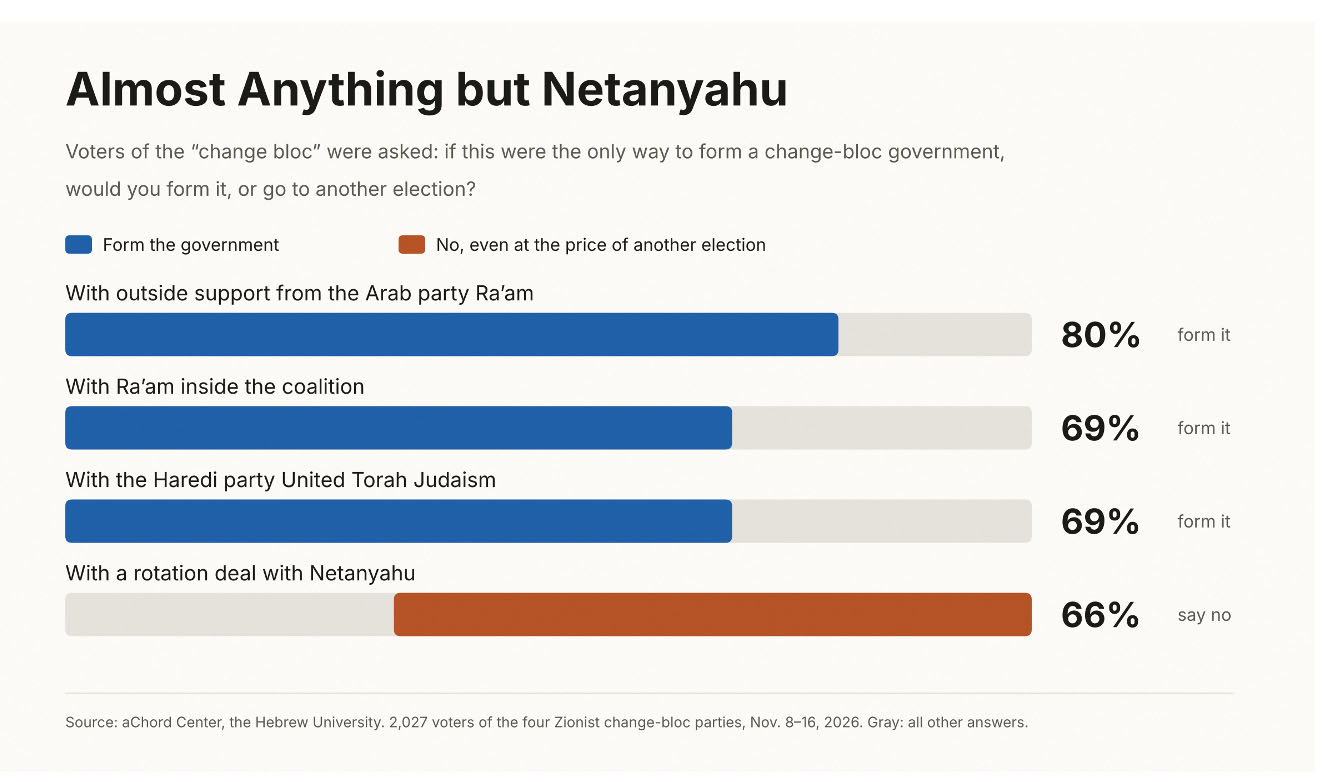
Most voters of the “change bloc” will accept almost any partner to get a government – except one: 66% of them say no to a rotation with Netanyahu, even at the price of another election.
A reader’s response
Naomi Eschenheimer asked: Why are Israelis becoming so racist towards the Arabs? My response: It’s a long conversation, but the very short version is “fear.”
Shmuel Rosner is senior political editor. For more analysis of Israeli and international politics, visit Rosner’s Domain at jewishjournal.com/rosnersdomain.































