

The name of this parsha is the lives of Sarah. This is another example of instant Torah wisdom. What do I mean by this? Think about your own life.
Are you the same person now that you were at, say, 30? Probably not. In short, none of us live one life.
We live multiple lives. Sarah, and for that matter, Abraham, would certainly agree.
This also explains the Jewish tradition of marking a person’s death each year — their yahrzeit — rather than their birth. It’s only after someone dies that we can fully assess their life, or as just noted, their lives.
Abraham takes Sarah’s passing hard. Why wouldn’t he? They’ve been a couple for over a century.
The last years, however, The Torah suggests, were not their best. In fact, they may not have even spent them together.
Their separation is suggested by the curious description of Abraham staying in Beersheba following his close shave with Isaac and our learning that the first matriarch died in the city of Hebron.
As it often is, the Torah is elliptical in matters of narrative. But one can fairly speculate that a tough old bird like Sarah would not have reacted well to the news that her husband had almost sacrificed their only son.
Whatever happened, now she’s gone, and Abraham is left with the task of arranging her funeral.
He negotiates with the leaders of the local population for a burial site — the cave of Machpelah. The idea that Jews never pay retail did not originate with the first Jew.
The people of Hebron, in deference to Abraham’s considerable reputation, offer the site to him as a gift. But the patriarch insists on paying full fare. He doesn’t want future ownership disputed.
Never let it be said that he acquired this property in any way other than one that was above board, transparent and honest. In other words, “I bought it. I own it. Here’s the receipt to prove it.”
The funeral and mourning concluded, it’s now time to look for a wife for Isaac.
Not happy with the idol-worshipping women of Canaan — a population never held in high esteem in the Torah — Abraham sends his right-hand man, Eliezer, one of the true good guys of the Five Books, east to the town of Nahor, Abraham’s ancestral home, to find a suitable bride.
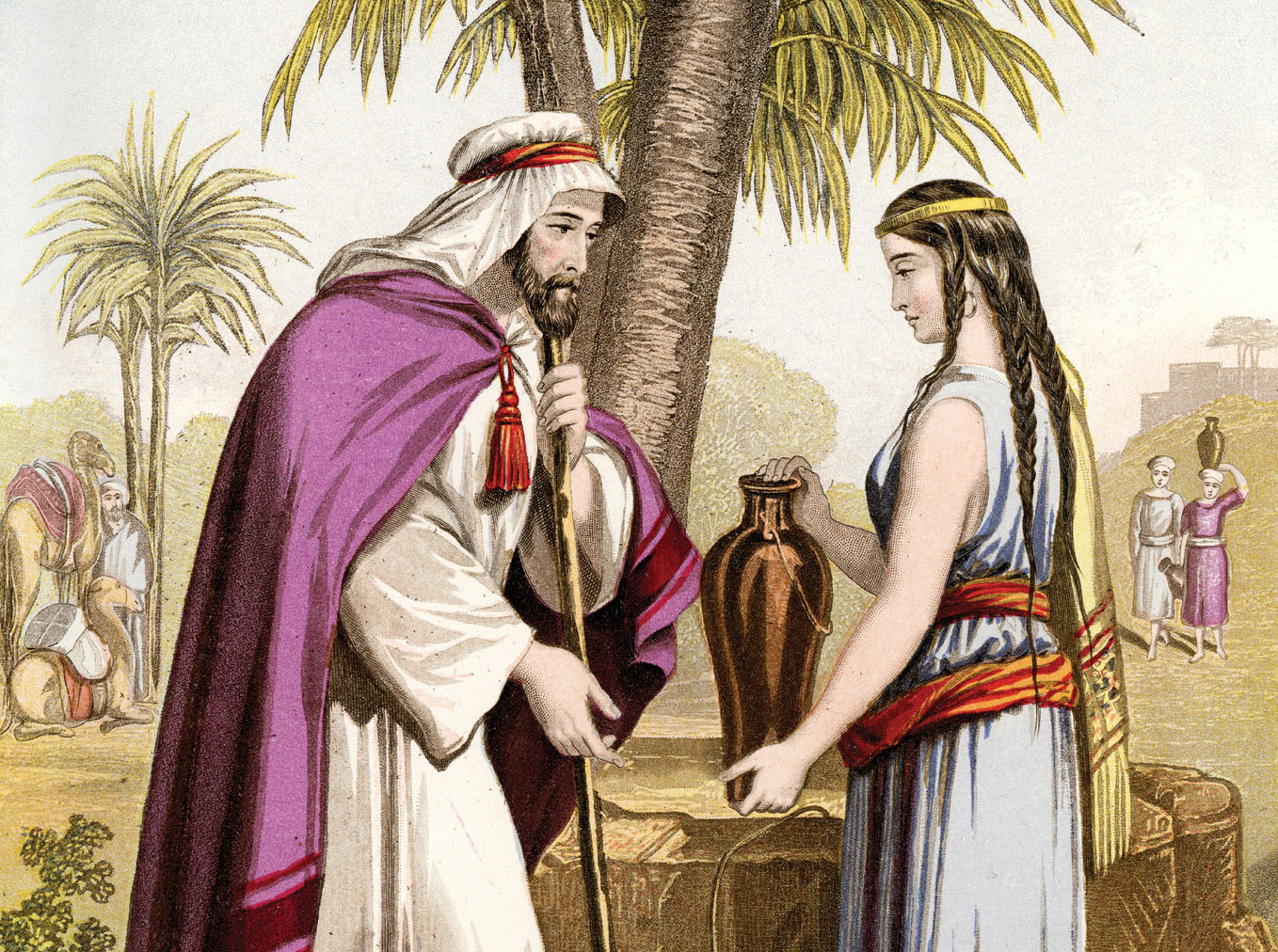
The emissary arrives at the outskirts of the town and makes the first prayer in the Torah. He asks God to direct him to a young woman who, by right action, will demonstrate herself to be a mate worthy of the son of his master.
And, as he prays, it happens.
A girl steps forth and helps him water his camels. She does so in such a friendly, generous and guileless way that he is deeply touched. It doesn’t hurt that she is also beautiful. And the topper? She’s part of the Abraham’s extended family.
Her name is Rebekah, and she offers to take the stranger to meet her brother, Laban. A sharpie who has a big part in the Genesis story, Laban is suitably impressed by Eliezer’s display of Abraham’s wealth.
A marriage contract between the young woman and Isaac is quickly agreed upon.
His task completed, Eliezer is anxious to return home. But Laban wonders what the rush is. Why not stay a while and relax; let mother and daughter have some time together. Who knows if they’ll ever see each other again.
One can almost imagine Laban suggesting a friendly game of poker, anything to separate the servant from his master’s money.
But the emissary wishes to brook no delay. Settling the question is left to Rebekah. Does she want to leave now or linger for a few more days with her family?
Flashing the spine for which she will become known and admired, she decisively opts for the former.
A few days later, Isaac and Rebekah meet as the sun sets over the desert. He likes what he sees, and so does she. He takes her into his tent as night falls, and the marriage is consummated.
Meanwhile, Abraham marries again and has six more children. His second wife and his second family quickly fade into history.
While providing for their needs, he leaves his estate and his legacy to Isaac. At the ripe old age of 175, the patriarch dies and is, according to the text, “gathered to his kin,” the first suggestion in the Torah of the existence of an afterlife.
How does this suggest something beyond this life? Because it says, “he died, old and contented,” and then it says, “and he was gathered to his kin.”
It could very easily have said he died old and contented and left it that. But “gathered to his kin” can have no other meaning than an afterlife. If “gathered to his kin” merely meant he was buried next to Sarah, it would have exactly said that.
Still, the Torah spends scant time on the afterlife question.
There are two likely reasons for this: 1) The Torah is anti-all-things-Egyptian. And Egypt was a death-obsessed culture, the Pyramids being an obvious expression of this.
And 2) the idea of an afterlife was taken as a given in the ancient world. The Jews were not going to be obsessed with it like the Egyptians, but that didn’t mean it wasn’t an issue for them.
Anyway, how can you have a God who exists outside of space and time and dispenses ultimate justice and not have an afterlife? It doesn’t make sense. No less a source than Maimonides affirms this view.
Unfortunately, most modern Jews have “scienced” themselves out of this belief just like they have almost every other traditional Jewish belief. That’s their mistake and their loss. Not the Torah’s.
The Torah offers a comforting view of a life beyond this life. We aren’t told what it will be exactly — yes, it’s abstract and vague — but we are told it’s waiting for us as it was for Abraham.
So, Isaac and his half-brother, Ishmael, bury their father in the cave that Abraham bought at retail all those years ago, a monument to a life — or should I say lives — lived long and well.
And that is a brief summary of Torah Portion Chaya Sarah.
Allen Estrin is the Executive Director and Co-Founder of PragerU.

































