
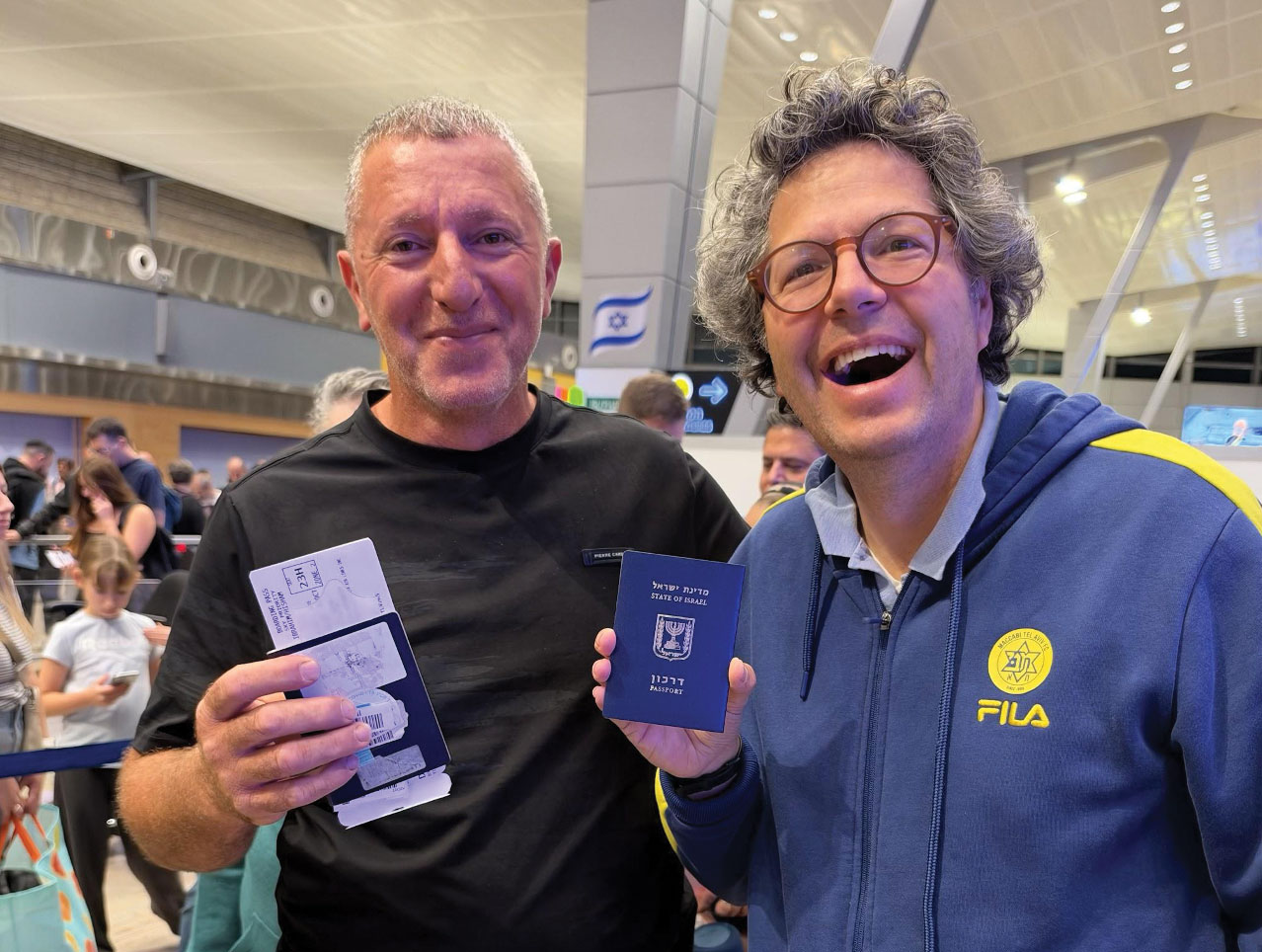
Returning from Israel this past Saturday evening, Jacqueline and I were stopped at the airport security checkpoint. An officer asked the usual questions, took our passports, and directed our cab driver to pull over for an inspection. A few minutes later, a different officer returned them.
As I put them in my backpack, I noticed that mine had gotten folded and bent. I opened it.
Not my face. Not my birthdate. Not my name.
Instead, a stranger named Ibrahim Hisham was staring back at me.
Somewhat panicked, I called the officer over.
“Zeh lo ha-darkon sheli,” I said. “This isn’t my passport.”
He seemed as confused as I was. Had I given him the wrong passport? Could it have gotten switched at the hotel?
“We didn’t stay at a hotel,” I explained. “You must have accidentally switched the passports. This man Ibrahim probably has mine!”
After checking with the other officers, he returned empty-handed. He suggested traveling on my American passport and replacing my Israeli one in Los Angeles.
“Should I take Ibrahim’s passport to lost and found?” I asked. “Maybe he’ll come with mine and we can swap.”
“Good idea,” he said.
I returned Ibrahim’s passport and explained the situation at check-in.
“Yeah, that happens sometimes,” the security agent said. She suggested, with utmost seriousness, that I lodge a complaint on the security services website.
That made me laugh.
As we headed toward the gates, I heard my name announced.
My passport had been returned.
Later, waiting in another security line, I spotted a familiar face belonging to a total stranger.
“Ibrahim?” I said.
“Yehoshua?” he replied.
He had studied my photograph, too.
We shook hands and thanked each other, deeply relieved.
Ibrahim is about my age, an Arab citizen of Israel born in Nazareth, with four children around the ages of my own. I mentioned our upcoming visit to Nazareth with pastors, educators and leaders from Compton.
He offered to welcome us to his home.
He was traveling to Las Vegas for a car battery conference with 30 other Israelis, Jews and Arabs alike. His first trip to America.
We exchanged contact information. I promised to be in touch.
A chance encounter. But I couldn’t help thinking about the elections I had come to Israel to participate in, and the national conversation about the Arab parties’ unprecedented gains and their role in forming a government.
An election forces us to recognize our fellow citizens — their hopes, fears, and needs alongside our own — and consider how to share a society.
This week’s Torah portion, Chayei Sarah, offers a powerful image. After Abraham dies, we read:
“His sons Isaac and Ishmael buried him in the cave of Machpelah” (Genesis 25:9).
Two brothers with a painful family history. At Sarah’s insistence, Abraham had sent Ishmael and his mother, Hagar, into the wilderness.
And yet they come together to bury their father.
The Torah describes no embrace, no resolution of their grievances. But they unite for a shared purpose. Something both needed to do, even with everything that lay between them.
Ibrahim — whose name is the Arabic form of Avraham, the ancestor we share — and I each needed our passport back. Returning his was right. It also made recovering mine more likely. Each of us helped the other continue his journey.
The challenges we face, here in America and in Israel, are infinitely more complicated. But finding where our interests intersect is part of the work. How can our leaders bring those interests together for everyone’s good? How can we help?
As the story of our Torah unfolds, another pair of brothers will become estranged. Jacob will deceive his father, Isaac, taking the blessing intended for Esau. Esau will threaten to kill him. Jacob will flee. Years will pass.
Then they will meet again.
Esau will run to embrace Jacob. They will weep. Jacob will say, “To see your face is like seeing the face of God” (Genesis 33:10).
That is my hope: that by finding things we can do together, by recognizing each other’s humanity, we might come to see each other more fully. That shared purpose might open a path toward reconciliation.
It takes work and grace and empathy and patience and resilience.
Maybe it begins with something simple, something human, like returning a lost object. Seeing someone’s face. Learning someone’s name and story.
Who knows what might happen next? Maybe, just maybe, we can build connections that heal, find a common purpose, and help one another recognize something holy in the face of a stranger.
Rabbi Yoshi Zweiback is the Senior Rabbi of Stephen Wise Temple in Los Angeles and host of the podcast “Search for Meaning with Rabbi Yoshi.”

































