
Print Issue: Election Fever | November 6, 2026
Print Issue: Election Fever | November 6, 2026 Read More »


Shall we continue? Last week, when I was writing based on Israel’s exit polls – they turned out to be not the most accurate – I argued that Israel is a state in superposition. This still holds true. In Iran – a superposition that is neither victory nor defeat. In Gaza – a superposition that is neither the eradication of Hamas nor consent to its continued rule. Facing the Haredi challenge – a superposition of mandatory conscription and no enforcement of conscription. The final outcome of the election also placed Israel in a superposition: victory and defeat. The coalition won because it didn’t lose; the opposition lost because they didn’t win. Both sides are now looking for a way out. This requires patience, nerves of steel and some luck. Don’t expect a final outcome anytime soon.
Politicians are used to not telling the whole truth. And there’s no time in which they excel more at not telling the whole truth than the weeks dedicated to forming a new coalition. Thus, we must consider most of what we hear from them as spin. Words and leaks and rumors and interviews all serve one purpose: to improve their chances of getting what they want.
But what is it that they want? If you have an urge to feel sorry for this group of power-hungry leaders, note that Israel’s voters left them with few, if any, good options. Israelis went to the polls and provided a result that leads to no clear path for creating a functioning coalition. The bloc of parties supportive of P.M. Netanyahu got 53 seats in the Knesset. That’s eight short of a majority, and 15 short of what it currently has. The bloc of parties opposing the PM is at 67 – but 18 of these went to Arab parties with whom the leaders of the coalition committed not to form a new coalition.
What are the options available to the parties? Opposition leaders can break promises and try to form a change coalition with the Arab parties or the ultra-Orthodox parties. There will be a high price for both. The first option will be highly controversial no matter how the deal is presented to the public. The second option will require complete surrender on an issue that was front and center in the campaign – drafting young Haredi men to the IDF.
Netanyahu has no path for a coalition except one: getting an opposition party to bolt and join his side. He’d have to give much in return, and it’s not clear he wants to do such a thing. His best option might be a repeat election in three or four months in which he expects to win. Then – there’s the option of a unity government. Netanyahu will not form such a government unless he is the P.M. Other parties will be rightly suspicious of his promises and intentions. They can easily test him: will he agree to pass a strong draft law, that would alienate his ultra-Orthodox partners, in exchange for unity with his Zionist rivals? Probably not. Netanyahu wouldn’t want to be a prisoner within his own government. He wouldn’t form a coalition that would leave him exposed to a sudden change of heart of his reluctant rivals.
So here we are, stuck with just a few bad options to consider. And that’s just the political superposition of undetermined future – alongside it there’s also the possible – probable? – war with Iran.
Consider this: last week I had to write as the polls closed in Israel, thus relying on exit polls for an incomplete analysis. This week I must write as the polls in America close, and a deadline for possible attack on Iran is looming. In fact, if President Trump decided to rush into a conflict right after Election Day, you might be reading this as sirens are already wailing in the region. If not, we have more waiting ahead of us. Politicians will discuss coalition-building. Statesmen will discuss nation-building. Citizens will have to passively wait as their fate is determined by leaders in whom they have little trust (but for whom they chose no clear alternative).
Iran isn’t just a question of when, it is also one of why. Of course, getting rid of Iran’s nuclear program – or belligerent regime – is a worthy cause. But such a saying was true in June 2025, when Israel attacked for 12 days, and the U.S. joined at the last minute, and was true when both the U.S. and Israel attacked in February 2026. What will they do now that could provide us with an outcome more satisfying than the last two rounds? Do they – Trump and Netanyahu – have the same objective in mind as they entertain the idea of launching a third round of attacks?
Brace yourself for more such known unknowns. Look at the locked box and keep wondering: what is the cat inside it doing?
The question regarding which parties Israelis do not want in a coalition (see graph) allows us to examine whether there is any coalition at all that a majority of Israelis would accept (and we are talking here about a 61-seat majority coalition, not a minority coalition, whose time will come). This is not just one question, but actually two. First question: Are there voters whose total disqualifications allow for a 61-seat coalition based on the election results? Second question: Is there any coalition that a majority of Israelis do not disqualify? To the first question, the answer is yes. To the second, the answer is no. There is no combination of parties that can form a coalition supported by a majority of Israelis. At least not according to the answers given three days ago regarding party disqualifications.
Why is it so difficult to form a majority coalition? Here are some examples.
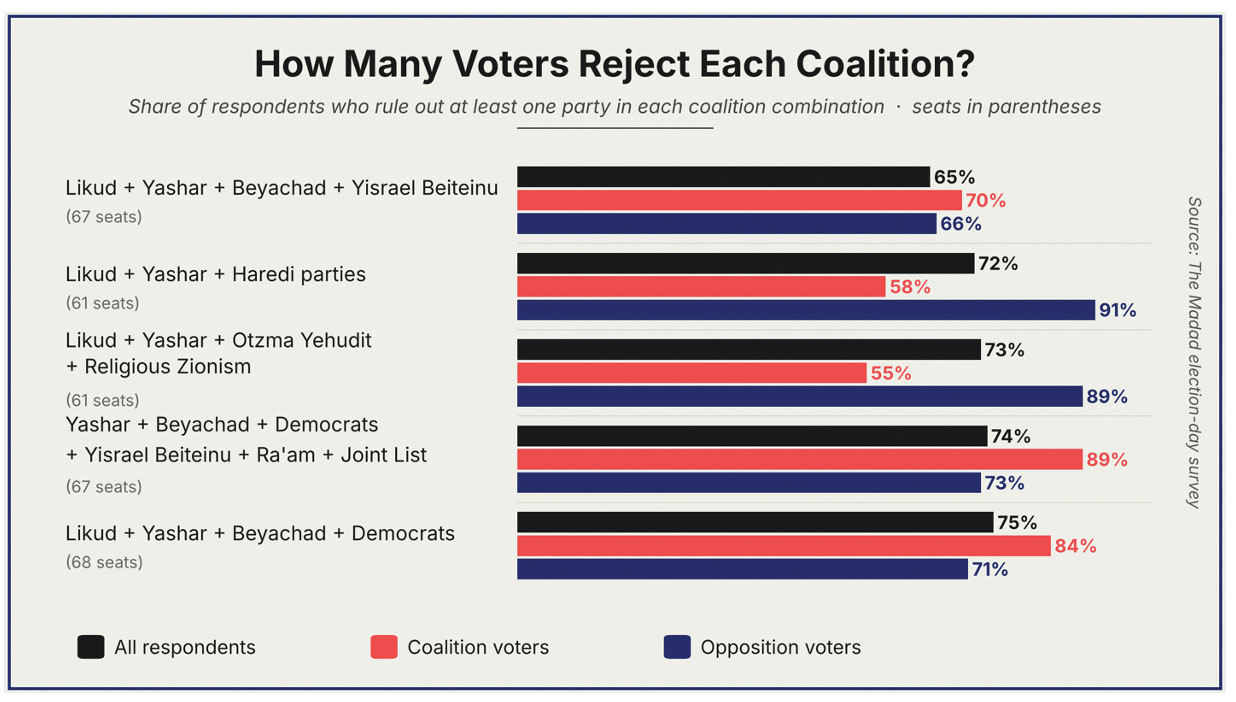
Gabi wrote: “You should never write based on exit polls.” My response: A newspaper deadline is often trickier than you think. But there’s always the next issue.
Shmuel Rosner is senior political editor. For more analysis of Israeli and international politics, visit Rosner’s Domain at jewishjournal.com/rosnersdomain.
Rosner’s Domain: Weeks of Known Unknowns Read More »

Returning from Israel this past Saturday evening, Jacqueline and I were stopped at the airport security checkpoint. An officer asked the usual questions, took our passports, and directed our cab driver to pull over for an inspection. A few minutes later, a different officer returned them.
As I put them in my backpack, I noticed that mine had gotten folded and bent. I opened it.
Not my face. Not my birthdate. Not my name.
Instead, a stranger named Ibrahim Hisham was staring back at me.
Somewhat panicked, I called the officer over.
“Zeh lo ha-darkon sheli,” I said. “This isn’t my passport.”
He seemed as confused as I was. Had I given him the wrong passport? Could it have gotten switched at the hotel?
“We didn’t stay at a hotel,” I explained. “You must have accidentally switched the passports. This man Ibrahim probably has mine!”
After checking with the other officers, he returned empty-handed. He suggested traveling on my American passport and replacing my Israeli one in Los Angeles.
“Should I take Ibrahim’s passport to lost and found?” I asked. “Maybe he’ll come with mine and we can swap.”
“Good idea,” he said.
I returned Ibrahim’s passport and explained the situation at check-in.
“Yeah, that happens sometimes,” the security agent said. She suggested, with utmost seriousness, that I lodge a complaint on the security services website.
That made me laugh.
As we headed toward the gates, I heard my name announced.
My passport had been returned.
Later, waiting in another security line, I spotted a familiar face belonging to a total stranger.
“Ibrahim?” I said.
“Yehoshua?” he replied.
He had studied my photograph, too.
We shook hands and thanked each other, deeply relieved.
Ibrahim is about my age, an Arab citizen of Israel born in Nazareth, with four children around the ages of my own. I mentioned our upcoming visit to Nazareth with pastors, educators and leaders from Compton.
He offered to welcome us to his home.
He was traveling to Las Vegas for a car battery conference with 30 other Israelis, Jews and Arabs alike. His first trip to America.
We exchanged contact information. I promised to be in touch.
A chance encounter. But I couldn’t help thinking about the elections I had come to Israel to participate in, and the national conversation about the Arab parties’ unprecedented gains and their role in forming a government.
An election forces us to recognize our fellow citizens — their hopes, fears, and needs alongside our own — and consider how to share a society.
This week’s Torah portion, Chayei Sarah, offers a powerful image. After Abraham dies, we read:
“His sons Isaac and Ishmael buried him in the cave of Machpelah” (Genesis 25:9).
Two brothers with a painful family history. At Sarah’s insistence, Abraham had sent Ishmael and his mother, Hagar, into the wilderness.
And yet they come together to bury their father.
The Torah describes no embrace, no resolution of their grievances. But they unite for a shared purpose. Something both needed to do, even with everything that lay between them.
Ibrahim — whose name is the Arabic form of Avraham, the ancestor we share — and I each needed our passport back. Returning his was right. It also made recovering mine more likely. Each of us helped the other continue his journey.
The challenges we face, here in America and in Israel, are infinitely more complicated. But finding where our interests intersect is part of the work. How can our leaders bring those interests together for everyone’s good? How can we help?
As the story of our Torah unfolds, another pair of brothers will become estranged. Jacob will deceive his father, Isaac, taking the blessing intended for Esau. Esau will threaten to kill him. Jacob will flee. Years will pass.
Then they will meet again.
Esau will run to embrace Jacob. They will weep. Jacob will say, “To see your face is like seeing the face of God” (Genesis 33:10).
That is my hope: that by finding things we can do together, by recognizing each other’s humanity, we might come to see each other more fully. That shared purpose might open a path toward reconciliation.
It takes work and grace and empathy and patience and resilience.
Maybe it begins with something simple, something human, like returning a lost object. Seeing someone’s face. Learning someone’s name and story.
Who knows what might happen next? Maybe, just maybe, we can build connections that heal, find a common purpose, and help one another recognize something holy in the face of a stranger.
Rabbi Yoshi Zweiback is the Senior Rabbi of Stephen Wise Temple in Los Angeles and host of the podcast “Search for Meaning with Rabbi Yoshi.”
The Switched Passport: A Lesson in Seeing the Other Read More »

Someone tell Michael Rubin. The Jewish sports memorabilia magnate and CEO of collectibles company Fanatics might not be aware that with the World Series over, some kids might consider putting aside their collection of baseball cards, or at least make room beside them, for a set that answers a different question of the child holding it, not “what was his batting average and slugging percentage?” but, “what Hebrew book did he write, and where was he chief rabbi?”
The recently released Jewish Legacies trading cards (available at jewishlegacies.com) celebrate the rabbis, Torah scholars and spiritual leaders whose contributions have helped shape Jewish life across generations. And for anyone who grew up ripping open packs of baseball cards in search of that one elusive player, the concept will feel familiar, albeit with an intentionally educational Jewish twist.
The base set runs 150 cards, joined by five insert and short-print collections and numbered parallels, with silver cards limited to fifty copies and gold to just twenty-five. A hobby box holds 10 packs of 10 cards, with a numbered card or insert in every pack and, on average, two short-print “hits” per box. Anyone who ever chased a rookie card will recognize the thrill of the chase.
Among the personalities featured are Rabbi Samson Raphael Hirsch, the 19th-century German rabbi whose approach to combining Torah observance with engagement in the wider world continues to influence Orthodox Jewish thought; the Chafetz Chaim, the renowned scholar whose name is synonymous with the laws of ethical speech; and Rabbi Moshe Feinstein, whose halachic rulings helped guide American Orthodox Jewry through a period of extraordinary growth and change.
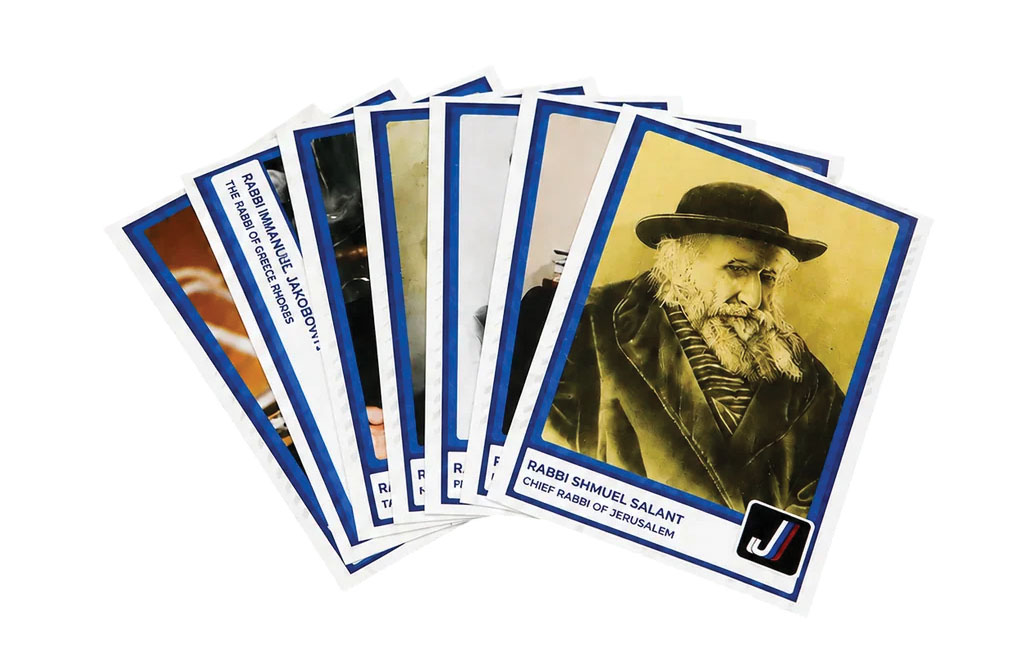
The checklist also includes figures such as Rashi, the indispensable medieval commentator; the Rambam, whose scholarship continues to shape Jewish law and philosophy; the Vilna Gaon, one of the most celebrated Torah scholars in Jewish history; and Rabbi Avraham Yitzchak Kook, whose religious thought profoundly influenced Religious Zionism. The cards with their portraits and biographies sit alongside lesser known figures like Rabbi Shimon Shkop (1860–1939), who reshaped the study of Talmud from his yeshiva in Grodno, Belarus; Rabbi Isser Zalman Meltzer (1870–1953), who carried the Lithuanian yeshiva tradition from Slutsk to Jerusalem; Rabbi Tzvi Pesach Frank (1873–1960), who served as Jerusalem’s chief rabbi through the turbulent decades around Israel’s founding; Rabbi Yitzhak Kaduri, born in Baghdad, became one of Israel’s best-known kabbalists; Rabbi Yehuda Amital, who survived the Holocaust and went on to found Yeshivat Har Etzion, and Rabbi Hershel Schachter of Yeshiva University, a leading voice of contemporary Jewish law.
Special “inserts” include “Shul Stars” celebrating the American pulpit and featuring Henry Pereira Mendes (1852–1937), who led New York’s Spanish and Portuguese Synagogue and Leo Jung (1892–1987) who made the Jewish Center on Manhattan’s Upper West Side a model of Modern Orthodoxy.
Then there are “Legendary Duos,” a sort-of rabbinic double-play combination. Rabbi Akiva Eger (1761–1837) of Posen, the preeminent scholar of his day, is paired with his son-in-law, the Chasam Sofer, Rabbi Moses Sofer (1762–1839) of Pressburg. Rabbi David Zvi Hoffmann (1843–1921) is twinned with Rabbi Jehiel Jacob Weinberg (1884–1966). Both led the Rabbinical Seminary of Berlin, which trained Orthodox rabbis in the heart of German academia.
At a time when Jewish education is competing for attention in a world dominated by screens, sports, short-form videos and endless streams of content, these easily collectable cards offer a different kind of engagement. As the company puts it on their site’s FAQ, punning off of the Passover Haggadah, “What makes Jewish Legacies different from other trading cards? Jewish Legacies combines the excitement of collecting with a brilliant design and meaningful content rooted in Jewish history and tradition. Each card is designed not only to be collectible, but also to educate and inspire a deeper connection to the Jewish people.”
Barring a lockout, Spring Training sits only a few months away, and the box scores will return soon enough. Meanwhile, the card industry continues to grow. During the first half of 2026, eBay sports card single sales reportedly reached $1.36 billion, compared with $815.6 million during the first half of 2025. More than 42 million individual card transactions were tracked on the platform last year, with an average transaction value of around $39. Amidst all the Betts’, Ohtani’s, and Freeman’s, then, consider making room for a different kind of all-star lineup.
Rabbi Dr. Stuart Halpern is Associate Provost for Strategic Initiatives at Yeshiva University and Deputy Director of Y.U.’s Straus Center for Torah and Western Thought. His books include the newly released “Jewish Roots of American Liberty,” “The Promise of Liberty: A Passover Haggada,” “Esther in America,” “Gleanings: Reflections on Ruth” and “Proclaim Liberty Throughout the Land: The Hebrew Bible in the United States.”
After the Last Out, Collect a Different Kind of Card Read More »

The sheer size and geographic scope of the Republican wipeout Tuesday makes it hard to read anything definitive into the results beyond a nationwide repudiation of President Donald Trump (and his candidate selections). But whether or not any other factors were at play in the GOP bloodbath, the fallout will have a range of reverberations. Here are 6 takeaways that point to what comes next.
1. A significantly weakened Donald Trump doesn’t bode well for Netanyahu
For Prime Minister Benjamin Netanyahu, Trump has been a longshot bet that keeps on paying off. It’s hard to overstate how significant Trump’s improbable wins in 2016 and 2024 were in bolstering Netanyahu’s domestic standing and giving him space to advance his regional agenda. Trump also served as a security blanket, leaving Netanyahu and his allies with a sense for many years that they didn’t need to worry too much about skyrocketing Democratic and international anger with Israel.
In fact, there was even a hope in Bibi world that The Donald’s support could save Netanyahu from political defeat at home (and, to be fair, his 11th-hour endorsement may have). Whether Netanyahu holds on or chief rival Gadi Eisenkot succeeds in replacing him, Israel is entering uncharted territory. There is little chance that the combination of a weakened Trump and an emboldened Democratic Congress produces similar levels of support for aggressive action against Iran and its proxies, and other policies that a wide spectrum of Israelis see as crucial to their security.
2. Jeffries and Schumer have a massive headache coming their way
With Tuesday night’s Democratic wave, Hakeem Jeffries is on track to become Speaker of the U.S. House of Representatives and Chuck Schumer will likely get a second shot as U.S. Senate Majority Leader. These New Yorkers have longstanding ties to the pro-Israel community and are among their party’s strongest Israel supporters – putting them at odds with the growing number of congressional Democrats who want their party to take a much harder line against Israel. It won’t be long before members in each caucus are demanding concrete action, including meaningful limits on U.S. military sales.
Both Democratic leaders have ratcheted up their criticism of Prime Minister Benjamin Netanyahu and his government in the wake of its war on Hamas in Gaza, but they have ultimately voted against various legislative attempts to punish Israel. This past April, Schumer was one of only seven Senate Democrats to vote against a pair of resolutions that together would have blocked the sale of D-9 bulldozers, widely used in military operations, and 1,000-pound bombs to Israel. In July, Jeffries voted against ending U.S. military aid to Israel, but the measure was supported by almost half of the Democratic caucus. As leaders of their respective chambers, Jeffries and Schumer will likely face immense pressure to bring more anti-Israel legislation to the floor and face much tougher scrutiny from the party base over continued support for Israel.
3. The impact of the anti-Israel vote was diluted
On the other hand, the massive Democratic victory dilutes the power of the anti-Israel lawmakers in Congress. Their numbers will grow, causing problems for party leaders trying to keep anti-Israel measures off the agenda. But they will remain a relatively small subset within a much larger Democratic majority that includes many moderates and Israel supporters.
Not only will anti-Israel lawmakers have less leverage over Democratic leaders, but their electoral victories will be harder to interpret as evidence of growing opposition to Israel when Democrats across the political spectrum benefited from the same wave.
4. John Fetterman just lost his juice
Just as the sizable Democratic House majority makes Jeffries less dependent on anti-Israel lawmakers in his caucus, the next Senate Majority Leader won’t need to rely on Pennsylvania Sen. John Fetterman. For years, Fetterman has been driving fellow Democrats crazy with his cozying up to Republicans, with progressives especially upset over his die-hard support for Israel. Fetterman has even said that the one thing that could cause him to leave the Democratic Senate caucus would be his party turning decisively against Israel.
Had things broken differently, with Democrats grabbing a narrow 51-49 majority, Fetterman’s influence would have been hypercharged. Now, not so much. The Democrats no longer need him to keep control of the chamber. So Schumer, should he regain the majority leader role, will have to worry much less about keeping the party’s top pro-Israel cheerleader happy. In 2028, he’ll be up for reelection and highly unlikely to survive the Democratic primary.
5. AIPAC has not found a formula for success
A few years back, the leading pro-Israel lobby decided the best way to counter the initial anti-Israel rumblings in Congress was to jump deep into the campaign fundraising business. Hundreds of millions of dollars later, the number of Israel critics in Congress – especially on the Democratic side of the aisle – has grown, with a fresh batch on the way. Moreover, in many races, anti-Israel candidates and AIPAC critics managed to turn the lobby’s backing into a liability.
Meanwhile, Trump’s seemingly impromptu announcement Tuesday that his administration would end aid to Israel after this year suggests that Republican backing for such support is dropping alongside Democrats’. And Tuesday’s results suggest AIPAC’s strong support for the U.S. and Israeli military strikes against Iran is out of step with the American public and many incoming lawmakers.
For all its money and political muscle, AIPAC has yet to find an effective response to the growing backlash against Israel across American politics.
6. It was a great night for Jewish presidential hopefuls
U.S. Sen. Jon Ossoff says he isn’t running for president in 2028. But that won’t stop the speculation from skyrocketing after his impressive reelection in Georgia – Georgia?! – with nearly 60% of the vote. More importantly, he probably just grabbed frontrunner status in the race to become America’s first Jewish president. Pennsylvania Gov. Josh Shapiro also registered a similarly sized reelection victory in a state that Trump won just two years ago, but Ossoff – a fierce Trump antagonist and, increasingly, a critic of Israel’s military actions – cemented his rock star status among Democrats this cycle and has demonstrated an ability to bridge the gap between younger progressives and more traditional liberals.
Illinois Gov. JB Pritzker also cruised to reelection. Meanwhile in Michigan, moderate Elissa Slotkin – another senator and possible presidential hopeful (of course, which senator isn’t a presidential hopeful?) – may have at least propped open the door to some progressive support by campaigning hard for Abdul El-Sayed. All four have been highly critical of Netanyahu, with both Ossoff and Slotkin joining most of their fellow Democratic senators in voting in April for a curb on various weapons sales. Both senators have declined to label Israel’s actions in Gaza as genocide.
Ami Eden is the CEO and executive editor of the Jewish Telegraphic Agency’s parent company, 70 Faces Media.
6 Jewish Takeaways from the Midterm Elections Read More »

The haters, antizionists, antisemites, the intimidating protesters — they are all driven crazy by the existence of the State of Israel. In London, Paris, New York, Toronto, in the entire diaspora.
From 2015 to the present, the U.N. General Assembly has passed 187 resolutions against Israel and 90 resolutions against all other countries combined.
Why “crazy”? Because for 2,000 years, almost all Jews lived in countries during golden ages where they were loyal and productive, but those times always ended. They thought they were home, only to discover that they were no longer welcome. They were uprooted and left to find a safe haven until it, too, was no longer safe. Others would decide the Jews’ fate. Always at the mercy of others.
And now, there is a Jewish state. Jews prayed for 2,000 years for a return to their homeland, a place where Jews belong. After a Holocaust! After all the fevered efforts to erase Jews from the Earth.
The Jews are back! And not just back. With a rebirth, on their ancestral soil, speaking the language of their forefathers and mothers, praying the same prayers: it’s a nightmare for those who were taught to hate and to believe the Jews were inferior and destined to disappear.
Not just that: the Jews have an army, an air force, a navy and an intelligence service that is actually intelligent. And a thriving economy: Start-Up Nation. The Jews have created a thriving democracy in an area of the world where no other democracy exists. This is intolerable! It can drive an antisemite insane. It does drive them insane. No wonder there is vilification, demonization, fabrications about genocide and floods of malignant lies everywhere.
The Jews have created a thriving democracy in an area of the world where no other democracy exists. This is intolerable! It can drive an antisemite insane. It does drive them insane. No wonder there is vilification, demonization, fabrications about genocide and floods of malignant lies everywhere.
The very existence of this thriving, successful, dynamic Jewish country must be delegitimized so that Jews can again become vulnerable and wander the Earth, begging for asylum as in the past. That is why the rhetoric keeps getting more deliriously fevered. According to those committed to putting the Jews in their place, reducing them to dependents again, there never was a Holocaust. They deny the real genocide, documented and verified historically – the Holocaust – and, to add insult to injury, they accuse the Jews of committing a genocide in Gaza, a complete fabrication. According to the haters, the Jews weren’t persecuted throughout history, they are an apartheid state persecuting others. Reality is lost; history is denied; facts don’t matter. Whatever it takes to portray the Jewish State as illegitimate and unworthy of existence.
As Kathleen Hayes wrote in the Jewish Journal, the Trotskyites she knew, and later disavowed, rejected truth that did not support their claim and instead invoked a “higher truth” which fit their fixed narrative. This corrupted thinking is morally bankrupt, intellectually dishonest and loathsome but it soothes the conscience of the self-righteous and has been adopted by antisemitic woke culture.
If Christianity and Islam are supremacist religions that have attempted to leave Judaism behind in the dust of history as an obsolete relic, Israel’s rebirth and success undermines their claim and challenges their view.
The persistence of Jew-hatred is no mystery. In her book “As a Jew,” Sarah Hurwitz reminds us that Constantine, Emperor of the Roman Empire, converted to Christianity, and it became the official religion of the Roman Empire. Christianity was not only a religion but a state power. The Jews’ position became greatly compromised.
St. Augustine, in the first years of the Common Era, proposed that the Jews become subservient rather than killed. The Jews’ “Old Testament” would be interpreted as the basis for a superior “New Testament” and the Jews’ suffering and misery “would indicate that God is punishing them for rejecting Christianity.”
Hurwitz also quotes the enlightened Christian theologian Gregory Baum, who wrote that “the church made the Jewish people a symbol of unredeemed humanity; it painted a picture of the Jews as a blind, stubborn, carnal and perverse people.” Author and historian James Carroll adds: “However modern Nazism was, it planted its roots in the soil of age-old Church attitudes and a nearly unbroken chain of Church-sponsored acts of Jew Hatred.”
The Jews’ subsequent field of nightmares was well prepared long before the rise of Islam and Islamists. A thousand years of received thinking and official, sanctioned hatred will not disappear.
Jew-hatred, of course, is not limited to Israel. In the final analysis, it is about Judaism and Jews wherever they live.
Whether in the Diaspora or in Israel, Jews have become an obstacle to Christianity’s and Islam’s claim to preeminence. It did not need to be. They could have understood that Judaism is the rock, the foundation on which their beliefs are founded, rather than competition in a zero-sum game. Except for those exceptional individuals whose great humanity saw in the Jew a common bond of humankind, the past 2,000 years were a tragic failure of western civilization.
Whether in the diaspora or in Israel, Jews have become an obstacle to Christianity’s and Islam’s claim to preeminence. It did not need to be. They could have understood that Judaism is the rock, the foundation on which their beliefs are founded, rather than competition in a zero-sum game.
Is there no remedy? Well, we still live in democracies. We do have friends who accept and even love their Jewish fellow citizens. We have agency and are far from powerless even in the Diaspora. We are not alone. Ironically, the largest pro-Zionist organization in the U.S. is Christians United for Israel.
But we cannot afford to wait for the woke to awaken. Montreal, an epicenter of out-of-control antisemitism, has taken effective action, according to a writer in Canada’s National Post: “The Quebec government acted decisively by strengthening its secularism laws and making it clear that intimidation would not dictate public policy” as well as adopting the International Holocaust Remembrance Alliance working definition of antisemitism. Jewish organizations took university administrations to court. In addition, they built alliances with Italian, Greek, Filipino, Hindu, Armenian and other communities. There are still serious challenges, but Montreal Jews are actively involved in change for the better.
There are many organizations doing important work on behalf of the Jewish community. StandWithUs has launched a new legal program to support Jewish students; the Legal Forum for Israel will be training students to assist organizations and individuals fighting antisemitism around the world; the Canadian Antisemitism Education Foundation (CAEF) informs and hosts many speakers and writers in person and online. These and other organizations, like EndJewHatred, need our support.
In addition, write letters to the editor, write and phone politicians. Take action.
In the Diaspora and in Israel, we cannot turn back the clock and undo the harm that was done to us. But we can shape our own future. Israel is strong and resolute. So must we be.
Dr. Paul Socken is Distinguished Professor Emeritus and founder of the Jewish Studies Program at the University of Waterloo.
Israel Drives Them Crazy Read More »

It was a big night for the Democrats and a very, very bad night for U.S. President Donald Trump and the Republican Party. But amid the wreckage left by the blue wave that flipped control of both the House of Representatives and the Senate, members of the GOP aren’t the only big losers. Supporters of the U.S.-Israel alliance and those who worry about the surge of antisemitism that has swept across the globe over the past three years should be equally worried about the implications of the Democrats’ midterm victory.
The consequences of the Democrats’ return to power on Capitol Hill will be primarily directed at the Trump administration. But whatever that will mean for Trump’s ability to govern effectively in his final two years in office, control of Congress by a party that is now largely dominated by its intersectional left-wing will have a serious impact on the U.S.-Israel relationship as well as the battle against Jew-hatred.
Jews in denial
That will not be the message we hear from most Jewish Democrats. They will point to the exit polls that show Democrats winning their usual two-thirds of the Jewish vote, though we don’t know for sure yet whether that was also true in states like Michigan where their candidate, Dr. Abdul El-Sayed, is an open antisemite.
They will also say that the leadership of the Democratic Party in both the House and Senate will remain in the hands of relative moderates like House Minority Leader Hakeem Jeffries (D-N.Y.) and Sen. Chuck Schumer (D-N.Y.) who both speak of themselves as supporters of Israel. Though, especially in the case of Schumer, his longtime pose as the shomer or “guardian” of Israel in Congress has been largely conditional with the senator backing up efforts by his fellow Democrats to attack the government of Israeli Prime Minister Benjamin Netanyahu and hamstring its efforts to defeat Hamas, Hezbollah and Iran and even downplaying the threat of antisemitism.
But as we saw throughout 2026, the moderates are no longer in control of the Democratic Party, especially where Israel is concerned.
As a result of primary wins across the nation, the composition of both the House and Senate Democratic caucuses has been materially altered. Progressives, including members of the Democratic Socialists of America and their left-wing allies will now be sitting in seats that were once held by traditional liberals.
Progressives dominate
That doesn’t just mean that the ranks of the far-left congressional “Squad,” which had already grown since its first four members were elected in 2018, will be increased. The swing to the left is being felt across the country amid a midterm election where Democrats made gains at every level of government.
What will this mean?
During the campaign, the primary theme of the Democrats largely centered on the economy. The rise in gas prices as a result of the ongoing conflict with Iran has hit voters across the board, but most of the pain is felt by those working-class voters who largely supported Trump and the GOP in 2024. Their defection to the Democrats seems to have gone well beyond the usual backlash against the party in power two years after it won the presidency and Congress.
But while dissatisfaction with the economy as well as a sense that Trump had not improved the lives of voters during the past two years may have won them the midterms, the winners will have other priorities once they are sworn into office in January.
As the primaries demonstrated, the two issues that are the main motivating factors for the party’s activists and their candidates are only tangentially connected to what enabled them to win. The organizing principles of the Democratic Party and its base are now opposition to enforcement of immigration laws and hostility towards Israel.
Trump has effectively ended the flood of millions of illegal immigrants that entered the United States during the Biden administration. That will likely remain the case even with a Democratic Congress. But we can expect them to try to use their control of Congress and government funding to end the deportations of illegals.
And it’s equally true that their priority will be to confront Trump.
That will mean attempts at impeachment of the president and members of his cabinet that will likely fail. But it will tie the administration up in knots, as was the case during the Democrats’ efforts to undermine Trump during the last two years of his first term. Even more important, control of congressional committees will give the ability to launch investigations of every department as well as members of the president’s family. Yet whether any of it leads to any tangible consequences for those put in their crosshairs, it will materially influence Trump’s ability to govern effectively or get anything done.
Targeting Israel
But along with that, the large number of anti-Israel Democrats elected by voters who have accepted lies about the war in Gaza will be trying to sever the relationship with Israel.
Democrats who were long considered “moderates” or even pro-Israel have been signaling over the course of the last year that they can no longer be relied upon to back a Jewish state under assault by Iran and its terrorist proxies. The reason is that they can read the polls that indicate those who identify as Democrats have turned upon Israel as well as the primary results that are sending anti-Israel leftists to Washington.
Rather than try to resist the base of their party and find themselves out of power, figures like Schumer are going along with the progressives.
During the campaign, that meant backing an open antisemite like El-Sayed. They feared being targeted by angry leftists. And now that the Michigan Democrat with links to the Muslim Brotherhood appears poised to join Schumer on the Senate floor while others with similar views enter the House, the same dynamic will be in play.
We already know that will lead to measures that will fundamentally alter the alliance with the Jewish state. That will mean sanctions on Israelis in Judea and Samaria — an effort that will be driven by acceptance of the false narrative about “settler violence.”
Military aid to Israel will also be targeted by the Democrats.
Trump may have thought he could forestall such efforts by announcing this week that the aid will now wind down by the end of the year and be replaced with a partnership rooted in joint efforts to research and develop weaponry.
In the long run, that is, as Netanyahu has actually been saying for decades, exactly what Israel needs. Doing so will enable the Jewish state to be less dependent on the United States and remove a major talking point employed by Israel-bashers. That’s in spite of the fact that almost all of it was spent in the United States and was as much of an aid package for American arms manufacturers as the Israelis. It’s also true that the amount spent on assistance to Israel is actually dwarfed by the aid that Europe gets via American participation in NATO that is part of the Pentagon budget rather than called “aid.”
Still, making this change abruptly rather than gradually, as Israelis who desire this shift wanted, will create a strain on their military at a time of war when it is already hard-pressed.
Mainstreaming antisemitism
What Trump and whoever winds up leading the next Israeli government need to realize is that the anti-Israel progressives are not really focused so much on ending aid so much as they are interested in severing the relationship altogether.
For one thing, that will likely mean efforts to stop the transition from aid to partnership. But the impact of congressional majorities that are overwhelmingly hostile to Israel will transcend the ongoing debate about the aid package.
It’s been clear for years that the Democrats have not only rejected any idea of a bipartisan consensus about the alliance but have been transitioning to being an anti-Israel party. But the 2026 results have produced more than just majorities that don’t want to aid Israel’s efforts to defend itself.
With the victories of figures like El-Sayed and others who were willing to spread blood libels about Israel committing “genocide” in Gaza and who sought to anathematize the pro-Israel AIPAC lobby, we’ve gone well beyond arguments about military assistance.
A public square in which the sort of antisemitism that they spout is normalized is one that can fundamentally change the way that Jews interact with society. El-Sayed’s focus on AIPAC, which was echoed in other campaigns around the country, employed classic tropes of Jew-hatred. This will make it even harder for the dwindling numbers of pro-Israel Democrats to be heard or influence policy.
But it will also impact Republicans.
The majority of Republicans remain supportive of Israel and opposed to the left’s antisemitism that is driven by their acceptance of the toxic doctrines of the left about race such as critical race theory, intersectionality and settler-colonialism.
It won’t only be the antisemitic extremists of the far right who are influenced by podcasters like Tucker Carlson and Candace Owens who will be speaking of the conflict with Iran as being the primary reason for the GOP defeat. There were other causes for the Republican catastrophe including Trump’s failure to adequately explain his decision to the American people, choosing terrible candidates in several states and general disillusionment with the administration.
But rather than just blaming Trump for his correct decision to go to war against an Islamist regime that is a threat to America, some will likely blame it on Israel.
That will likely undermine Republican efforts to resist the Democrats’ push to target the Jewish state. It will make it more difficult for them to join in efforts to push back against a tsunami of antisemitism that is making itself felt in every sector of society including academia, popular culture and the arts, as Trump has attempted to do.
The pendulum swings
Nothing is permanent in politics and the Democrats celebrating now should remember that. In the 21st century, the two parties have exchanged control of both Capitol Hill and the White House with increasing frequency. There is no telling now which side will be in a better position to win in 2028. The more the currently triumphant Democrats overplay their hand with their harassment of Trump and even their measures against Israel, the less likely it will be that they will win the presidency, especially if they nominate one of the increasingly dominant progressives who will be running.
The one thing that is certain is that the pendulum of American politics is always swinging.
Some Jewish liberals who appear deaf, dumb and blind to the way they are being marginalized along with the rest of the community may try to deny this or focus solely on their hatred for Trump. But there can be no disguising the fact that the midterms have delivered a devastating blow to supporters of Israel and a victory to those who wish to eradicate the Jewish state. That will make it all the more necessary for decent persons, whether Republican or Democrat, Jewish or non-Jewish, to redouble their efforts to fight back against the growing volume of antisemitic invective that has insinuated itself into so much of public discourse.
Jonathan S. Tobin is editor-in-chief of JNS. Follow him: @jonathans_tobin.
A Democratic-Run Congress Will Target Israel as Well as Trump Read More »

Why is Jewish unity so hard to achieve? Because the stakes seem so high. When your counterparts are wrong, they are not just wrong — they are disastrously so. When each dispute seems existential, an error is a catastrophe and disagreement seems like betrayal. To make a concession is to open the floodgates of the apocalypse. Those who oppose you are not merely mistaken; they are apikorsim, heretics, traitors.
The appeal is almost unvarying: “I cannot be moderate, because the other side is bringing us to disaster.” Yet a single decision or position very rarely guarantees catastrophe. History is filled with turning points, missed opportunities and chances to change course. Even in the 1930s there were many waystations on the path to destruction. Additionally, fury is not a persuasive argument. To be vigilant is to be careful along their way, not assuming every bend in the road is the edge of the cliff. Not every compromise or even loss is ruinous.
Throughout their history Jews have argued fiercely. The Bible itself is a chronicle of rebellion and fury, from sibling fractures to Korach’s revolt in the wilderness onward. When the Rabbis attribute the destruction of the Second Temple to “baseless hatred,” they are warning of what happens when disagreement turns to enmity. In Roman times Jews killed one another over how to deal with Rome. In medieval times the Maimonidean controversy led to his books being burned, then later the Mitnagdim excommunicated the Hasidim, Orthodox rabbis in America burned Mordecai Kaplan’s prayer book, the Rabin assassination reminded us too briefly of the consequences of such division and more recently, Israeli society tore itself over judicial reform. We are a people of passionate disputes.
Rabbis point with pride to the argumentation in the Talmud, but its example is more often honored in the breach. The Talmudic ideal is argument about ideas, however tortuous the reasoning, rather than the thunderous denunciations so common in our discourse. The sages could be very sharp, but to an end and in a common enterprise. Pirkei Avot calls this machloket l’shem shamayim, an argument for the sake of heaven, and its model is the dispute between Hillel and Shammai. Its opposite is the quarrel of Korach and his company.
Jewish tradition teaches that process can be as powerful as result. In the Talmud, disputes favor Beit Hillel over Beit Shammai because the former were humble, and even taught the opinions of their opponents before their own. They understood something we too often forget: how you argue is often as important as what you argue, and in the long run may prove more persuasive than the argument itself. In the Talmud the defeated views are preserved, not erased. And for all their disputes, the two schools never refused to marry into each other’s families. They disagreed without a breach. The purpose of the argument is to ensure we still have a people when the argument is over.
David Wolpe is the Max Webb Senior Rabbi at Sinai Temple. His most recent book is “David: The Divided Heart” (Yale University Press). This piece was published on his Substack.
Why Jewish Unity Is So Difficult Read More »

The name of this parsha is the lives of Sarah. This is another example of instant Torah wisdom. What do I mean by this? Think about your own life.
Are you the same person now that you were at, say, 30? Probably not. In short, none of us live one life.
We live multiple lives. Sarah, and for that matter, Abraham, would certainly agree.
This also explains the Jewish tradition of marking a person’s death each year — their yahrzeit — rather than their birth. It’s only after someone dies that we can fully assess their life, or as just noted, their lives.
Abraham takes Sarah’s passing hard. Why wouldn’t he? They’ve been a couple for over a century.
The last years, however, The Torah suggests, were not their best. In fact, they may not have even spent them together.
Their separation is suggested by the curious description of Abraham staying in Beersheba following his close shave with Isaac and our learning that the first matriarch died in the city of Hebron.
As it often is, the Torah is elliptical in matters of narrative. But one can fairly speculate that a tough old bird like Sarah would not have reacted well to the news that her husband had almost sacrificed their only son.
Whatever happened, now she’s gone, and Abraham is left with the task of arranging her funeral.
He negotiates with the leaders of the local population for a burial site — the cave of Machpelah. The idea that Jews never pay retail did not originate with the first Jew.
The people of Hebron, in deference to Abraham’s considerable reputation, offer the site to him as a gift. But the patriarch insists on paying full fare. He doesn’t want future ownership disputed.
Never let it be said that he acquired this property in any way other than one that was above board, transparent and honest. In other words, “I bought it. I own it. Here’s the receipt to prove it.”
The funeral and mourning concluded, it’s now time to look for a wife for Isaac.
Not happy with the idol-worshipping women of Canaan — a population never held in high esteem in the Torah — Abraham sends his right-hand man, Eliezer, one of the true good guys of the Five Books, east to the town of Nahor, Abraham’s ancestral home, to find a suitable bride.
The emissary arrives at the outskirts of the town and makes the first prayer in the Torah. He asks God to direct him to a young woman who, by right action, will demonstrate herself to be a mate worthy of the son of his master.
And, as he prays, it happens.
A girl steps forth and helps him water his camels. She does so in such a friendly, generous and guileless way that he is deeply touched. It doesn’t hurt that she is also beautiful. And the topper? She’s part of the Abraham’s extended family.
Her name is Rebekah, and she offers to take the stranger to meet her brother, Laban. A sharpie who has a big part in the Genesis story, Laban is suitably impressed by Eliezer’s display of Abraham’s wealth.
A marriage contract between the young woman and Isaac is quickly agreed upon.
His task completed, Eliezer is anxious to return home. But Laban wonders what the rush is. Why not stay a while and relax; let mother and daughter have some time together. Who knows if they’ll ever see each other again.
One can almost imagine Laban suggesting a friendly game of poker, anything to separate the servant from his master’s money.
But the emissary wishes to brook no delay. Settling the question is left to Rebekah. Does she want to leave now or linger for a few more days with her family?
Flashing the spine for which she will become known and admired, she decisively opts for the former.
A few days later, Isaac and Rebekah meet as the sun sets over the desert. He likes what he sees, and so does she. He takes her into his tent as night falls, and the marriage is consummated.
Meanwhile, Abraham marries again and has six more children. His second wife and his second family quickly fade into history.
While providing for their needs, he leaves his estate and his legacy to Isaac. At the ripe old age of 175, the patriarch dies and is, according to the text, “gathered to his kin,” the first suggestion in the Torah of the existence of an afterlife.
How does this suggest something beyond this life? Because it says, “he died, old and contented,” and then it says, “and he was gathered to his kin.”
It could very easily have said he died old and contented and left it that. But “gathered to his kin” can have no other meaning than an afterlife. If “gathered to his kin” merely meant he was buried next to Sarah, it would have exactly said that.
Still, the Torah spends scant time on the afterlife question.
There are two likely reasons for this: 1) The Torah is anti-all-things-Egyptian. And Egypt was a death-obsessed culture, the Pyramids being an obvious expression of this.
And 2) the idea of an afterlife was taken as a given in the ancient world. The Jews were not going to be obsessed with it like the Egyptians, but that didn’t mean it wasn’t an issue for them.
Anyway, how can you have a God who exists outside of space and time and dispenses ultimate justice and not have an afterlife? It doesn’t make sense. No less a source than Maimonides affirms this view.
Unfortunately, most modern Jews have “scienced” themselves out of this belief just like they have almost every other traditional Jewish belief. That’s their mistake and their loss. Not the Torah’s.
The Torah offers a comforting view of a life beyond this life. We aren’t told what it will be exactly — yes, it’s abstract and vague — but we are told it’s waiting for us as it was for Abraham.
So, Isaac and his half-brother, Ishmael, bury their father in the cave that Abraham bought at retail all those years ago, a monument to a life — or should I say lives — lived long and well.
And that is a brief summary of Torah Portion Chaya Sarah.
Allen Estrin is the Executive Director and Co-Founder of PragerU.
Torah Portion: Chayei Sarah Read More »
