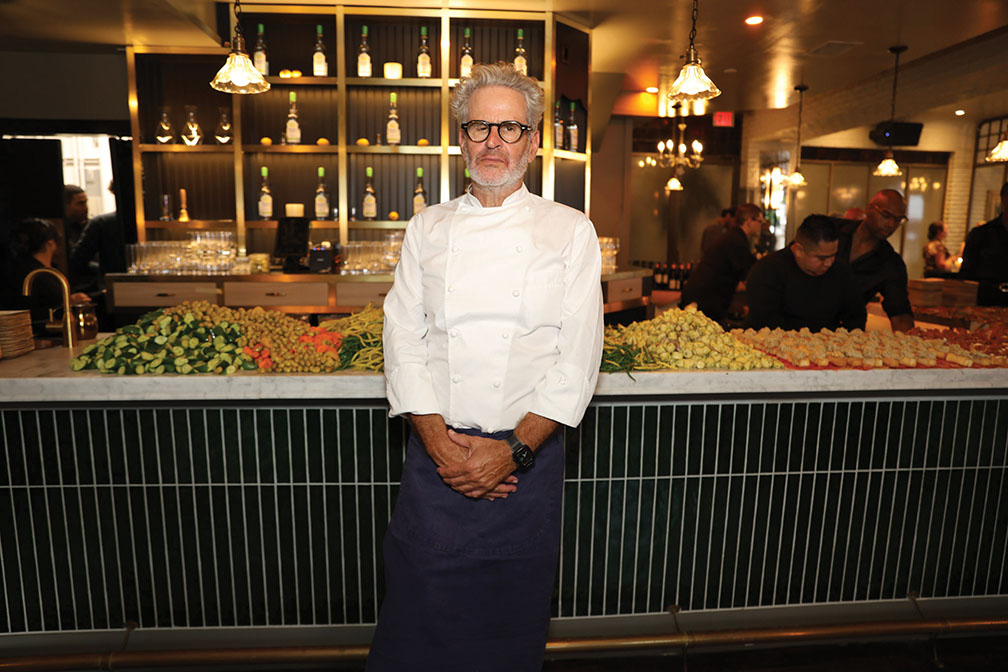

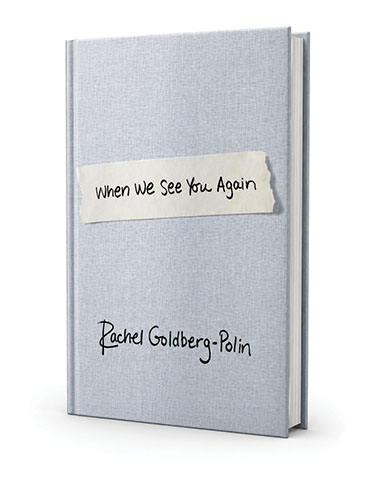
Rachel Goldberg-Polin is the mother of Hersh Goldberg-Polin, the 23-year-old Israeli American taken hostage by Hamas at the Nova music festival on Oct. 7, 2023 and murdered while held captive. She came to Los Angeles this spring to speak about “When We See You Again,” her new book about grief, pain, love and the aftermath of her son’s murder. More than 1,300 people came to Valley Beth Shalom in Encino on April 30. Two days later, another crowd came to Stephen Wise Temple.
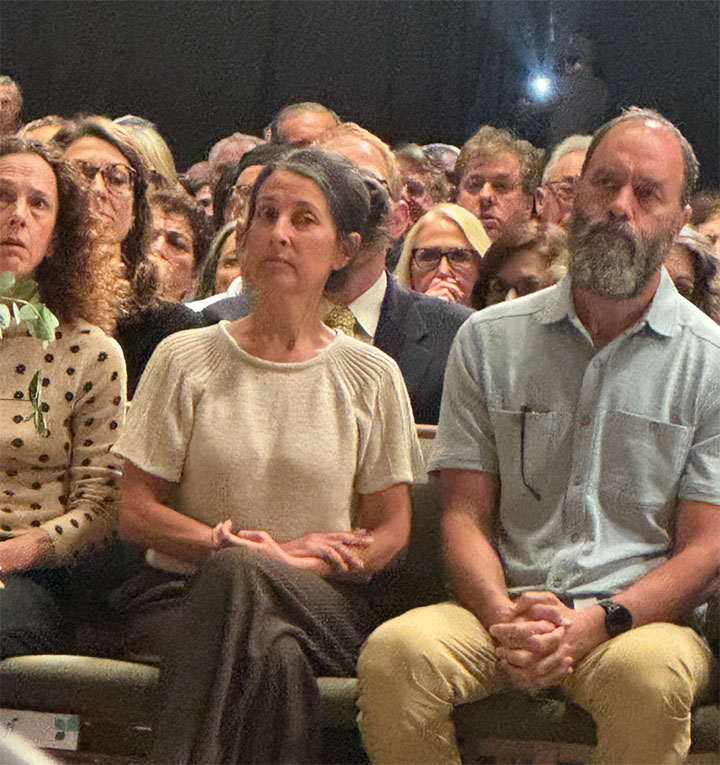
Between those public appearances, Goldberg-Polin sat down with The Jewish Journal at a house in Los Angeles, with her husband, Jon Polin, nearby.
There’s one version of Goldberg-Polin on stage: the mother many in the Jewish world had been watching, praying with and counting beside since October 2023. The interview gave another: a woman trying to explain what happens after words written in private are handed to the public, after strangers begin carrying pieces of your pain, after people who mean only love keep coming toward your body.
Three days after Oct. 7, Goldberg-Polin was on CNN, speaking about the two messages Hersh sent at 8:11 that morning. The first said, “I love you.” The second said, “I’m sorry.” Goldberg-Polin said she knew at once that something horrible was happening.
By late October, Goldberg-Polin was speaking at the United Nations. On Oct. 19, she delivered the speech that became known for the line “Hate is easy. Love is hard.” On Oct. 24, she spoke at U.N. headquarters in New York, asking for proof of life and Red Cross access to the hostages. Ten months later, Goldberg-Polin and Polin walked onto the stage at the Democratic National Convention in Chicago with “320” taped over their hearts. The number marked the days Hersh had been held in Gaza. The crowd chanted, “Bring them home.” For many Americans, it was the first time the Goldberg-Polin family’s story broke through.
The book became an immediate bestseller. Though Goldberg-Polin has read excerpts at public events, she only read the full manuscript once, when she recorded the audiobook in March.
At Valley Beth Shalom, Goldberg-Polin spoke to a room where the audience seemed afraid to move.
 Goldberg-Polin also had quips that made the crowd laugh. That mattered because in her book, Goldberg-Polin writes about how painful laughter had once been to hear. At VBS, Goldberg-Polin could make the room laugh while holding it in a silence where many seemed afraid to shift in their seats.
Goldberg-Polin does not speak as if she is handling it. Like many survivors, bereaved families and friends of those murdered on Oct. 7, Goldberg-Polin speaks about a life split into before and after. At VBS, Goldberg-Polin said she misses the ease of the life she had before Oct. 7, 2023, and feels grateful for that life. One-on-one, Goldberg-Polin was less sure about what the book had done for her.
But Goldberg-Polin resisted the neatest label for the book. “I want to be careful because I think a lot of people write and then are asked, ‘Why did you write this?’” Goldberg-Polin said. “And I think it’s impressive when people write for very altruistic reasons. I think it’s amazing. And I’ve read books over my life where I’ve thought, wow, I feel very privileged to have read this and it helped me, but I did not write this in that way.”
At a national news interview earlier that day, a journalist called the book a memoir. “I said, ‘listen, this is not a memoir. It is not a tell-all,’” Goldberg-Polin said. “This is like I’m in agony and I’m giving over these tiny bubbles of my pain and I don’t know how it will be received or what will happen with them, but I just want to be very honest about what it is.”
Nearly 90 pages were cut while editing the book. “It felt like it was asking too much, I think, of people to even be exposed to that much suffering,” Goldberg-Polin said. “So we sort of whittled and with a peeler, we peeled down and put 87 pages into a document that I call ‘the suitcase.’ … I felt so much like when you fill your cup too much and you think …” She paused to edit herself. “No, no, no, tip out some of that, because otherwise it’s going to spill all over the place. When you fill a pitcher of water to bring to the table and it’s too full, you have to actually dump some out in order for it to be a successful pitcher that you’re bringing to the table. And I think that there was such a surplus of burning, searing material that I didn’t agonize over getting it out. It just came out.”
The writing came from necessity. Goldberg-Polin rejected the idea of herself as a writer. “Oh, I’m completely not a writer, but I think that life makes us into things sometimes when there’s no other option,” Goldberg-Polin said. “I mean, I’m not a swimmer, but if I had to save myself, I could swim from one place to another.” Goldberg-Polin reached for a memory from the years when Hersh was a baby in Berkeley, California. She remembered being told to “keep ipecac in the house” – if a child swallowed poison, the medicine would make the child throw up. “So in many ways, I think the writing was ipecac,” she said. “It was something I was doing to save myself from this really severe syrupy, dark, drippy suffering. And in order to get that out, it was ‘get me a pen’ or ‘get me a computer.’”
College essays were hard. This book came from another place. “This wasn’t hard for me, unfortunately, I think because it came from such a terrible place and it was just a life-support solution.”
Even before Oct. 7, she had a real yearning “to explain what I’m feeling in a way that is digestible and understandable,” Goldberg-Polin said. “And so all the more so now when you’re desperately trying to have people in any way comprehend what you’re going through.”
She loved books before writing one, though not from childhood. During the interview, Goldberg-Polin edited herself after saying she had always loved reading. “I’ve always loved reading…That’s a lie. I started to love reading once I was 18 and above. I wasn’t a great reader when I was young.” That changed when Goldberg-Polin came to Israel for a year at 18. There was no internet, no movies or television. The 28 young people in the program relied on whatever books were around. “And so someone passed around the book, ‘The Godfather,’ and I really wasn’t a reader, but I got into it,” Goldberg-Polin said.
Then came “The Shining,” which scared her enough that she had to sleep in her roommate’s bed for a few nights, and “The World According to Garp.” That book “sealed the deal,” Goldberg-Polin said. “And I’ve been a bibliophile and obsessed with books, and I worked in the library when I was in college. But all that is to say that I’ve been a devourer of books, but not a writer.”
Goldberg-Polin mentioned a friend named Dasi, who years earlier used a phrase that stayed with her: “broadcast therapy.” “I think she made it up, meaning sometimes if you’re going through something, you want to discuss it with one or two people to process and turn it over and untangle it. And sometimes there are people who need to talk to 14 people about what they’re going through in order to untangle it on not this huge ball of confusing yarn.”
She said many people in pain are doing some version of that. “I think that so much of what people who are in pain are trying to do is broadcast therapy in different ways,” Goldberg-Polin said. “And maybe someone only needs one person to be the receiver, but I’m understanding since last week that finally I’m able to talk about the book because for many months, the book was finished being written already in November and we were editing it in December. And then there was ‘Mums the word,’ we’re not saying anything for many, many months. Having people read it, it means a lot to me that you are now carrying some of those molecules, some of those flecks, little, little tiny flecks of dust or something. That oddly feels like I can breathe in a different way.”
What was really heartening and really hopeful, she said, is that “we’ve gotten thousands of messages in this past week since the book came out from people all over the place and all different backgrounds and textures and colors and brands and different belief systems and different philosophical world outlooks, and they’re in pain and they are sharing their pain to say ‘yes,’” Goldberg-Polin said. “And there’s something about yes, that means ‘there’s room for this here. There’s room for this pain. We’re not getting better. None of us are getting better. We’re getting different, and I’m okay with that.’”
Goldberg-Polin had written about how much laughter hurt after Oct. 7. At VBS, Goldberg-Polin made the room laugh with a quip about giving birth to Hersh without any pain medication. “It was in Berkeley” she said to a round of laughter. But, she said, laughter remains complicated unless she is the one bringing it into the room. “I don’t know that I’m great at being around it unless I’m sort of bringing it to the table, which isn’t fair, but I think it’s true,” Goldberg-Polin said. “I think in our home and between Jon and me, there is actually a lot of laughter. I always think he should feel very lucky because I think he is hilarious and I feel like most partners should want their partner to feel that way about them.”
Even over the last two and a half years, Goldberg-Polin said, there has been laughter, though not in the beginning and not right after Hersh was killed. “I mean, obviously less in the beginning, there was such a complete traumatic terror, active terror that was going on, true terror right after Oct. 7,” Goldberg-Polin said. “So then I think there wasn’t. And certainly right after Hersh was killed, there wasn’t, but it is a real relief to hear us laughing and to feel the laughter and to cry from laughing so much, which we do and we have done. And also, I think it’s a sign within the brokenness that something is still cohesive.”
Hersh shared some of his father’s relationship to humor, Goldberg-Polin said. Hersh could make someone else laugh while holding in his own laughter. “I think he was also a lot like Jon is, where he tries to hold into,” Goldberg-Polin said. “There’s some sort of suppression. I see that Jon does that and Hersh used to do that as well because I think there’s some sort of pride of knowing that you have made someone else laugh, but you don’t want to crack yourself up because then it’s saying, ‘I know I’m funny.’ So there’s a humility in the ability to provide this sense of joy.”
Readers now tell Goldberg-Polin they feel they know Hersh through the book. She mentioned her friend Sarit Zussman, whose son Ben Zussman was killed in Gaza in December 2023. Zusman’s son and Hersh had been in the same high school class.
“When she talks about how we process information now as mothers who lost our firstborn son, but it’s anyone who’s lost anybody, it’s not firstborn sons,” Goldberg-Polin said. “She calls it ‘bereavement dementia,’ and it sounds better in Hebrew, but she coined that term. And I do think that it’s very hard to retain and remember things.”
She thinks it’s nice that people keep saying, “Now I really feel like I really know Hersh”: “I’m so glad that people feel that.”
She knows people visit Hersh’s grave because they send her photos “Again, I’m old, so I don’t really know how things like Facebook and Instagram work, but we have young people who are helping us with those things and they forward those to us. And it is really beautiful.”
But she is not a grave person. “I don’t need to. … Hersh is right here,” she said, gesturing to her heart.
Still, the grave has become a place for others, calling it “a beautiful place for people to go.” Visitors leave rocks, letters, pictures and stickers. At the end of Passover, the Burial Society goes around the cemetery to straighten things up thinking they were doing the family a favor. The Society noticed how cluttered the site had become, and removed objects that people left.
The family protested, “‘No, no, we’re okay with it. You can leave all of that stuff.’ But it does look messy,” she said. “I think that what’s really beautiful is the messiness of a grave. There’s something very beautiful about these letters that clearly are either from children or adults with extremely bad handwriting.”
The grave is one place where public love becomes an object. Every one of those objects ends up in the family home. Friends’ garages hold even more: six storage bins, thousands of letters and pieces of art.
Goldberg-Polin is not ready to go through them just yet. “Maybe in six months or six years or six decades, I’ll suddenly want them,” she said. “And people have taken the time to write or to express themselves. That’s holy, and I don’t want to mistreat that, but I also am not in a place where I can really do it.”
But she and her daughters will sometimes “go through these boxes and start opening things and reading things,” she said. “And I hope that one day I have grandchildren who would be curious about their Uncle Hersh, who they never got to meet, and maybe they’ll have the stamina, the emotional stamina and courage to go through some of those things. So we try to keep everything that we can. We know that it comes from a place of love, and I’m so respectful and grateful for it.”