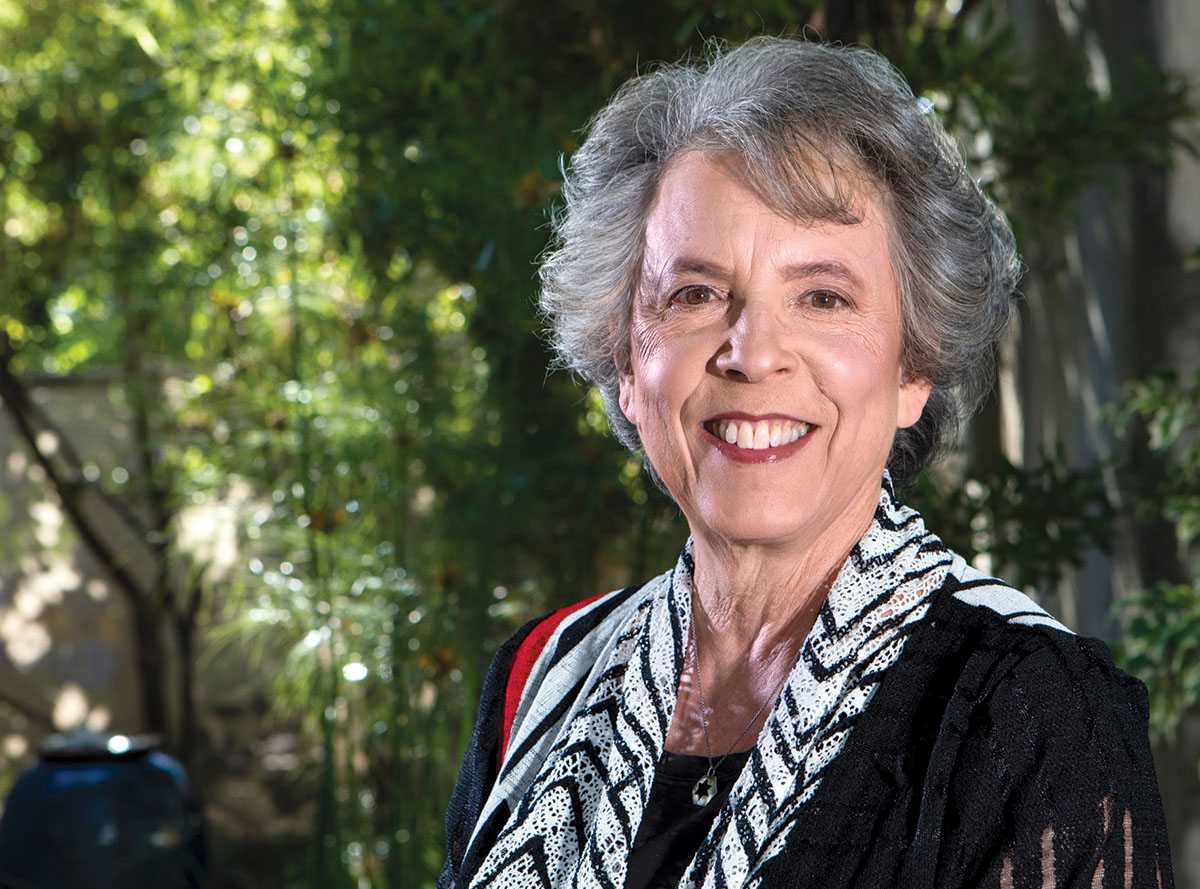
This year marks the 50th anniversary of Rabbi Laura Geller’s ordination, the third Reform woman to earn the honor. In 1994, Rabbi Geller was again a trailblazer when she became the first woman rabbi to lead a major metropolitan synagogue, Temple Emanuel of Beverly Hills. When you meet her, you realize that her extraordinary success is due in part to her thoroughness when meeting any professional challenge.
She showed up for her interview with The Journal with three of her books, explaining that when she retired in 2016, “instead of asking for a present, I wanted a book that talked about my rabbinic life. We called it ‘The Torah of My Life,’ an expression I used a long time ago in a public talk, and now everybody uses it. I believe there are two Torahs, not just the written Torah and the Oral Torah, but there is a Torah of Tradition and a Torah of Our Own Life. Those Torahs interact with each other, and each is changed because of interaction with the other.”
In the book’s introduction, she provides readers with a sample of her thinking. “Forty is a powerful number,” it begins. “The Torah tells the story that it rained and rained for 40 days. Moses was up on Mount Sinai alone for 40 days. There are 40 weeks of gestation. A mikvah has 40 seah of water. Our ancestors wandered in the wilderness for 40 years, and just as the wandering ended, Moses told them, ‘God has not given you a heart to know, and eyes to see, and ears to hear until this day.’ Forty suggests renewal, clarity, rebirth, the conclusion of one phase of a journey and the beginning of the next. And if you are lucky, after 40 years, you have a heart to know, eyes to see, and ears to hear.”
The introduction concludes with this paragraph: “This book is a retrospective of my career in published articles, sermons and images concerning the issues and themes that have been central to my experience as a rabbi, hence the Torah of my life. We’ve organized it (a bit pretentiously, I admit) around a reinterpretation of the Five Books of Moses: hence, the Torah of tradition. I have chosen the above in collaboration with my editor, Rabbi Beth Lieberman, who assembled this volume. The book would have been much too heavy to pick up if I had made the choices myself.”
Lieberman was a Temple Emanuel congregant in the publishing business. “While she was here,” Rabbi Geller said, “she decided she wanted to become a rabbi.”
“The Torah of My Life” is an immensely personal book. At one point, she writes about “a memory that has shaped the Torah of my life that was deeply buried until recently. My sister Meggie died of cancer before I was born. She was two. My mother found out she was pregnant with me on the day of her funeral. We never talked too much about Meggie, but there were always pictures of her in my parents’ bedroom. It wasn’t until I had a baby of my own that I was ready to hear the story. I learned that my parents mourned her death very differently. My mom turned to family and friends for support. My dad was more private; it was very difficult for him to find solace. And then he went to talk to his rabbi, a man I never knew. The story comforted my dad. Meggie, somehow, was always a part of his life.”
While holding a copy of “The Torah of My Life,” she pointed out two details: The cover, she said, was painted by Los Angeles artist Ruth Weisberg; she also insisted the book includ the credit, “edited by Beth Lieberman.”
The book is dedicated to Lynn Franklin, her assistant and the B’nai Mitzvah coordinator of Temple Emanuel for 22 years. The rabbi wrote that Franklin “supported and worried about me from the start.” Further, “she soothed congregants when there were hard feelings and made everyone feel as if he or she was the most important person at our temple.”
The rabbi discusses what it was like to be a pioneer for Jewish women, to be a rabbinic explorer, and her work with Barbra Streisand during the making of the film “Yentl.” She wryly notes that “in my retirement, I have written two books — ‘Moments That Matter’ and ‘Getting Good at Getting Older.’” The latter book, she said, is intended to offer road signs for growing older, a joint effort of Rabbi Geller and her late husband, Richie Siegel, who died in 2018, just short of his 71st birthday. She gave him much of the credit for the book. “My last promise to him,” she said, “was that I would finish the book. It was mostly written, but I knew I couldn’t complete it by myself. That’s when I reached out to Beth Lieberman.” It’s organized around a variety of helpful topics, such as “Getting Good at Getting Ready,” “Getting Good at Giving Away” and “Getting Good at Gaining Wisdom,” The latter titled chapter, she writes, offers “tools for gaining wisdom. One tool was creating new ritual, something I have been interested in from my first year in rabbinical school.”
The book was published in 2019, and soon she began drawing invitations to speak about the book. Then came COVID. “It was a great time to be in conversation with communities around the country because they didn’t have to pay for me,” she said. “During COVID, I spoke at more than 100 congregations across the country.”
Fast Takes with Rabbi Geller
Jewish Journal: What is your proudest achievement?
Rabbi Geller: I am grateful for my children and their children. I am grateful I had the good fortune to be in the right place at the right time, and to recognize the land ahead is flowing with milk and honey, but it’s about perspective. My greatest achievement was to have the perspective to look ahead and see the possibilities, to be curious, challenged and to find people who helped me.
J.J.: If you could, would you change any aspect of your life?
R.G.: While at USC, as a rabbi, I had an opportunity to pursue a doctorate, and I started in the School of Social Ethics. It became too complicated, and I didn’t do it.
J.J.: Your single most memorable moment?
R.G.: The birth of my children. The death of my husband. The caregiving at the end of his life.