There’s a reason why the expression “tough love” ends with love.
We know that the most important things in life are usually said last– after the obligatory “but.”
I have a lot of feelings for you, but I can’t continue.
I’d love to make a donation, but now’s not a good time.
America does some great things, but it’s irredeemably racist.
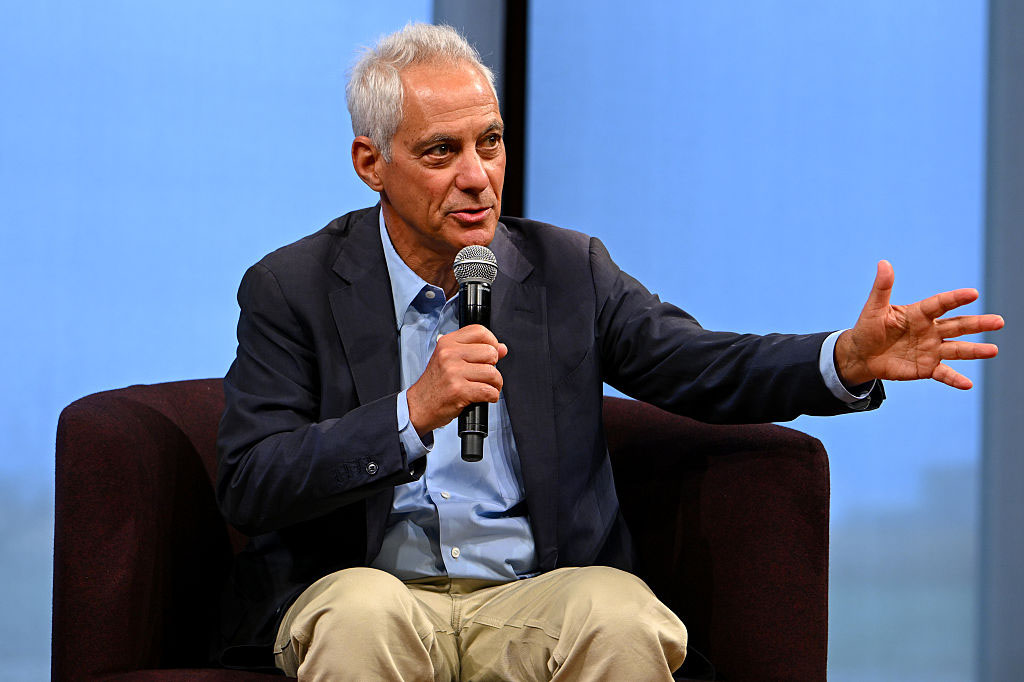
In his speech Wednesday at Tel Aviv University, Democratic presidential hopeful Rahm Emanuel tried the same thing: he led with “love” to set up his “tough.” He assumed savvy Israelis would not see he was softening them up before delivering the hammer.
Sure enough, he began with empathy: “I want to start by saying four words that Israelis don’t hear often anymore: I understand your cynicism.”
He acknowledged that Palestinian leadership has failed its people; that it rejected Israeli peace offers and responded with violence and intifadas.
He acknowledged the horror of Oct. 7, adding: “For those that paraded, celebrated and cheered on October 8, what happened on October 7, your moral bankruptcy speaks louder than any words today.”
He also got personal, recounting how his Jerusalem-born father fought in the War of Independence and that his uncle, whose grave he visited upon arrival, died fighting for Israel as part of the Irgun.
At this point, I can imagine many Israelis rolling their eyes: OK, where’s he going with this? When is he telling us what he really came here to say?
It didn’t take long for the “but” to show up, for Emanuel to let everyone know he was here for serious business.
The United States’ unconditional support for Israel, he warned, “has produced a prime minister who has presumed that his strategic interests would incur no cost if he ignored America’s concerns about the settlements and sparked a regional war.
“Unconditional support has allowed you to deny food and medical relief to innocent Palestinians suffering in Gaza, leaving the world to conclude that Israelis not only want to kill the Palestinians but that they are completely indifferent to their death, destruction, and suffering.
“Unconditional support has girded a political coalition in the Knesset that learned it can burn Palestinian farmland in the West Bank and terrorize Palestinian families without consequence.”
Under Prime Minister Benjamin Netanyahu, he said, support for Israel has plummeted around the world and made Israel a pariah state.
He said the United States should stop supplying military aid to Israel and instead treat it like any other ally. “The United States cannot continue to finance and support that cynicism in silence. You cannot fight indefinitely against a world that has stopped believing you have the right to fight. You must instead find a new sustainable path to peace, security, and prosperity.”
He promoted a plan, the “23-state solution,” in which the Arab states would accept the Jewish claim to Israel and Israel would “cease and desist from its cynical game of nurturing destructive organizations like Hamas rather than real partners in pursuit of peace.” If Israel attempts to annex the West Bank and “pursue the fantasy of a greater Israel,” he warned that it would lose its American support.
Here’s the point: Whether or not his criticisms and prescriptions have merit, they were undermined by his superficial appreciation of Israel’s shattered state since Oct. 7. I’ve been to the country numerous times in the past 1,000 days. The nerves are frayed. People are exhausted. The tragic memories are very much alive.
Emanuel didn’t show that he has the pulse of Israelis. He was full-throated and cocky with his hammer, but shallow with his empathy.
Instead of ending with his preaching, he would have been more credible had he finished with a poignant tribute to the victims of Oct. 7; with a recognition of the national trauma that continues to haunt Israelis and has only reinforced their deep distrust for “peace” with genocidal neighbors sworn to their destruction. That would have made empathy his central message, which, ironically, would have made the hammer go down easier.
Israelis know their country is in a mess. They know they need an eventual solution to the Palestinian conflict and to many others. They know they need change. They know they’re hated, especially on the left.
If you want to lecture them in their own country, you better do it with radical sensitivity, especially if you suddenly pop in one day as a potential future presidential candidate. Which makes one wonder: Was Emanuel’s real intent to talk to Israelis or to show progressive voters back home that he’s the kind of Jew who can bash Israel with the best of them?
In that sense, Emanuel came across more as a slick political operator than a concerned family member who has your best interest at heart.
That’s a shame.
Israel is in a real crisis, both internally and externally. Israelis could have used some tough love from someone they could trust.
Instead, they got a swaggering politician who buttered them up before adding more gloom and doom to a nation already on overdose.
If you don’t do the “love” right, it’s hard for the “tough” to get through.
Of course, I may be wrong. Emanuel’s bluntness, political agendas aside, may end up serving as a jarring wake-up call that will benefit Israel in the long run.
In any case, if he ends up in the White House one day, we may have no choice but to swallow his love tough.