“As matters now stand, we appear to be treating the Jews as the Nazis treated them except we do not exterminate them. They are in concentration camps in large numbers under our military guard instead of SS troops. One is led to wonder whether the German people, seeing this, are not supposing that we are following or at least condoning Nazi policy.”
So reads the Harrison Commission’s report on Displaced Persons camps operated by the Allies after the defeat of Hitler in 1945. Hundreds of thousands of Jews from across Europe were living in these poorly constructed encampments in squalor, many in the same complexes as captured German soldiers who had been seeking their utter destruction.
American Jewish organizations such as the Organization for Rehabilitation through Training (ORT) and the Joint Distribution Committee lobbied to improve the survivors’ living conditions.
In response to the report, President Truman ordered General Dwight D. Eisenhower, commander of U.S. forces in Europe, to “get these people out of camps and into decent housing until they can be repatriated or evacuated.” Truman continued, “I know you will agree with me that we have a particular responsibility toward these victims of persecution and tyranny who are in our zone. … We have no better opportunity to demonstrate this than by the manner in which we ourselves actually treat the survivors remaining in Germany.”
However, U.S. immigration quotas and Britain’s strict control over emigration to Palestine left American Jewish organizations and the United Nations with no choice but to encourage and assist Jewish displaced persons to restore Jewish communal life in Europe.
And the People of the Book, to be revived, required their books. After all, along with millions of humans, the Nazis had burned countless Jewish texts, schools and synagogues. As the historian Gerd Korman noted, “in post-war Europe complete sets were hard to find because in the previous 10 years the Talmud had been hunted as of yore, in the centuries when, as an embodiment of heresy, Christians had burned thousands of volumes at the stake.”
As Daniel Bonner has recounted in the journal Sapir, in order to remedy this situation, a group of rabbis — including Abraham Kalmanowitz, Samuel Rose and Samuel Snieg, a survivor of Dachau and the Orthodox Chief Rabbi of the American zone of Allied-occupied Germany, had an audacious idea: to print “an entire Talmud … in the land that had tried to destroy Jewish life forever.”
The Orthodox Rabbi Snieg reached out to Rabbi Philip Bernstein, a Reform rabbi and Army adviser, and together they sought the support of General Joseph T. McNarney, commander-in-chief of United States Armed Forces in Europe. As Korman observed: “No Gentile ruler had decided ever before to print and publish a Talmud for the Jews. It would be a distinctly American event, for it is impossible to imagine a European commander in 1946 doing what McNarney did.”
It took over a year for the U.S. government to provide enough paper, which was in short supply locally. The process required “millions of sheets of paper, tens of thousands of meters of bonds and strips of linen paper, cord, typesetting, cardboard, photoengraving equipment and a permit for electricity use.” Two sets of the Talmud had to be brought from New York from which engravings were made. To print the work, the Army requisitioned the Carl Winter Printing Plant in Heidelberg, which recently had been churning out Nazi propaganda. It would now produce the beloved Jewish text.
After approximately two years, roughly 500 sets appeared. The first 50 were printed by the Army. It was the only time in modern history that a national government published an edition of the Talmud. The rest were produced by the JDC.
Rabbi Snieg presented a copy to General Lucius Clay, Military Governor of the U.S. Occupation Zone in Germany, with the words, “I bless your hand in presenting to you this volume embodying the highest spiritual wisdom of our people.” The newly reborn State of Israel was also given a copy, accepted on its behalf by President Chaim Weizmann.
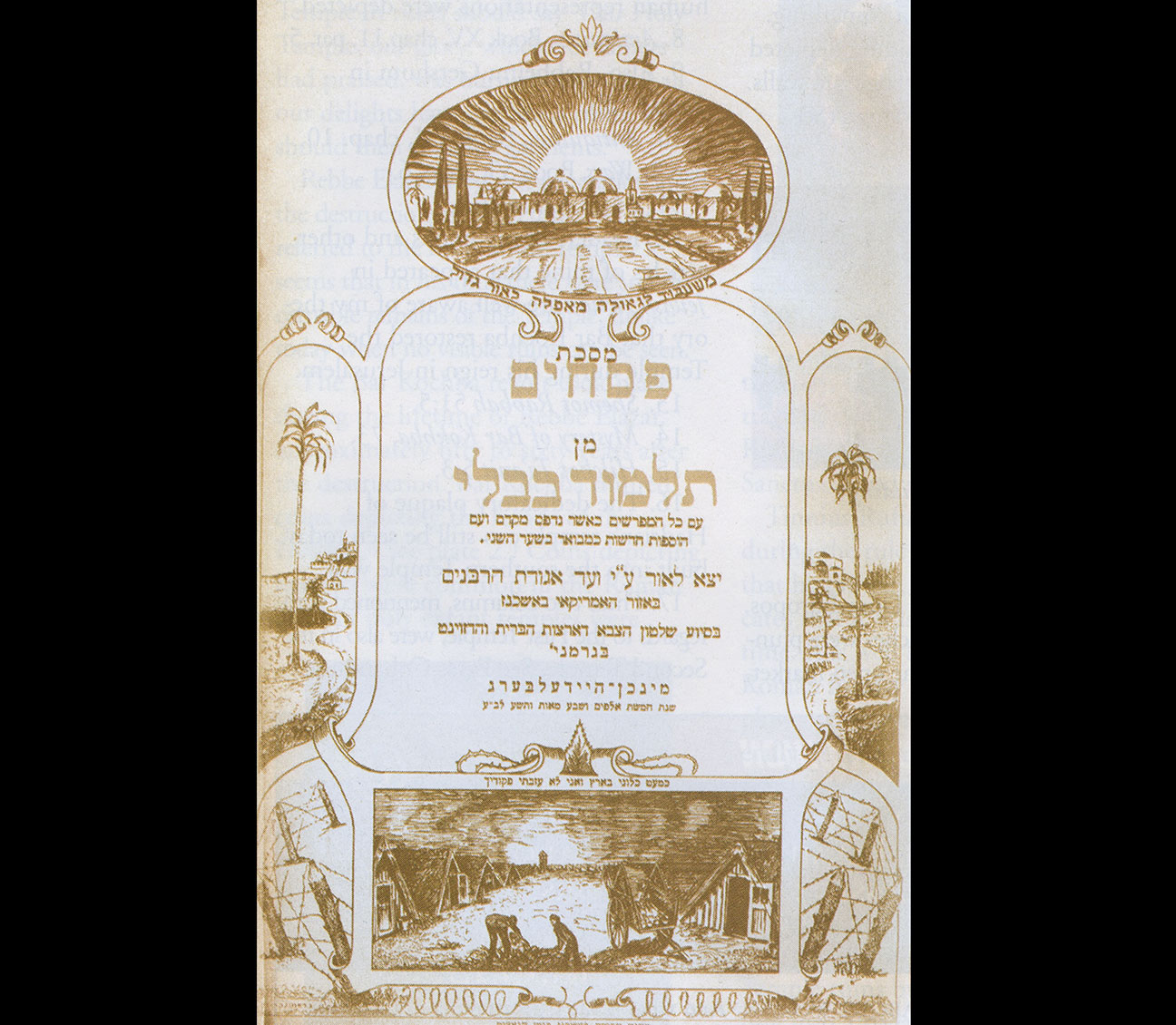
The illustration on the title page, designed by a survivor, shows a Nazi forced labor camp surrounded by barbed wire. Above it are pictured palm trees and scenes from the Holy Land accompanied by a Hebrew inscription “From bondage to freedom, from darkness to a great light.”
The preface reads: “This edition of the Talmud is dedicated to the United States Army. The Army played a major role in the rescue of the Jewish people from total annihilation, and their defeat of Hitler bore the major burden of sustaining the DPs of the Jewish faith. This special edition of the Talmud, published in the very land where, but a short time ago, everything Jewish and of Jewish inspiration was anathema, will remain a symbol of the indestructibility of the Torah. The Jewish DPs will never forget the generous impulses and the unprecedented humanitarianism of the American forces, to whom they owe so much.”
The sets, referred to as the U.S. Army Talmud, would spread across Europe, the U.S., Africa and Israel, where the refugees rebuilt their physical and spiritual lives. One survivor, a rabbi who eventually made his way to Israel and lived near Jerusalem recalled how he lost his wife and children when they were murdered in the Holocaust. Living in the biblical homeland of his people, he spent his days studying from his Survivors’ Talmud.
In 1951, the recently appointed Lubavitcher Rebbe received a copy in New York. He wrote the following letter to the JDC’s Moses Leavitt:
“The Babylonian Talmud, our Oral Law, which goes hand-in-hand with our Written Law (the Bible), represents our greatest and most sacred spiritual heritage, the very soul of our people and the light of our exile. The reprinting of this vast treasure would have been an occasion for rejoicing at all times. In our present day, after the Hitlerite hordes had destroyed a great many of our living Talmudists together with their holy books and the famous European Hebrew presses, the reprinting of the Talmud is not only a fitting monument to our great tragedy, but it fills an urgent need. That it was printed in the very country which had set out to spread a blanket of darkness over the whole world, adds a touch of Divine justice.”
This edition of the Talmud, then, stands as eternal testimony. Its pages attest to the miraculous nature of Jewish survival and the invaluable contribution of one covenantal nation, the United States, to another, in ensuring the spiritual flourishing of the Nation of Israel.
Rabbi Dr. Stuart Halpern is Senior Adviser to the Provost of Yeshiva University and Deputy Director of Y.U.’s Straus Center for Torah and Western Thought. His books include the newly released “Jewish Roots of American Liberty,” “The Promise of Liberty: A Passover Haggada,” “Esther in America,” “Gleanings: Reflections on Ruth” and “Proclaim Liberty Throughout the Land: The Hebrew Bible in the United States.”