On Apr. 13, the Phoenix of Gaza immersive virtual reality exhibit started a short run at San Diego State University’s Digital Humanities, located in the basement of Love Library. The opening featured a talk by Dr. Ahlam Muhtaseb, Professor of Media Studies at CSU San Bernardino and co-founder and faculty director of the Phoenix of Gaza project.
The exhibit—which started in 2022 and is touring schools up and down the academic ladder, including Yale, Tufts, and Salt Lake Community College—aims to preserve a record of Gaza before the present hostilities began (I’ll return to the question of what to call this conflict shortly). Visitors strap on VR goggles and watch one of several videos “capturing the untold stories of Gaza’s people and its transformation.” We are invited to “Dive deep into the lives of those who endured and rebuilt. It’s more than VR —it’s a testament to resilience.” This sounded like a fascinating, important project, featuring cutting edge technology. So I made a point of showing up for the exhibit and the introductory lecture by Dr. Muhtaseb.
My visit did not get off to a great start. When I entered the room, I saw a table filled with crayons and coloring pages, which seems a little infantilizing for college students. Then I saw what the students would be coloring:
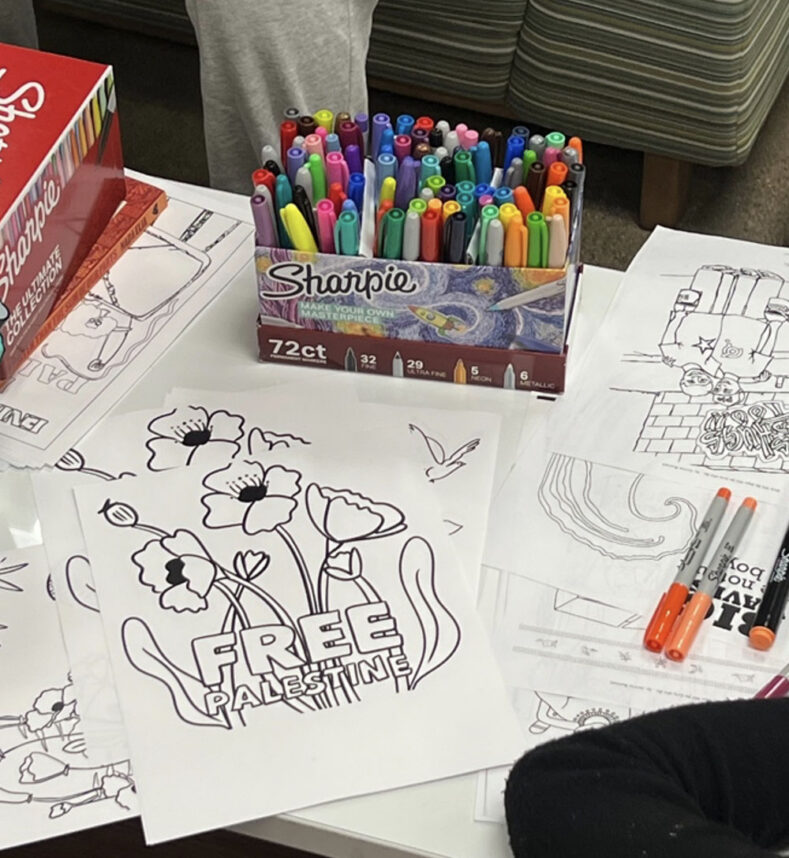
While waiting my turn for the VR goggles, I got into a conversation with a grade school teacher who said he came to the exhibit to be educated. This man told me he was a member of the Democratic Socialists of America, and he was working to get his school board to divest from Israel (so far, no luck). After he told me about how Israel is colonizing Gaza, I asked him a few questions.
Did he know that Israel pulled out of Gaza in 2005?
No.
Did he know that since 1948, there have been at least five major wars, none started by Israel?
No.
Was he aware that the Palestinians have been offered their own state numerous times, the most recent in 2000, when Yasir Arafat turned down a proposal that would have created a Palestinian state on 96% of the West Bank and East Jerusalem as the capital?
No.
Had he looked at the Hamas Charter?
No. Never heard of it.
So where does he go for information about the Middle East?
He said he relied on a “UN reporter.” He couldn’t remember the name, but I assume it’s Francesca Albanese, who is not exactly a reliable source.
Fortunately, at that point, a chair opened up and I sat down, put on the goggles, and wrapped myself in images of Gaza’s past glory. The technology, I’m happy to say, is spectacularly effective. Unlike a movie, you feel that you are actually there. As you move your head, the images shift just as they would in real life. To say this is disorientating is putting it very mildly. More like jaw-dropping.
The videos featured scenes of Gaza city, many filmed by Yahya Sobeih, a journalist who was killed (or “martyred”) in an Israeli airstrike, with many showing “before” and “after” the destruction caused by the war. Due to the goggles over my eyes, I couldn’t take notes, but the video that stayed with me was the seaside street. I saw a beautiful beach on one side, tall buildings on the other, and nice, new, clean cars zipping along, including a lime green Toyota 4×4 that gleamed in the sun.
While the project’s team says that their goal is to create a video archive of Palestinian life pre-recent conflict, the videos also have the unintended consequence of undermining the description of Gaza as an open-air prison, or a city under siege. The video of the seaside street, for example, could have been shot in Los Angeles, San Diego or, truth be told, Tel Aviv. The markets abound with produce. The church glows with gold-framed religious paintings. The bakery is redolent with all sorts of breads. The overall impression from this VR presentation is of a happy, prosperous city, not one subject to debilitating restrictions.
Then came Dr. Muhtaseb’s talk. After describing how “immersive technologies” started as pure entertainment, gaming, and yes, porn, with little sense of how the technology could be used for other than “capitalist” purposes, Dr. Muhtaseb started in on how VR could be “bent” for other uses. By placing the viewer in the middle of the action, the viewer becomes “part of the action,” fully immersed, in other words, in someone else’s reality. This “enforced embodiment” (her phrase) has the highly significant effect of turning VR into an “empathy machine” which could be used as a force for good and to change social attitudes. If, for example, you see a VR video of police brutality, then you are likely to protest police brutality.
But Dr. Muhtaseb does not approve of VR as an “empathy machine,” because: a.) empathy can be exploited for profit and “capitalist purposes” (which she opposes); and b.) empathy does not necessarily lead to action. In a surprising echo of the criticisms of land acknowledgments as mere virtue-signaling, the professor criticized empathy because it doesn’t lead to anything concrete; instead, you end up “feeling good about feeling bad.”
And here’s the key: The point of Phoenix of Gaza is not empathy for the sufferings of the Palestinian people, but responsibility and accountability for what happened and is continuing to happen in Gaza, and that is genocide, according to Dr. Muhtaseb. And every American, in her view, is complicit in the Gaza genocide because our taxes help underwrite Israel.
The extraordinary thing about the exhibit and Dr. Muhtaseb’s talk is that neither mentions Hamas or the invasion on 10/7. Instead, over and over again, we hear: “when the genocide started,” “before the genocide started,” “the ongoing genocide,” “during the genocide,” etc. Leaving alone the fact that there was no genocide in Gaza, there is zero acknowledgement of a precipitating event resulting in the Israeli bombing of Gaza. Neither the professor nor the exhibit acknowledges Hamas’s use of human shields, the Nova Festival massacre, the hostages, the rapes, the tunnels building, and Hamas using hospitals and schools for military purposes. In fact, there is no acknowledgment at all that Hamas bears the slightest responsibility for the destruction. Or that Hamas even exists. At one point in a video of a busy traffic circle, the narrator says, “and then the tanks rolled in.” But there’s nothing about why the Israeli tanks rolled in. Instead, the impression the exhibit gives, amplified by Dr. Mehtaseb’s talk, is that one fine day, Israel decided, for no discernable reason, to bomb the shit out of Gaza.
To say the least, the exhibit’s narrative is completely inaccurate. Imagine talking about America’s entry into World War II and not mentioning Pearl Harbor. That’s what this exhibit does.
Imagine talking about America’s entry into World War II and not mentioning Pearl Harbor. That’s what this exhibit does.
Nor is it alone in presenting such a lopsided view. The New York Times recently posted a guest essay, “Gaza’s Rubble is the Grave of our Future,” which at least refers to “the war,” not “the genocide.” The essay details story after story about the terrible and tragic results of the war on Gaza’s civilian population. Homes are destroyed. Families killed. Nonstop shelling and missiles. But again, the word “Hamas” does not appear. “10/7” is never mentioned. Nobody sees any Hamas fighters.There is no acknowledgement of what started this war, or how Hamas could have stopped the destruction at any time by surrendering and returning the hostages. But since the point of the article, like the point of the Phoenix of Gaza exhibit, is to depict Israel (or “the Zionist entity”) as an unqualifiedly malevolent, evil, settler-colonialist, illegitimate apartheid state that must be dismantled for justice to be served, admitting Hamas’s responsibility would only complicate or confuse the issue.
In fact, both Phoenix of Gaza and The New York Times piece are part of a new literary and artistic genre, termed by Matti Friedman “Gazology,” and just as all genres have certain expectations, the chief mark of “Gazology” is hatred of Israel, and to achieve that aim, “genocide” is repeated over and over again. Not, to quote Friedman, as “an analysis of Israeli operations but a tool designed to shift attention away from the people who started the war and built the twisted battlefield on which it would be fought, and to mass-produce a verbal weapon that can be used to anathematize opponents and obscure their concerns.”
Consequently, the goal of the Phoenix of Gaza exhibit is not education, but indoctrination. Which makes the fact that the exhibit, created under the auspices of a university and traveling from university to university, so disturbing. Instead of presenting a complex, nuanced picture, one that gives due deference to both sides of the conflict, the Phoenix of Gaza gives students a false, entirely one-sided narrative designed to gin up hatred of Israel and all who side, or even slightly sympathize, with Israel.
Unlike Las Vegas, what happens in a university does not stay in a university, and the Phoenix of Gaza exhibit I visited also showed how anti-Israelism spreads into K-12 schools. The room was filled with undergrads because a prof brought her “Modern World History for Teachers” class to view the VR exhibit and hear Dr. Muhtaseb’s talk. And the students (from what I can tell) ate it up. All of the subsequent questions were along the lines of “What can I do when people say there’s no genocide?” and “How can students help you in this struggle?” Nobody asked a critical question or presented a corrective. Nobody asked, “You repeatedly refer to a genocide, but what about 10/7?” Having been taught about the “genocide” at school, the expectation is that these future K-12 teachers will import this view into the classroom. By all accounts, that’s exactly what’s happening.
Unlike Las Vegas, what happens in a university does not stay in a university, and the Phoenix of Gaza exhibit I visited also showed how anti-Israelism spreads into K-12 schools.
Afterward, I sent a note to the professor who brought her future teachers, asking how her students responded to the exhibit. She said that the students were really interested in using VR in the classroom. I responded with another note, this time asking specifically what they thought of the presentation and Dr. Muhtaseb’s comments about “the genocide.”
I did not get a response.
Peter C. Herman is a professor of English literature at San Diego State University. He has published books on Shakespeare, Milton and the literature of terrorism, and essays in Quillette, Newsweek, Inside Higher Ed, and Times of San Diego. His latest book is “Early Modern Others: Resisting Bias in Renaissance Literature” (Routledge).

The Phoenix of Gaza Exhibit: Education or Indoctrination?
Peter C. Herman
On Apr. 13, the Phoenix of Gaza immersive virtual reality exhibit started a short run at San Diego State University’s Digital Humanities, located in the basement of Love Library. The opening featured a talk by Dr. Ahlam Muhtaseb, Professor of Media Studies at CSU San Bernardino and co-founder and faculty director of the Phoenix of Gaza project.
The exhibit—which started in 2022 and is touring schools up and down the academic ladder, including Yale, Tufts, and Salt Lake Community College—aims to preserve a record of Gaza before the present hostilities began (I’ll return to the question of what to call this conflict shortly). Visitors strap on VR goggles and watch one of several videos “capturing the untold stories of Gaza’s people and its transformation.” We are invited to “Dive deep into the lives of those who endured and rebuilt. It’s more than VR —it’s a testament to resilience.” This sounded like a fascinating, important project, featuring cutting edge technology. So I made a point of showing up for the exhibit and the introductory lecture by Dr. Muhtaseb.
My visit did not get off to a great start. When I entered the room, I saw a table filled with crayons and coloring pages, which seems a little infantilizing for college students. Then I saw what the students would be coloring:
While waiting my turn for the VR goggles, I got into a conversation with a grade school teacher who said he came to the exhibit to be educated. This man told me he was a member of the Democratic Socialists of America, and he was working to get his school board to divest from Israel (so far, no luck). After he told me about how Israel is colonizing Gaza, I asked him a few questions.
Did he know that Israel pulled out of Gaza in 2005?
No.
Did he know that since 1948, there have been at least five major wars, none started by Israel?
No.
Was he aware that the Palestinians have been offered their own state numerous times, the most recent in 2000, when Yasir Arafat turned down a proposal that would have created a Palestinian state on 96% of the West Bank and East Jerusalem as the capital?
No.
Had he looked at the Hamas Charter?
No. Never heard of it.
So where does he go for information about the Middle East?
He said he relied on a “UN reporter.” He couldn’t remember the name, but I assume it’s Francesca Albanese, who is not exactly a reliable source.
Fortunately, at that point, a chair opened up and I sat down, put on the goggles, and wrapped myself in images of Gaza’s past glory. The technology, I’m happy to say, is spectacularly effective. Unlike a movie, you feel that you are actually there. As you move your head, the images shift just as they would in real life. To say this is disorientating is putting it very mildly. More like jaw-dropping.
The videos featured scenes of Gaza city, many filmed by Yahya Sobeih, a journalist who was killed (or “martyred”) in an Israeli airstrike, with many showing “before” and “after” the destruction caused by the war. Due to the goggles over my eyes, I couldn’t take notes, but the video that stayed with me was the seaside street. I saw a beautiful beach on one side, tall buildings on the other, and nice, new, clean cars zipping along, including a lime green Toyota 4×4 that gleamed in the sun.
While the project’s team says that their goal is to create a video archive of Palestinian life pre-recent conflict, the videos also have the unintended consequence of undermining the description of Gaza as an open-air prison, or a city under siege. The video of the seaside street, for example, could have been shot in Los Angeles, San Diego or, truth be told, Tel Aviv. The markets abound with produce. The church glows with gold-framed religious paintings. The bakery is redolent with all sorts of breads. The overall impression from this VR presentation is of a happy, prosperous city, not one subject to debilitating restrictions.
Then came Dr. Muhtaseb’s talk. After describing how “immersive technologies” started as pure entertainment, gaming, and yes, porn, with little sense of how the technology could be used for other than “capitalist” purposes, Dr. Muhtaseb started in on how VR could be “bent” for other uses. By placing the viewer in the middle of the action, the viewer becomes “part of the action,” fully immersed, in other words, in someone else’s reality. This “enforced embodiment” (her phrase) has the highly significant effect of turning VR into an “empathy machine” which could be used as a force for good and to change social attitudes. If, for example, you see a VR video of police brutality, then you are likely to protest police brutality.
But Dr. Muhtaseb does not approve of VR as an “empathy machine,” because: a.) empathy can be exploited for profit and “capitalist purposes” (which she opposes); and b.) empathy does not necessarily lead to action. In a surprising echo of the criticisms of land acknowledgments as mere virtue-signaling, the professor criticized empathy because it doesn’t lead to anything concrete; instead, you end up “feeling good about feeling bad.”
And here’s the key: The point of Phoenix of Gaza is not empathy for the sufferings of the Palestinian people, but responsibility and accountability for what happened and is continuing to happen in Gaza, and that is genocide, according to Dr. Muhtaseb. And every American, in her view, is complicit in the Gaza genocide because our taxes help underwrite Israel.
The extraordinary thing about the exhibit and Dr. Muhtaseb’s talk is that neither mentions Hamas or the invasion on 10/7. Instead, over and over again, we hear: “when the genocide started,” “before the genocide started,” “the ongoing genocide,” “during the genocide,” etc. Leaving alone the fact that there was no genocide in Gaza, there is zero acknowledgement of a precipitating event resulting in the Israeli bombing of Gaza. Neither the professor nor the exhibit acknowledges Hamas’s use of human shields, the Nova Festival massacre, the hostages, the rapes, the tunnels building, and Hamas using hospitals and schools for military purposes. In fact, there is no acknowledgment at all that Hamas bears the slightest responsibility for the destruction. Or that Hamas even exists. At one point in a video of a busy traffic circle, the narrator says, “and then the tanks rolled in.” But there’s nothing about why the Israeli tanks rolled in. Instead, the impression the exhibit gives, amplified by Dr. Mehtaseb’s talk, is that one fine day, Israel decided, for no discernable reason, to bomb the shit out of Gaza.
To say the least, the exhibit’s narrative is completely inaccurate. Imagine talking about America’s entry into World War II and not mentioning Pearl Harbor. That’s what this exhibit does.
Nor is it alone in presenting such a lopsided view. The New York Times recently posted a guest essay, “Gaza’s Rubble is the Grave of our Future,” which at least refers to “the war,” not “the genocide.” The essay details story after story about the terrible and tragic results of the war on Gaza’s civilian population. Homes are destroyed. Families killed. Nonstop shelling and missiles. But again, the word “Hamas” does not appear. “10/7” is never mentioned. Nobody sees any Hamas fighters.There is no acknowledgement of what started this war, or how Hamas could have stopped the destruction at any time by surrendering and returning the hostages. But since the point of the article, like the point of the Phoenix of Gaza exhibit, is to depict Israel (or “the Zionist entity”) as an unqualifiedly malevolent, evil, settler-colonialist, illegitimate apartheid state that must be dismantled for justice to be served, admitting Hamas’s responsibility would only complicate or confuse the issue.
In fact, both Phoenix of Gaza and The New York Times piece are part of a new literary and artistic genre, termed by Matti Friedman “Gazology,” and just as all genres have certain expectations, the chief mark of “Gazology” is hatred of Israel, and to achieve that aim, “genocide” is repeated over and over again. Not, to quote Friedman, as “an analysis of Israeli operations but a tool designed to shift attention away from the people who started the war and built the twisted battlefield on which it would be fought, and to mass-produce a verbal weapon that can be used to anathematize opponents and obscure their concerns.”
Consequently, the goal of the Phoenix of Gaza exhibit is not education, but indoctrination. Which makes the fact that the exhibit, created under the auspices of a university and traveling from university to university, so disturbing. Instead of presenting a complex, nuanced picture, one that gives due deference to both sides of the conflict, the Phoenix of Gaza gives students a false, entirely one-sided narrative designed to gin up hatred of Israel and all who side, or even slightly sympathize, with Israel.
Unlike Las Vegas, what happens in a university does not stay in a university, and the Phoenix of Gaza exhibit I visited also showed how anti-Israelism spreads into K-12 schools. The room was filled with undergrads because a prof brought her “Modern World History for Teachers” class to view the VR exhibit and hear Dr. Muhtaseb’s talk. And the students (from what I can tell) ate it up. All of the subsequent questions were along the lines of “What can I do when people say there’s no genocide?” and “How can students help you in this struggle?” Nobody asked a critical question or presented a corrective. Nobody asked, “You repeatedly refer to a genocide, but what about 10/7?” Having been taught about the “genocide” at school, the expectation is that these future K-12 teachers will import this view into the classroom. By all accounts, that’s exactly what’s happening.
Afterward, I sent a note to the professor who brought her future teachers, asking how her students responded to the exhibit. She said that the students were really interested in using VR in the classroom. I responded with another note, this time asking specifically what they thought of the presentation and Dr. Muhtaseb’s comments about “the genocide.”
I did not get a response.
Peter C. Herman is a professor of English literature at San Diego State University. He has published books on Shakespeare, Milton and the literature of terrorism, and essays in Quillette, Newsweek, Inside Higher Ed, and Times of San Diego. His latest book is “Early Modern Others: Resisting Bias in Renaissance Literature” (Routledge).
Did you enjoy this article?
You'll love our roundtable.
Editor's Picks
Israel and the Internet Wars – A Professional Social Media Review
The Invisible Student: A Tale of Homelessness at UCLA and USC
What Ever Happened to the LA Times?
Who Are the Jews On Joe Biden’s Cabinet?
You’re Not a Bad Jewish Mom If Your Kid Wants Santa Claus to Come to Your House
No Labels: The Group Fighting for the Political Center
Latest Articles
Rosner’s Domain | Has Oct. 7 Made Israelis More Religious?
The Nexus of the Ruffalo Problem
Israel Has No Shortage of Biomedical Startups, but Where Are the Global Companies?
The Legacy of Everyday Love
Could Jon Ossoff Become the First Jewish President?
Intermarriage and the Conservative Movement – A Different Approach
Why I Don’t Care About Antisemitism
Maybe we are fighting the wrong battle.
America’s First, Remarkable Flag, a Reminder of Biblical Faith
The Continental Union Flag deserves to be remembered as a window into the political process of independence, as in the time of biblical Israel.
I’m So (Sorta) Sorry
The classic case of a “nonapology” apology is when the allegedly contrite offender says something to the effect of “I’m so sorry that you’re upset.” Note that the speaker doesn’t actually acknowledge doing anything wrong.
What the Return of Yehuda Katz Says About Israel’s Covenant With Its People
Most nations honor their fallen, but Israel does something more. We make a covenant with them.
Off the Hook
Without noticing it, my body has gone from a shiny new Audi to a dented rent-a-wreck. I went from “Let me get it” to “Just give me two minutes to catch my breath.”
AIPAC’s New Challenge
AIPAC’s leaders face fundamental strategic questions unlike those they have confronted in the modern era.… Their ability to adapt to these new circumstances will define not only their future, but that of the U.S.-Israel relationship in this uncertain era.
“Genocidaire: A Twilight Zone Episode”
Once an accusation this explosive becomes accepted as fact, it changes the moral status of the accused. Israelis become genocidaires. Zionists become supporters of genocide. Jews who support Israel become apologists for genocide.
Lesson from Montreal: When Will Jews Learn to be Offended?
Jews must attack the lies with the same fervor our enemies spew them.
Why Annette Shapiro Transcends Obituaries
Remembering Annette Shapiro: A Smile Eternal
Maintaining a positive disposition so consistently is difficult to pull off. I know I can’t.
Jewish Federation and AJU: In Memory of Annette Shapiro
In Loving Memory, 1930–2026
Mark Ruffalo Once Admitted the ‘Genocide’ Libel Fuels Antisemitism. Now He’s Doing It Again?
The most devastating rebuttal to Mark Ruffalo in 2026 comes from Mark Ruffalo himself in 2021.
Some of My Best Friends Are Jewish: Mark Ruffalo and the Anatomy of a Modern Blood Libel
What Ruffalo actually did was take a family’s business decision, an American company buying an American media conglomerate, and launder it through Israel to try and make it seem sinister.
The Dark Side of DEI
It’s racist to hand someone a job based on skin color alone. They will be doomed to fail because representing one’s identity is not the same thing as mastering a profession.
Israel Derangement Syndrome Hits Montreal City Council
On Monday, the council will vote on a motion to cut ties with Israel.
Creative Community for Peace Calls Mark Ruffalo’s Ellison Attack Antisemitic, Urges Hollywood to Stop Platforming Him
The entertainment-industry organization said Ruffalo fused criticism of Israel with conspiratorial themes involving Jewish wealth, media ownership and concentrated power. Ruffalo called the antisemitism allegation “fundamentally dishonest.”
In Accusing Ellison of Complicity in ‘Genocide,’ Mark Ruffalo Echoes Ancient Tropes of Jewish Control
Ruffalo made the Ellisons’ relationship with Israel—and the nationality of an Oracle executive—a core part of his indictment of the Warner Bros. Discovery deal.
The Death of the Bucket List: Discovering the Art of Slow Travel in Portugal.
When You Go Out To War — A poem for Parsha Ki Teitzei
When you go out to war, be nice.
“Jerusalemites”
Chosen Links by Boaz spotlight
More news and opinions than at a Shabbat dinner, right in your inbox.