fbpx

May 1, 2026

Rabbis of LA | Rabbi Artson Salutes His Mother

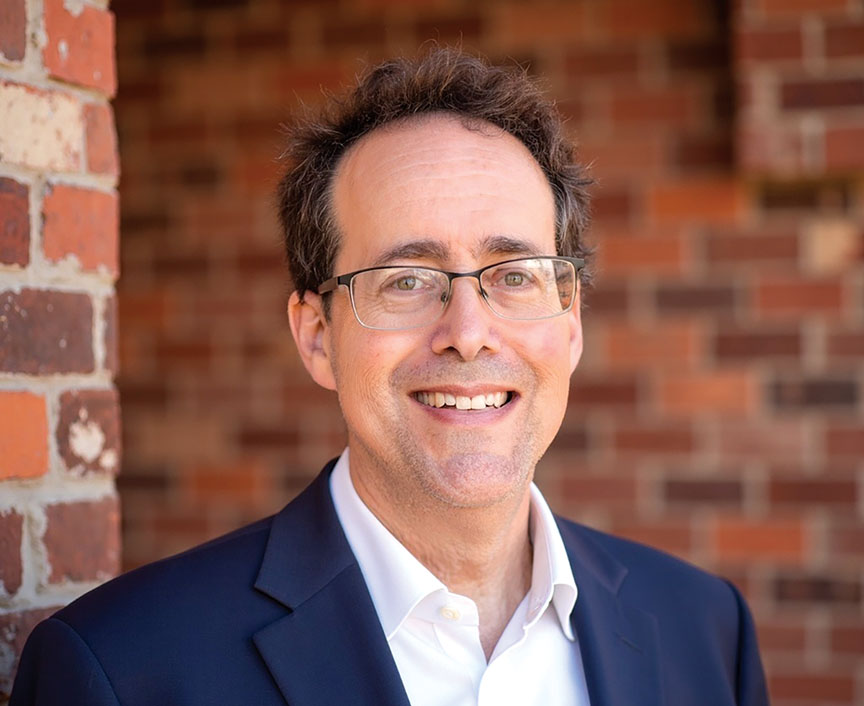
A rabbi whose mother is an athiest might sound like a pitch for a sit-com, but for Rabbi Bradley Shavit Artson, it was his reality. His mother, now a retired psychotherapist, does not believe in God. But there is a happy ending. The rabbi, who is set to become American Jewish University’s Mordechai Kaplan Distinguished Scholar on July 1, and his mother have lovingly made peace. The Dean of AJU’s Ziegler School of Rabbinic Studies for the past 25 years made their détente sound natural.

He is quick to take any opportunity to credit his mother. “Here is another great gift I got from my mother,” he began. “She always has put people first. Ideas matter, but people first. So the fact we disagree on fundamental things – she thinks I am nuts, she thinks I am wrong – but what she really values is scholarship and human dignity. I have used my rabbinate with LGBT people, with environmental issues, with Israel and peace in the Middle East and with special needs issues. Those are issues that my mother holds dear. We can differ on our metaphysics, but she really admires the leadership I have been able to muster.”

As reported in last week’s Journal, prior to his 1988 ordination, Rabbi Artson was a muscular early voice for LGBT acceptance in the Jewish community. Was he able to convince some people who opposed his position to come around? “Many, many, many have,” he replied.  “Even many who didn’t, could respect the integrity of the position.”

How did he accomplish this? “A very timely question,” he said. “We live in such a partisan age. Someone once asked President Clinton how he dealt with Sen. Bob Dole as his enemy. Clinton said ‘He’s not my enemy. He’s my opponent.’”

That exchange, Rabbi Artson said, shows that two sides can hold opposing views without turning into enemies. “The challenge is an approach out of curiosity,” he said. “Why would someone who is a thoughtful, caring person feel so strongly in a way I completely reject? Instead of writing it off, say ‘Let’s talk about that. What do you do with this? How do you handle that?’

“If we can get back to willingness to learn from each other – and we still don’t have to agree – but if we are willing to see each other as sources of learning, then we can do better than tolerate. I am willing to grow, to talk to you about something I find deeply problematic. In the process, you may not come around to my opinion, but you may say, ‘That’s not totally crazy. I understand why you feel that way.’ So we can see each other’s humanity.”

It should be clear Rabbi Artson is a calm, thoughtful presence, even when clashing with persons holding sharply opposite opinions. Using a phrase he would repeat throughout the conversation, he said “People can have strong disagreements without being enemies.”

Rabbi Artson called this reasoning “the genius of rabbinic Judaism,” a phrase that also comes up repeatedly. Noting that the Torah includes a vast number of opinions, he said the Mishnah and the Talmud multiply that. “Having a religion that loves good questions, that loves honest conversation and doesn’t insist on a smothering conformity, that is the greatness of rabbinic Judaism,” he said.

The rabbi stressed multiple times that Jews and others should be willing to learn from each other. “We still don’t have to agree,” he said. “But if we are willing to see each other as sources of learning, then we can do better than tolerate. I am willing to grow, to talk to you about something I find deeply problematic. In the process, you may not come around to my opinion, but you may say ‘that’s not totally crazy. I understand why you feel that way.’”

People are afraid of being different, he said. “We all are afraid of being ‘out there’ when everyone else is ‘over here.’” Part of the joy of life — and “one of the strengths of Jewish faith,” he said – is that “we can help people to really feel loved. I don’t expect righteousness to only come in one flavor. There are lots of different ways to be a decent human being. Part of it, then, is not to demand of people that they have to conform.”

One way that Rabbi Artson brings people to his viewpoint is never elevating his voice. “I am not silent, but it’s never at the expense of someone else’s voice. It’s not about ego. I take seriously that I am a servant of the Holy One.“ His job, he said, “is to make people feel their own holiness. So if they walk out thinking about my holiness, then I didn’t do what I was supposed to do. They should walk out feeling their own.”

Has Rabbi Artson ever doubted his beliefs?

He paused. “I grew up an atheist, and I became observant in college,” he said. “I have been with the same God and the same woman for 42 years. That doesn’t mean Elana and I haven’t had our tough moments. And it doesn’t mean God and I haven’t had our tough moments. That’s part of love. But I never doubted either of them.”

And has he always had full self-control?

“No,” he replied. “I am better publicly containing myself. If you could talk to my dog, she would reveal an entirely different version of who I am.”

Rabbis of LA | Rabbi Artson Salutes His Mother Read More »

Rabbi Peretz Named Ziegler School’s Interim Dean, ‘Survivors’ Play at Museum of Tolerance

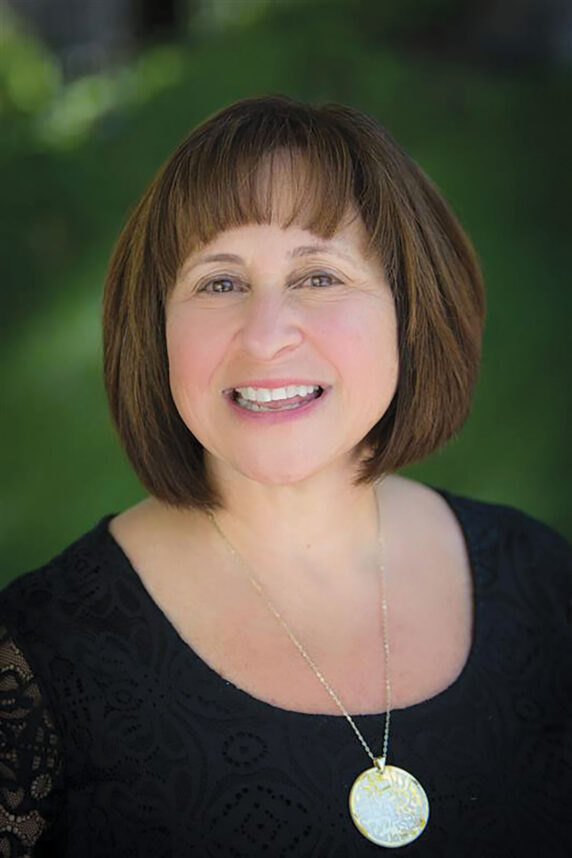
Rabbi Cheryl Peretz has accepted the position of interim dean of American Jewish University’s Ziegler School of Rabbinic Studies, effective July 1.

A longtime leader at Ziegler, Peretz has served the Ziegler School for 25 years, most recently as vice dean, where she has played a central role in academic leadership, student formation and faculty support. According to the university, she brings deep experience in clergy training, leadership development and pastoral guidance, along with a strong commitment to the mission and future of rabbinic education.

AJU Ziegler School’s Rabbi Cheryl Peretz. Courtesy of American Jewish University

“Rabbi Cheryl Peretz has served American Jewish University and the Ziegler School with distinction for more than 25 years,” AJU President and CEO Jay Sanderson said. “Rabbi Peretz brings a rare combination of vision, experience and deep commitment to Jewish learning and leadership”

In the interim dean role, Peretz will lead the school’s academic enterprise and oversee faculty, curriculum and student development while guiding key areas of rabbinic formation, including internships, placements and experiential learning.

“I am deeply committed to the future of rabbinic education and to the vital role rabbis play in shaping Jewish life and community,” Peretz said. “The Ziegler School has a powerful legacy of training thoughtful, engaged leaders, and I look forward to strengthening that foundation while preparing the next generation of rabbis for the opportunities and challenges ahead.”

Peretz holds a Master of Arts in Rabbinic Studies and rabbinic ordination from the Ziegler School of Rabbinic Studies at AJU; an MBA from Baruch College; and B.A.s from Barnard College and the Jewish Theological Seminary. She was ordained in 2001.

The Ziegler School of Rabbinic Studies ordains rabbis within the Conservative movement and is owned and operated by American Jewish University. Under Peretz’s leadership, the school, which is based near the Pico-Robertson neighborhood, will continue to advance its mission while contributing to AJU’s broader vision for the future of Jewish leadership, education, and engagement, AJU leadership said.

Peretz succeeds Rabbi Brad Artson, who is stepping away from his longtime role as Ziegler School dean to assume the newly created position of AJU’s Mordecai Kaplan Distinguished Scholar. Artson is being honored on May 19 during AJU’s annual gala at Stephen Wise Temple. The event will feature actor Mayim Bialik as its host and gather friends and colleagues of Artson for a celebratory evening.


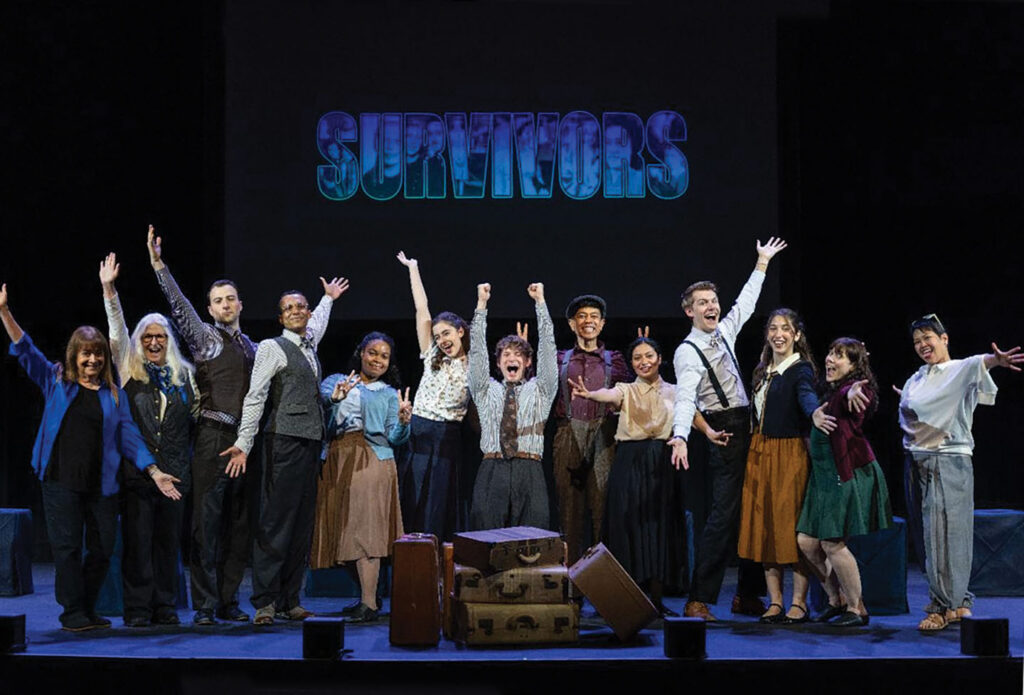
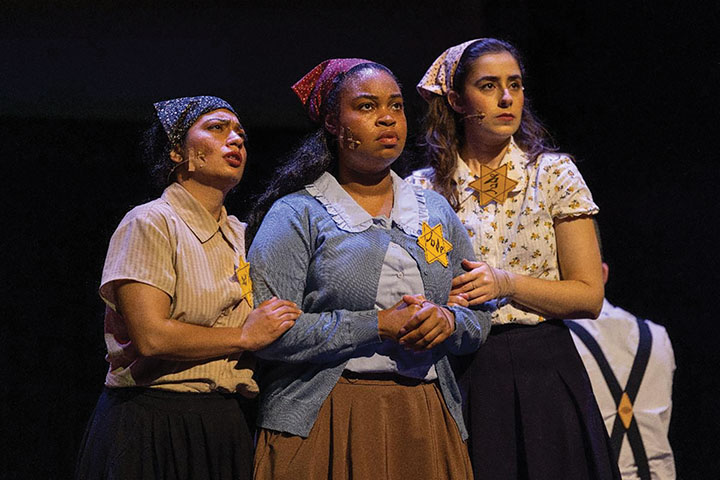
On April 12, the Holocaust-themed play “Survivors” returned to the Museum of Tolerance to commemorate Holocaust Remembrance Day (Yom HaShoah) and honor local Holocaust survivors. Along with the museum, the Los Angeles County’s Anti-Racism, Diversity and Inclusion (ARDI) Initiative co-organized the performance, which features a young and diverse cast enacting the history of the Holocaust through the eyewitness accounts of ten survivors.

Cast members of “Survivors.” Courtesy of Arts for Change

The show was introduced by Mark Katrikh, executive director of The Museum of Tolerance. This introduction was followed by a dedication from Arts for Change Executive Producer Genie Benson, and her son, Andrew, to her parents and all survivors of the Holocaust.

Honored guests included survivors Henry Slucki, Harry Davids, Gabriella Karin, Suzanne Zada, Viviane Nathan and Elisabeth Shomer.  Slucki and Davids, who speak at most of the “Survivors” school performances, also spoke from the stage and were joined by Karin. The indomitable survivors inspired everyone to stand up to today’s antisemitism and identity hatred for minority communities.

Rabbi Peretz Named Ziegler School’s Interim Dean, ‘Survivors’ Play at Museum of Tolerance Read More »

Why Today is the Coolest Day of the Jewish Calendar

If you’ve never messed up in your life, you can stop reading.

But if you’ve ever looked back with regret and embarrassment at some of the things you’ve done, today is a good day.

Today is Pesach Sheni—the “Second Passover.”

It’s the Jewish day of hope.

Hardly anyone talks about it. Even for the most religious Jews, the day means little more than not saying the supplicatory prayers and maybe eating some matzah.

For me, though, it’s the coolest Jewish day of the year, the day that commemorates what every human being craves: a second chance.

It started, as many stories do, with some kvetching. Israelites who had become ritually impure and could not prepare the Passover offering on the appointed day, decided they wanted a second chance.

So they approached Moses and Aaron and said: “Why should we be deprived, and not be able to present God’s offering in its time, amongst the children of Israel?”

In response to their plea, God established the 14th of Iyar as a day for the “Second Passover” for anyone who was unable to bring the offering on its appointed time in the previous month.

That day is today.

The day of second chances, the day that reminds us it’s never too late to do good.

That theme is so wonderfully broad one can argue it encompasses all other Jewish holidays. That’s because it’s more than a theme—it’s a mindset.

If the Torah and our Jewish holidays aim to make us better human beings and add holiness to our lives, a mindset of “never too late” will always apply. In many ways, Judaism and the Jewish people have survived precisely because we’ve never given up.

“Never too late” also applies to any self-help book you’re currently reading or class you’re taking on learning how to paint or play an instrument.

There’s always a second chance to grow. That never goes out of style.

Right now, we’re counting the 49 days between the end of Passover and the beginning of Shavuot, the day we received the Torah at Sinai. This is a period of both anticipation and spiritual refinement. Pesach Sheni reminds us it’s never too late to work on refining our characters.

The notion of a second chance also connects to the essential Jewish idea of teshuvah, repentance and “return.” It’s never too late to reconnect with your tradition and your people.

Since no one today has any biblical reason to miss Passover, Pesach Sheni has fallen off the radar. It has lost its relevance because we’ve taken it too literally.

But behind this humble and obscure day of the Jewish calendar lies an idea that can reenergize our lives. Hope always gives us a second chance.

It’s never too late to internalize that message of Pesach Sheni.

How cool is that?

Shabbat shalom.

Why Today is the Coolest Day of the Jewish Calendar Read More »

The Phoenix of Gaza Exhibit: Education or Indoctrination?

On Apr. 13, the Phoenix of Gaza immersive virtual reality exhibit started a short run at San Diego State University’s Digital Humanities, located in the basement of Love Library. The opening featured a talk by Dr. Ahlam Muhtaseb, Professor of Media Studies at CSU San Bernardino and co-founder and faculty director of the Phoenix of Gaza project.

The exhibit—which started in 2022 and is touring schools up and down the academic ladder, including Yale, Tufts, and Salt Lake Community College—aims to preserve a record of Gaza before the present hostilities began (I’ll return to the question of what to call this conflict shortly). Visitors strap on VR goggles and watch one of several videos “capturing the untold stories of Gaza’s people and its transformation.” We are invited to “Dive deep into the lives of those who endured and rebuilt. It’s more than VR —it’s a testament to resilience.” This sounded like a fascinating, important project, featuring cutting edge technology. So I made a point of showing up for the exhibit and the introductory lecture by Dr. Muhtaseb.

My visit did not get off to a great start. When I entered the room, I saw a table filled with crayons and coloring pages, which seems a little infantilizing for college students. Then I saw what the students would be coloring:
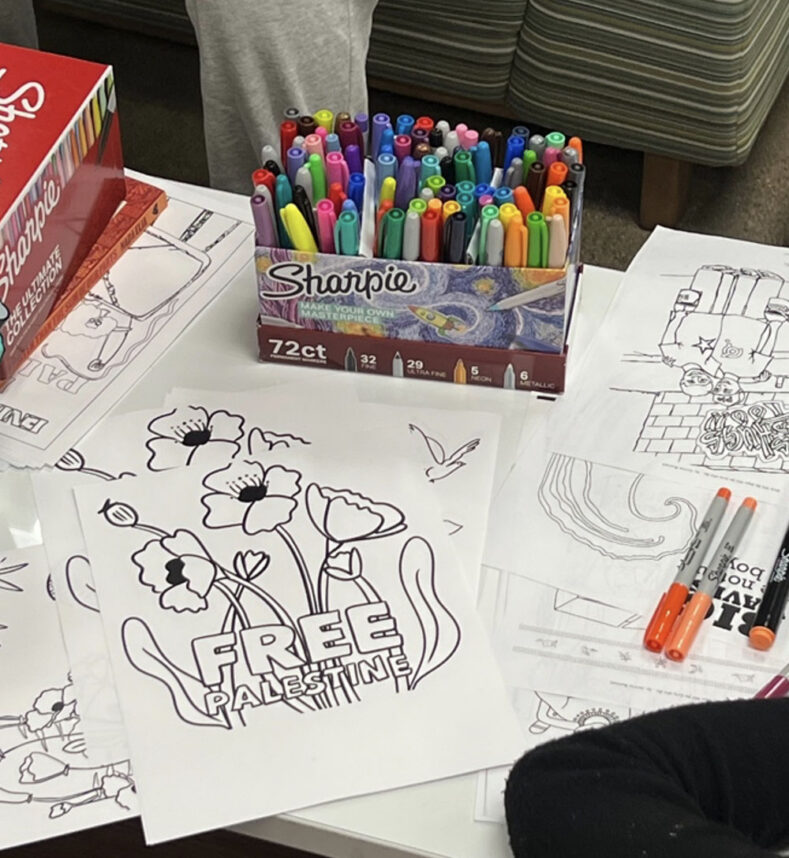
While waiting my turn for the VR goggles, I got into a conversation with a grade school teacher who said he came to the exhibit to be educated. This man told me he was a member of the Democratic Socialists of America, and he was working to get his school board to divest from Israel (so far, no luck).  After he told me about how Israel is colonizing Gaza, I asked him a few questions.

Did he know that Israel pulled out of Gaza in 2005?

No.

Did he know that since 1948, there have been at least five major wars, none started by Israel?

No.

Was he aware that the Palestinians have been offered their own state numerous times, the most recent in 2000, when Yasir Arafat turned down a proposal that would have created a Palestinian state on 96% of the West Bank and East Jerusalem as the capital?

No.

Had he looked at the Hamas Charter?

No. Never heard of it.

So where does he go for information about the Middle East?

He said he relied on a “UN reporter.” He couldn’t remember the name, but I assume it’s Francesca Albanese, who is not exactly a reliable source.

Fortunately, at that point, a chair opened up and I sat down, put on the goggles, and wrapped myself in images of Gaza’s past glory. The technology, I’m happy to say, is spectacularly effective. Unlike a movie, you feel that you are actually there. As you move your head, the images shift just as they would in real life. To say this is disorientating is putting it very mildly. More like jaw-dropping.

The videos featured scenes of Gaza city, many filmed by Yahya Sobeih, a journalist who was killed (or “martyred”) in an Israeli airstrike, with many showing “before” and “after” the destruction caused by the war.  Due to the goggles over my eyes, I couldn’t take notes, but the video that stayed with me was the seaside street. I saw a beautiful beach on one side, tall buildings on the other, and nice, new, clean cars zipping along, including a lime green Toyota 4×4 that gleamed in the sun.

While the project’s team says that their goal is to create a video archive of Palestinian life pre-recent conflict, the videos also have the unintended consequence of undermining the description of Gaza as an open-air prison, or a city under siege. The video of the seaside street, for example, could have been shot in Los Angeles, San Diego or, truth be told, Tel Aviv. The markets abound with produce. The church glows with gold-framed religious paintings. The bakery is redolent with all sorts of breads. The overall impression from this VR presentation is of a happy, prosperous city, not one subject to debilitating restrictions.

Then came Dr. Muhtaseb’s talk. After describing how “immersive technologies” started as pure entertainment, gaming, and yes, porn, with little sense of how the technology could be used for other than “capitalist” purposes, Dr. Muhtaseb started in on how VR could be “bent” for other uses. By placing the viewer in the middle of the action, the viewer becomes “part of the action,” fully immersed, in other words, in someone else’s reality. This “enforced embodiment” (her phrase) has the highly significant effect of turning VR into an “empathy machine” which could be used as a force for good and to change social attitudes. If, for example, you see a VR video of police brutality, then you are likely to protest police brutality.

But Dr. Muhtaseb does not approve of VR as an “empathy machine,” because: a.) empathy can be exploited for profit and “capitalist purposes” (which she opposes); and b.) empathy does not necessarily lead to action. In a surprising echo of the criticisms of land acknowledgments as mere virtue-signaling, the professor criticized empathy because it doesn’t lead to anything concrete; instead, you end up “feeling good about feeling bad.”

And here’s the key: The point of Phoenix of Gaza is not empathy for the sufferings of the Palestinian people, but responsibility and accountability for what happened and is continuing to happen in Gaza, and that is genocide, according to Dr. Muhtaseb. And every American, in her view, is complicit in the Gaza genocide because our taxes help underwrite Israel.

The extraordinary thing about the exhibit and Dr. Muhtaseb’s talk is that neither mentions Hamas or the invasion on 10/7. Instead, over and over again, we hear: “when the genocide started,” “before the genocide started,” “the ongoing genocide,” “during the genocide,” etc. Leaving alone the fact that there was no genocide in Gaza, there is zero acknowledgement of a precipitating event resulting in the Israeli bombing of Gaza. Neither the professor nor the exhibit acknowledges Hamas’s use of human shields, the Nova Festival massacre, the hostages, the rapes, the tunnels building, and Hamas using hospitals and schools for military purposes. In fact, there is no acknowledgment at all that Hamas bears the slightest responsibility for the destruction. Or that Hamas even exists. At one point in a video of a busy traffic circle, the narrator says, “and then the tanks rolled in.” But there’s nothing about why the Israeli tanks rolled in. Instead, the impression the exhibit gives, amplified by Dr. Mehtaseb’s talk, is that one fine day, Israel decided, for no discernable reason, to bomb the shit out of Gaza.

To say the least, the exhibit’s narrative is completely inaccurate. Imagine talking about America’s entry into World War II and not mentioning Pearl Harbor. That’s what this exhibit does.

Imagine talking about America’s entry into World War II and not mentioning Pearl Harbor. That’s what this exhibit does.

Nor is it alone in presenting such a lopsided view. The New York Times recently posted a guest essay, “Gaza’s Rubble is the Grave of our Future,” which at least refers to “the war,” not “the genocide.” The essay details story after story about the terrible and tragic results of the war on Gaza’s civilian population. Homes are destroyed. Families killed. Nonstop shelling and missiles. But again, the word “Hamas” does not appear. “10/7” is never mentioned.  Nobody sees any Hamas fighters.There is no acknowledgement of what started this war, or how Hamas could have stopped the destruction at any time by surrendering and returning the hostages. But since the point of the article, like the point of the Phoenix of Gaza exhibit, is to depict Israel (or “the Zionist entity”) as an unqualifiedly malevolent, evil, settler-colonialist, illegitimate apartheid state that must be dismantled for justice to be served, admitting Hamas’s responsibility would only complicate or confuse the issue.

In fact, both Phoenix of Gaza and The New York Times piece are part of a new literary and artistic genre, termed by Matti Friedman “Gazology,” and just as all genres have certain expectations, the chief mark of “Gazology” is hatred of Israel, and to achieve that aim, “genocide” is repeated over and over again. Not, to quote Friedman, as “an analysis of Israeli operations but a tool designed to shift attention away from the people who started the war and built the twisted battlefield on which it would be fought, and to mass-produce a verbal weapon that can be used to anathematize opponents and obscure their concerns.”

Consequently, the goal of the Phoenix of Gaza exhibit is not education, but indoctrination. Which makes the fact that the exhibit, created under the auspices of a university and traveling from university to university, so disturbing. Instead of presenting a complex, nuanced picture, one that gives due deference to both sides of the conflict, the Phoenix of Gaza gives students a false, entirely one-sided narrative designed to gin up hatred of Israel and all who side, or even slightly sympathize, with Israel.

Unlike Las Vegas, what happens in a university does not stay in a university, and the Phoenix of Gaza exhibit I visited also showed how anti-Israelism spreads into K-12 schools. The room was filled with undergrads because a prof brought her “Modern World History for Teachers” class to view the VR exhibit and hear Dr. Muhtaseb’s talk. And the students (from what I can tell) ate it up. All of the subsequent questions were along the lines of “What can I do when people say there’s no genocide?” and “How can students help you in this struggle?” Nobody asked a critical question or presented a corrective. Nobody asked, “You repeatedly refer to a genocide, but what about 10/7?” Having been taught about the “genocide” at school, the expectation is that these future K-12 teachers will import this view into the classroom. By all accounts, that’s exactly what’s happening.

Unlike Las Vegas, what happens in a university does not stay in a university, and the Phoenix of Gaza exhibit I visited also showed how anti-Israelism spreads into K-12 schools.

Afterward, I sent a note to the professor who brought her future teachers, asking how her students responded to the exhibit. She said that the students were really interested in using VR in the classroom. I responded with another note, this time asking specifically what they thought of the presentation and Dr. Muhtaseb’s comments about “the genocide.”

I did not get a response.


Peter C. Herman is a professor of English literature at San Diego State University. He has published books on Shakespeare, Milton and the literature of terrorism, and essays in Quillette, Newsweek, Inside Higher Ed, and Times of San Diego. His latest book is “Early Modern Others: Resisting Bias in Renaissance Literature” (Routledge).

The Phoenix of Gaza Exhibit: Education or Indoctrination? Read More »

A Proud Jew

Judaism is not a parochial religion, a private Jews-only club oblivious to the rest of humanity. Actually, the opposite is true. As Abraham Joshua Heschel wrote, “The gravest sin for a Jew is to forget what he represents. We are God’s stake in human history.”

Jews have a mission to fulfill on this earth. And that has been true from the very beginning.

God tells Abraham that he will be a source of blessing for the world, and the Talmud speaks of Abraham and Sarah converting others to the belief in one God. The Torah expects the Jews to be a nation of priests who bring humanity closer to divine service; and Isaiah declares, “I will also make you a light for the nations, that my salvation may reach to the ends of the earth.”

We are meant to bring God’s word to the world.

The religious foundation of this universal mission is based on two deeply intertwined commandments: the obligations of Ahavat Hashem, to love God, and Kiddush Hashem, to sanctify His name.

Maimonides, in his “Book of Commandments,” explains why the love of God compels us to share that belief with others:

“We have also explained that this commandment includes another element: that we should call upon all people to serve God and to believe in Him.

This is because when you love someone, you naturally speak of their praises, emphasize them, and encourage others to love that person as well. So too, when you truly love God, once you have attained a genuine understanding of His reality, you will certainly call upon the ignorant and the simple to come to know the truth that you have come to know.”

Love of God leads us to share our faith in God with all of humanity.

Kiddush Hashem also requires a Jew to act in a manner that raises the public’s view of Judaism. The Rambam explains that a Torah scholar needs to be kind, humble and friendly because Torah scholars represent the Torah. If they act properly, and “all praise him, love him, and find his deeds attractive,” then the Torah scholar has sanctified God’s name.

Every Jew is expected to do the same; their actions represent Judaism. As Seder Eliyahu Rabbah explains, “the Torah was not given except … to sanctify His great Name. As it says: … ‘they shall declare My glory among the nations.’” This means that interactions with non-Jews are particularly important. The Talmud Yerushalmi explains a Jew must hold themselves to an even higher standard when transacting business with non-Jews.

One story in the Jerusalem Talmud stands out. Rabbi Shimon ben Shetach went beyond the call of duty to return a precious gem to a non-Jew. He explained to his student: “Do you think that Shimon ben Shetach is a robber? Shimon ben Shetach wants to hear ‘Blessed be the God of the Jews’ more than any treasure in this world!”

Nothing was more precious to him than making a Kiddush Hashem.

Jews fulfill their mission through exemplary behavior; our calling is to inspire the world to hear God’s word.

What is fascinating is that these two commandments have a second definition as well. Both require martyrdom in extreme circumstances. The commandment of “I will be sanctified among the children of Israel” directly commands martyrdom during times of persecution. Similarly, one is obligated to love God “with all your soul,” to which the Mishnah adds, “even if He takes your soul.” This too requires martyrdom when confronted with violating idolatry, murder, adultery.

Martyrdom is an act of defiance. It is an obstinate refusal to accept the authority of anyone but God. It is a moment when the Jew stands alone against the world around him.

The stark contrast between the two definitions of Kiddush Hashem is puzzling. One requires a person to shut out the demands of a heartless world, even at the cost of a person’s own life; the other requires missionary zeal, a way of interacting with others that inspires them to draw closer.

How do these two different aspects of Kiddush Hashem connect with each other?

Before answering this, it needs to be noted that if your religious focus is exclusively on the “martyrdom” type of Kiddush Hashem, you will in all likelihood become unnecessarily adversarial. Every interaction with a non-Jew will turn into a test of whether they will challenge your faith. This sort of distrust will end up antagonizing outsiders.

American Jews face a different issue. Here, the missionary aspects of Kiddush Hashem receive too much emphasis. When people reduce Judaism to tikkun olam, it becomes completely outward-oriented. This distorts our own mission. We begin to look to non-Jews for validation; a Jew is only as good as what the rest of the world thinks of them. Marketing criteria then define sanctifying God’s name. When something like Zionism becomes unpopular, it is immediately jettisoned. Judaism becomes a kitschy amalgam of tikkun olam, bagels, and brisket—a combination that fits comfortably in campus safe spaces, but betrays 3,000 years of Jewish history.

When people reduce Judaism to tikkun olam, it becomes completely outward-oriented. This distorts our own mission.

Kiddush Hashem then becomes an excuse to reduce the Torah to what popular opinion wants it to be.

So, where is the middle path between martyrdom and missionizing?

I believe it is found in pride. To recognize that our Jewish mission is both too important to abandon and also too precious to hide away. To be thankful to be chosen, with all of its obligations and headaches.

A proud Jew is ready to fight for their family and their home.

A proud Jew is unafraid to speak up in the face of hostility.

A proud Jew searches for the truth, even if it is to their own harm.

A proud Jew is ready to engage and build bridges.

A proud Jew is ready to stand up for themselves.

A proud Jew is ready to make difficult sacrifices.

And at the same time, a proud Jew is ready to give to others. Always ready to help total strangers, and even to treat enemies with dignity and humanity.

The Jewish mission is not a simple one; but it is only possible with pride.

May God give strength to his people, and them with peace.


Rabbi Chaim Steinmetz is the Senior Rabbi of Congregation Kehilath Jeshurun in New York.

A Proud Jew Read More »