
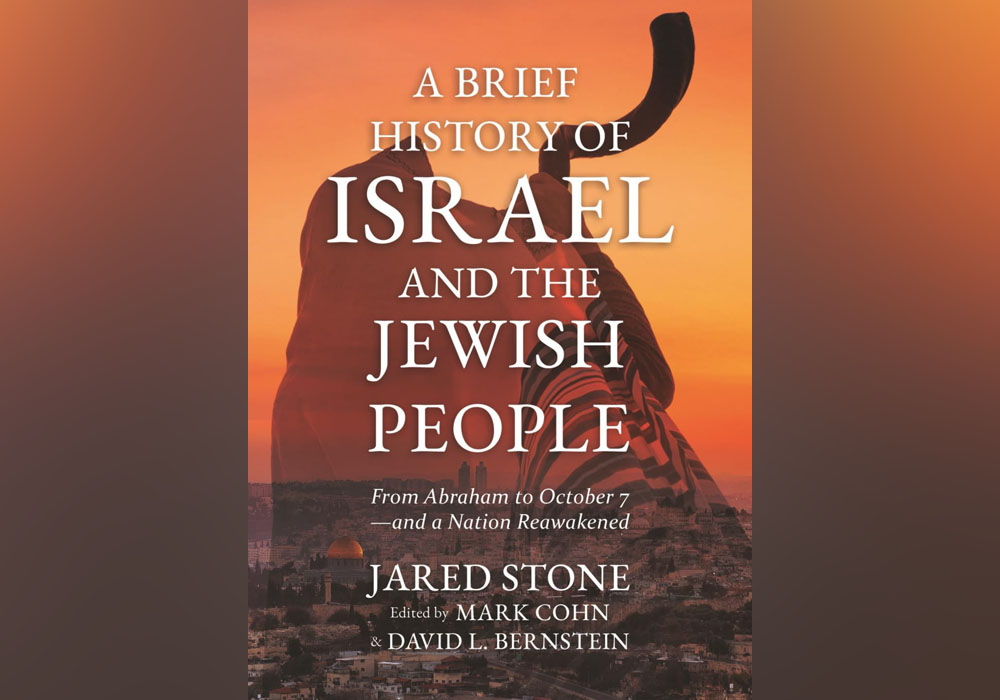
In the wake of the Oct. 7, 2023 attacks, American Jewry has been thrust into an eighth front of the Israel–Hamas war: the fight for truth amid a deluge of lies. Across social media, university quads and the streets of major American cities, Jews have been met with an intensity of vitriol that few expected — and even fewer were prepared to face.
Oct. 7 served as a wake-up call for American Jews of every stripe. In an instant, the rug was pulled out from under us. Many felt betrayed by fair-weather friends who vanished when their support mattered most, worn down by the constant need to justify basic facts to a hostile or indifferent public and demoralized by new fears about our place in Western society.
As the community has tried to make sense of this moment, much of the focus has understandably been outward. Why, despite the long shadow of the Holocaust, has the West tolerated such a rapid resurgence of hatred? How has America — the “golden land” that for centuries has offered Jews unprecedented opportunity and security — stood by as its liberal reflexes faltered?
These are serious questions. But they are not the only ones we should be asking. The present moment also demands an internal reckoning.
In the months following Oct. 7, while an undergraduate at Princeton University, I saw many American Jews respond with passion and sincerity, yet without the historical grounding needed to orient themselves amid the chaos. Their hearts were in the right place. Their instincts were sound. But too often, their lack of historical perspective left them reacting defensively rather than confidently in the face of opposition.
This gap matters. Without a firm grasp of history, even committed Jews can find themselves conceding premises they should reject outright or struggling to explain truths that ought to be obvious.
This is striking because Judaism is a civilization built on memory. As Jews, we feel history deep in our kishkes. Our rituals are saturated with references to our endurance amid the churn of empires. Our texts repeatedly urge us to take the long view and warn against shortsightedness. Every Passover, we reaffirm this when we recite the Vehi Sheamda: in every generation, our enemies rise up to destroy us, but the Holy One, Blessed be He, delivers us from their hands.
And yet, for too many American Jews, there has been no truly accessible resource that situates today’s reality within that broader historical arc.
In the summer of 2024, I decided to write the book I wished had existed — a pocket history capable of communicating our 4,000-year story without academic pretense or ideological distortion. The result, “A Brief History of Israel and the Jewish People,” was recently published by Wicked Son.
The goal of the book is straightforward: to provide readers with the historical grounding needed to engage seriously in today’s debates. It assumes no prior knowledge and is written for readers across ages, backgrounds and political sensibilities. Concise, intelligible and narrative-driven, it aims to be informative without being dense and comprehensive without being excessive.
Despite the strain of the current moment, I remain optimistic about the future of American Jewry. But that future is not guaranteed. It will require vision, determination and a recommitment to our historical inheritance.
After the noise subsides, it will be upon us to rebuild cohesion by affirming what we share. Understanding our history is not ancillary to that effort. It is the prerequisite.
Jared Stone is the author of “A Brief History of Israel and the Jewish People,” available at jewishpockethistory.com, and a 2025 graduate of Princeton University. His interests lie in political and intellectual history, and he currently works in American foreign policy in Washington, D.C.