fbpx

January 27, 2026

Inside Birthright’s Bet on Jewish Storytellers

Birthright Israel is widely associated with short-term trips designed to introduce young Jews to Israel for the first time. Jacqueline Korren is working on something built for what happens after people return home. Through Birthright’s Storytellers initiative, Korren is leading an effort buttressing Jewish presence in media and culture, rather than exhausting debate.

“Birthright Israel Onward Storytellers is Birthright’s newest program which aims to support Jewish creators from around the world to integrate Judaism and their connection to Israel into their platforms,” Korren, Director of Storytellers at Taglit-Birthright Israel, told The Journal. “Then we’re giving them funding and tools and an opportunity to activate that voice post-program.”

Storytellers was developed after Oct. 7, 2023 as an investment in creators who already shape audiences through their own film, music, writing, art and social media. The mission is to work with participants and support them as they weave Israel and Judaism into the work they are already doing in the Diaspora.

It operates within Birthright Israel Onward, a division of Birthright that focuses on longer-form programs rather than first-time travel to Israel. Travel and tourism are part of the Storytellers experience, but are not the purpose. Earlier this month, the Storytellers Impact Incubator concluded a nine-day trip, bringing together 30 Jewish filmmakers, social media content creators and writers who already reach audiences in the tens and hundreds of thousands.

“I see Storytellers as being the centralized platform for all of these organizations to plug in with their expertise and what they’re good at doing to really activate in a different way in the online space,” Korren said. “Taglit is so uniquely positioned to be that centralizing force for so many organizations where that’s definitely an issue that we face in the Jewish world.”

Korren drew a line between Storytellers and Hasbara.

“There’s two words that are not associated with Storytellers,” Korren said. “One of them is Hasbara and the other is combating antisemitism. Because if we are doing Hasbara and we are combating antisemitism, it means that we are meeting everyone who hates us. At this level here, our program is so much about emboldening and building Jewish identity in connection to Israel. It’s about positive identity building, which people are talking about and just it’s really about visible Jewish representation in mainstream spaces. … Let’s elevate the heck out of this next generation of Jewish leaders across the board.”

Korren acknowledged that visibility carries professional risk, and that Israel changes the stakes for many creators. She described a distinction she hears often from participants navigating public platforms: the brand deals won’t go away if they show up as Jewish, but those brand deals risk being terminated if they are connected to Israel.

Ari Frenkel, an actor, writer and director who participated in the Birthright Israel Onward Storytellers, said the experience reinforced his commitment to telling Israeli stories and not shying away from who he is as an Israeli-American. He is currently making his debut feature film, “See You on the Other Side,” which centers on grief and the loss of his Israeli father.

“I think it’s so important that storytellers go to Israel right now with the intent of telling Israeli stories,” Frenkel told the Journal. “We are a tiny minority of people with more stories about us than people, so we might as well get to tell some of those stories too.” After the trip ended, and before returning to the United States, Frenkel visited his father’s grave in Israel.


View this post on Instagram


A post shared by Ari Frenkel (@arifrenkel)

Rebecca Cantor, a Jewish content creator on TikTok who participated in the Storytellers initiative, described the experience as a shift in how they think about their work and community. Cantor said the program eschewed focusing on online Jewish life alone and pushed them to think about building physical community, alongside digital platforms.

“It’s not enough to just have my entire Jewish community be online,” Cantor told The Journal. Cantor also pointed to a vibe within the group that aimed to pivot Jewish storytelling away from trauma alone, saying that “the Jewish story is not defined by Jewish death, but by Jewish life.”


View this post on Instagram


A post shared by becky c (@becky.dc)

Cantor pointed to Matt Ryan, a food creator who goes by @thegastronautsguide on Instagram, as one example of how Storytellers participants inspired and encouraged each other. Cantor said Ryan used cooking to bring people together during the trip, inviting others into shared meals, including Shabbat dinners, and documenting those moments as they happened. The focus was on cooking, eating and spending time together, far from anything resembling explaining or arguing.

Korren said that the initiative is something meant to outlast any single crisis, built for a media environment where culture travels faster than policy and presence shapes perception over time. “This is about the future,” she said. “We’re setting the foundation and framework for what the future is going to look like for Jews in media.”

Ultimately, the Storytelling initiative is about supporting creators who already influence audiences, rather than to waiting for moments when Jewish identity becomes reactive or defensive. “It’s not about responding to every headline,” Korren said. “It’s about showing up consistently in spaces where culture is being made.”

Storytellers could be an answer to how Jewish life shows up in mainstream spaces, during moments of geopolitical tension, as well as part of any storyteller’s ordinary day. “Storytellers is not a program,” Korren said. “Storytellers is a movement … At the end of the day, we are all the narrators of our own story.”

Inside Birthright’s Bet on Jewish Storytellers Read More »

What Was Never Said: Beautiful Blu’s Holocaust-Inspired Album ‘One Final Day’

Benny V’s grandparents didn’t like to speak about what they had experienced during the Holocaust. His grandmother would often shut down any attempt at conversation, brushing it aside with a familiar question: “Would you like something to eat?”

“That was her answer to everything,” said Benny, the musician behind the Toronto-based project Beautiful Blu.

He grew up understanding that silence was part of how some people cope with things.

“There were those who were open to speaking about their experiences, and those who weren’t,” he said. “On my mother’s side, my grandfather, who came from the same town as Elie Wiesel, lost his entire family – nine siblings. My grandmother came from a family of 10 children; only five survived.”

Though he was curious to learn more about their experiences during the Holocaust, Benny learned not to push for answers. Then in 2015, he joined a group traveling to Poland to mark the 70th anniversary of the liberation of Auschwitz.

When Benny called his uncle to tell him he had gone to Auschwitz, the reaction was not what he expected. “He was upset,” Benny recalled. “My grandmother never wanted to go back. I don’t think she ever left Chicago once she arrived in the U.S.”

During the trip, Benny took black-and-white photographs, and a friend suggested turning them into a show. “I didn’t want to do just a show,” he said. “So we rented a 5,000-square-foot space, built sculptures, and I created a soundtrack that played as people moved through the exhibit. That’s where it all began.”

Only afterward did he decide to put words to the music — a process he describes as the most difficult part of the project. Writing the lyrics meant revisiting his grandparents’ lives during the darkest chapter of Jewish history. “It’s not meant to make a statement,” he said. “It’s simply a story — the story of my grandparents. And while the album is undeniably dark, the one thing I hold close to my heart is the realization that every Holocaust survivor experienced at least one miracle in order to make it out alive. Someone or something helped them at a life-or-death moment.”

The album takes listeners on a somber musical odyssey, blending haunting vocals with moments of electronic texture to reflect both historical horror and emotional disorientation. It begins in Europe before the war, where Jewish communities coexist with their neighbors, before descending into deportations, cattle cars, slave labor and gas chambers. The music explores timeworn patterns that continue to repeat throughout history.

The song “Lost Love Story” tells the story of a young couple hiding from the Nazis, who are ultimately discovered and murdered. “One Final Day,” the album’s title track, examines how governments repeatedly rally young people to fight for a so-called “great cause” — one that rarely changes.

“The song explores young men — often barely adults — sent to war, convinced they must fight for their country, only to come face-to-face with an enemy soldier who mirrors their own fears, hopes, and dreams.

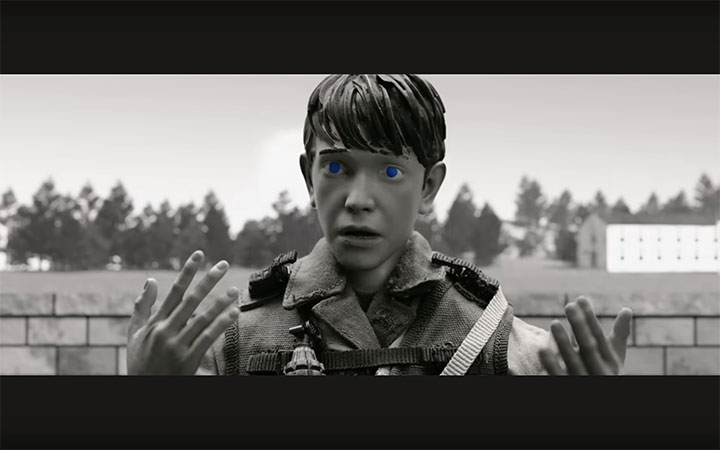
Animation for One Final Day video was made by Paul Hollingsworth of Digital Wizards

“For me, it’s about how easily young people can be swept into war,” he said. “They’re taught they have to fight, and then they’re standing across from someone who isn’t so different from them.”

The song is accompanied by a hand-illustrated animated music video that visually tells that story.

“No One to Remember,” sung by Sophie Michalitsianos, may be the album’s most emotionally devastating track.

“Sophie asked me what the song was about,” he said. “I told her it’s about a mother walking her child to the gas chambers, thinking about everything that child could have become, maybe a novelist, a musician, maybe someone who could cure cancer. She feels like she failed him because she couldn’t protect him.”

Michalitsianos initially refused to sing the song, thinking it’s just too painful. After some persuasion, she eventually agreed to record it in a single take. “She went into the booth and cried while she sang it,” he said. “She has a daughter, and it touched her deeply. It was beautiful that she did it.”

The album features an accomplished group of collaborators, including Bill Ryder-Jones of The Coral on lead vocals, Aaron Johnston on drums, and Byron Isaacs on bass, who also plays with The Lumineers. Veteran producer David Baron, whose credits include Lenny Kravitz, Keith Urban and Shania Twain, helped shape the album’s overall sound.

When asked how his grandmother might have reacted had she known her life story would inspire an album about the Holocaust, Benny replied honestly. “It probably would have gone over her head,” he said. “She wouldn’t have understood it.”

He reflected on how differently survivors are viewed today. “Time has changed so much,” he said. “The few Holocaust survivors still alive are almost seen as superheroes now. They’re revered. But back then, they weren’t seen that way. They were viewed as damaged goods — people with heavy accents who had lived through something horrific. They weren’t celebrated like today.”

As the album unfolds, that idea flows into, “Morning Angel,” which Benny described as a meditation on foreknowledge and blindness. “It’s about the angels knowing what’s coming,” he said. “People are living their lives — not necessarily in denial – but they don’t fully grasp what lies ahead. They see warning signs, but they look away.”

Listening to the album today, it’s hard not to hear echoes of the present — moments where history feels uncomfortably close rather than safely distant. “History repeats itself. It never changes and will never change — this is the plague of humanity,” he said. “Yes, there is more awareness now because of the media. People don’t want to go through this again, but at the same time, it’s happening. As human beings, we always rationalize things. Everybody is always right; you can argue on each side. However, with the Holocaust, it’s so extreme that you can’t argue the other side. I always joke that Hitler didn’t think he was doing a bad thing for Germany; he didn’t think he was an evil guy.”

The Canadian musician spends a couple of months each year in Los Angeles for his recordings but said he doesn’t think he would want to perform the album live. “To be honest, it would be amazing to perform it, but the journey was so intense and draining,” he said. “The topic is heavy — if you listen to this album once, would you want to listen to it again? How many times, after all, can you watch ‘Schindler’s List’?”

“The Beautiful Blu” is available on Spotify, Tidal and Apple Music, as well as a limited vinyl release. 

What Was Never Said: Beautiful Blu’s Holocaust-Inspired Album ‘One Final Day’ Read More »

After Being Canceled for Being a Zionist, Jewish Musician Mikey Pauker Makes a Comeback

Jewish musician Mikey Pauker said he never imagined that believing in Israel’s right to exist would cost him performance opportunities — or expose him to years of harassment and threats. But in recent months, Pauker said that is exactly what has happened.

In December, Pauker was removed from a scheduled sound-healing performance following an Ecstatic Dance event in Nevada City, California, after what he describes as an escalating campaign of intimidation tied to his Jewish identity and his identification as a Zionist. The cancellation came just 1 day after his sold-out Hanukkah concert in the same town, and echoed a similar cancellation campaign last year at Harbin Hot Springs, also justified by organizers as a “security concern.”

Pauker, who is studying to become both a rabbi and a cantor at the Academy of Jewish Religion in New York, grounds his music and spiritual work in Jewish liturgy, theology and communal practice. He said the backlash began years earlier, after a fellow musician learned that he was Jewish.

“The person started targeting me about four years ago,” Pauker said. “One of the first things they asked me was whether I support circumcision. Then they began spreading rumors that I support genital mutilation.”

Despite a formal cease-and-desist letter sent several years ago, Pauker said the harassment continued and intensified after Oct. 7, 2023. He shared messages in which the person referred to him as “Zionist scum of the earth” and accused Judaism of “breeding terrorism, white supremacy and domination.”

As Pauker prepared for a Northern California Hanukkah tour in December — with concerts scheduled in San Rafael and Nevada City — he claimed that this musician and activists affiliated with Nevada City for Palestine launched a public campaign calling for his cancellation. A flyer circulated urging people to “Cancel the Zionist Mikey Pauker,” and community members were encouraged to pressure venues hosting his performances.

The effort ultimately failed. Both concerts sold out, and no protest materialized. Pauker said members of the local Jewish and Israeli community showed up in force, relieved to see the events go forward.

But the following day, Pauker was informed that he had been removed from the Ecstatic Dance Nevada City lineup by event producers. The stated reason, he said, was concern for his safety — despite the fact that Pauker had told organizers he felt safe and had already arranged for professional security the night before due to threats. The organizer said he is welcome to attend as a guest.

“If this was really about my safety, why would I be safer as a participant than as the artist?” Pauker asked. “That logic doesn’t hold. The community knows who I am.”

Pauker said he received a text from the producer saying, “Someone made a post under the flyer for next week and they called you a Zionist.”

Pauker then asked to jump on a call with the producer and asked her if she knew what is the meaning of a being a Zionist. “She had “googled Zionism” and concluded that it had nothing to do with Judaism, while accusing Israel of genocide and occupation,” said Pauker.

Pauker said he tried to explain that Zionism is not a political slogan but the right for self-determination. “I said to her, you know you could disagree with the Israeli government and that doesn’t make you antizionist, but calling for the destruction of the only Jewish state is antisemitic.”

Pauker said the pattern feels painfully familiar. In December 2024, he was also removed from a Hanukkah concert at Harbin Hot Springs, again under the rationale of security concerns stemming not from his actions, but from threats directed at him.

“These situations follow the same pattern,” Pauker said. “Instead of addressing harassment or standing up to intimidation, institutions remove the Jewish artist and label it safety. That framing has a long and dangerous history.”

Pauker is now a plaintiff in a federal civil rights lawsuit against Harbin Hot Springs and its leadership, alleging religious discrimination. Central to the case is the argument that Zionism is not a detachable political opinion, but an intrinsic element of Jewish religious identity, peoplehood and historical connection to the land of Israel. The lawsuit challenges what Pauker and his legal team see as a growing trend: excluding Jews from public and cultural spaces by redefining essential aspects of Jewish identity as controversial or optional.

“If ‘security concerns’ can be used to justify removing Jews rather than confronting those who threaten them,” Pauker said, “then civil rights protections are being hollowed out in real time.”

Following the Ecstatic Dance cancellation, Jewish residents in Nevada City and nearby Grass Valley publicly expressed alarm, with many saying the decision made them feel unwelcome and unsafe in a space that claims to be inclusive. Hundreds of comments appeared online, with community members speaking out – many for them for the first time – about enduring  antisemitism quietly for years.

Pauker said the financial toll of being canceled was significant. He estimates that he lost more than $50,000 in income due to festival cancellations, lost merchandise sales and withdrawn performance opportunities. “For a couple of years, things were really hard,” Pauker said. “After Harbin happened last year, and before the lawsuit, I was really depressed. I felt like no one cared anymore.”

Yet in an unexpected turn, the months following Oct. 7, 2023 marked a dramatic shift. While antisemitic attacks against him intensified, so did demand for his work — particularly within Jewish communities. “Since Oct. 7 started, I’m actually doing way better,” Pauker said. “Jewish communities are bringing me out — some for speaking about what I’ve been dealing with, some for performances, some for keynotes at conferences.”

Pauker is optimistic about 2026 and his calendar is fuller than it has been in years. He is scheduled to headline a Jewish music festival in Northern California and will be traveling to synagogues across the country to sing, lead prayer and share his story. “We’re going to play more shows this year than we have in the last three years,” he said. “I honestly can’t even tell you how many gigs we have lined up.”

While the losses were painful, Pauker said the support he has received has been deeply affirming. “Things are moving in a very positive direction,” he said. “That doesn’t mean we shouldn’t speak up about antisemitism — but it does mean that, for me, something powerful came out of a very dark time.”

Pauker continues to tour nationally, lead prayer and healing gatherings and work across Jewish and interfaith communities. On the fourth night of Hanukkah, Dec. 17, he released a new song, “Shema (listen),” a contemporary Jewish chant in collaboration with The Human Experience, (aka David Block), Chava Mirel, Melita and Benjy Wertheimer. “People really love it, and it’s one of my most successful releases so far.”

“I’m not going to disappear,” Pauker said. “I’m going to keep showing up — as a Jew, as a Zionist and as an artist.”

After Being Canceled for Being a Zionist, Jewish Musician Mikey Pauker Makes a Comeback Read More »

Yes, It’s (Still) a Good Time to Be a Jew

This isn’t the first Jewish Journal column I have written arguing that it is a good time to be a Jew. Previously, I called out those I thought were overly worried about the future of Israel and about threats to the Jewish people as a whole. There were plenty of reasons to be hopeful. With the Abraham Accords likely to be expanded and with Jews achieving unprecedented success in a wide range of endeavors, I was sure that a golden age for Jews was upon us.

That column appeared in the Sept. 29-Oct. 5, 2023 issue.

We know all too well what took place just a few days later. In light of the Oct. 7, 2023 massacre and the global rise in antisemitic rhetoric and violence that ensued, would anyone in his or her right mind consider this to be a “golden age”?

But, based on my perspective on Jewish life today versus in the past, and with an optimism that comes from my faith, I remain convinced that our prospects are bright.

Why? Because the way in which we have approached our Jewish identity has changed for the better.

What a contrast with growing up in the ’50s and ’60s. Though my parents were devoted synagogue members and volunteers, I found Hebrew school to be uninspiring, and services a bore. My bar mitzvah extravaganza was purely performative, devoid of any spiritual meaning.  I bet I’m not the only baby boomer who felt that way.

So why, given all that, did many of us continue to lead Jewish lives? For me at least, it was a sense of obligation.  Having been raised in the shadow of the Shoah, and living in the Diaspora, being a Jew was a way to show the world that against all odds we had survived. Whether intentionally or not, that was the message I heard in temple and at home. If there was any real joy in being a Jew, I, for one, seldom experienced it. 

I doubt that attitude could have secured our Jewish future. While obligation may have been enough for me and for some of my friends, I suspect it would not have been enough for my children and for theirs.

Fortunately, what it means to be Jewish has evolved, and Jews of all ages have been embracing their heritage with indomitable pride and genuine passion.

The challenges Jewish students have been experiencing at America’s colleges and universities are well-known. Yet, their response has been heartening. One of the benefits of being an active participant in campus Jewish life over the past four decades is having a front-row seat from which to view generational change. It has been thrilling to observe a transformation in how young Jews think of their identity.  Some undoubtedly feel the trauma of the Holocaust, but contemporary Judaism represents so much more than that.  It is summer camps and Birthright. It is Jewish Studies courses and programs such as Challah for Hunger. It is a Hillel community that grapples with the most vexing of issues. The campus environment for Jews has never been easy, and the past two years have been especially fraught, but the Jewish community perseveres. 

It is gratifying to witness how the dreary experiences that pervaded my childhood have been replaced with something much more hope-filled and joyous. When I reflect on my life as a Jew today, I think of lively Shabbat dinners and inspirational synagogue services, and of the music, food and community that fortify me. And about the pride I feel in celebrating Jewish achievement in virtually every field imaginable, from sports to politics to the arts. Do I continue to worry about the future for Jews inside Israel and beyond? Of course. But after what once felt like a load to bear, being a Jew has become an invigorating lifeline that nourishes and sustains me.

So let’s immerse ourselves in the pleasures of being Jewish. Whether you observe Shabbat, limit your temple attendance to the High Holy Days, or represent your Jewishness culturally rather than ritually, proclaim your Jewishness loudly and clearly, bursting with gratitude and joy.

That earlier column turned out to be pollyannish. I pray this one will not be.


Morton Schapiro served for more than 22 years as President of Northwestern University and Williams College. He taught almost 7,000 undergraduates over his more than 40 years as an economics professor.

Yes, It’s (Still) a Good Time to Be a Jew Read More »

Why I Wrote a Pocket History of the Jewish People

In the wake of the Oct. 7, 2023 attacks, American Jewry has been thrust into an eighth front of the Israel–Hamas war: the fight for truth amid a deluge of lies. Across social media, university quads and the streets of major American cities, Jews have been met with an intensity of vitriol that few expected — and even fewer were prepared to face.

Oct. 7 served as a wake-up call for American Jews of every stripe. In an instant, the rug was pulled out from under us. Many felt betrayed by fair-weather friends who vanished when their support mattered most, worn down by the constant need to justify basic facts to a hostile or indifferent public and demoralized by new fears about our place in Western society.

As the community has tried to make sense of this moment, much of the focus has understandably been outward. Why, despite the long shadow of the Holocaust, has the West tolerated such a rapid resurgence of hatred? How has America — the “golden land” that for centuries has offered Jews unprecedented opportunity and security — stood by as its liberal reflexes faltered?

These are serious questions. But they are not the only ones we should be asking. The present moment also demands an internal reckoning.

In the months following Oct. 7, while an undergraduate at Princeton University, I saw many American Jews respond with passion and sincerity, yet without the historical grounding needed to orient themselves amid the chaos. Their hearts were in the right place. Their instincts were sound. But too often, their lack of historical perspective left them reacting defensively rather than confidently in the face of opposition.

This gap matters. Without a firm grasp of history, even committed Jews can find themselves conceding premises they should reject outright or struggling to explain truths that ought to be obvious.

This is striking because Judaism is a civilization built on memory. As Jews, we feel history deep in our kishkes. Our rituals are saturated with references to our endurance amid the churn of empires. Our texts repeatedly urge us to take the long view and warn against shortsightedness. Every Passover, we reaffirm this when we recite the Vehi Sheamda: in every generation, our enemies rise up to destroy us, but the Holy One, Blessed be He, delivers us from their hands.

And yet, for too many American Jews, there has been no truly accessible resource that situates today’s reality within that broader historical arc.

In the summer of 2024, I decided to write the book I wished had existed — a pocket history capable of communicating our 4,000-year story without academic pretense or ideological distortion. The result, “A Brief History of Israel and the Jewish People,” was recently published by Wicked Son.

The goal of the book is straightforward: to provide readers with the historical grounding needed to engage seriously in today’s debates. It assumes no prior knowledge and is written for readers across ages, backgrounds and political sensibilities. Concise, intelligible and narrative-driven, it aims to be informative without being dense and comprehensive without being excessive.

Despite the strain of the current moment, I remain optimistic about the future of American Jewry. But that future is not guaranteed. It will require vision, determination and a recommitment to our historical inheritance.

After the noise subsides, it will be upon us to rebuild cohesion by affirming what we share. Understanding our history is not ancillary to that effort. It is the prerequisite.


Jared Stone is the author of “A Brief History of Israel and the Jewish People,” available at jewishpockethistory.com, and a 2025 graduate of Princeton University. His interests lie in political and intellectual history, and he currently works in American foreign policy in Washington, D.C.

Why I Wrote a Pocket History of the Jewish People Read More »

When to Say I Love You

Here is a flying tip I learned many years ago: take the first flight out in the morning. Even though it might mean waking at 3 a.m., the plane has probably been there all night, and the crew has likely rested (unless they fooled around with each other at The Hilton). These morning flights have fewer delays.

Be sure to make your breakfast the night before so you can take it with you. There is nothing at the airport under 10,000 calories or $35. If you have a safe room or an attached garage, get dressed in there so you don’t wake anyone. Even better, go to sleep fully outfitted.

Rising at 3 a.m., I keep the room pitch dark.  After banging my knee a few times, I complete a walk around to the missus’ side of the bed to say: “I love you,” and to plant a very delicate kiss on her forehead. In Islam, a Muslim man is allowed four wives. To get all the kissing done, these men must wake up earlier than a one-wifer.

At 3 a.m., when I kiss my wife goodbye, she may mumble a barely audible slurry: “I love you.  Call me when you get there.” I’ve learned most adults can live without the middle-of-the-night goodbye kiss. It’s nice to do, but it might be safer just to leave a loving note. If you really want to know whether the person you are kissing at 3 a.m. loves you, when they open their eyes, ask them to pick up some pickles and sauerkraut for you when you return.

If you’ve never kissed a sleeping adult, it’s very different from kissing a sleeping baby. Babies generally stay asleep when you kiss them. Let’s face it, if loading a diaper won’t wake them, a kiss certainly won’t. A baby’s skin is soft and moist at 3 a.m., whereas an adult’s is dry and pasty or full of creams and oils. Stroke a baby’s cheek in the dark, and they seem okay with it. Stroke an adult’s cheek, and they may call a lawyer, or if they’re from Brooklyn, shoot you with the .357 under their pillow.

If traveling that next day, try kissing goodbye an hour before you go to bed. Then you can say “I love you” as often as you need. If you’re going to bed at 10:30 p.m., kiss at 9:30 p.m. This is your best shot at getting a real kiss and a sincere goodbye — not the birdseed peck you get after the lights go dim.

Whenever leaving the house, I tell my wife, “I love you,” because it may be the last time we see each other. Pick up any newspaper, and you’ll read about someone who never made it back. Maybe, every time you go to the loo, you should consider saying, “I love you.”  Here’s a short list of those who kicked off in the loo: Elvis, Whitney Houston, Judy Garland, John Ritter, Jim Morrison, and King George II. If you are not severely constipated or on illegal drugs, then you have a better-than-average shot at returning to your day; the “I love you” is optional.

I think saying “I love you” when you arrive back home is just as important. You may be wondering whether these frequent expressions of affection are excessive. I don’t think so. When I walk into my small but beautiful home, it is so neat and clean. My socks are perfectly balled and placed in the sock drawer. The refrigerator is stocked with things I love and did not buy.

How in the world can I not tell the person who did all these things for me that I love them and miss them? How, when I know how I used to live before they entered my life.

So, when you walk out of the house and are lucky enough to return safely, remember how blessed you are to have someone there to say, “I love you.”  Now, if you don’t mind, I’m going to enjoy these Bubbies Pickles my wife picked up when I left for my last trip.

P.S. I exclude the housekeeper and the dog from the “I love you.” The dog doesn’t care, and I’m not famous enough to one day marry my housekeeper.


Mark Schiff is a comedian, actor and writer and hosts, along with Danny Lobell, the “We Think It’s Funny” podcast. His new book is “Why Not? Lessons on Comedy, Courage and Chutzpah.”

When to Say I Love You Read More »

Scott Wiener Comes Clean

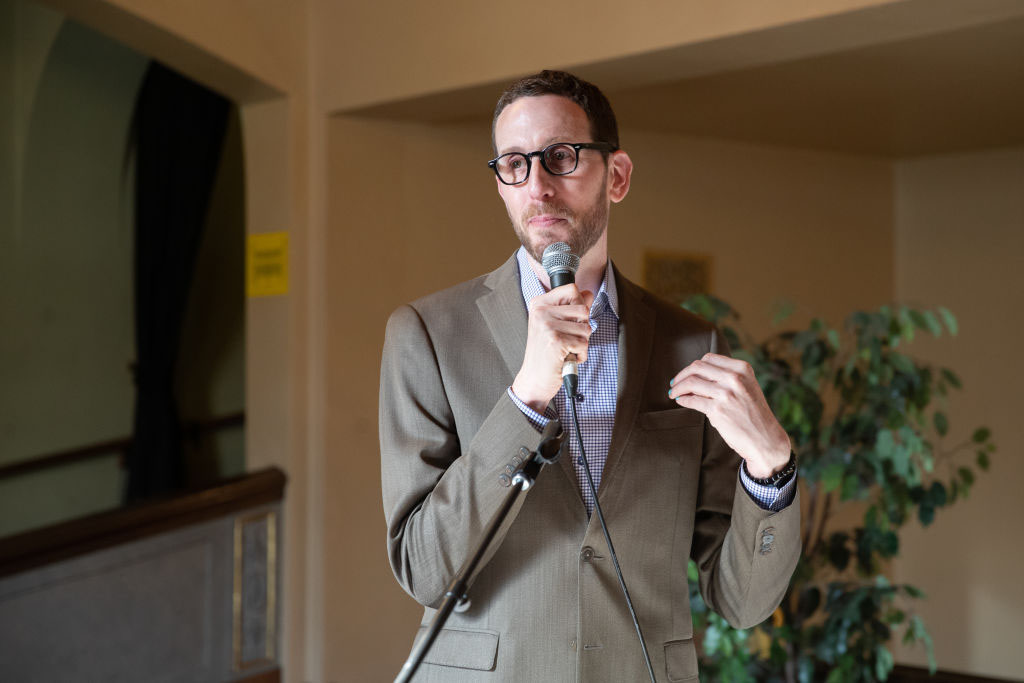
Scott Wiener is a California State Senator who represents the city of San Francisco. During his years in the legislature, he has earned a reputation as a tireless and effective (if sometimes condescending) policy wonk who has been one of the Capitol’s driving forces in confronting issues such as affordable housing, clean energy and artificial intelligence over the years. Even his critics agree that he is extremely intelligent, masterful on policy details and relentless in pursuit of common ground and tangible outcomes. He has also been the co-chair of the Jewish Legislative Caucus, where he has been a supporter of Assemblymember Jesse Gabriel’s (D-Encino) efforts in the fight against antisemitism.

Wiener is now running for Congress, pursuing the seat of retiring House Speaker Nancy Pelosi. While Wiener is aggressively and proudly progressive, he is in a race against two candidates to the left of him on many issues. One of the issues on which he has been outflanked is Israel. Or at least it used to be.

In early January, Wiener participated in a debate in which the candidates were asked whether they believed that Israel was guilty of genocide in Gaza and told to hold up a sign saying either “yes” or “no”. His opponents both held up their “yes” signs. Wiener, who had previously refused to use that incendiary term against the Jewish state, did not raise either sign and was met by a barrage of boos  and cries of “shame” from the angry audience.

But only four days later, Wiener released a video reversing his position and stating he will now use the word “genocide” to criticize Israel’s conduct. He explained that his previous hesitation stemmed from the painful connection of the term to the Holocaust for many Jews. He added, “But despite that pain … we all have eyes, and we see the absolute devastation and catastrophic death toll in Gaza … that qualifies as genocide”.

“We all have eyes.” Very true. Wiener’s eyes were open wide enough to read polls showing how much his previously-principled beliefs about Israel’s defense against Hamas were harming his chances for victory. And our eyes can see how mortifying it is for a Jewish political climber to turn on his own people and their homeland and how ludicrous it is for him to continue to claim a position of legislative leadership.

So last week, Wiener resigned as Jewish Caucus co-chair, making official what most of us already knew: that he no longer deserved that honor. In a group of courageous Jewish legislators who work tirelessly every day on behalf of our community, he simply no longer belonged. He was not courageous. He was craven. He had become an embarrassment to the caucus – and to us.

If Wiener is elected to Congress, he may be more comfortable in an environment where many of his new colleagues regularly prioritize their own political ambition over the well-being of the communities they pretend to represent. Hopefully, the Congressional Jewish Caucus will have the dignity to refuse his admission into their ranks. 

Or he might never get to Washington. Perhaps the left-leaning voters of San Francisco will see through his subterfuge, and they will elect a truly dedicated antizionist rather than a craven politician who merely pretends to oppose Israel for his own political benefit. Then he can spend the rest of his life wondering if selling out his people, his religion and his heritage in a futile bid for higher elective office was worth the humiliation it brought.

Let’s be clear: Wiener has the right to take any political position he chooses. That is his prerogative and he has not broken any laws by simply changing his mind. But he no longer deserves to represent us, in elective office or in any other way.

Good riddance, Scott Wiener. For prioritizing your own political ambition over the safety and security of your own community, you will become a reminder to all of us why we fight every day for our principles, our history and our future — and why self-haters like you have made that battle so much more challenging.


Dan Schnur is the U.S. Politics Editor for the Jewish Journal. He teaches courses in politics, communications, and leadership at UC Berkeley, USC and Pepperdine. He hosts the monthly webinar “The Dan Schnur Political Report” for the Los Angeles World Affairs Council & Town Hall. Follow Dan’s work at www.danschnurpolitics.com.

Scott Wiener Comes Clean Read More »

The Progressive Zionist Has Become an Endangered Species

I am a progressive Zionist — someone who believes Israel has a right to exist as a Jewish homeland and Palestinians have a right to self-determination, and who refuses to conflate the Jewish state with any single politician. This used to be a large, confident tribe in American life. Today it has become a politically endangered species, and that is dangerous — not only for American Jews, but for the bipartisan consensus that has underwritten Israel’s security for generations.

The origin story of my relationship with Israel was shaped by standing on the South Lawn of the White House as a young staffer in 1993 watching my boss Bill Clinton broker the Oslo Accords between Israeli Prime Minister Yitzhak Rabin and PLO Chairman Yasser Arafat. After signing the accord, Rabin defiantly declared: “Enough of blood and tears! Enough!”

Unlike my teenage daughters, I grew up knowing Israel as a peacemaker, not a warmonger.

My first trip to Israel on Nov. 5 ,1995 wasn’t a Birthright trip or a family vacation. It was a mission: I was urgently flown to Jerusalem on a military transport plane as part of a mostly Jewish White House advance team because Prime Minister Rabin had just been assassinated and would be buried within 24 hours, according to Jewish tradition.

My first trip to Israel was to bury one of the great Israeli peacemakers.

The following spring I returned to Israel with President Clinton to campaign for the pro-peace candidate against a young, articulate hardliner named Benjamin Netanyahu to succeed Rabin as prime minister.

I often think about those three flashpoints in history. In an alternate universe, Rabin lives. In another, Netanyahu loses. But in this one, entire generations have come to experience Netanyahu as the de facto king of Israel. That fusion is not just a branding problem; it is a political and moral paradox for Jews who want to defend Israel’s legitimacy while opposing the ideology of permanent conflict.

When I worked for Bill Clinton, the Democratic Party was a natural home for traditionally liberal American Jews. Clinton staunchly supported Israel and spent his final weeks in office unsuccessfully pushing both sides toward a two-state deal. Peace requires partnership, and many chapters of the peace process, including Clinton’s final push for peace, have been stymied by the obstinance of Palestinian leadership. But as Netanyahu has retained power across decades and fended off corruption probes by aligning with far-right extremists, entire generations of American voters only know an Israel run by Netanyahu that’s transformed a two-state solution from a political project into a fairy tale.  This dynamic has only emboldened enemies of Israel and inflamed antisemitism.

I grew up in Greenwich Village and Venice Beach in the ’70s and ’80s believing antisemitism was a punchline in a Woody Allen film. If anything, as someone who believed more in string theory than the Torah, I experienced peer pressure to be more Jewish, not less.

During the pandemic school closures in Los Angeles, that assumption collapsed.

I watched powerful progressive institutions — especially the teachers union — supporting BDS-style measures like boycotting Israel years before the Oct. 7, 2023 massacre. It was hardly reassuring to Jewish students like my daughters, isolating at home, to know that their own teachers didn’t think our people should have a homeland.

At the same time, when I began organizing with Jewish parents to reopen all schools for all kids after a lost year for our children, we were targeted and attacked as Jewish parents by the teachers union, and treated as suspect outsiders in our own communities. That was the first time I felt the political ground shifting beneath progressive Zionists in America.

Like many secular Jews, Oct. 7 was my bar mitzvah. It was the day I transitioned from being Jew-ISH to JEWISH. I grew up with a healthy dose of privilege. But in the days and years following Oct. 7, like many Jews, I’ve felt a lot less privileged.

Antisemitism is not a problem confined to the left. Trump and the right continue to embrace devout antisemites and normalize antisemitic tropes. To state the obvious, Nazism is a right-wing movement.

Jews are being squeezed from both sides, which makes it even more urgent that the center space — the place where we can support Israel, support democracy, oppose antisemitism and oppose permanent war — does not collapse. The path forward for the Jewish Diaspora and Israel’s long-term security requires rebuilding a home for progressive Zionists in American life.

That means progressive institutions must treat antisemitism like any other prejudice and stop using “Zionist” as an epithet. It means Reform Jewish leaders must model how to love Israel while challenging its government. It means schools must scrub antisemitism from their ethnic studies curricula. And it means pro-Israel politics in America must decouple support for Israel’s security from unconditional support for any single leader — especially one whose governing coalition requires permanent war.

If we cannot rebuild that vital center, American Jews risk going it alone in a world with antisemitism metastasizing on the left and right. And Israel risks losing durable bipartisan American support that’s been the bedrock of its security for generations.

Ben Austin is an experienced political activist and thought leader in LA.

The Progressive Zionist Has Become an Endangered Species Read More »

On Intl Holocaust Remembrance Day, UCLA Chancellor Calls for “Empathy and Respect”

On International Holocaust Remembrance Day, UCLA Chancellor Julio Frenk issued a video statement that said hate of any kind—including antisemitism—has no place on UCLA’s campus.

“With antisemitism on the rise across the nation, it is more important than ever that we remember our shared humanity and practice empathy and respect,” Frenk, who has served as chancellor of UCLA since Jan. 2025, said. “This moment calls for decisive action grounded in moral clarity. Hate—of any kind—has no place at UCLA or anywhere. We must choose kindness by lifting up dialogue and stamping out intolerance and bigotry in all forms.”

In the video, Frenk speaks about what he calls the “defining moment of my life,” when his paternal grandparents were forced to leave Germany during the 1930s – his father was 6 years old at the time. They were “driven out of their home by an intolerable climate of antisemitism and hate,” Frenk says.

“Members of my family who did not make that decision [to flee Germany] perished,” he says in the video.

A series of coincidences resulted in his father’s family leaving Europe for Mexico, where they found a more welcoming environment. It was a nation “poorer in material wealth but richer in what mattered the most then and now—kindness to strangers,” Frenk says.

Meanwhile, his wife—health economist Felicia Knaul—is the daughter of a Holocaust survivor.

Frenk, who made history when he was named UCLA’s first Latino chancellor, began his tenure at a time when UCLA was still reeling from the anti-Zionist encampments that swept the public university in the aftermath of Oct. 7. Since becoming chancellor, he has launched the Initiative to Combat Antisemitism, bringing together members of the UCLA community and civic leaders to mobilize efforts to address campus antisemitism. Led by Stuart Gabriel, a professor at the UCLA Anderson School of Management, it’s described as a “standing initiative,” reporting directly to Frenk, that convenes “leaders from diverse backgrounds, faiths and perspectives” in combating antisemitism.

Last year, during an online event organized by Jews United for Democracy and Justice, Frenk spoke of the Trump administration’s threats to the university’s federal funding in light of allegations of antisemitic and civil rights violations on the Westwood campus. During this appearance, Frenk acknowledged a “rise in antisemitism at American universities…and part of that definitely affected what happened here at UCLA.”

Frenk was one of many local leaders who spoke about the importance of combating hate on International Holocaust Remembrance Day. Held every year on Jan. 27, the day marks the anniversary of the liberation of Auschwitz-Birkenau. On Nov. 1, 2005, the United Nations General Assembly formally adopted a resolution designating the day one of commemoration for the victims of the Nazis.

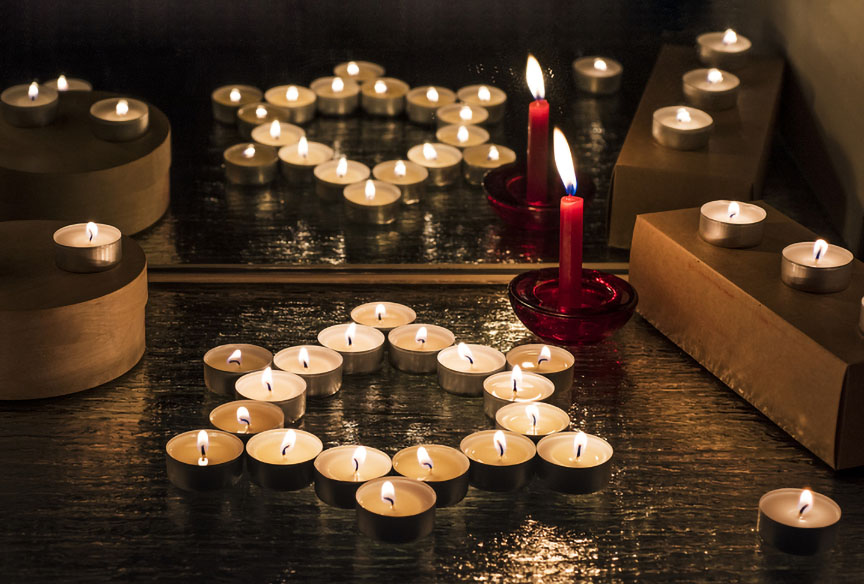
Local efforts marking International Holocaust Remembrance Day included a ceremony this past weekend organized by Jewish Federation of the Greater San Gabriel and Pomona Valleys. It was a 25-hour Holocaust commemoration and vigil at Pasadena City Hall. For 24 hours straight, participants read aloud the names of Holocaust victims.

On Intl Holocaust Remembrance Day, UCLA Chancellor Calls for “Empathy and Respect” Read More »

‘Never Forget’ How Jews Responded to Holocaust

There are few things that have dominated American Jewish life more than the Holocaust. Over the decades, we’ve been telling the world over and over again that it must “never forget” this singular Jewish nightmare so that it “never again” happens.

Hundreds of millions have been poured into memorials and cultural projects, from Spielberg’s Shoah Foundation to countless films, books, exhibits, educational initiatives, you name it.

At the Journal, we never stop receiving submissions connected to the Shoah. There are always new stories and new angles. This week, we weigh in on the outrage of using Holocaust analogies for political or other nefarious ends.

In academia, the Holocaust continues to be a cottage industry attracting scholars from all fields.

One way or another, the Holocaust is the story that never quits.

From a Jewish standpoint, this focus makes sense: If we want people to “never forget” something, shouldn’t we focus on that thing?

Yes we should and yes we do.

There is a problem, however, that few people want to talk about: Focusing on Jews who died makes us look weak at a time when we must look especially strong.

The most important and least-discussed aspect of the Holocaust is how strong we came out of it.

It’s the way we built our dreams after the nightmare to end all nightmares.

It’s the way we refused to wallow in victimhood even though we had every reason to.

It’s the way we were battered and traumatized after losing six million and still rose to write one of our greatest chapters.

It’s the way we came to America and created a golden age of American Jewry, even as Holocaust memorials were proliferating.

It’s the way we went back to our biblical homeland and created the nation state of Israel, a world leader in all areas of innovation.

In short, it’s the way we stood up and decided we would no longer be sitting ducks.

Antisemitism may be on the rise, but Jews are no longer the Jews of Kristallnacht.Today we have the power to fight back.Some Jews even fight back by laughing.

Just ask Todd Diamond, who writes in his new book, “Pass the Trauma, Please,” about how his father finally opened up about his Holocaust survival story — over Chinese food.

Todd’s father, whom he describes as a cross between Mel Brooks and Larry David, told him: “Son, if you’re going to write my story, go easy on the horrors. Remember, you’re no Elie Wiesel. You’re an ad guy. So do what you always do to make people buy things, put in some jokes.”

Put in some jokes. What a way to fight. Live with laughter. Go easy on the horrors.

These horrors only show one thing—weak Jews.

I am not that weak Jew.

I am a proud Jew from Morocco who is blessed to be part of a highly successful Jewish-American community.

This is not triumphalism—it’s the truth. Jews are winners; that is partly why we are so hated.

I don’t want pro-Hamas Jew-haters to see images from Auschwitz and think that it’s me. It’s not me. The Jews of Auschwitz are my beloved ancestors who were not blessed the way I am.

When I stand up as a proud Jew, as a lover of life, as a lover of America, I am honoring my ancestors who perished because they had no choice.

We have a choice.

We can choose to remember them by remembering to thrive on their behalf.

Call me crazy, but what I want the world to know most about the Holocaust is that it’s in our past and they should never forget how strong we came out of that darkest moment.

That is also what I want Jewish kids to know—not how we died but how we thrived after we died.

I’m not naïve enough to think that the Holocaust industry is going anywhere. It will continue to make the noise it makes. The films, the books, the memorials, the education, will never stop, and it shouldn’t.

But maybe it’s time we close the loop — to remind everyone that it’s what we did after the Holocaust that matters most, that serves as the best model for a world in dire need of resilience.

We are no longer the sitting ducks of Auschwitz. Today we stand, we live, we fight and we laugh.

‘Never Forget’ How Jews Responded to Holocaust Read More »