Benny V’s grandparents didn’t like to speak about what they had experienced during the Holocaust. His grandmother would often shut down any attempt at conversation, brushing it aside with a familiar question: “Would you like something to eat?”
“That was her answer to everything,” said Benny, the musician behind the Toronto-based project Beautiful Blu.
He grew up understanding that silence was part of how some people cope with things.
“There were those who were open to speaking about their experiences, and those who weren’t,” he said. “On my mother’s side, my grandfather, who came from the same town as Elie Wiesel, lost his entire family – nine siblings. My grandmother came from a family of 10 children; only five survived.”
Though he was curious to learn more about their experiences during the Holocaust, Benny learned not to push for answers. Then in 2015, he joined a group traveling to Poland to mark the 70th anniversary of the liberation of Auschwitz.
When Benny called his uncle to tell him he had gone to Auschwitz, the reaction was not what he expected. “He was upset,” Benny recalled. “My grandmother never wanted to go back. I don’t think she ever left Chicago once she arrived in the U.S.”
During the trip, Benny took black-and-white photographs, and a friend suggested turning them into a show. “I didn’t want to do just a show,” he said. “So we rented a 5,000-square-foot space, built sculptures, and I created a soundtrack that played as people moved through the exhibit. That’s where it all began.”
Only afterward did he decide to put words to the music — a process he describes as the most difficult part of the project. Writing the lyrics meant revisiting his grandparents’ lives during the darkest chapter of Jewish history. “It’s not meant to make a statement,” he said. “It’s simply a story — the story of my grandparents. And while the album is undeniably dark, the one thing I hold close to my heart is the realization that every Holocaust survivor experienced at least one miracle in order to make it out alive. Someone or something helped them at a life-or-death moment.”
The album takes listeners on a somber musical odyssey, blending haunting vocals with moments of electronic texture to reflect both historical horror and emotional disorientation. It begins in Europe before the war, where Jewish communities coexist with their neighbors, before descending into deportations, cattle cars, slave labor and gas chambers. The music explores timeworn patterns that continue to repeat throughout history.
The song “Lost Love Story” tells the story of a young couple hiding from the Nazis, who are ultimately discovered and murdered. “One Final Day,” the album’s title track, examines how governments repeatedly rally young people to fight for a so-called “great cause” — one that rarely changes.
“The song explores young men — often barely adults — sent to war, convinced they must fight for their country, only to come face-to-face with an enemy soldier who mirrors their own fears, hopes, and dreams.
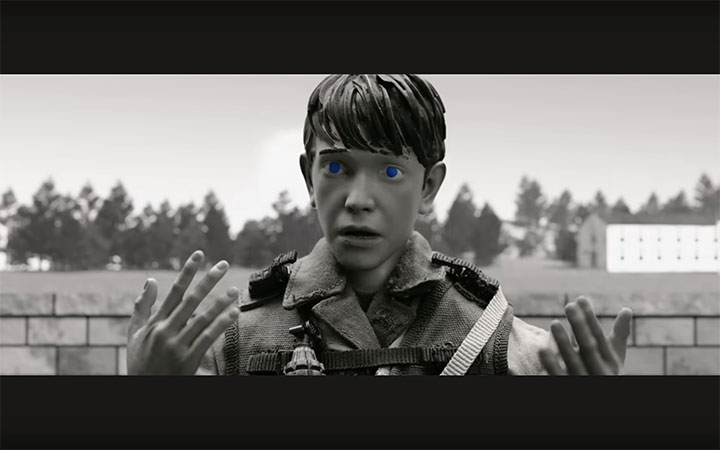
“For me, it’s about how easily young people can be swept into war,” he said. “They’re taught they have to fight, and then they’re standing across from someone who isn’t so different from them.”
The song is accompanied by a hand-illustrated animated music video that visually tells that story.
“No One to Remember,” sung by Sophie Michalitsianos, may be the album’s most emotionally devastating track.
“Sophie asked me what the song was about,” he said. “I told her it’s about a mother walking her child to the gas chambers, thinking about everything that child could have become, maybe a novelist, a musician, maybe someone who could cure cancer. She feels like she failed him because she couldn’t protect him.”
Michalitsianos initially refused to sing the song, thinking it’s just too painful. After some persuasion, she eventually agreed to record it in a single take. “She went into the booth and cried while she sang it,” he said. “She has a daughter, and it touched her deeply. It was beautiful that she did it.”
The album features an accomplished group of collaborators, including Bill Ryder-Jones of The Coral on lead vocals, Aaron Johnston on drums, and Byron Isaacs on bass, who also plays with The Lumineers. Veteran producer David Baron, whose credits include Lenny Kravitz, Keith Urban and Shania Twain, helped shape the album’s overall sound.
When asked how his grandmother might have reacted had she known her life story would inspire an album about the Holocaust, Benny replied honestly. “It probably would have gone over her head,” he said. “She wouldn’t have understood it.”
He reflected on how differently survivors are viewed today. “Time has changed so much,” he said. “The few Holocaust survivors still alive are almost seen as superheroes now. They’re revered. But back then, they weren’t seen that way. They were viewed as damaged goods — people with heavy accents who had lived through something horrific. They weren’t celebrated like today.”
As the album unfolds, that idea flows into, “Morning Angel,” which Benny described as a meditation on foreknowledge and blindness. “It’s about the angels knowing what’s coming,” he said. “People are living their lives — not necessarily in denial – but they don’t fully grasp what lies ahead. They see warning signs, but they look away.”
Listening to the album today, it’s hard not to hear echoes of the present — moments where history feels uncomfortably close rather than safely distant. “History repeats itself. It never changes and will never change — this is the plague of humanity,” he said. “Yes, there is more awareness now because of the media. People don’t want to go through this again, but at the same time, it’s happening. As human beings, we always rationalize things. Everybody is always right; you can argue on each side. However, with the Holocaust, it’s so extreme that you can’t argue the other side. I always joke that Hitler didn’t think he was doing a bad thing for Germany; he didn’t think he was an evil guy.”
The Canadian musician spends a couple of months each year in Los Angeles for his recordings but said he doesn’t think he would want to perform the album live. “To be honest, it would be amazing to perform it, but the journey was so intense and draining,” he said. “The topic is heavy — if you listen to this album once, would you want to listen to it again? How many times, after all, can you watch ‘Schindler’s List’?”
“The Beautiful Blu” is available on Spotify, Tidal and Apple Music, as well as a limited vinyl release.