As America’s 250th birthday approaches, it is an occasion for all Americans to be grateful for their country and for American Jews to celebrate how Jewish ideas and individuals have contributed to the American story.
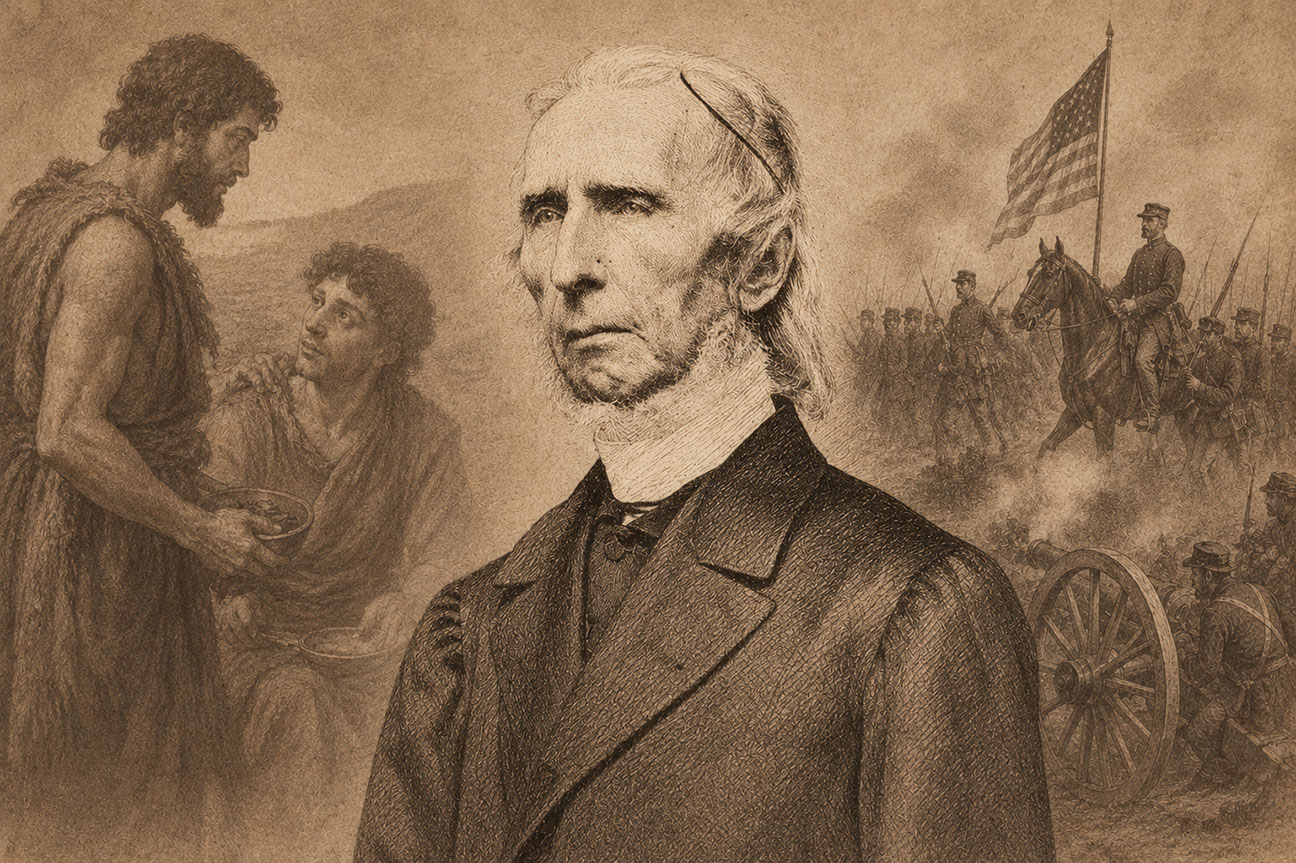
Case in point is the remarkable career of Rabbi David Einhorn. After the outbreak of the Civil War, Rabbi Einhorn was forced to flee from Baltimore to the North due to his abolitionist views. He accepted an invitation to lead Philadelphia’s Keneseth Israel Congregation, where he would remain until 1866, when he moved to New York. Having experienced first-hand the danger and divisiveness in the country, he nonetheless heeded with gusto President Lincoln’s call for Thursday Nov. 26, 1863 to be the first official Thanksgiving.
On that day, Einhorn delivered a sermon to his newfound community that drew from the covenantal courage of the patriarch Jacob as he readied himself to confront his brother Esau. Quoting the scene described in Genesis’s 32nd chapter, he began by acknowledging “Although the sad spectacle of fratricidal strife has not yet ceased, nor the time arrived, when we may joyfully wave the olive branch of peace, yet if we duly consider all the surrounding circumstances, the dread and apprehension which filled every heart at the commencement of this horrible conflict, we are made to feel the presence of an overruling providence, marvelous to behold, and which should cause every inhabitant of the North to exclaim in the language of Jacob, ‘I am not worthy of the least of all the mercies and of all the truth, which thou hast showed to thy servant’ [32:10]. When the Patriarch spoke these words he had likewise not yet reached the desired goal.”
Despite the difficult challenge that stood before him, “He nevertheless recalled to his remembrance the great things that God had done for him, and drew from this reflection renewed courage, hope and resolution.”
Einhorn then further articulated the analogy. “And has not God done great things for us also? He has blessed us with a surplus where want was impending, that might have produced the most dangerous consequences. He has maintained peace and order in our midst during the most violent agitations of party strife, and finally he has granted glorious victories to our armies over a potent enemy.”
The miraculous momentum in the North, was, Einhorn believed, because “God has directed it, God who loves liberty and who hates slavery – who declared to you O Israel at your national birth: ‘I am the Lord thy God, which has brought thee out of the land of Egypt, out of the house of bondage’ [Exodus 20:2] and who has also proclaimed to the American people, struggling for their birthright the promise made to Jacob ‘Return to thy heritage and I will deal well with thee’” [Genesis 31:3].
Jews, the rabbi felt, despite the personal travails his own beliefs had brought upon him, should uniquely rejoice in the war’s progress. After all, liberation of the slaves was a cause long dear to Jewish hearts. “And who ought to rejoice more at this state of things than we, the descendants of Abraham, of whom 40,000 were carried away into slavery by Titus; who during the dark ages were bartered like chattel, and whom the German emperors used to designate their body-servants?” he argued.
Overlaying Jacob’s commitment to the covenant of his fathers with America’s national character, Einhorn promised “neither will the American people sacrifice in this struggle their birth-right, the exalted mission of proclaiming freedom to all the world, though many a precious sacrifice it has already cost to bring this war to a happy issue in the interest and for the sake of the nation’s divine mission.”
Resting assured that the Union would prevail as the patriarch had, Einhorn concluded “And we, the inhabitants of this new world, shall we be afraid or think it even possible, that Esau in his robe of purple approaches to smite the mother, our republic, with the children? Never! The divine spirit that rules the events of the world has ordered it otherwise. Liberty, an emanation of this spirit, is designed to be purged and purified of the dark spot that still mars her heavenly countenance, that her light may shine brighter and fuller and gladden the whole earth with her lustre. A brilliant throne shall be erected for her in the new and in the old world, that when the storms and violent commotions shall have ceased, she may exclaim – ‘With my pilgrim staff have I crossed the sea to seek a place of refuge here, and now I have become two bands, bearing here and there the staff of rule and sway’” [Genesis 32:10].
Einhorn’s confidence was eventually confirmed. America, like the Jewish forefather, would survive its enemy and earn its birthright, confidently stepping forward into its future, proclaiming freedom to all the world.
Rabbi Dr. Stuart Halpern is Senior Adviser to the Provost of Yeshiva University and Deputy Director of Y.U.’s Straus Center for Torah and Western Thought. His books include the newly released “Jewish Roots of American Liberty,” “The Promise of Liberty: A Passover Haggada,” “Esther in America,” “Gleanings: Reflections on Ruth” and “Proclaim Liberty Throughout the Land: The Hebrew Bible in the United States.”