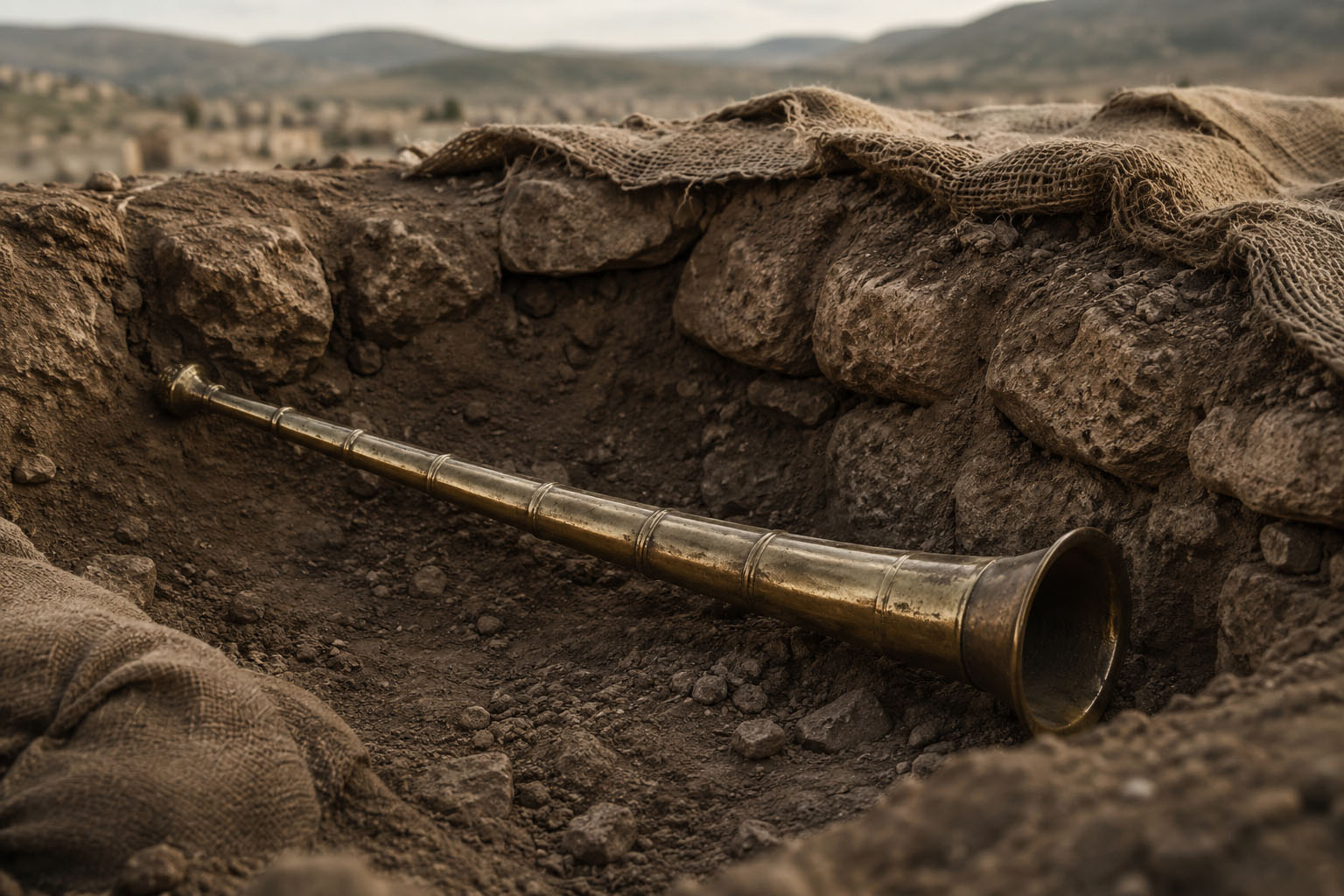
In his book Musical Instruments of the Bible, Jeremy Montagu explains that the trumpet is “the one musical instrument in the Bible which we can identify with absolute certainty from the prescription of how it was to be made…” They were made of “hammered silver.” Josephus describes them as being “composed of a narrow tube, somewhat thicker than a flute, but with so much breadth as was sufficient for admission of the breath of a man’s mouth: it ended in the form of a bell, (i.e., flared opening) like common trumpets.” And this is how the trumpets are depicted on the Arch of Titus and on coinage from the Bar Kokhba era.
Montagu and many others note that the biblical trumpets seem very similar to two trumpets, one silver and one bronze, that were discovered in the tomb of Pharaoh Tutankhamun. These Egyptian trumpets are from roughly the same period as the Exodus and are symbols of royalty.
Remarkably, this dovetails with what several commentaries say about the Torah’s trumpets. The Midrash Tanchuma explains that they indicate Moses was a king, and God tells Moses to make the silver trumpets “so that they may be sounded before you like before a king.” Don Isaac Abrabanel adds that “they should be made of silver and not of another metal, out of honor for Moses, for it is the way of kings to have them made [of silver].”
The fact that the Torah’s trumpets are nearly identical to Tutankhamun’s is unsurprising; the Torah borrows from a culture that the Israelites knew well. But this borrowing is also subversive; these trumpets declare that the Israelites have a new king, Moses, and are no longer subjects of Pharaoh.
In the desert, Moses used the trumpets to assemble the leaders and the people, and to indicate that they were about to travel. But the Torah (Numbers 10:9-10) adds the following commandment for future generations:
When you go to war in your land against the enemy who oppresses you, then you shall sound an alarm with the trumpets, and you will be remembered before the Lord your God, and you will be saved from your enemies. Also in the day of your gladness, in your appointed feasts, and at the beginning of your months, you shall blow the trumpets over your burnt offerings and over the sacrifices of your peace offerings; and they shall be a memorial for you before your God.
The trumpets were used to sound the piercing, broken cry of the teruah when going into battle; they were used as well for the comforting, continuous sound of the tekiah while celebrating in the Temple.
After the destruction of the Temple and the loss of Jewish sovereignty, the trumpets no longer served any purpose.
The trumpets have disappeared from Jewish practice; but their influence lives on. Maimonides explains the trumpets were not just for times of war; they were sounded on fast days for drought and other calamities. He writes that:
It is a positive Torah commandment to cry out and to sound trumpets in the event of any difficulty that arises which affects the community…Whenever you are distressed by difficulties, such as famine, plague, locusts, or the like, cry out because of them and sound the trumpets.
Maimonides then offers a theological reason for the trumpets:
This practice is one of the paths of repentance, for when a difficulty arises, and the people cry out and sound the trumpets, everyone will realize that the difficulty occurred because of their evil conduct….
The purpose of sounding the trumpets is to awaken the hearts of the people to repent and be worthy of God’s providence and salvation. Maimonides offers a similar reason for the shofar of Rosh Hashanah as well.
The Sefer HaChinuch takes this idea a step further and explains:
…At times of trouble, a person needs great focus in his prayers before his Creator, ….we are therefore commanded to sound the trumpets at these times, for man is inherently physical, and he requires a great deal to awaken him to these things….. And there is nothing wakes one up better than the sounds of music, as is well-known, and all the more so the sounds of trumpets, which produces the loudest sound of all musical instruments.
To Maimonides and the Sefer HaChinuch, the trumpets are a wake-up call. In times of trouble, they call upon us to pray and repent.
Maimonides adds that the rabbinic practice of declaring public fast days in response to calamity is based on the mitzvah to sound trumpets. Just like the trumpets, fasting shakes up the soul and inspires one to repent.
Nachmanides takes a very different view. He explains that the obligation to sound trumpets may be the foundation of Jewish prayer.
Nachmanides takes the bold view that there is no Biblical commandment to pray; one can and should pray to God; but there is no explicit commandment to do so.
However, Nachmanides admits that there is one situation when prayer is a biblical obligation: during times of distress. Nachmanides explains that the call of the trumpets is a cry for divine help, much like prayer in a time of distress.
He writes:
…We should pray to Him in times of distress, and that our eyes and our hearts should be directed toward Him, like the eyes of servants toward the hand of their master. This is the meaning of the verse, ‘And when you go to war in your land against an enemy who oppresses you, you shall sound the trumpets, and you shall be remembered before the Lord your God’ (Numbers 10:9). This is a commandment that, when a calamity comes upon the community, they should cry out before Him with prayer and with the sounding of the trumpets.
At first glance, this view seems odd. Faith in times of crisis is inherently suspect; desperate people will try anything. The saying that “there are no atheists in foxholes” highlights how hollow a religious conversion under fire is. To turn to God only because you need something seems a tad insincere.
Some mystics denigrated the sections of the prayer where we ask God for help precisely because of this problem. Rabbi Joseph Soloveitchik notes that “mystics and philosophers …alike considered petitionary prayer an unworthy part of the service, a remnant of magical religion, when the savage bartered with his gods and tried to reach a quid pro quo deal with them.” Rabbi Dov Ber, the Maggid of Mezerich, expresses it directly: “one should be ashamed and not pray for that which his body lacks.”
In prayer, one should simply commune with the divine; to take that time to ask for petty human needs is crass.
Nachmanides attacks this perspective and defends the faith found in foxholes. We imagine that faith is built on grand visions: on contemplating the vastness of the universe, and searching for what comes before and what stands above.
But faith more frequently arrives during a crisis. When we are broken and worried. When we are alone. When we recognize we are simply dust and ashes.
At that moment, life seems absurd.
And the only thing left that can redeem man is faith.
The Lubavitcher Rebbe would emphasize that when one has faith in God, they are never alone. And that faith has given strength and comfort to Jews during the worst moments of exile.
In the tunnels of Gaza, many of the hostages learned this truth firsthand; and that is why they turned to faith. They would tell you it was not the superficial faith of those looking for a quick fix; it was because the crisis of captivity forced them to rethink their priorities and search for meaning and purpose.
Eli Sharabi spent 491 days in captivity. Hamas murdered his wife, Lian, and daughters, Noya and Yahel. He described his spiritual journey this way:
I came from the darkest place in the world–50 meters below ground. What gave me strength was saying ‘Shema Yisrael’ every morning. Every Friday night, we tried to make kiddush. We didn’t have wine, so we used water. Faith is what kept us alive.
Faith in the foxhole is the recognition that with faith, you are never alone.
And from the wail of the royal silver trumpets to the crying prayers of the brokenhearted hostages, this faith has kept us alive.
Rabbi Chaim Steinmetz is the Senior Rabbi of Congregation Kehilath Jeshurun in New York.