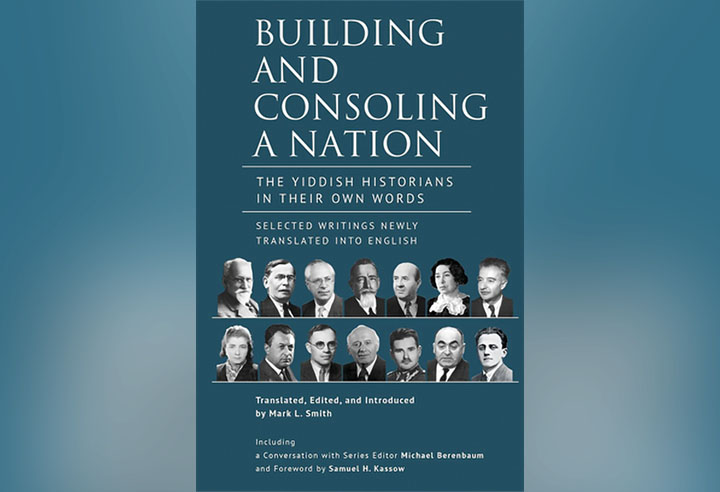
In “Building and Consoling a Nation: The Yiddish Historians in their Own Words — Selected Works Newly Translated into English,” Mark Smith has compiled an important anthology of Jewish history using 49 works by Yiddish historians to recreate or at least open the door to a world of Jewish thought that was once almost mainstream, but which no longer exists, except in the minds of too few specialists. Jewish history had been the subject of his “leisure reading” since childhood. His maternal uncle, a former Jewish educator, would bring him leading books on Jewish history, all in English. Later, when he began to read Jewish history in Yiddish, he discovered that, by contrast, the Yiddish works were not written incidentally in Yiddish but were part of a cultural system that existed entirely in Yiddish.
He found that two preconceptions are common among American Ashkenazi Jews. The first is that their own half-remembered or imagined view of Yiddish language and culture captures the whole of it. The second — perhaps because we live in an age when English is the lingua franca of Jewish scholarship — is that, since the content of Jewish historical writing in English is largely independent of language, the same should be true in other languages, including Yiddish. Thus, they are unaware of scholarly writing in Yiddish and believe that if such writing exists, it would be language-neutral.
Smith coined the expression “Yiddish historians” to describe a group of scholars who undertook the task of giving historical consciousness to the Yiddish-oriented national movement that arose in Eastern Europe between the world wars — and which continued as long as Yiddish remained a spoken vernacular (outside of Hasidic Jewish communities). His contention: these historians used Jewish sources of information wherever possible, often solicited from the Jewish public and, in turn, wrote about the history of Ashkenazi Jewry — for an educated lay audience of Yiddish speakers — in their own national language.
The Yiddish national-cultural context is the main theme of this book and of his previous book on the Yiddish historians of the Holocaust. Historians who chose to work significantly in Yiddish created a distinct school of historical thought that is found in their Yiddish writings, one that was conducted well before the internet through worldwide conversations among themselves and their readers. Despite their many disagreements about politics and historical method, they shared a research agenda that focused on the “internal” aspects of Jewish life, including the economic, legal, literary, religious and social organization of Jewish communities, largely with a positive view of Jewish history. The Yiddish historians focused on how Jews lived, less so on how they were persecuted and murdered, in contrast to prior and contemporaneous Jewish, and non-Jewish, historians.
The book is unique. As Smith points out, it would be hard to think of another language in which professional historians wrote the history of their own people and that thereafter fell into disuse among that very audience. Typically, the suppressed languages of literate colonized peoples, the Irish or Welsh for example, have become a vehicle for scholarly work during a stage of national revival, not following linguistic decline. As a result, Yiddish may well be unique in having a body of modern, professional scholarship that has become increasingly unreadable even by its own populace.
Most Jewish historians of Eastern Europe began their work in other languages, such as Russian, Polish or Hebrew, and turned deliberately to Yiddish for national and popular purposes to reach their people. Most of them can also be included in more than one national or language community. Few wrote exclusively in Yiddish. Smith uses the term “Yiddish historian” for those who wrote to a significant degree for a Yiddish-speaking audience as part of a consciously national-Yiddish culture.
Before the Holocaust, Jewish historians in Eastern Europe struggled for inclusion in mainstream academia. Polish historical journals, for example, would publish reviews of Polish works by Jewish historians, often very critical of their statements on Polish-Jewish relations or the role of Jews in Polish economic history, but virtually never articles by Jewish historians themselves. Many Jewish historians were able to expand in positive directions by turning to Yiddish and writing for their own people.
If prewar Eastern Europe had been like postwar America, there might have been no Yiddish national movement. But historians such as Jacob Shatzky and Isaiah Trunk would, respectively, come to regret the choice to write in Yiddish and begin to publish in English. Trunk’s award-winning “Judenrat” was written originally in Yiddish. Smith emphasizes that what had been liberating before the war became confining after the war. Too few would read the work, and thus its impact would be minor at best. A major theme of Smith’s work on the Yiddish historians of the Holocaust is that their works would achieve great influence, especially on topics related to internal Jewish life under German occupation, but only a generation or two after the fact, with their eventual translation or a turn to publishing in English.
After the Holocaust, the surviving scholars who experienced the catastrophe at first hand felt a personal commitment to their fellow survivors, both to research every aspect of the Jewish experience of Nazi domination and, especially, to answer the ultimate Jewish question of the Holocaust—how could this have happened to us?
Smith discovered that the topic most widely studied among all Yiddish historians came to be that of resistance, particularly the unarmed resistance without which there would have been no survivors. They succeeded at times in expanding their readership, but they would never have abandoned their chief constituents, the survivors as well as the Jews who left Eastern Europe before the war but retained ties to family and community and an allegiance to the Yiddish language.
Their unique contribution was a view of the Yiddish-speaking Jews of Eastern Europe as a national group defined, within the larger Jewish context, by a shared history and culture that transcended the boundaries of their home countries. These historians fashioned a Jewish history of shared culture and internal relations that was more portable and independent of physical landmarks than earlier or parallel schools of Jewish history. Even the exception, of focusing on a specific location to establish the age and contributions of a given Jewish community, was in the service of national self-defense.
How did this second-generation, English-speaking Los Angeles native begin?
Smith was fortunate to begin collecting Yiddish books in the early 1990s when they were still in used bookstores and, more often, in the libraries of older Yiddish readers then being disbursed. He collected and read widely, both in literature and nonfiction, but found that history remained his field — and Yiddish his language.
With time, he collected articles written by historians in dozens of well-known and obscure Yiddish journals and periodicals, as well as Yizkor books. He collected not only the historians’ original works, but their reviews of each other’s works — a conversation that extended, over the decades, from St. Petersburg to Warsaw, Berlin, Paris, New York, Tel Aviv, Jerusalem, even Lincoln, Nebraska, and, on occasion, to Latin America and South Africa.
He recreated the process pioneered by Simon Dubnow and his followers in the early 20th century, of first gathering an archive of materials on which to base their work — and collecting almost indiscriminately until they had done their best to exhaust the field.
He considered his method “preventive research,” not knowing what would become important, but attempting to collect everything. He tried to let these writers speak to him, tell what themes were broadly shared, which individuals had specialties or areas of divergence, until he had arrived at some understanding of how these historians conceived of the study of Jewish history. An early result was his Ph.D. in Jewish history at UCLA.
In writing his prior book on Holocaust historiography, he regretted that the earlier, formative, period of Yiddish historical work could be discussed there only as an introduction to the broader subject. In essence, this new anthology redresses that omission by covering the entire period of modern historical writing in Yiddish, from the early to late 20th century. Second, it serves as a companion volume in offering at length the historians’ own words that are quoted only briefly in the prior book. It allows readers to evaluate for themselves his interpretations of their works, and, above all, it allows the Yiddish historians themselves to breathe again.
The book is available for free download at https://uplopen.com and at Amazon, courtesy of the Conference on Jewish Material Claims Against Germany.
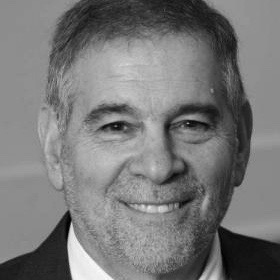
Michael Berenbaum is director of the Sigi Ziering Institute and a professor of Jewish Studies at American Jewish University. This review is an outgrowth, a condensation and editing of the conversation between Mark Smith and the reviewer that begins this new book.