In January 2002, Rabbi Jonathan Sacks stood at Ground Zero with the Archbishop of Canterbury, a Muslim imam, a Hindu guru, and the Chief Rabbi of Israel, each of whom offered a prayer for the victims. Standing among them, he recognized that we must confront religious violence:
“In that moment I found myself reflecting on the contrast between the religious zeal that drove the hijackers who crashed into the towers and the equally fervent longing for peace of the religious leaders gathered there. This juxtaposition of good and evil, harmony and conflict, world peace and holy war, suddenly seemed to me the essence of the twenty-first century, which had only just begun. … The possibilities and the dangers have never been so great, and the choice is ours.”
Rabbi Sacks had not paid much attention to religious violence until that moment of epiphany. He wrote two books on the subject, “The Dignity of Difference” and “Not in God’s Name,” and made dialogue, pluralism, and mutual understanding central to his rabbinate.
Religion is sacred and profoundly cherished; that’s why many people are reluctant to confront, or even consider, its faults. But the sad truth is that ordinary religious passion can pervert morality.
The Talmud tells the story of two Kohanim in the Temple who were running up the ramp of the altar, trying to get there first to do the divine service. One took his knife and stabbed the other to death. Most shocking is the reaction of the father of the dead Kohen. He looked at his own child and exclaimed, “My son is still convulsing [and not dead]. The knife has not become ritually impure!” The Talmud adds a bitter remark: “To teach you that the ritual purity of utensils was of more concern to them than the shedding of blood.”
The Talmud holds pious fools in contempt. It recognizes how easily people get fixated on religious minutiae, and that an all-encompassing obsession with observance can end up betraying the Torah’s fundamental values. In this story, the sacrificial ritual and purity laws have become an end in themselves; forgotten is a foundation of human connection and spiritual insight.
What is remarkable is how the Torah reminds us that religious violence is as old as religion itself, and demands that we transform our perspective.
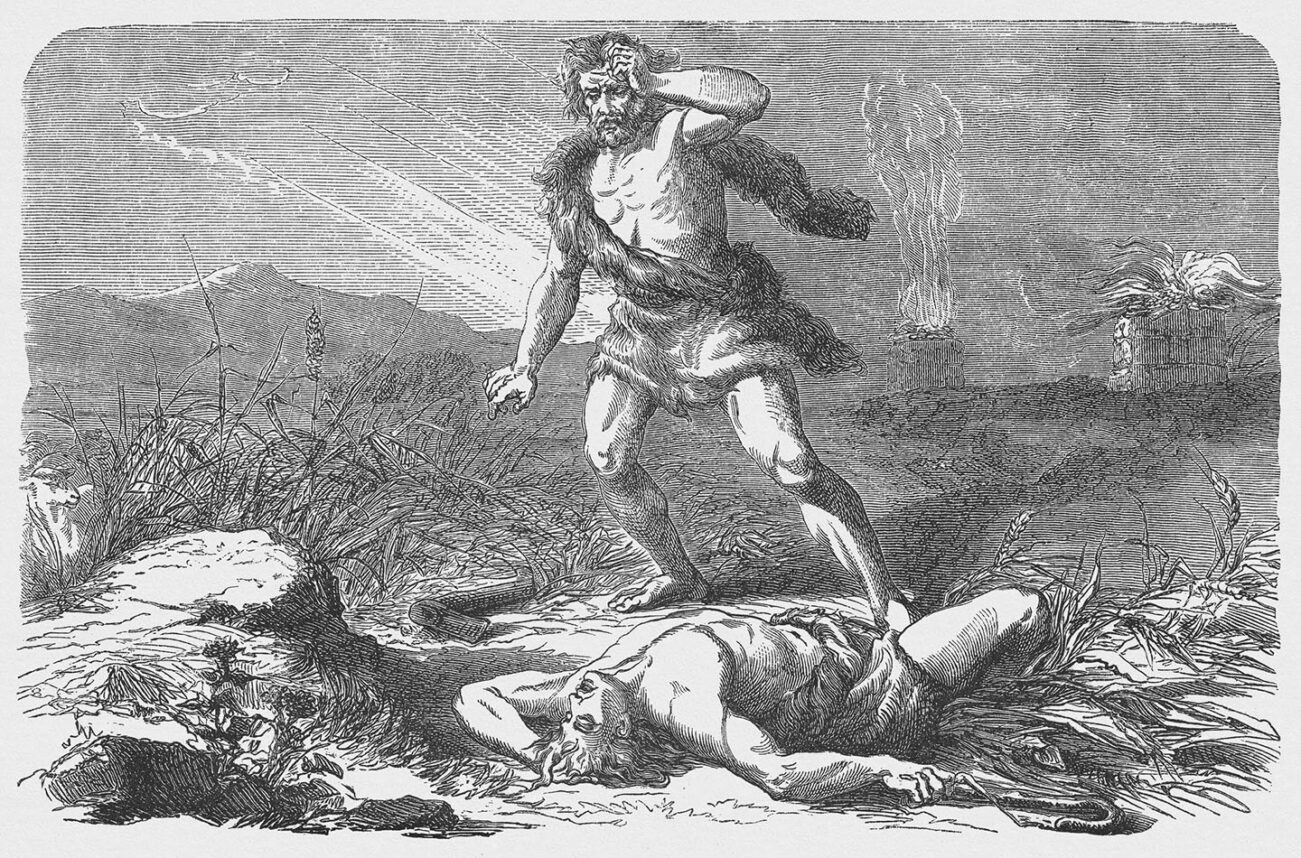
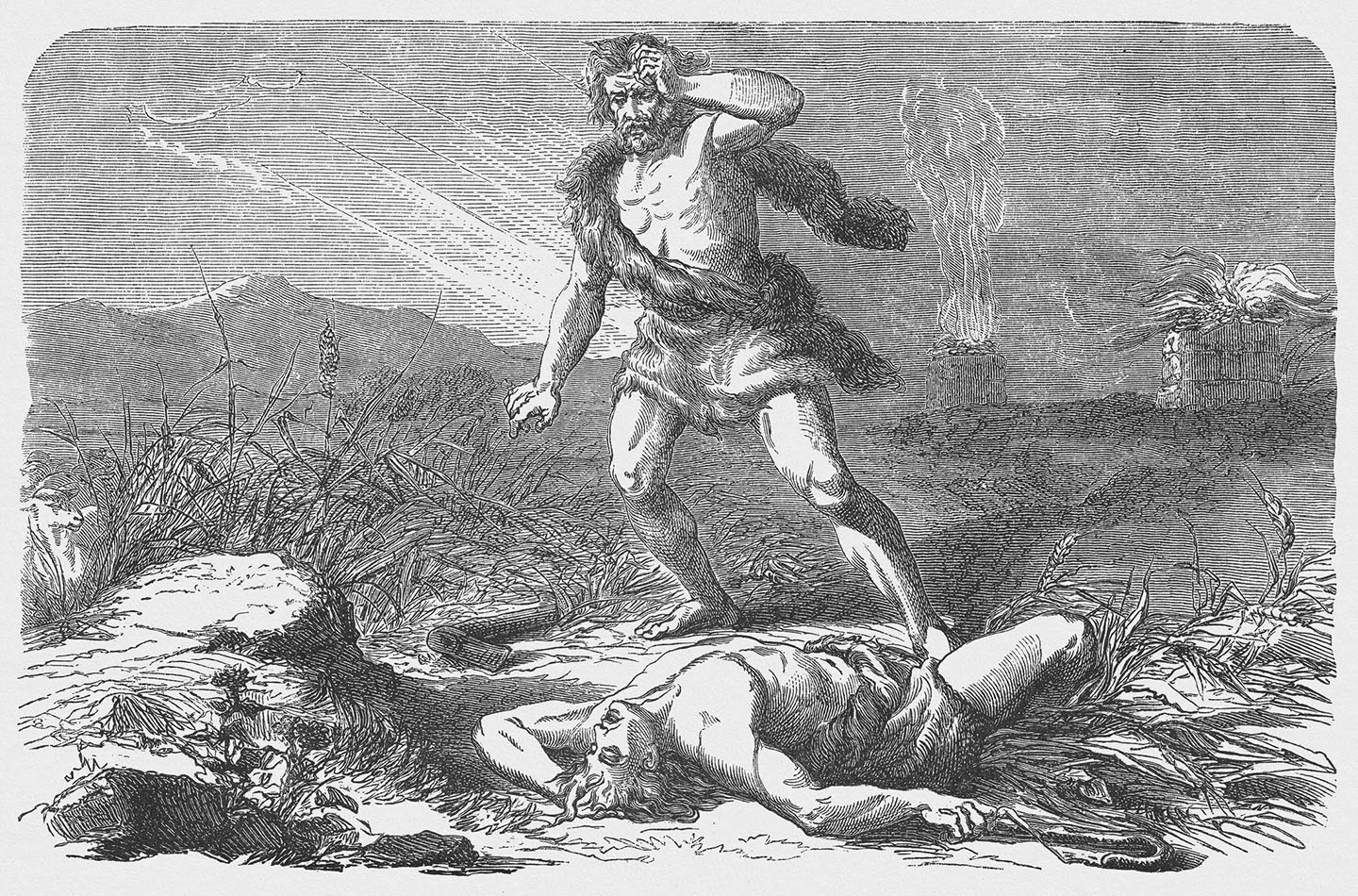
The first murder in history is a religious one: Cain’s killing of Abel. The Midrash underscores this idea. It makes the striking assertion that Cain learned how to kill by observing his father Adam bring an animal sacrifice, and Cain imitated the method of ritual slaughter when murdering Abel.
The Midrash’s comment is strange, but its purpose is clear: to highlight that this murder is rooted in ritual and worship.
To fully understand this, we need to read the biblical text carefully:
“And Abel was a keeper of flocks, but Cain was a tiller of the ground. In the course of time Cain brought an offering to the Lord of the fruit of the ground. Abel also brought the firstborn of his flock and of their fat portions. And the Lord had respect for Abel and for his offering, but for Cain and for his offering, He did not have respect. And Cain was very angry and his countenance fell.”
Cain is the first to decide to bring an offering to God; only after that does Abel decide to emulate his brother and bring an offering as well.
So why does God reject Cain’s offering?
Commentators have proposed several theories. Perhaps Cain brought inferior-quality fruit. Or he waited well into the harvest rather than offering his first fruit. Or maybe his intentions were wrong.
I believe another explanation is readily apparent.
The key lies in the simple fact that Cain went first. One might think that this should bring Cain praise; after all, he initiates the sacrifices to God. And Cain had every reason to take the lead. The Malbim explains that in ancient times the firstborn son was dedicated to divine service. Eve intended Cain to be the family priest. His name, which means “I have acquired a man with God,” expresses that Cain “would be designated for God, to perform His service.”
But here is what Cain failed to do: include his younger brother. If Cain wanted to serve God, why didn’t he ask Abel to join him?
The question answers itself. Cain believes in a God of me and not a God of we. And that is why God rejected Cain’s offering.
Cain imagines all that matters is his own relationship with God. When God asks Cain where Abel is, he answers, “I do not know. Am I my brother’s keeper?” This is not simply a deflection. It exposes Cain’s perspective: God is purely interested in being served. Why would God care whether or not Cain is watching Abel? Cain gladly accepts the special relationship with God; he just doesn’t want to share God with his brother. For Cain, God is a trophy to be won and wrested away from Abel.
This is the same race we saw on the altar ramp. The two Kohanim were running to be first in the service of God, and one could not bear for the other to arrive before him. Cain could not bear to share the altar either, and he killed his brother in a fit of jealousy, furious that he no longer had God to himself.
And this is where religion fails: when we treat God as a possession.
In chapter 4 of Genesis we have the Torah’s warning label. It reminds us not to fall into the pitfall of religious self-centeredness, because our service of God can quickly degenerate into a paganism of self-worship. That is where the deepest religious failures, including violence, take hold.
God is the God of the entire universe, not just one man. The Creator of all living beings cares about all living beings, and He expects us to love each other just as He loves all of us.
There is no end to the applications of this lesson. The motto Derech eretz kadmah la-Torah, that decency and morality must come first before embracing Torah, is the litmus test for whether anything we do is the service of God.
A story told by Rabbi Abraham Twersky about two great Rabbinic leaders illustrates this point extremely well:
“On the return from a convention in which many Torah sages participated, the train made stops in several towns, whose Jewish communities came out to greet the gedolim. The Chofetz Chaim, however, in his profound humility, never went on the train platform to meet the people. Rav Meir Shapiro of Lublin, although he was a young man, boldly approached the elderly sage. ‘Why aren’t you going out to meet the people?’ he asked. The Chofetz Chaim answered, ‘Why should I go out? What is it that they want to see? I don’t have horns on my head. It is because they have this idea about me that I am a tzaddik (righteous), and if I go out to them, I am making a statement about myself that I am someone special.’ Rav Meir Shapiro asked, ‘And what is wrong with making such a statement?’ The Chofetz Chaim said, ‘What do you mean “what is wrong?” It is ga’avah (arrogance).’ Rav Meir Shapiro said, ‘And if it is ga’avah, so what?’ The Chofetz Chaim said, ‘Ga’avah is a terrible aveirah (sin).’ Rav Meir Shapiro said, ‘And what happens if one does an aveirah?’ The Chofetz Chaim said, ‘Why, for an aveirah one will be punished in Gehenom (hell).’ Rav Meir Shapiro said, ‘Throngs of Jews will have pleasure from seeing you. Aren’t you willing to accept some punishment in order to give Jews pleasure?’
From then on, every time the train pulled into a station, the Chofetz Chaim was the first one on the platform to meet the people.”
That short conversation holds the solution to Rabbi Sacks’s concern: Putting man first does not mean ignoring God; on the contrary, it is how we serve God on a higher level.
Rabbi Chaim Steinmetz is the Senior Rabbi of Congregation Kehilath Jeshurun in New York.