fbpx

October 8, 2026

Religious Violence and Other Failures

In January 2002, Rabbi Jonathan Sacks stood at Ground Zero with the Archbishop of Canterbury, a Muslim imam, a Hindu guru, and the Chief Rabbi of Israel, each of whom offered a prayer for the victims. Standing among them, he recognized that we must confront religious violence:

“In that moment I found myself reflecting on the contrast between the religious zeal that drove the hijackers who crashed into the towers and the equally fervent longing for peace of the religious leaders gathered there. This juxtaposition of good and evil, harmony and conflict, world peace and holy war, suddenly seemed to me the essence of the twenty-first century, which had only just begun. … The possibilities and the dangers have never been so great, and the choice is ours.”

Rabbi Sacks had not paid much attention to religious violence until that moment of epiphany. He wrote two books on the subject, “The Dignity of Difference” and “Not in God’s Name,” and made dialogue, pluralism, and mutual understanding central to his rabbinate.

Religion is sacred and profoundly cherished; that’s why many people are reluctant to confront, or even consider, its faults. But the sad truth is that ordinary religious passion can pervert morality.

The Talmud tells the story of two Kohanim in the Temple who were running up the ramp of the altar, trying to get there first to do the divine service. One took his knife and stabbed the other to death. Most shocking is the reaction of the father of the dead Kohen. He looked at his own child and exclaimed, “My son is still convulsing [and not dead]. The knife has not become ritually impure!” The Talmud adds a bitter remark: “To teach you that the ritual purity of utensils was of more concern to them than the shedding of blood.”

The Talmud holds pious fools in contempt. It recognizes how easily people get fixated on religious minutiae, and that an all-encompassing obsession with observance can end up betraying the Torah’s fundamental values. In this story, the sacrificial ritual and purity laws have become an end in themselves; forgotten is a foundation of human connection and spiritual insight.

What is remarkable is how the Torah reminds us that religious violence is as old as religion itself, and demands that we transform our perspective.

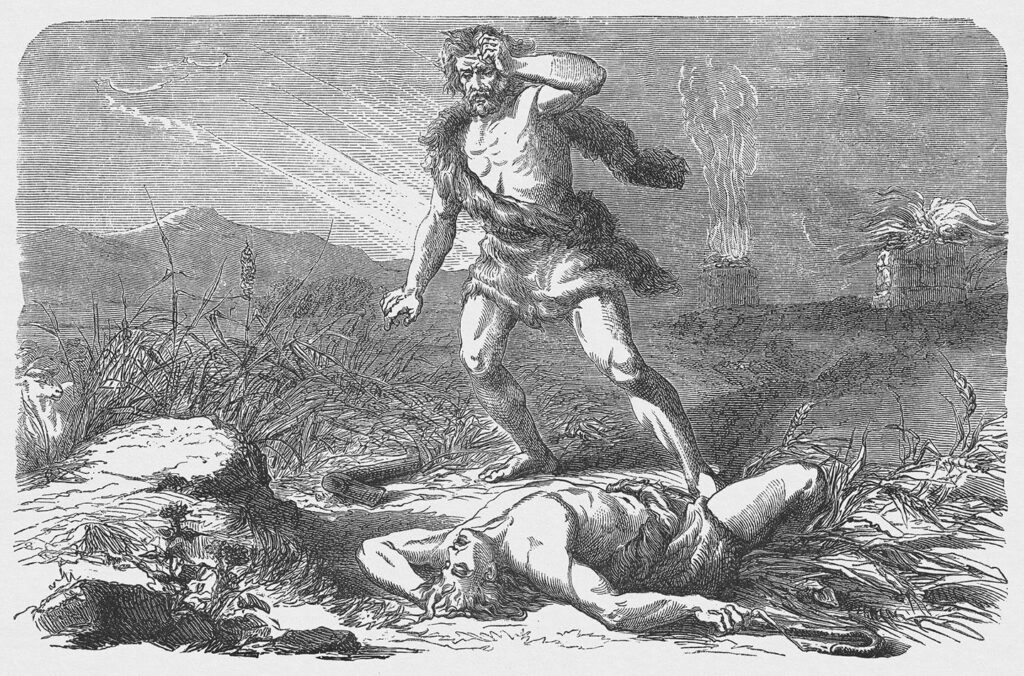
The first murder in history is a religious one: Cain’s killing of Abel. The Midrash underscores this idea. It makes the striking assertion that Cain learned how to kill by observing his father Adam bring an animal sacrifice, and Cain imitated the method of ritual slaughter when murdering Abel.

The Midrash’s comment is strange, but its purpose is clear: to highlight that this murder is rooted in ritual and worship.

To fully understand this, we need to read the biblical text carefully:

“And Abel was a keeper of flocks, but Cain was a tiller of the ground. In the course of time Cain brought an offering to the Lord of the fruit of the ground. Abel also brought the firstborn of his flock and of their fat portions. And the Lord had respect for Abel and for his offering, but for Cain and for his offering, He did not have respect. And Cain was very angry and his countenance fell.”

Cain is the first to decide to bring an offering to God; only after that does Abel decide to emulate his brother and bring an offering as well.

So why does God reject Cain’s offering?

Commentators have proposed several theories. Perhaps Cain brought inferior-quality fruit. Or he waited well into the harvest rather than offering his first fruit. Or maybe his intentions were wrong.

I believe another explanation is readily apparent.

The key lies in the simple fact that Cain went first. One might think that this should bring Cain praise; after all, he initiates the sacrifices to God. And Cain had every reason to take the lead. The Malbim explains that in ancient times the firstborn son was dedicated to divine service. Eve intended Cain to be the family priest. His name, which means “I have acquired a man with God,” expresses that Cain “would be designated for God, to perform His service.”

But here is what Cain failed to do: include his younger brother. If Cain wanted to serve God, why didn’t he ask Abel to join him?

The question answers itself. Cain believes in a God of me and not a God of we. And that is why God rejected Cain’s offering.

Cain imagines all that matters is his own relationship with God. When God asks Cain where Abel is, he answers, “I do not know. Am I my brother’s keeper?” This is not simply a deflection. It exposes Cain’s perspective: God is purely interested in being served. Why would God care whether or not Cain is watching Abel? Cain gladly accepts the special relationship with God; he just doesn’t want to share God with his brother. For Cain, God is a trophy to be won and wrested away from Abel.

This is the same race we saw on the altar ramp. The two Kohanim were running to be first in the service of God, and one could not bear for the other to arrive before him. Cain could not bear to share the altar either, and he killed his brother in a fit of jealousy, furious that he no longer had God to himself.

And this is where religion fails: when we treat God as a possession.

In chapter 4 of Genesis we have the Torah’s warning label. It reminds us not to fall into the pitfall of religious self-centeredness, because our service of God can quickly degenerate into a paganism of self-worship. That is where the deepest religious failures, including violence, take hold.

God is the God of the entire universe, not just one man. The Creator of all living beings cares about all living beings, and He expects us to love each other just as He loves all of us.

There is no end to the applications of this lesson. The motto Derech eretz kadmah la-Torah, that decency and morality must come first before embracing Torah, is the litmus test for whether anything we do is the service of God.

A story told by Rabbi Abraham Twersky about two great Rabbinic leaders illustrates this point extremely well:

“On the return from a convention in which many Torah sages participated, the train made stops in several towns, whose Jewish communities came out to greet the gedolim. The Chofetz Chaim, however, in his profound humility, never went on the train platform to meet the people. Rav Meir Shapiro of Lublin, although he was a young man, boldly approached the elderly sage. ‘Why aren’t you going out to meet the people?’ he asked. The Chofetz Chaim answered, ‘Why should I go out? What is it that they want to see? I don’t have horns on my head. It is because they have this idea about me that I am a tzaddik (righteous), and if I go out to them, I am making a statement about myself that I am someone special.’ Rav Meir Shapiro asked, ‘And what is wrong with making such a statement?’ The Chofetz Chaim said, ‘What do you mean “what is wrong?” It is ga’avah (arrogance).’ Rav Meir Shapiro said, ‘And if it is ga’avah, so what?’ The Chofetz Chaim said, ‘Ga’avah is a terrible aveirah (sin).’ Rav Meir Shapiro said, ‘And what happens if one does an aveirah?’ The Chofetz Chaim said, ‘Why, for an aveirah one will be punished in Gehenom (hell).’ Rav Meir Shapiro said, ‘Throngs of Jews will have pleasure from seeing you. Aren’t you willing to accept some punishment in order to give Jews pleasure?’

From then on, every time the train pulled into a station, the Chofetz Chaim was the first one on the platform to meet the people.”

That short conversation holds the solution to Rabbi Sacks’s concern: Putting man first does not mean ignoring God; on the contrary, it is how we serve God on a higher level.


Rabbi Chaim Steinmetz is the Senior Rabbi of Congregation Kehilath Jeshurun in New York.

Religious Violence and Other Failures Read More »

francescoch/Getty Images

The End of the Beginning – A poem for Parsha Bereshit

But Noah found favor in the eyes of the Eternal. ~ Genesis 6:8

This is the end of the beginning.
It post-credits us into the reset.

Noah was not perfect but
we don’t know that yet.

Unless you’ve read ahead
or remember from last year.

Assuming we’re bookmarked
where we’re supposed to be

we’ve already met the imperfect –
the forbidden fruit eater

the brother slayer
the serpent itself.

I don’t mean to give it away
but there are more to come.

This is knowledge I possess.
This is how our year will progress.

Like opening a book to the last page.
This is what it’s going to be like all year.

We know where we’re going.
We may get wet. Unless we

find favor in the eyes of the Eternal
like Noah did, despite our imperfections

and best intentions
we may not make it.


Rick Lupert, a poet, songleader and graphic designer, is the author of 30 books including “Begin the Beget” and “God Wrestler: A Poem for Every Torah Portion.” Visit him at www.JewishPoetry.net

The End of the Beginning – A poem for Parsha Bereshit Read More »

A Bisl Torah ~ Sharp Anchoring

Our middle son turned 13 this week. Please send help—we now have two teenagers and a pre-teen ruling the house.

This milestone invites reflection on how we prepare our children and almost (gulp) young adults to enter the world. The Talmud explains that in teaching Torah, we should “v’shinnantam.” A phrase we say every single day in the Shema and V’ahavta, “v’shinnantam” can be translated as diligently teaching our children Torah. However, the Hebrew roots shin, nun, nun also implies a sharpness. When we teach our children, the lesson they glean should be sharp and clear enough, so they feel anchored by our tradition and confident in our values.

If we are wishy-washy in what we impart and in what we model, how can we be surprised when they continue forward with ambivalence and confusion?

There is always room for debate, struggling, questioning, and wonder. That is the beauty of our tradition. However, the central Jewish values we want our children to learn should be presented with clarity and conviction.

Our children will find their own path forward; paths that will look different than our own. But we will continue to teach with a sharpness and decisiveness that invites Torah to firmly root itself within their souls. For as they walk forward, our children will know it is Torah that anchors each step and enables them to achieve the highest of their aspirations.

Shabbat Shalom


Rabbi Nicole Guzik is senior rabbi at Sinai Temple. She can be reached at her Facebook page at Rabbi Nicole Guzik or on Instagram @rabbiguzik. For more writings, visit Rabbi Guzik’s blog section from Sinai Temple’s website.

A Bisl Torah ~ Sharp Anchoring Read More »

A Moment in Time: October 7 – We Will Not be Defined by Loss

Dear all,

Last week, as the terrifying yet heroic FlyDubai hijacking attempt unfolded, I found myself thinking about Entebbe.

In 1976, terrorists hijacked an Air France flight carrying Israelis and Jews and diverted it to Uganda. Israel responded with the nearly unthinkable: a daring nighttime rescue mission that brought more than 100 hostages home.

Israel fought back. Israel rescued its people.

I think about Entebbe on this third anniversary of October 7, 2023.

Perhaps that is part of why October 7 wounded us so deeply. We had come to believe that, when threatened, we could protect our people.

But on October 7, we were wounded. We were murdered. We were violated.

And when Israel fought back, much of the world turned against us.

We felt terribly alone.

But in this moment in time, let us remember:

We are not alone.

We stand with one another.

We hold hope in our hearts.

We will never forget.

And we will not allow our loss to become our defining moment.

We will mourn.

We will build.

With love and shalom,

Rabbi Zachary R. Shapiro

A Moment in Time: October 7 – We Will Not be Defined by Loss Read More »

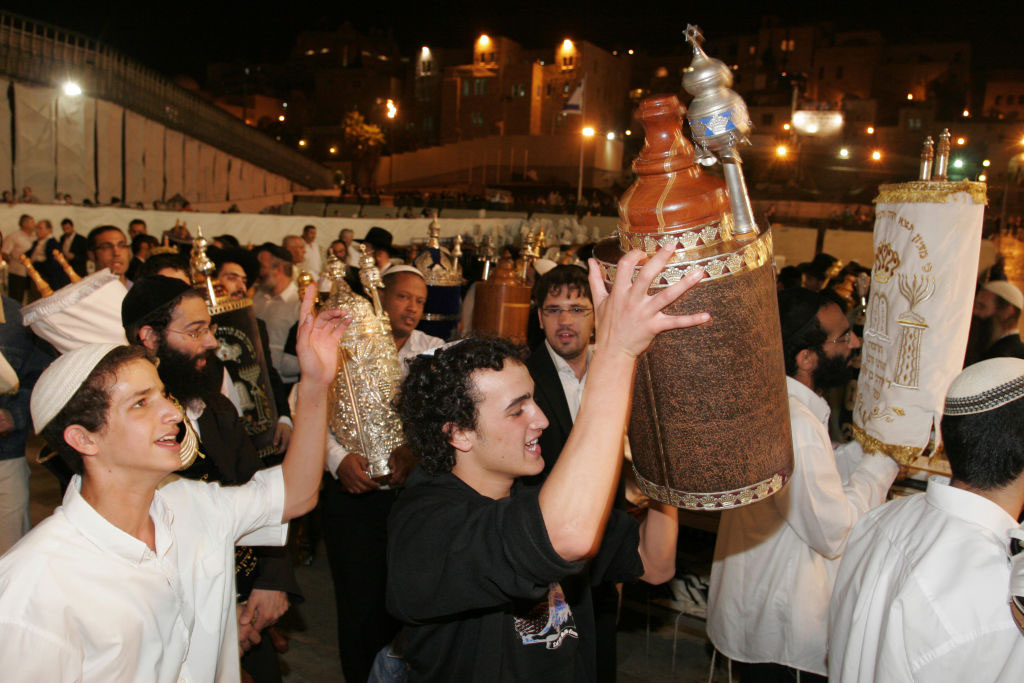
Simchat Torah is the Antidote of Hevel

Simchat Torah is the antidote of hevel,
since joy that’s generated by reading
Torah texts
is the greatest of the antidotes
of hevel, vanity caused by fatal
lack of breath,

we celebrate
after reading  Kohelet — which discusses this —
the festival of Simchat Torah,
since the Torah
enables anyone
who closely studies Bible texts
to become of hevel an ignorer.

Hevel, lack of breath and cause of
everybody’s death,
is cured by Torah-generated joy,
the solution
of all its causes
which Kohelet quotes.

Simchat Torah is the antidote to the lack of breath that bothered Kohelet so much that he composed a book about “hevel,” which means of course vanity, but also lack of breath. We read this book ecclesiastically on one of the last days of the festival of Sukkot, before we celebrate the festival of Simchat Torah, which means “Joy of the Torah’:

In “Remembrance of Former Things and why Simhat Torah is the response to the perplexity of Qohelet,” Mosaic, Tikvah, 10/2/26 Gary Saul Morson writes:
Anton Chekhov reminds us how biblical stories invest a seemingly chaotic world with order and meaning……
Perhaps no Russian writer had a more profound religious sensibility than Anton Chekhov. Chekhov was that odd figure who was not himself a believer but believed in believing. He respected, perhaps craved, the faith he did not have.
Of Chekhov’s many stories—he wrote over 500—his favorite was a quite short one, “The Student.” First it evokes the sense of life as a meaningless sequence of events that add up to nothing. Then it conveys the sense of life as a meaningful whole where, in some mysterious way, even the most trivial events demonstrate the presence of God. William Blake juxtaposed two views of human experience in his “Songs of Innocence and Experience: Shewing the Two Contrary States of the Human Soul.” Instead of poetic juxtapositions, “The Student” offers a story describing how its hero moves from “vanity and vexation of spirit” to a direct feeling of divine presence.

The idea which inspired this explanation of the juxtaposition of Simhat Torah to Qohelet is confirmed by the Book’s final two verses, Qoh. 11:13-14:
יג  סוֹף דָּבָר, הַכֹּל נִשְׁמָע:  אֶת-הָאֱלֹהִים יְרָא וְאֶת-מִצְוֺתָיו שְׁמוֹר, כִּי-זֶה כָּל-הָאָדָם. 13 The end of the matter, all having been heard: fear God, and keep His commandments; for this is the whole man.
יד  כִּי, אֶת-כָּל-מַעֲשֶׂה, הָאֱלֹהִים יָבִא בְמִשְׁפָּט, עַל כָּל-נֶעְלָם:  אִם-טוֹב, וְאִם-רָע.  {ש} 14 For God shall bring every work into the judgment concerning every hidden thing, whether it be good or whether it be evil.


Gershon Hepner is a poet who has written over 25,000 poems on subjects ranging from music to literature, politics to Torah. He grew up in England and moved to Los Angeles in 1976. Using his varied interests and experiences, he has authored dozens of papers in medical and academic journals, and authored “Legal Friction: Law, Narrative, and Identity Politics in Biblical Israel.” He can be reached at gershonhepner@gmail.com.

Simchat Torah is the Antidote of Hevel Read More »

Print Issue: The Genocide Case Against Hamas | October 9, 2026

CLICK HERE FOR FULLSCREEN VERSION

Print Issue: The Genocide Case Against Hamas | October 9, 2026 Read More »

Yasmin Levy Refuses to Put Ladino Music in a Museum

Yasmin Levy inherited one of the Jewish world’s oldest musical traditions and built a career by refusing to leave it untouched. The Israeli singer returns the Saban Theater in Beverly Hills on Oct. 11 with “One More Night,” bringing the mix of Ladino, flamenco and Middle Eastern music that has defined much of her work.

Ladino, or Judeo-Spanish, developed among Sephardic Jews after their expulsion from Spain. Levy was born in Jerusalem in 1975 to a family of Turkish Sephardic heritage. Her father, Yitzhak Levy, was a composer, hazzan and researcher of Ladino music and culture who died when Yasmin was one year old.

Levy’s catalog includes “Adio Kerida,” “La Alegría,” “Me Voy,” “Nací en Álamo,” “Irme Kero” and “Una Pastora.” “Me Voy” won the USA Songwriting Award for Best World Music Song in 2008, according to Levy’s website.

“For me, it’s like Fado, Argentinian tango, flamenco, songs that came from pain and from streets, from life and lives of people,” Levy told the Journal. “And actually those songs like Fado, it helped people to survive difficulties. And there are many funny songs because they had a huge humor. When you’re sad, you use humor.”

One of Levy’s career turns came about 23 years ago during a concert in London. At the time, audiences expected traditional material from her. When the crowd asked for an encore and Levy had nothing left prepared, she asked her manager if she could sing an unreleased song she had written.

“It was the first time that I performed my song,” Levy said. “He said, ‘Yes, of course.’ And this was the theme of my life. It’s changed everything.”

The song was “Me Voy.” The experience pushed Levy toward more of her own writing and away from the musical categories she felt had been assigned to her.

“I broke every frame, every possible frame. Also, my fears,” Levy said.

Levy said promoters could treat Ladino or world music as a slot to fill on a festival bill. She began to feel it did not matter who the singer was as long as somebody occupied that category.

Then she began changing the old songs.

Levy added elements including Turkish music and flamenco. Some Sephardic listeners, Levy said, viewed songs inherited from parents and grandparents as material that should remain in the form they remembered.

“Because I came to something very fragile,” Levy said. “I took songs from their fathers and mothers that sang for them for a baby and very gentle and you can’t do anything. It’s like from a museum. And I said, ‘No, I’m wild when I’m singing.’”

She said it wasn’t received well at all. 

.“When I did that, the Jewish community Sephardic in Israel totally boycott me for seven years,” Levy said.

That willingness to reject a framework also appears in the way Levy talks about religion.

Levy said she chose to become religious and lived that way for 21 years. She came to believe that her interpretation of faith had become built around fear, punishment and reward.

“My problem is that I don’t have a middle. I don’t have gray. It’s either white or black. Also, my singing,” Levy said. “People can’t sit and drink wine with my music. It’s either you hate it or you really love it. And what I did with religious was also like this.”

Levy said fear began shaping the way she viewed good and bad actions. “My religion, sorry, my faith was based on fear,” Levy said. “Even the good I did was not to do good to get reward because I’m scared that now I did bad thing and I will get punished.”

Her relationship with criticism changed too. She said reviews could devastate her when she was young. Her newest album came after her divorce, during a period when she no longer wanted critics determining the value of what she made. She told her manager she did not want the record sent to journalists and described it as a private gift to herself.

“That’s why this one is different. But to get to this point that you don’t care about critics, it’s 25 years of really eating s—.”

At another point in her career, Levy stopped recording for seven years.

Producer Ben Mandelson had told her an album should represent what an artist has to say during that part of life. Levy took the idea at face value.

Asked why she went seven years without making another record, Levy gave a short answer.

“If I sing something, I only sing something that I personally live,” Levy said. “And when I sing something, I commit a suicide on a song. This is everything for me. Nevermind, I sang it 20 times, 30. My whole being is singing. All my body. I can’t sing, for example, about the sunshine, flowers.”

Levy has less affection for recording than performing.

“I really hated the studio because I need to bring all my emotions into some computer,” Levy said. “I need to compress. This drives me crazy. My freedom is only on stage. I’m so free, you can’t imagine.”

When asked what audiences should expect from her concerts, Levy stopped during the answer and reconsidered what happens between performer and listener.

“Listen, yes. No one asked me this, but I realize now something,” Levy said. “I bring my journey of life, my sadness, my pain, my happiness. I bring everything on stage.”

Levy said she sees the stage as a place where listeners can confront feelings they may have trouble expressing.

“And now my answer for you is that I bring their pain, that they’re not capable or scared to express,” Levy said. “I was not ashamed to think about all my problems. And people like, ‘Okay, she also suffers. He also, not only me. Okay, let’s deal with this.’”

Music filled Levy’s family life long before it became her career. Levy is the youngest of four children, and the siblings grew up playing piano. Her own children, now 15 and 12, have developed tastes of their own.

“They definitely don’t like my music,” Levy said.

One of Levy’s children had begun listening to Sade, which delighted Levy. Levy said she was glad her children grew up around happier music than the sad songs that surrounded her childhood.

She also believes musical taste can reveal something about relationships.

“I want to prove. I know this. I don’t know how to prove that music tells about you and you can tell if you match or not. I swear to God,” Levy said.

For all the changes Levy has made to the music she inherited, one part of that inheritance has remained constant. Asked which parts of her father’s work she still finds herself returning to, Levy rejected the premise of the question.

“No, because I never left,” Levy said.

Yasmin Levy appears at The Saban Theater, Sunday Oct. 11, at 8 p.m. Tickets: https://wheremusicmeetsthesoul.com/events/yasmin-levy-one-more-night-tour-saban-theatre/ 

Yasmin Levy Refuses to Put Ladino Music in a Museum Read More »

Amichai

My dreams like life are full with you
God, an apartment whose door opens
to you

Your father a tree in a grove
of fathers

You a tree in the forest of our fathers

You told me to name my trees

This a loved teacher once
taught you

At the end of a table long and dusty in light and books

The windows sheets of frost

I want
somehow you

Last night at the wedding of Russian Jews round with light feet

They kicked happiness in thick voices they sang the wedding prayers

My thoughts of you
saying we have many voices

I didn’t know I knew myself then

Leaving for the East with nothing but faith and age


Tova Gannana is a film curator, essayist and poet. She writes film essays for SIFF, and her chapbook “Human Dust” was published by Finishing Line Press in 2012.

Amichai Read More »