In the beginning of chapter 12 in the book of Genesis, we read that God calls out to Abraham (called Abram at the time) to go “to the land that I will show you. And I will make you a great nation; I will bless you, and make your name great.” Thus begins the story of the Jewish people. But why did God reach out to Abraham in the first place? Why the need to single out any one individual to embark on a new mission to create a new people — the Jewish people — under a new covenant?
Genesis 18:19 provides a clue. God, speaking to the men at the time with Abraham, says, “For I have chosen him [Abraham] so that he may direct his children and his household after him to keep the way of the Lord by doing what is right and just. …”
But this begs the question. Why designate any specific people “to keep the way of the Lord by doing what is right and just”? Isn’t humankind capable of finding its way to what is right and just without some new people selected by God? The story of the Tower of Babel offers an important insight.
By way of background, in the beginning chapters of Genesis, we learn of humankind’s troubling inclinations. “The Lord saw that the wickedness of man was great upon the earth, and that every product of the thoughts of his heart was but evil always.”
Would it be helpful, one might ask, if the world could begin anew with one righteous man? That seems to be the message of the story of Noah. “Noah found favor in the Lord’s sight,” as “Noah was a righteous man … in his generation.” Seeing new hope, God saves Noah and his family and animals from the great flood that wipes out the rest of humankind.
God says to Noah to be fruitful and to multiply and to fill the earth — the same instructions He gave to man in the creation story. And that they do — with distinct languages and distinct nations. At this point in the story, all appears well. One might conclude that humankind, beginning with the righteous Noah, would be able to stay on track. There does not seem to be a need for any new people with a new covenant.
So, again, why did God decide to reach out to Abraham? This brings us to the Tower of Babel. As Rabbi Menachem Leibtag suggests in an OU Torah article, the story of the Tower of Babel “sets the stage for God’s choice of Avraham Avinu … to bring God’s Name back into the history of civilization …”
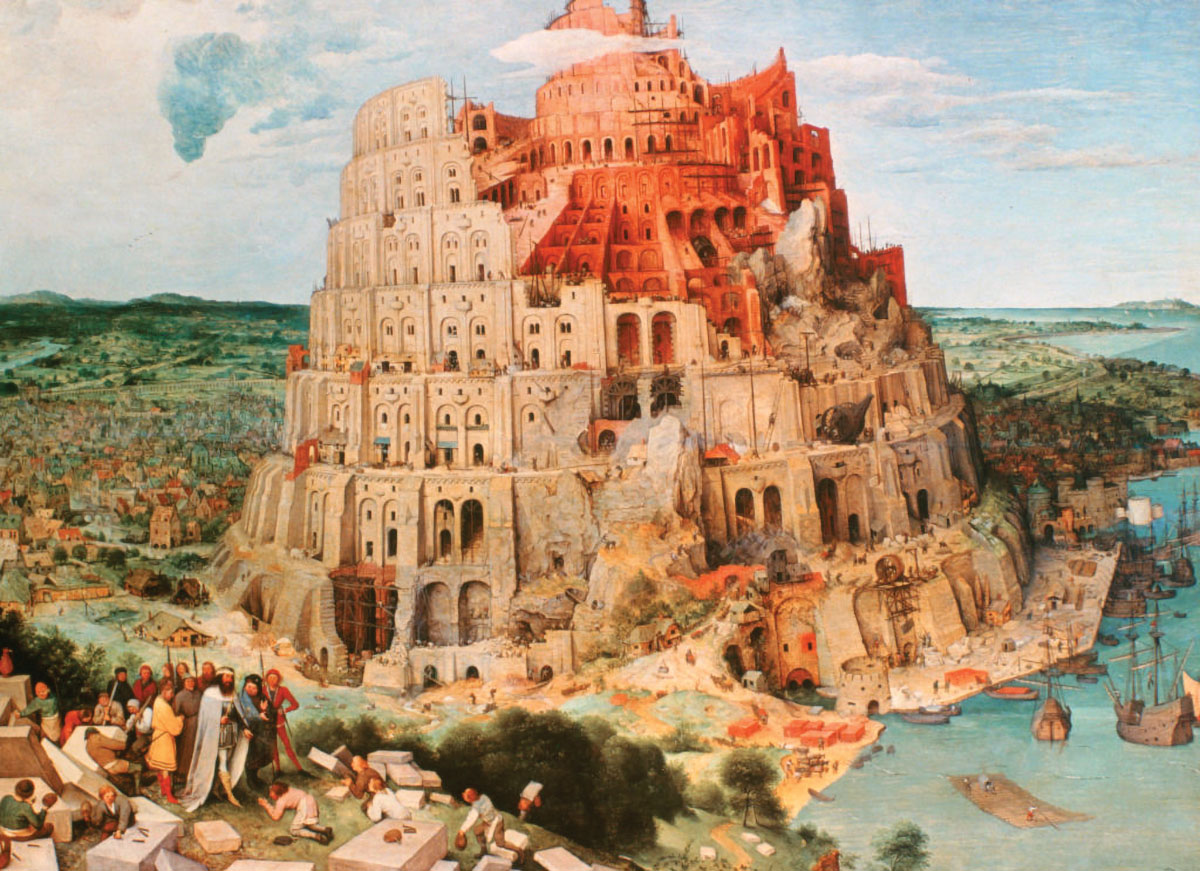
The Tower of Babel story begins, “The whole earth was of one language and of common purpose … And they said, “Come, let us build us a city and a tower with its top in the heavens, and let us make a name for ourselves, lest we be dispersed across the whole earth.”
One could suppose that the people, in desiring to build a tower into the heavens, were being industrious and ambitious. Alternatively, in trying to make a name for themselves, they were full of hubris, seeking their own self-aggrandizement, if not their own self-idolatry.
Additionally, they came together with one language with one common purpose. The idea of a unified people with their own unified vision might sound reasonable, even aspirational. However, who knows what humankind might do if unconstrained in this way? One need only review a little history to know how dangerous this kind of monolithic thinking can be — potentially sowing the seeds of totalitarianism and ultimately tyranny — communism being one of the horrific examples in the modern age.
The story continues, “The Lord descended to look at the city and tower which the sons of man built, and the Lord said, “Behold, they are one people with one language for all, and this they begin to do! And now, should it not be withheld from them all they proposed to do?”
God then finds a solution. “’Come, let us descend and there confuse their language, that they should not understand one another’s language.’ And the Lord dispersed them from there over the face of the whole earth; and they stopped building the city.”
With the building stopped and the people dispersed and the languages confounded, all appears well again. The question remains — why did God reach out to Abraham?
There is another important aspect to the story. Let’s remember that the story is about the people building a structure, an edifice for how they wanted their city to look — in effect, what they sought as a societal outcome.
Yet, there’s no indication in the story about how they were governing the building of the tower, how they were governing the city, what sorts of laws they were following, or even if they were following any laws. It’s as though doing what was right and just was not even a consideration.
There’s a rabbinic legend, from Pirkei DeRabbi Eliezer, that laments their thinking. It surmises, “If a man fell and died, they paid no heed to him, but, if a brick fell, they all sat down and wept, and said: ‘Woe is us! When will another one come in its stead?’”
As a reminder, no reason was given at the outset for why everyone came together in the first place to build the tower. It’s as though it was inevitable, as though it was a natural human inclination to think monolithically, to focus on some unified vision, with a grand societal outcome — without any focus on doing what is right and just.
One should note that what is right and just pertains to individual actions, not to particular outcomes. For example, Torah commandments — like “do not steal,” “do not gossip,” “do not favor the rich or the poor in matters of justice” — all pertain to right and just action, not to outcomes.
One should note that what is right and just pertains to individual actions, not to particular outcomes. For example, Torah commandments — like “do not steal,” “do not gossip,” “do not favor the rich or the poor in matters of justice” — all pertain to right and just action, not to outcomes.
One should also note that desired outcomes will not necessarily be aligned with right and just action. In fact, they’ll often conflict. For example, trying to achieve a certain economic outcome like economic equality will inevitably entail “legal plunder,” as the French economist Frédéric Bastiat named it — i.e., theft, which is not right and just action.
Incidentally, many who’ve thought monolithically with grand societal outcomes in mind, like the Tower of Babel generation, have often singled out the Jews as those who’ll be in the way. As Dara Horn said in a recent podcast, referring to the Jewish tradition as anti-tyrannical, “When you have an anti-tyrannical movement, it pisses off tyrants.”
Many who’ve thought monolithically with grand societal outcomes in mind, like the Tower of Babel generation, have often singled out the Jews as those who’ll be in the way. As Dara Horn said in a recent podcast, referring to the Jewish tradition as anti-tyrannical, “When you have an anti-tyrannical movement, it pisses off tyrants.”
Human beings are fraught with many inclinations, some good, some bad, including the desire for particular societal outcomes, grand visions, monolithic ones — exemplified by the Tower of Babel — not guided by Godly right and just action. God came up with a solution — reaching out to Abraham to establish a new covenant with a new people with laws and commandments to be taught to our children to keep the way of God to do what is right and just. While the story of the Tower of Babel is short, its message is huge.
Curt Biren, an investment advisor in LA, has written for First Things, Religion & Liberty, The American Mind and the Journal of Markets and Morality.