Many travelers come to Portugal for the light on the Tagus, a warm pastel de nata, and a glass of something from the Douro, and they go home happy. But there is a second Portugal folded inside the one on the postcards, and once someone shows it to you, you start seeing it everywhere. You see it in a street name in Alfama, in a carved lion above a doorway in a mountain town, and in a sausage hanging in a market in the north.

This is the journey I recommend to clients who have already “done” Europe and tell me they want something with more meaning the next time. It is also the trip I find myself describing over dinner long after I’ve stopped talking about anything else.
My Experience: Walking through the historic streets during my first visit to Portugal felt less like visiting a new country and more like closing a very long circle. I’m mostly relieved I can finally enjoy the famous alheira sausages now that they don’t have to be secretly made with poultry
Why Portugal Is Built for a Cultural Journey.
Long before there was a Portugal, there were people here. The Lusitanians held the hills of the interior, Phoenician and Greek traders sailed into the Tagus estuary, and Rome knew Lisbon as Olisipo. From 711, much of the land became part of Al-Andalus, and the Islamic world left behind irrigation, almond groves and hundreds of words the Portuguese still use every day, including azeite for olive oil and azulejo for those famous painted tiles.

Jews were part of this story from the very beginning. They were present on the peninsula since Roman times and served the crown from the kingdom’s first reign. Portugal was shaped by many peoples and many faiths, and traveling with that in mind turns an ordinary sightseeing day into something you feel.
The country is also compact enough that the whole arc of the story can unfold over a few unhurried days on the road, which means you spend your time with the history itself rather than in transit.

A Few Things Most Visitors Never Learn.
These are the stories my clients bring home and repeat at every dinner party. The first book ever printed in Portugal was in Hebrew. It was a Pentateuch, the Five Books of Moses, completed in Faro in 1487, two years before the first book printed in Portuguese. The only surviving copy now sits in the British Library in London.
The Age of Discovery ran on Jewish science. Abraham Zacuto, astronomer to King João II, produced the tables that let sailors fix their position at sea. Vasco da Gama consulted him before sailing for India in 1497, and within months Zacuto himself was forced to flee the country.
There is a sausage with a secret. In Mirandela, in the far north, the story goes that New Christians who could not eat pork made their own smoked sausages from poultry, bread and garlic so their neighbors would see something hanging in the kitchen. That became the alheira. Historians treat it as a cherished tradition rather than documented fact, and most alheiras today do contain pork, but ordering an alheira de Mirandela is still the most delicious way to meet this history.
For American travelers, the story starts closer to home than you would think. Families who fled Portugal shaped Jewish life in Amsterdam, London and the Americas. Shearith Israel, the first Jewish congregation in New York, founded in 1654, is still known as the Spanish and Portuguese Synagogue.

The Journey, Place by Place: Lisbon, Where the Story Begins.
Start in Alfama, where a Rua da Judiaria still marks the medieval Jewish quarter, and walk down to Largo de São Domingos beside Rossio. A memorial there recalls the massacre of April 1506, and the square now carries an inscription declaring Lisbon a city of tolerance in dozens of languages. Standing there is quietly powerful.
Then visit Shaaré Tikvá, built in 1904 as the first synagogue in Portugal since the fifteenth century. Its main façade faces an inner courtyard instead of the street, because the law at the time did not allow non-Catholic places of worship to face a public road. During the Second World War it sheltered many of the Jewish refugees passing through Lisbon on their way to freedom. Later, in Belém, the monuments of the Age of Discoveries take on new meaning once you know how much Portuguese navigation owed to Jewish astronomers and cartographers.
NONIUS Pro Tip: Visits to Shaaré Tikvá are always guided and must be booked in advance. Tourist visits run only on Tuesday and Thursday mornings, never on Fridays, Saturdays or holidays, and identification may be requested, so have your passport details ready. Book that slot before anything else and build the rest of Lisbon around it. Leave suitcases and shopping bags at the hotel, because they are not allowed inside.
Kosher travelers are often surprised by how workable Portugal is. Lisbon has a small but dependable kosher scene, including a restaurant under the supervision of the city’s rabbinate and a kosher shop and catering kitchen that sends ready meals around the country. Porto has its own kosher deli and an active Jewish community that can tell you what is serving on your dates.
NONIUS can run the entire journey fully kosher, with meals arranged through certified kosher suppliers.
NONIUS Pro Tip: The most memorable kosher meal in Lisbon is not in a restaurant at all. The Jewish Community of Lisbon hosts a Friday night Shabbat dinner at the Shaaré Tikvá synagogue, and visitors can register to join. Registration closes at 6 pm on the Thursday before, so arrange this in advance. For a sit-down kosher dinner, the table we point people to first is Genesis Lisbon at Campo Pequeno 41, supervised by Lisbon’s rabbinate, in a part of the city most visitors never think to explore.
Tomar, Two Communities in One Town.
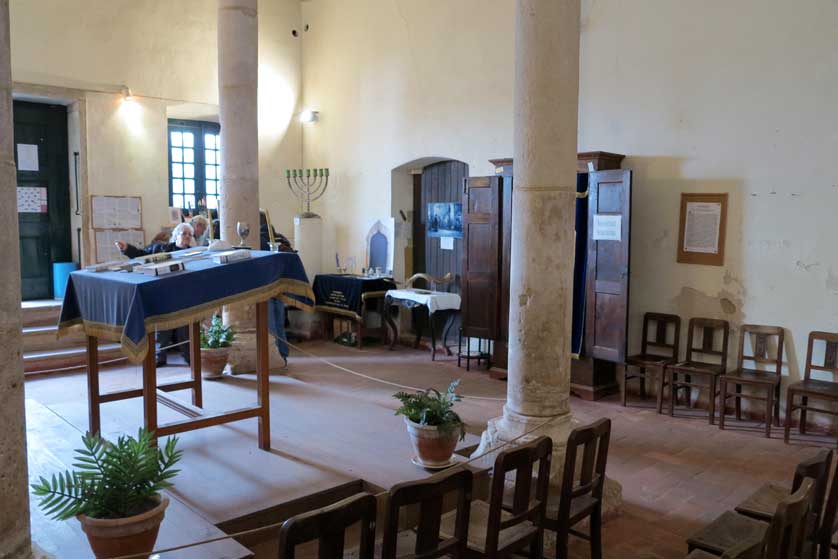
Tomar is famous for the Convento de Cristo, seat of the Knights Templar and later the Order of Christ. A few streets below it stands one of only two medieval synagogues to survive in Portugal, now home to the Abraão Zacuto Luso-Hebraic Museum. Few places show so clearly how two communities once lived side by side.
NONIUS Pro Tip: “See the Convento de Cristo in the morning and the synagogue after lunch. The contrast between the scale of one and the intimacy of the other is the whole point.”
Belmonte, the Heart of the Journey.
Belmonte sits in the hills below the Serra da Estrela, and it is where a community kept its faith in secret for more than four centuries, lighting candles behind closed shutters, marrying within families and passing prayers down by memory. In the early twentieth century a Polish-Jewish mining engineer named Samuel Schwarz brought their story to the outside world. Today the Bet Eliahu Synagogue and the Jewish Museum of Belmonte, the first Jewish museum in Portugal, tell that story in the place where it actually happened.

Nearby Trancoso adds another layer. The Casa do Gato Preto, its façade carved with the Lion of Judah, is believed to have served as a synagogue and rabbi’s house, and the town’s Jewish interpretation center is named for Isaac Cardoso, the seventeenth century physician and philosopher born there to a New Christian family.
NONIUS Pro Tip: If a close friend asked us for one place that explains Jewish Portugal, we would send them to Belmonte. Do not do it as a day trip from Lisbon. Stay the night, pair it with Tomar on the way north and the Aristides de Sousa Mendes Museum on the way to Porto, and the whole arc of the Jewish story falls into place over three unhurried days. Check the Jewish calendar before fixing dates, since synagogues close for Shabbat and the festivals, and the Jewish Museum of Belmonte is closed on Mondays.

Cabanas de Viriato, the House of Conscience.
In June 1940, Aristides de Sousa Mendes, Portugal’s consul in Bordeaux, defied his government and issued visas to thousands of refugees fleeing the Nazi advance, many of them Jewish. He lost his career and died in poverty, and in 1966 Yad Vashem recognized him as Righteous Among the Nations. His family home, the Casa do Passal, opened in July 2024 as a museum filled with original visas, letters, family archives and testimonies from the people he saved.
NONIUS Pro Tip: Visit on the drive between Belmonte and Porto. It sits naturally on that route, and arriving in Porto straight from this house gives the city’s own twentieth century story a different weight.
Porto, Revival and Community.
The Kadoorie Mekor Haim Synagogue, inaugurated in 1938, is the largest synagogue on the Iberian Peninsula and the centerpiece of a movement to bring descendants of crypto-Jews back to open Jewish life. Its art deco complex also houses the Jewish Museum of Porto, and the Holocaust Museum of Porto tells the story of the refugees who passed through the city in 1940 and 1941. Then you finish where every great Portugal trip should, among the vineyards of the Douro Valley.

Kosher wine is a newer chapter of the story, and a happy one. In 2020 the cooperative winery in Figueira de Castelo Rodrigo, not far from Trancoso, released a kosher red made from native Portuguese grapes, with a kashrut supervisor based in Belmonte helping oversee production. In Porto, kosher port is bottled under the Porto Cordovero label, and Douro producers such as Godin now offer kosher whites. Availability shifts from season to season, so if you would like Portuguese kosher wine on your Shabbat table or for a toast in the Douro, I arrange it before you travel.
NONIUS Pro Tip: For a relaxed lunch between the old Jewish quarter and the synagogue, Le J on Rua de Vale Formoso is a kosher deli that fills a real gap in the city. Beyond that, write to the Jewish Community of Oporto a few weeks before traveling to confirm which kosher kitchens are serving on your dates. Options change with the seasons and the community calendar, and a single email turns a stressful search into a reserved table.
The Alentejo.
In the white towns of the south the Jewish past is quieter but still present. In Évora you can trace the old quarter’s outline through the historic center, and in Castelo de Vide the medieval Judiaria climbs the hill below the castle to the other surviving medieval synagogue. Hilltop Monsaraz, above the Alqueva lake, makes a gorgeous final stop.

NONIUS Pro Tip: For travelers staying in apartments or moving around the country, KosherIN Portugal on Rua do Salitre in Lisbon is the quiet workhorse of kosher Portugal. It is a shop and catering kitchen that supplies ready meals from north to south, which is exactly what makes a road trip to Tomar or Belmonte workable for an observant family.
Why I Trust NONIUS With This Journey
A trip like this lives or dies on access, and that is exactly why I partner with NONIUS DMC. They are a Portugal-based destination management company that specializes in culturally and historically grounded journeys, and their Jewish heritage programs are designed by their own team rather than pulled from a catalog.
Much of Jewish Portugal is invisible from the street. You can walk past a medieval synagogue or a carved doorway and never know what you are looking at. NONIUS opens the doors that matter: a walk through the old quarter with a member of the community, a conversation inside a synagogue, a meal shared at a community table. In their own words, “We do not sell destinations; we build access.”
That shows up in the details I care about as a travel advisor. Their journeys include community guides in Belmonte and Porto and a shared evening with the Belmonte community. Every program can be adapted to the Jewish calendar, and fully kosher versions are available, with meals arranged through certified kosher suppliers. They know which days the synagogues welcome visitors, which kosher kitchens are serving in a given season, and how to pace a route so the story unfolds in the right order. That is the knowledge behind the tips throughout this piece, which come straight from their team.

How We Plan This Trip for You
The signature itinerary is NONIUS’s Jewish Heritage Portugal, The Sephardic Journey: ten days and seven chapters from Lisbon’s medieval Judiaria through the Alentejo, Tomar and Belmonte to the Sousa Mendes Museum, Porto and the Douro. It includes a private specialist guide throughout, community guides in Belmonte and Porto, and a shared evening with the Belmonte community. That evening is the part I expect you’ll be talking about for years.
If you have less time, there is a six-day In the Footsteps of Sepharad, a three-day Lisbon, Sintra and Tomar route, a full day of Jewish Lisbon, and a walking experience through the city’s Jewish quarters. You don’t need to be Jewish to fall in love with this trip. It is made for anyone curious to understand a country from the inside. You can read more about immersive travel in Portugal here.
So much of this journey depends on access, such as limited synagogue visiting hours, Shabbat dinner registration and community guides, so the travelers who plan early get the experience at its best. If Portugal has been on your list, this is the way to see it.
 This is where the trip actually comes together. NONIUS DMC, Portugal’s destination specialists, hold relationships with venues in every region and a full bench of trusted suppliers (planners, photographers, florists, musicians, private drivers), with one point of contact who stays with you from your very first question throughout the journey.
 Next Steps: You book with me. I’ll help you choose the region, the season, and the shape of the week, and then NONIUS finishes the trip, guiding you and every guest through it on the ground in Portugal, so nothing is left to chance and nothing falls on you. A trip, not a night. An experience, not a venue. Let’s start planning it. Email me at Contact@luxetravelpartners.com