What is Israel’s election about? Don’t say “it’s the economy, stupid.” Yes, the cost of living is the issue Israelis most often name (21% in a late September survey) as one that will affect their vote. But no party is running in favor of high prices, and there is little evidence that economic performance decides Israeli elections. Menachem Begin was reelected in 1981 amid runaway inflation of his government’s making.
Don’t say security, either. No party is against security. Among the parties that represent the Jewish majority, none opposes forceful action in Iran, in Gaza, in Lebanon. The leaders argue about who would have attacked where, but only because each of them claims that he would have attacked everywhere. Almost no one says that Israel should have stayed out of Gaza, or that it was too aggressive there.
So the pundits fall back on tribes: Israelis vote by habit and find a reason later. The evidence for that is strong. Ask who wants the government’s direction to continue: nearly all who call themselves right-wing do, and none who call themselves left-wing.
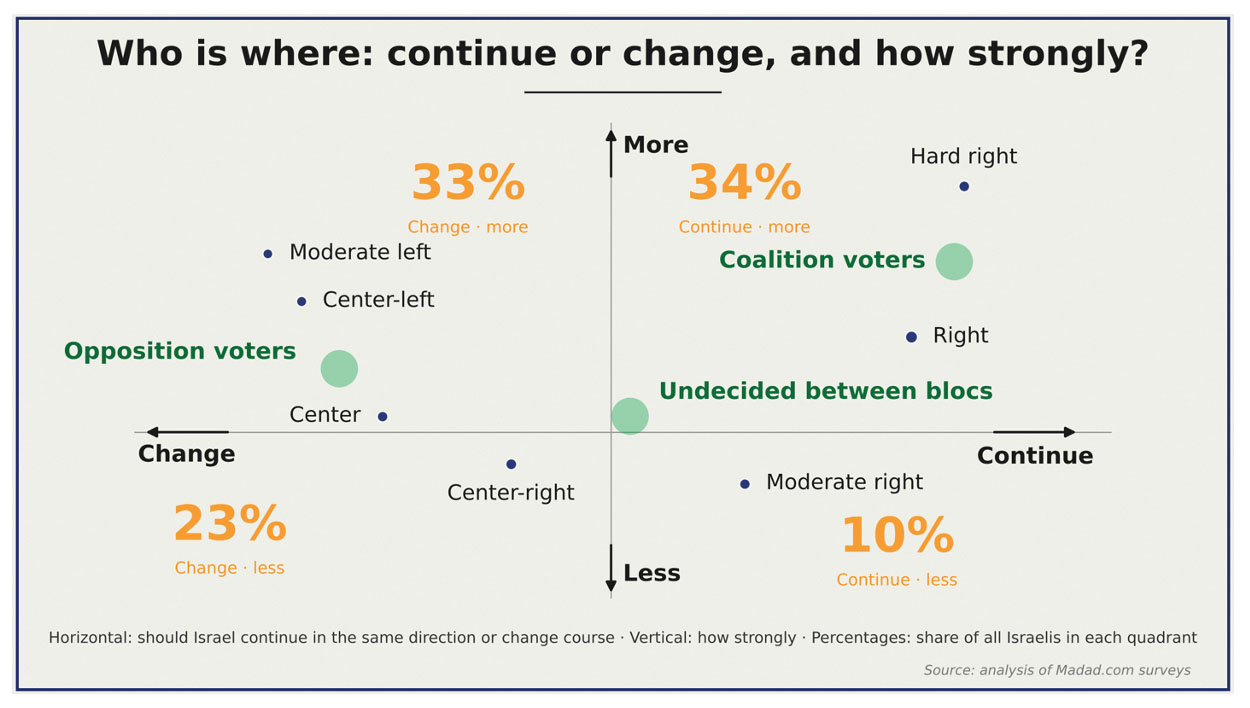
But there is one thing the tribes do not explain: how hard to push. Do voters want their preferred direction full throttle, or with brakes? It is possible — I say possible, not certain — that this is where the election is decided. That 2026 is not a contest between “continuity” and “change,” but between change and change. One camp wants “more”: the coalition’s direction, only stronger. The other camp wants “other”: a different policy. And the voters who may decide between them want something that almost no one offers: less.
To test this, we used polls we already had on the shelf, not a survey designed for the purpose. So treat what follows as an experiment, not a verdict. We scored respondents on two scales. One is direction: continue the government’s actual policy, or depart from it. Twenty-eight questions, on Gaza, settlements, the courts, Netanyahu. The other is intensity, by which we mean one thing: willingness to compromise. Policy my way, or more unity? A coalition of my camp alone, or a broad one? Six questions, on which a right-winger and a left-winger can get the same score.
Among Jewish Israelis, about 42% want the same direction, full throttle. About 29% want a different direction, just as hard. That is seven-in-10 who are in no mood to compromise. The rest are split: 16% want a different direction and are willing to compromise; 12% want the same direction and are willing to compromise. Add Arab Israelis, whom we can place only roughly — nearly all want a different direction — and the two full-throttle camps are about equal, a third of Israelis each. And do not assume that zeal is a right-wing trait. The least compromising voters on our map vote for the left-wing Democrats.
Two real respondents, with invented names, show the difference. Arnon trusts the government and Netanyahu, wants the current coalition back, and wanted to return to fighting in Gaza. Asked to place himself between “policy my way” and “unity,” he chose the far end of “my way.” Galit, on paper, is his twin. She trusts the government, shares the right’s complaint that the legal system “controls the important things,” thinks settlements add to security, and wants the same coalition. But in Gaza she preferred giving the Trump plan a chance to renewed fighting. On the same scale, she placed herself near “unity.” How important is it that policy be what she wants? Three out of 10. And if her side loses? “I respect any decision of the public.”
Galit’s group is the smallest on the map. It may also be the one that decides the election, for three reasons.
First, she stands where the right-wing bloc cracks. Sort Israelis by ideology, and the only groups in which most people lean toward compromise are the moderate right and the center-right. Not the center. Not the left.
Second, she moves. Take those who voted for coalition parties in 2022 and still want the same direction. Among the uncompromising, 11% have left the coalition, for Gadi Eisenkot, Naftali Bennett, Avigdor Lieberman or the undecided column. Among the rest, 20%. The groups are small, but other polls show the same pattern. In July, 66% of the Arnons were completely sure of their vote; of the Galits, 39%. In September, 77% of Likud voters wanted a “full-on” right-wing government; among voters of Ofer Winter’s new right-wing party, most of them former Likud voters, 62% wanted a broad unity government. And it is not fear that moves them. Those who feel that this election is fateful leave the coalition at about the same rate as those who do not.
Third, the other side is not a mirror image. The opposition has its own compromisers, and they hesitate too, but only among opposition parties. They do not cross to the coalition. The opposition offers many parties of “less.” The right offers almost none. A voter who wants Netanyahu’s direction, minus the full throttle, is politically homeless.
So the coalition is losing voters not because they want a different direction, but because they want the same direction, moderated. If we are right, this election will be decided by a right-winger who agrees with her government on almost everything, except how hard to push.
Something I wrote in Hebrew
In Israel, every poll is a beginning of a debate, as citizens attempt to examine the results and decide if the poll is trustworthy. Here’s what I wrote:
Suspicion is the only plausible explanation for this bizarre phenomenon.
We simply do not see this kind of behavior anywhere else. When you take your car to the garage and the mechanic fixes it, you don’t pop the hood to verify that they tightened every single screw correctly. When you go to a restaurant and order a bowl of soup, you don’t march into the kitchen to smell every spice and demand proof that the pumpkin soup is, in fact, made of actual pumpkins.
Yet, when it comes to political polls, everybody suddenly wants to audit the work.
Worse, they attempt to conduct this audit without actually possessing the tools to do so. They are trying to cook the chef’s pumpkin soup without having any pumpkins. They are trying to rebuild the engine without the right wrenches.
A week’s numbers
Change (more!) vs. Change (other!): Another way to interpret Israel’s election (see column on the left-hand side).
A reader’s response
Lior writes: “If the Democrats win this November, Israel is doomed.” My response: The Democratic Party is going to win, this November or in some future November, and Israel is going to have to learn to live with that.
Shmuel Rosner is senior political editor. For more analysis of Israeli and international politics, visit Rosner’s Domain at jewishjournal.com/rosnersdomain.