fbpx

June 5, 2026

Rabbis of LA | Rabbi Bookstein’s Polish Education

A graduate of Ohr Somayach Monsey, Oxford University, Jagiellonian University and the University of Oregon, Rabbi Yonah Bookstein’s scholarly bona fides are beyond reproach. And as a student, he relocated to Poland in the ‘90s with a number of aims in mind, with the Holocaust on top of the list.

“When I got back to the States,” the founder of the Pico Shul said, “I knew I didn’t want to be a philosophy student. I wanted to study Polish Jewry. I was fascinated by the Holocaust. I was fascinated by how Poles and Jews could not get along.”

Combining his ambitions, he was interested in conflict studies. He created his own major at the University of Oregon, “Peace Studies in a Jewish Context.” His goal was to study the conflict in Polish-Jewish relations, before, during and after the Holocaust. “I did that with professors in sociology and anthropology and rhetoric. They had a special program that probably started in the ‘60s or ’70s. About one student every four years managed – that rare – to put together his or her own major, getting it approved/accepted at the Honors College. I had to write a thesis, a 300-page thesis, called ‘The Dictionary of the Kielce Pogrom.’”

This spring, Bookstein published a book “Denial Is a River in Poland,” an expansion of his undergraduate and graduate work on the Holocaust.

“I was absolutely passionate about the subject,” he said. “I went to Poland as an undergrad, did field work. In sociology, there are different kinds of fields. My mentor at the University of Oregon, Dr. Ken Liberman, said that rather than trying to analyze culture from the outside, you have to be part of that society to get to know it. You have to spend time in the community, get to know how people think in their own language and culture. That’s the goal of that kind of study.”

To get a better feel for Polish-Jewish relations, Bookstein hit the Polish streets and interviewed people. This was 1992 in Kielce, a community that became notorious during – and after – the Holocaust. According to Yad Vashem, in July 1946, a Kielce resident filed a police report that his son had been kidnapped by Jews but managed to escape. While the claim was phony, the subsequent police investigation led to a massive outbreak of violence against the Jewish community. Forty-two Jews were murdered and 80 others were injured.

When Bookstein started the project, he didn’t speak Polish, so he had to use translators. “I recorded many interviews, and they are transcribed,” he said. “I started digitizing those tapes, and I hope they will be included in my Kielce Pogrom website that is being published with the book.”

Another advisor at the University of Oregon urged the Detroit native to continue his pursuit, and apply for a Fulbright scholarship to go to Poland and continue his studies. “I did that, and I was accepted,” he said flashing one of his many smiles. So he went to Kraków, site of Jagiellonian University, where they had an intensive Polish language program. He enrolled in their Polish Ulpan to master reading, writing and speaking Polish.

He continued his research and volunteering in the Jewish community in Kraków for the school year of 1993-94. While there he met Jonathan Webber, an anthropology professor from Oxford. The professor told Bookstein, “You are doing interesting work. You should continue at Oxford.” The young man agreed, and after flying from Poland to England, he enrolled in the Oxford Center for Hebrew and Jewish Studies.

Bookstein then thought about where he wanted to take his studies. “I said if I am going to pursue this, I have to know Yiddish. So I enrolled at the Oxford Yiddish Center. I studied Yiddish, cultural anthropology and Jewish Studies at Oxford. I got a master’s degree in Jewish Studies. My thesis was about Poland and the Jewish pilgrimage to Poland. I compared Hassidic and Zionist tours of Poland.”

While studying at Oxford he had begun writing a book about Polish-Jewish relations. “Then I started writing about the Kielce Pogrom as a book, and I wrote my first version of a book on it.” Then a new interest came on the horizon. “I met this great, amazing, amazing girl at Oxford, Rachel Steiner. We hit it off. She came over from Northern California to do her master’s degree in Jewish history. When we met, I said ‘This is clearly why I stayed at Oxford.’ I was smitten. We dated, got engaged and we married in June 1996.”

It’s been 30 happy years and four children for the onetime campus rabbi at Long Beach State and UC Irvine and leader of JConnect & Jewlicious in LA.

The next decision after marrying was to relocate. The Booksteins moved to Israel. But the Ronald S. Lauder Foundation “really needed our help in Poland,” he said. “Rachel offered to check it out. We started commuting from Israel to Poland. The reason we moved to Israel was – we were both observant Orthodox Jews, but our Jewish knowledge was pretty poor.

“We would go sit and learn for a year, and the Lauder Foundation would hire us to go to Poland six times a year. We commuted back and forth for two years, and we moved there in 1998. My work on the Kielce Pogrom just took a backseat.”

Bookstein retained all of his files, and thought about finishing his book, but he had become more interested in Jewish communal work. There was a very practical reason for shifting the interests in his life: “It’s depressing writing about pogroms and antisemitism,” he said. “I had done it for a bunch of years. It’s a painful subject.”

But what about the Holocaust survivors he had been focused on? He said they remained central to the rabbi and rebbetzin. “While we were [in Poland] to help Jewish Communal Renewal, a major part of that was tending to survivors – in helping to create community for them – minyanim and programs,” said the rabbi. “We had a café in the Lauder Foundation in the building we managed. We had daily programming while providing kosher supervision in the Joint Distribution Committee soup kitchen where any elderly Jew could come in – and they did.”

Rabbis of LA | Rabbi Bookstein’s Polish Education Read More »

Rabbis of LA | How Rabbi Bookstein Discovered His Life’s Work

Community outreach has long been important to Rabbi Yonah Bookstein. But sitting in his modest upper-story office on Pico Boulevard, the founder of Pico Shul offers no hint of his extensive background.

How does the rabbi see his career? “I’m at an amazing point,” he said. “I have been in Jewish communal work for more than 30 years. I started working with the Jewish community in Poland before I was officially a rabbi. I started working as a volunteer when I was a graduate student. I had a Fulbright Fellowship in Kraków, and when I was at Oxford, I used to go back and forth to Poland. I lived there as a Fulbright [Scholar].”

One of the friendliest rabbis you’ll ever meet, you feel as if you have known him for years, before you take a seat. Engaging and passionate, he was attracting Orthodox crowds to Pico Shul before COVID.

But the story he wants to tell is from his past, when he was attending University of Oregon (“Not many Jewish boys from Detroit end up at the University of Oregon,” he joked).

He was off to Israel in 1990 for his junior year abroad. “In the spring of ’91,” he said, “I went to Turkey and Hungary as a representative of the Zionist youth movement from Israel to help work with youth groups there. Since I was going to Europe anyway, I said ‘Oh, I should go see where my grandparents are from.’”

To this day, he can’t say what inspired him to go. “I had a buddy in Detroit whom I had grown up with who also had a grandfather from Poland,” and they decided to meet up in Warsaw in June 1991. “That trip changed my whole life.” They ended up going to Łożma, the town in northeastern Poland where his grandfather had grown up.

“The Pope showed up in town on the same day. It was the craziest thing. As we were trying to get there, the train was packed, the bus was packed. Pope John Paul was making his first visit. It seemed as if there were a million people there to see the Pope.”

Bookstein and his friend went back to Warsaw, where his friend decided to move on. “I wanted to stay for Shabbos,” he said. “I met young Jews in Warsaw who were putting together Shabbos meals in the basement of the Jewish theater. And so I had Shabbos dinner with them.”

He was in for a shock. “My mind was blown,” he said, “because I had been told everyone (Jewish) is dead. No Jewish life. I had a black-and-white picture of Poland. But now I was getting a very different perspective. Young Jews are there. And they are interested in their Jewish roots. I was very passionate about it.”

Bookstein ended up spending three weeks with his new friends in Warsaw and Kraków. He also went to Lublin, “meeting all kinds of interesting people interested in Jewish things. There was a whole post-communist euphoria … about everything. One was about discovering people’s roots – Jews and non-Jews.”

The lure of Poland was so strong that Bookstein’s wife joined him there in 1996, following their marriage. “So we started to commute from Israel, and we moved there in ’98,” working as director of the Ronald S. Lauder Foundation, spanning his 10-year commitment to the rebirth of Polish Jewry. “Although I still wasn’t a full rabbi – I had studied. I had a lot of knowledge under my belt but hadn’t finished all of my smicha studies – but they needed us to run the Lauder Foundation.”

He cut short his studies and moved to Poland in ’98, where he spent four years. Then he moved to New York where he finished his rabbinic studies. But “while we were in Poland, I was basically an acting rabbi – I did funerals, I worked on kashrush and education for the Lauder Foundation.”

He had a good background for it, he said. “I grew up going to Jewish day school, very traditional, in Detroit. There’s not really an equivalent today in LA, but we had Shabbos and Pesach. We were traditional. Thank God. In college I was much more interested in learning all about different streams in Jewish life, from Hassidic to Reconstructionist. I was fascinated.”

Next came two life-changing introductions. “I met Rabbi Shlomo Carlebach my freshman year in college, and I had a great Hillel rabbi, Rabbi Hanan Sills (z”l). He opened my mind because I came to college quite down on the (Conservative) Judaism I had experienced growing up in Detroit.”

Detroit, he said “was just not inspiring … I might have learned or done a lot, but I was not inspired by it. Rabbi Hanan, one of the founders of Jewish Renewal, and Shlomo Carlebach, they kind of opened my eyes to the possibility Judaism is inspiring, meaningful, contemporarily relevant, more than I had experienced as a kid. Rabbi Hanan was incredible. He had gotten arrested with Martin Luther King in St. Augustine, Fl. Terrific, wonderful man.”

Fast Takes with Rabbi Yonah

Jewish Journal: Your favorite form of relaxation?

Rabbi Yonah: Walking in nature, a quiet Northern California beach, in the Redwoods, walking through forests and valleys in Scotland.

J.J.: Your favorite Shabbat moment?

Rabbi Yonah: Singing Shabbat songs at the table with my kids.

J.J.: Do you have any unfulfilled goals?

Rabbi Yonah: I’d like to have a plum orchard.

Rabbis of LA | How Rabbi Bookstein Discovered His Life’s Work Read More »

Rabbis of LA | A Deep Dive into Sound Baths with Rabbi Aaron

Rabbi Jonathan Aaron, leader of Temple Emanuel of Beverly Hills, is a fairly recent convert to the world of sound baths, and this week he describes some intricacies of leading the exercise.

When a crowd is involved, is it important how they are arranged?

“No,” he replied. The people themselves need to be comfortable. “Sound bath is a little different because we lie down on the ground. We put down yoga mats. People lie down on their backs, close their eyes, and that is it.”

He doesn’t give any directions about your breath or anything else. “We are just listening to the sound. We start with a niggun. Our bodies start to vibrate a little bit while listening to the niggun. We sing together. Usually there is a theme I introduce.” During Pesach, the theme was “Try to find those places in your life where you are feeling narrow. How can we help ourselves come out of those narrow places into open space?”

For the sound bath, he explained, people can sit if they want or lie down. “There aren’t a lot of rules because you don’t want people to feel badly that they are doing it wrong. There is no way to do it wrong.”

Rabbi Aaron was introduced to this world by his yoga instructor wife and his two yoga-loving daughters. He explained the difference between a mindfulness meditation and experiencing a sound bath. “Meditation you can do alone or with groups,” the Boston native said. “But it’s more of an internal thing that’s happening with no external influences.”

A sound bath, on the other hand, is all about outside influence. Renee Noa Harris – who does TEBH’s sound bath –uses a combination of three different sounds.

“She uses crystal bowls, which are like whoooooooo (an upper sound). You can feel the vibration inside of your head. It is a most incredible feeling. Renee sits down in front. She has bowls arrayed around her so she can reach all of them. Sometimes she hits them with a mallet around the edge. The sound it makes is incredible.”

When those sounds begin to fade, he said, “she goes over to a very large gong behind her. I start a little speaking just to get people to thinking. When she goes over to the gong, the sound is different from what you have heard before. The gong, he admitted, “agitates my body a little bit. But I want that. You are feeling like your body is moving.”

When the gong rings “there is a layer of sound that I don’t know how to describe … There is a sound up here, a higher register, then there is this rumbling underneath, and it’s all happening at the same time.” This goes on for about 10 minutes. “She used to have a smaller gong, and I would take that and bang it while going over people, over their heads, one at a time. One person was, like, ‘No, I don’t want that.’

“Then Noa Harris returns to the bowls. There’s no speaking. Next is an ocean drum, a wide drum, probably 16 inches across, that has little pellets in it. She tilts it back and forth so that the little green pellets move around. It sounds just like ocean waves.”

The rabbi’s voice softens when he describes Noa Harris walking around the room, elevating the sound over the crowd. Then, he said, “she will bring it back to the sound of the bowls. It’s okay, like make your way slowly up to a sitting position.” By that time, the rabbi is seated, holding his guitar.

“Next is Havdalah, and she kind of finishes up. I have kind of changed [the late] Debbie Friedman’s Havdalah. It’s just kind of an even, mellow (slowly paced) version of it,” and tries to incorporate the symbols into the things people are talking about.

“How can you find joy when you are stuck? Where can you find sweetness? What’s keeping you from finding the sweetness? From finding the light?”

Since the pandemic Rabbi Aaron was doing Havdalah online. “It’s my wife and me, sometimes my kids, and then we always end with an amazing Israeli song from the ‘70s that says ‘you and I will change the world. People have said it before, but that doesn’t matter. We are going to try and change the world.’ It’s an amazing song. That kind of finishes it up. We are there to help ourselves and then go into the world and help make it better.”

Rabbi Aaron’s voice turned even softer. “In the last several years,” he said, “we really have been thinking about what we want to bring to people. Jewish spiritual expression I think is something people desire but they don’t know where to go for it.

“We were hoping that by doing this kind of sound bath, more meditation, more mindfulness, that people could find another entrance into Judaism from things they already are doing.” He turned to his daughters, asking how are they finding their spirituality, and how we can incorporate Jewish elements into that part of spirituality? “Then you have the Institute for Jewish Spirituality, which is bringing mindfulness into the Jewish discourse. Those two things came together very nicely.”

Typically, he said 25 to 35 people attend the sound bath. Who are they? The answer surprised the rabbi.

“Originally, I thought this was going to be all young people,” he said. “Eighty-year-olds are coming to this. There’s 30-year-olds, a couple 24-year-olds. People bring their friends.” It’s funny, he said. “A lot of people react as if – bath? Am I going to get wet? – it just seems weird.”

But what persuaded Rabbi Aaron? Both his daughters said he should try this because they think he would like it. “They started the sound bath stuff. I already had done the mindfulness and meditation. They do go hand-in-hand, but the sound baths usually come out of yoga studios.”

And the first time he went, “I thought this is amazing, amazing. So open. So peaceful. That is what I want a synagogue to bring to people.”

Rabbis of LA | A Deep Dive into Sound Baths with Rabbi Aaron Read More »

Faith in the Foxhole

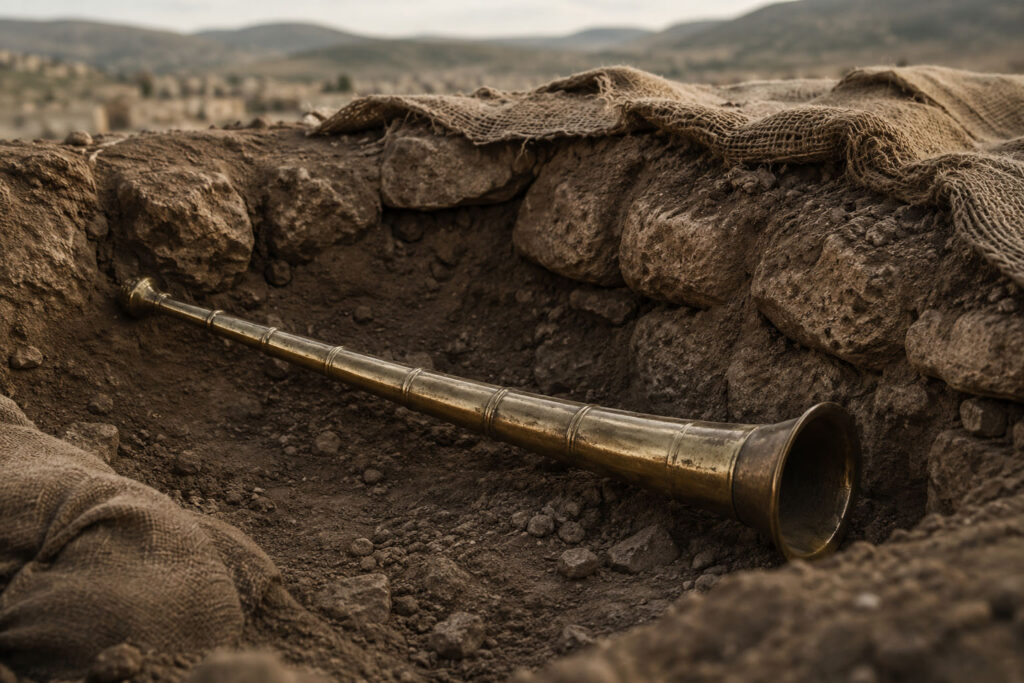
In his book Musical Instruments of the Bible, Jeremy Montagu explains that the trumpet is “the one musical instrument in the Bible which we can identify with absolute certainty from the prescription of how it was to be made…” They were made of “hammered silver.” Josephus describes them as being “composed of a narrow tube, somewhat thicker than a flute, but with so much breadth as was sufficient for admission of the breath of a man’s mouth: it ended in the form of a bell, (i.e., flared opening) like common trumpets.” And this is how the trumpets are depicted on the Arch of Titus and on coinage from the Bar Kokhba era.

Montagu and many others note that the biblical trumpets seem very similar to two trumpets, one silver and one bronze, that were discovered in the tomb of Pharaoh Tutankhamun. These Egyptian trumpets are from roughly the same period as the Exodus and are symbols of royalty.

Remarkably, this dovetails with what several commentaries say about the Torah’s trumpets. The Midrash Tanchuma explains that they indicate Moses was a king, and God tells Moses to make the silver trumpets “so that they may be sounded before you like before a king.” Don Isaac Abrabanel adds that “they should be made of silver and not of another metal, out of honor for Moses, for it is the way of kings to have them made [of silver].”

The fact that the Torah’s trumpets are nearly identical to Tutankhamun’s is unsurprising; the Torah borrows from a culture that the Israelites knew well. But this borrowing is also subversive; these trumpets declare that the Israelites have a new king, Moses, and are no longer subjects of Pharaoh.

In the desert, Moses used the trumpets to assemble the leaders and the people, and to indicate that they were about to travel. But the Torah (Numbers 10:9-10) adds the following commandment for future generations:

When you go to war in your land against the enemy who oppresses you, then you shall sound an alarm with the trumpets, and you will be remembered before the Lord your God, and you will be saved from your enemies. Also in the day of your gladness, in your appointed feasts, and at the beginning of your months, you shall blow the trumpets over your burnt offerings and over the sacrifices of your peace offerings; and they shall be a memorial for you before your God.

The trumpets were used to sound the piercing, broken cry of the teruah when going into battle; they were used as well for the comforting, continuous sound of the tekiah while celebrating in the Temple.

After the destruction of the Temple and the loss of Jewish sovereignty, the trumpets no longer served any purpose.

The trumpets have disappeared from Jewish practice; but their influence lives on. Maimonides explains the trumpets were not just for times of war; they were sounded on fast days for drought and other calamities. He writes that:

It is a positive Torah commandment to cry out and to sound trumpets in the event of any difficulty that arises which affects the community…Whenever you are distressed by difficulties, such as famine, plague, locusts, or the like, cry out because of them and sound the trumpets.

Maimonides then offers a theological reason for the trumpets:

This practice is one of the paths of repentance, for when a difficulty arises, and the people cry out and sound the trumpets, everyone will realize that the difficulty occurred because of their evil conduct….

The purpose of sounding the trumpets is to awaken the hearts of the people to repent and be worthy of God’s providence and salvation. Maimonides offers a similar reason for the shofar of Rosh Hashanah as well.

The Sefer HaChinuch takes this idea a step further and explains:

…At times of trouble, a person needs great focus in his prayers before his Creator, ….we are therefore commanded to sound the trumpets at these times, for man is inherently physical, and he requires a great deal to awaken him to these things….. And there is nothing wakes one up better than the sounds of music, as is well-known, and all the more so the sounds of trumpets, which produces the loudest sound of all musical instruments.

To Maimonides and the Sefer HaChinuch, the trumpets are a wake-up call. In times of trouble, they call upon us to pray and repent.

Maimonides adds that the rabbinic practice of declaring public fast days in response to calamity is based on the mitzvah to sound trumpets. Just like the trumpets, fasting shakes up the soul and inspires one to repent.

Nachmanides takes a very different view. He explains that the obligation to sound trumpets may be the foundation of Jewish prayer.

Nachmanides takes the bold view that there is no Biblical commandment to pray; one can and should pray to God; but there is no explicit commandment to do so.

However, Nachmanides admits that there is one situation when prayer is a biblical obligation: during times of distress. Nachmanides explains that the call of the trumpets is a cry for divine help, much like prayer in a time of distress.

He writes:

…We should pray to Him in times of distress, and that our eyes and our hearts should be directed toward Him, like the eyes of servants toward the hand of their master. This is the meaning of the verse, ‘And when you go to war in your land against an enemy who oppresses you, you shall sound the trumpets, and you shall be remembered before the Lord your God’ (Numbers 10:9). This is a commandment that, when a calamity comes upon the community, they should cry out before Him with prayer and with the sounding of the trumpets.

At first glance, this view seems odd. Faith in times of crisis is inherently suspect; desperate people will try anything. The saying that “there are no atheists in foxholes” highlights how hollow a religious conversion under fire is. To turn to God only because you need something seems a tad insincere.

Some mystics denigrated the sections of the prayer where we ask God for help precisely because of this problem. Rabbi Joseph Soloveitchik notes that “mystics and philosophers …alike considered petitionary prayer an unworthy part of the service, a remnant of magical religion, when the savage bartered with his gods and tried to reach a quid pro quo deal with them.” Rabbi Dov Ber, the Maggid of Mezerich, expresses it directly: “one should be ashamed and not pray for that which his body lacks.”

In prayer, one should simply commune with the divine; to take that time to ask for petty human needs is crass.

Nachmanides attacks this perspective and defends the faith found in foxholes. We imagine that faith is built on grand visions: on contemplating the vastness of the universe, and searching for what comes before and what stands above.

But faith more frequently arrives during a crisis. When we are broken and worried. When we are alone. When we recognize we are simply dust and ashes.

At that moment, life seems absurd.

And the only thing left that can redeem man is faith.

The Lubavitcher Rebbe would emphasize that when one has faith in God, they are never alone. And that faith has given strength and comfort to Jews during the worst moments of exile.

In the tunnels of Gaza, many of the hostages learned this truth firsthand; and that is why they turned to faith. They would tell you it was not the superficial faith of those looking for a quick fix; it was because the crisis of captivity forced them to rethink their priorities and search for meaning and purpose.

Eli Sharabi spent 491 days in captivity. Hamas murdered his wife, Lian, and daughters, Noya and Yahel. He described his spiritual journey this way:

I came from the darkest place in the world–50 meters below ground. What gave me strength was saying ‘Shema Yisrael’ every morning. Every Friday night, we tried to make kiddush. We didn’t have wine, so we used water. Faith is what kept us alive.

Faith in the foxhole is the recognition that with faith, you are never alone.

And from the wail of the royal silver trumpets to the crying prayers of the brokenhearted hostages, this faith has kept us alive.


Rabbi Chaim Steinmetz is the Senior Rabbi of Congregation Kehilath Jeshurun in New York.

Faith in the Foxhole Read More »

Jerusalem: A City that Defies Description

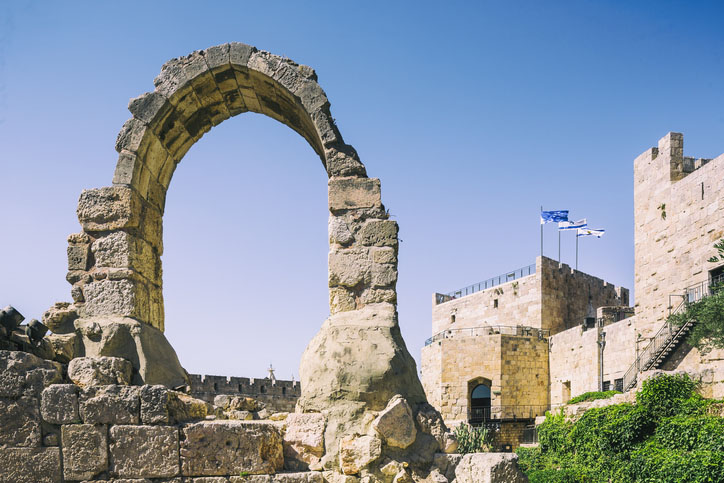
The Tower of David, located near the Jaffa Gate entrance to the Old City of Jerusalem, is one of those museums that is not designed for control freaks.

You wander around ancient structures, discover stairs that can lead you astray, stroll down random pathways that lead to other ancient structures. All along, you’re navigating various multi-media “exhibitions” that try to describe a city that can’t be described.

That was my first takeaway from a recent visit: Don’t try to make sense of Jerusalem. Don’t look to “frame” it in a way that will make it easier to digest.

Jerusalem is not meant to be digestible. It’s meant to confuse, arouse, marvel, complicate, stimulate … did I mention confuse?

For about an hour or two, you’re asked to absorb centuries upon centuries of kings, armies, religions and empires taking turns trying to control the center of the world.

Your mind spins.

When was the Mamluk period again? Did it come before or after the Ottoman empire? How about the Hasmonean, Herodian, Byzantine and early Muslim periods? Which ones got destroyed by the Crusaders? Remind me again how long the Jews were in control? And how did they get all that water up the forbidding mountain?

The history overload is blessedly interrupted by moments of easy pleasure, like a stunning film montage showing a modern Jerusalem as a welcoming home to the world’s three monotheistic religions. It almost makes you forget how they were at each other’s throat for millennia.

Maybe that’s why Jerusalem can be such a confusing experience. It’s not just the impossibly complicated history – it’s also the stark contrast with today.

A few minutes from the Tower of David, for example, is the Mamilla promenade that features retail jewels like Dior, Pierre Cardin, Nike, Tommy Hilfiger, Guess and Rolex. You might as well be on Rodeo Drive.

A foreign tourist might be astonished by the presence of so many Israeli Arabs happily strolling down Mamilla and enjoying the cafes and restaurants. It’s a Jewish state, after all, but Arabs attract no special attention. They fit right in.

Given that my eyes travelled so quickly from ancient Biblical stones to modern Mamilla stores, it was tempting to look at Jerusalem’s tortured history and say, “Who cares about the past? What matters is that today things seem to be OK.”

Well, yes, they do. To walk in today’s Jerusalem is to witness people from around the world, whether Jewish, Christian or Muslim or Ethiopian, Russian or Moroccan, and thinking, “Yes, things seem to be OK.”

Of course, we know things are never OK in this war-torn nation. The threat of violence is never too far away. Enemies of peace still dream of conquering the city. The bomb shelters are always at the ready.

In a way, it makes sense that an ancient city that various tribes fought over for millennia can’t simply transform into an open city that achieves ideal coexistence. As we saw in the museum, the animosities run deep. The dreams and the traumas are bound to linger.

Still, after a few hours at the Tower of David, hearing head-spinning stories about this indescribable place, it felt therapeutic to walk around and see pleasant things that were rather easy to describe — like Jews and non-Jews just going about their lives.

Shabbat shalom from the center of the world.

Jerusalem: A City that Defies Description Read More »