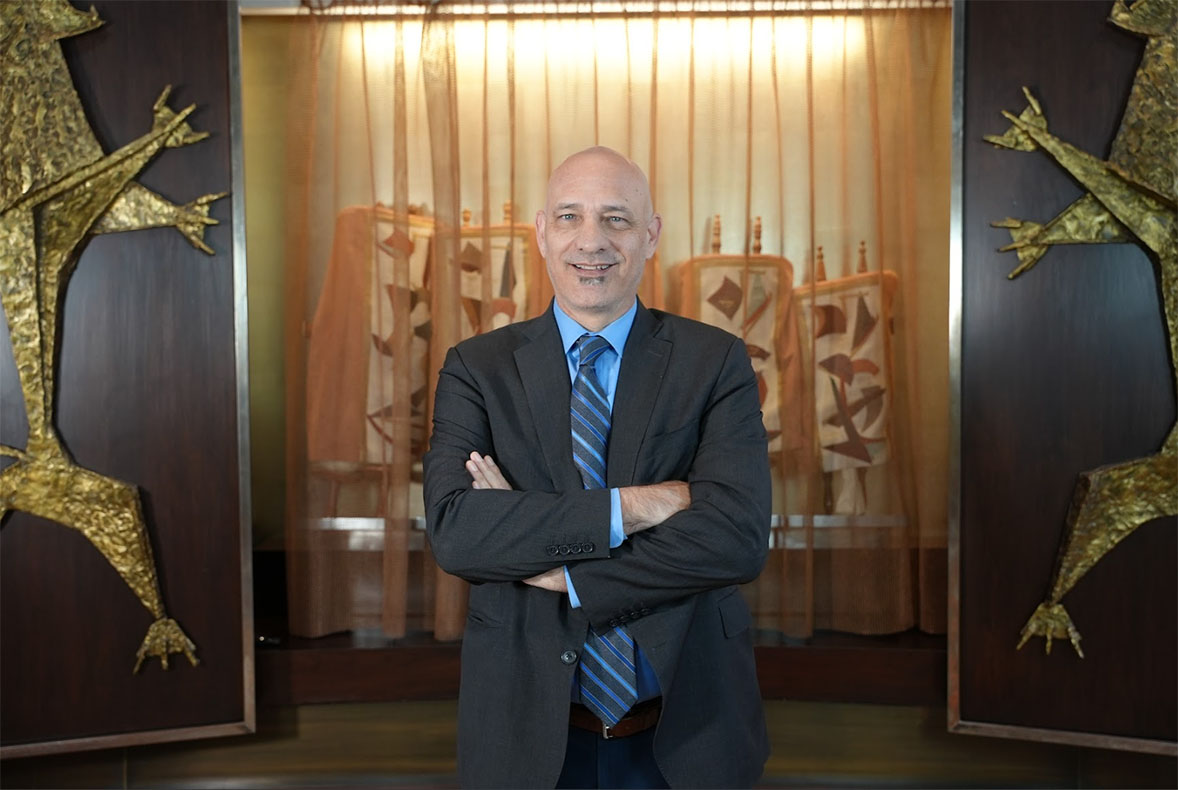
Rabbi Jonathan Aaron, leader of Temple Emanuel of Beverly Hills, is a fairly recent convert to the world of sound baths, and this week he describes some intricacies of leading the exercise.
When a crowd is involved, is it important how they are arranged?
“No,” he replied. The people themselves need to be comfortable. “Sound bath is a little different because we lie down on the ground. We put down yoga mats. People lie down on their backs, close their eyes, and that is it.”
He doesn’t give any directions about your breath or anything else. “We are just listening to the sound. We start with a niggun. Our bodies start to vibrate a little bit while listening to the niggun. We sing together. Usually there is a theme I introduce.” During Pesach, the theme was “Try to find those places in your life where you are feeling narrow. How can we help ourselves come out of those narrow places into open space?”
For the sound bath, he explained, people can sit if they want or lie down. “There aren’t a lot of rules because you don’t want people to feel badly that they are doing it wrong. There is no way to do it wrong.”
Rabbi Aaron was introduced to this world by his yoga instructor wife and his two yoga-loving daughters. He explained the difference between a mindfulness meditation and experiencing a sound bath. “Meditation you can do alone or with groups,” the Boston native said. “But it’s more of an internal thing that’s happening with no external influences.”
A sound bath, on the other hand, is all about outside influence. Renee Noa Harris – who does TEBH’s sound bath –uses a combination of three different sounds.
“She uses crystal bowls, which are like whoooooooo (an upper sound). You can feel the vibration inside of your head. It is a most incredible feeling. Renee sits down in front. She has bowls arrayed around her so she can reach all of them. Sometimes she hits them with a mallet around the edge. The sound it makes is incredible.”
When those sounds begin to fade, he said, “she goes over to a very large gong behind her. I start a little speaking just to get people to thinking. When she goes over to the gong, the sound is different from what you have heard before. The gong, he admitted, “agitates my body a little bit. But I want that. You are feeling like your body is moving.”
When the gong rings “there is a layer of sound that I don’t know how to describe … There is a sound up here, a higher register, then there is this rumbling underneath, and it’s all happening at the same time.” This goes on for about 10 minutes. “She used to have a smaller gong, and I would take that and bang it while going over people, over their heads, one at a time. One person was, like, ‘No, I don’t want that.’
“Then Noa Harris returns to the bowls. There’s no speaking. Next is an ocean drum, a wide drum, probably 16 inches across, that has little pellets in it. She tilts it back and forth so that the little green pellets move around. It sounds just like ocean waves.”
The rabbi’s voice softens when he describes Noa Harris walking around the room, elevating the sound over the crowd. Then, he said, “she will bring it back to the sound of the bowls. It’s okay, like make your way slowly up to a sitting position.” By that time, the rabbi is seated, holding his guitar.
“Next is Havdalah, and she kind of finishes up. I have kind of changed [the late] Debbie Friedman’s Havdalah. It’s just kind of an even, mellow (slowly paced) version of it,” and tries to incorporate the symbols into the things people are talking about.
“How can you find joy when you are stuck? Where can you find sweetness? What’s keeping you from finding the sweetness? From finding the light?”
Since the pandemic Rabbi Aaron was doing Havdalah online. “It’s my wife and me, sometimes my kids, and then we always end with an amazing Israeli song from the ‘70s that says ‘you and I will change the world. People have said it before, but that doesn’t matter. We are going to try and change the world.’ It’s an amazing song. That kind of finishes it up. We are there to help ourselves and then go into the world and help make it better.”
Rabbi Aaron’s voice turned even softer. “In the last several years,” he said, “we really have been thinking about what we want to bring to people. Jewish spiritual expression I think is something people desire but they don’t know where to go for it.
“We were hoping that by doing this kind of sound bath, more meditation, more mindfulness, that people could find another entrance into Judaism from things they already are doing.” He turned to his daughters, asking how are they finding their spirituality, and how we can incorporate Jewish elements into that part of spirituality? “Then you have the Institute for Jewish Spirituality, which is bringing mindfulness into the Jewish discourse. Those two things came together very nicely.”
Typically, he said 25 to 35 people attend the sound bath. Who are they? The answer surprised the rabbi.
“Originally, I thought this was going to be all young people,” he said. “Eighty-year-olds are coming to this. There’s 30-year-olds, a couple 24-year-olds. People bring their friends.” It’s funny, he said. “A lot of people react as if – bath? Am I going to get wet? – it just seems weird.”
But what persuaded Rabbi Aaron? Both his daughters said he should try this because they think he would like it. “They started the sound bath stuff. I already had done the mindfulness and meditation. They do go hand-in-hand, but the sound baths usually come out of yoga studios.”
And the first time he went, “I thought this is amazing, amazing. So open. So peaceful. That is what I want a synagogue to bring to people.”