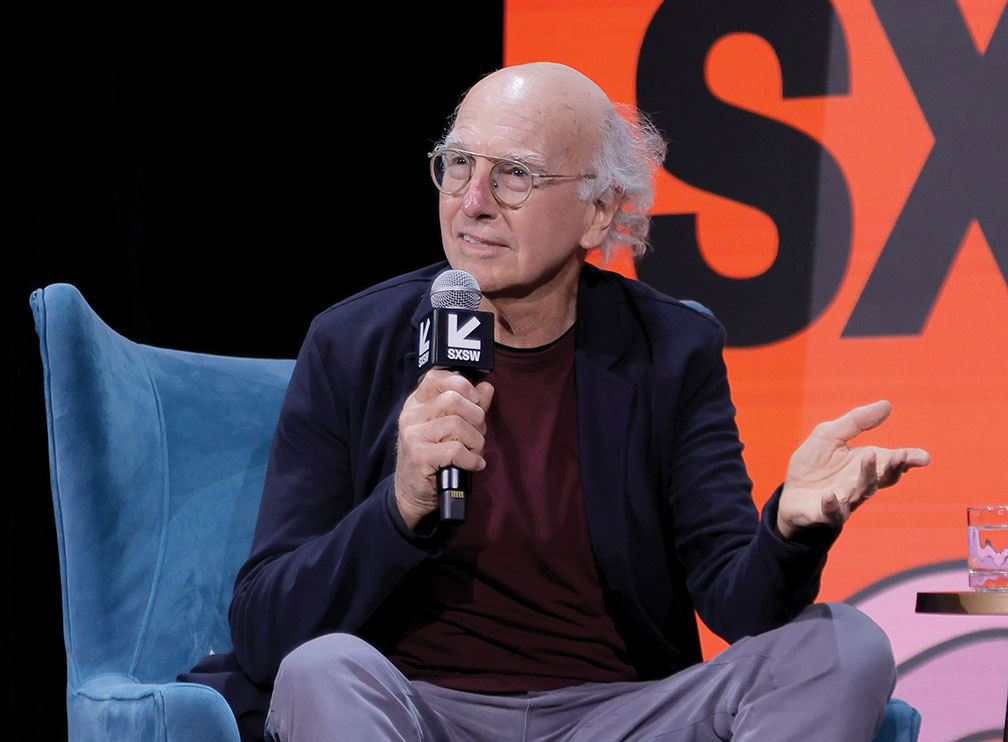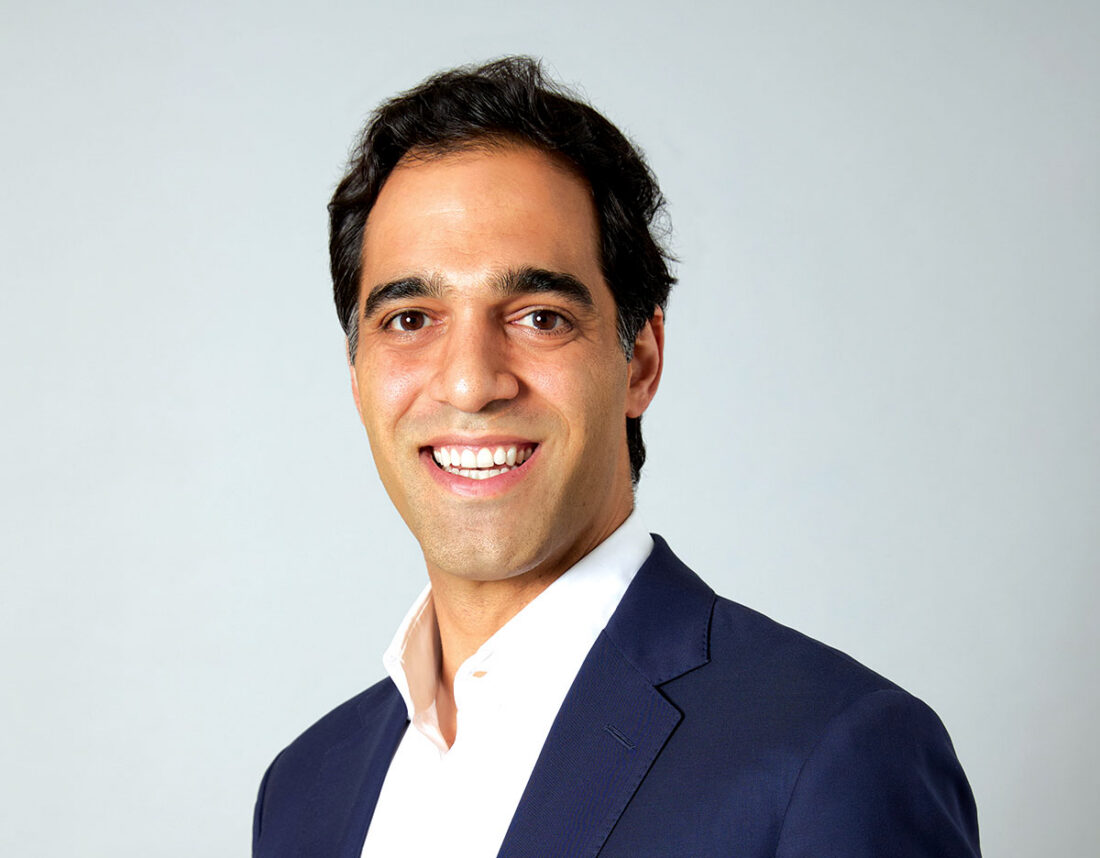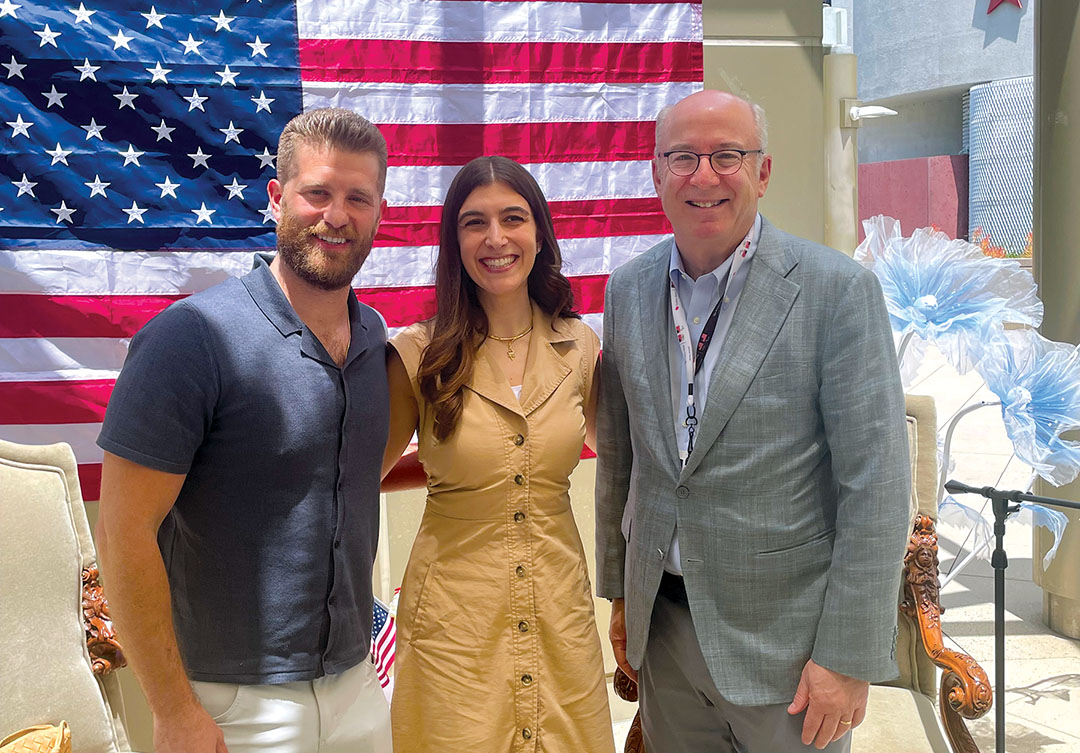
Jonah Platt returned to Cedars-Sinai Medical Center, where he was born 39 years ago and where two of his three children were also born. This time, however, it wasn’t for a baby delivery but for another kind of “delivery” — a conversation about Judaism and what it means to him.
The event, hosted by the hospital’s Jewish Staff for Tradition, Advocacy and Representation (J-STAR), took place on the rooftop of Cedars-Sinai, overlooking Los Angeles. Doctors, nurses and staff gathered on May 28 for an Israeli-style lunch, including cheese and mushroom burekas and a fresh fruit station. For many, it was a welcome pause in the workday — a chance to share a meal while engaging in a conversation about identity, purpose and faith.
This marked J-STAR’s second event overall, with this gathering held in celebration of Jewish American Heritage Month.
Emily Carter, senior major gift officer at Cedars-Sinai, asked Platt – a singer, actor and podcast host – what it means for him to be Jewish. “It’s who I am,” Platt said. “It wraps around how I move through the world and how I identify as a person. I’m a son, father, husband, friend — and I’m a Jew. Those words are tattooed on my arm. It’s a very meaningful legacy to me, both through my immediate family, my parents and grandparents and as a member of this tribe that’s been around for thousands of years.”
In the immediate aftermath of Oct. 7, 2023, Platt became increasingly active as a Jewish advocate online, sharing videos, participating in Q&As and meeting with hostage families. He also stepped into a rapidly evolving public conversation around antisemitism and Jewish identity.
Although he had been engaged in advocacy prior to that moment, he has described Oct. 7 as “the generational occurrence of my lifetime.” In that context, what began as public engagement gradually became more structured. After about six months, he reflected on whether to continue prioritizing acting as before or fully commit to this emerging direction. He ultimately chose to focus his energy on Jewish advocacy and his podcast, “Being Jewish with Jonah Platt.”
In conversation with Carter, Platt emphasized Jewish values and responsibility as a guiding framework that extends beyond formal advocacy into everyday life. “We Jews are told over and over again that we are responsible for everything — for our speech, thoughts, actions, for the widows, orphans, the environment, all of these things,” he said. “And I ask myself: what can I do? If not you, then who?”
That sense of responsibility, he added, is something he actively tries to pass on to his children. In everyday moments such as walking through his neighborhood, he makes a point of picking up litter — not as a statement, but as a habit rooted in example. Over time, he has seen his son begin to do the same.
For Platt, these small gestures reflect a broader understanding of how values are transmitted: not only through teaching, but through observation. Responsibility, in his view, is a lived practice that begins at home and extends outward into the community.
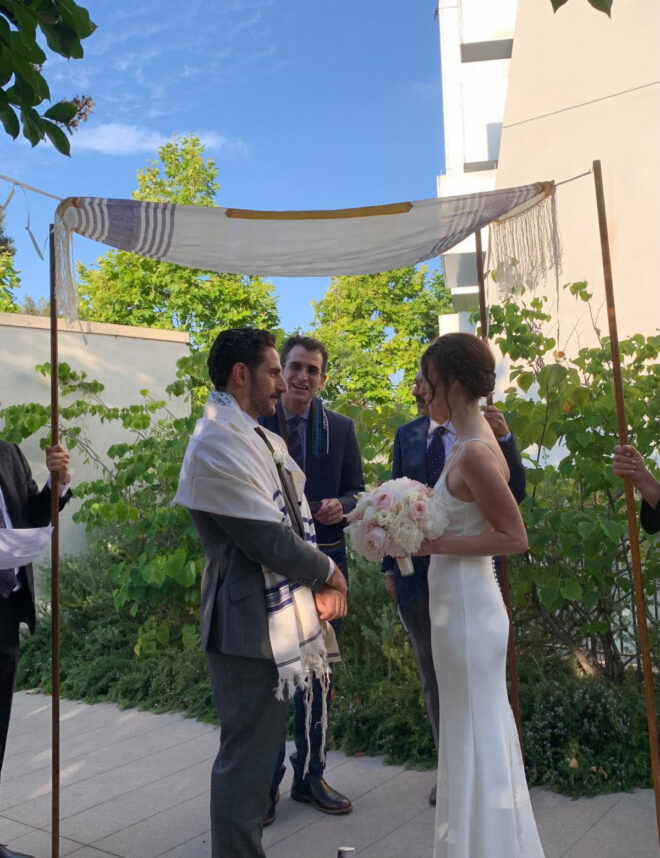
Born and raised in Los Angeles, Platt attended Jewish day school and Camp Ramah. He is the son of producer Marc Platt (“Legally Blonde,” “La La Land”) and former Jewish Federation Board chair Julie Platt. His brother is actor and singer Ben Platt (“Pitch Perfect”). He is married to Courtney Galiano, who converted to Judaism. The couple was married by Rabbi David Wolpe and have three children. Their family life is deeply rooted in Jewish practice and education, with their children attending Jewish day school alongside his nephews.
He spoke with particular pride about watching the younger generation engage with Jewish learning — not only through history and tradition, but also through contemporary cultural expressions such as Israeli music. “I see their enthusiasm when they listen to Israeli songs like ‘Hashem Yitbarach Tamid Ohev Oti’ and Omer Adam’s ‘Tel Aviv,’” Platt said, before breaking into song.
Speaking with The Journal about the broader purpose of the gathering, Carter reflected on how J-STAR has evolved, particularly since Oct. 7. “Shortly after Oct. 7, we came together to be a safe space for Jewish employees and our allies, but also for everybody to feel safe,” she said.
What began as a response to a moment of crisis has developed into an ongoing initiative focused on education, awareness, and community support. J-STAR now organizes programming on Holocaust remembrance, antisemitism and cultural observance, alongside celebratory events such as the rooftop luncheon.

Carter also noted the hospital’s origins, explaining that Cedars-Sinai was founded by Jewish physicians and community leaders who faced barriers elsewhere and created their own medical institution in Los Angeles. That legacy, she said, continues to inform the hospital’s culture of inclusion and service today.
Alongside its cultural programming, J-STAR also addresses practical needs within the workplace, including kosher food access, religious accommodation and scheduling support for employees observing Jewish holidays. Under the leadership of Rabbi Dr. Jason Weiner, the initiative serves as a resource for staff navigating both cultural and religious concerns. “We are one of the many resources at Cedars-Sinai,” Carter said. “People can come to us with their concerns. We make sure they have kosher food, and we help with understanding schedules for those who need time off for Jewish holidays. We want to take care of patients — but we also want to take care of our staff.”