God told Moses to send scouts
to the promised land.
So they knew where it was
this whole time.
They came back like grasshoppers –
not hopping, but small.
The words they said were an evil report.
They almost died of stones.
Egypt started looking pretty good
to the complainers.
This led to the forty-year delay.
They walked and walked until they were dead.
Except for their children who were
now approaching forty years old.
Hardly children anymore.
Except for Moses and Caleb and Joshua –
the oldest of men, the ones who said
we could eat that fruit now, if we want.
We could be dousing our manna
in fig-honey, if we want.
No one thought to say, during the walking, you know, it’s just over there.
Unclear if there really were giants
and fallen angels and Canaanites galore
or if their eyes were just
too small.
Rick Lupert, a poet, songleader and graphic designer, is the author of 29 books including “God Wrestler: A Poem for Every Torah Portion.” Visit him at www.JewishPoetry.net
These past few weeks, I have watched commencement ceremonies at both universities and high schools. The featured content is either the commencement address or valedictorian speech. Sadly, the audience holds its breath from start to finish, wondering if the seemingly pre-approved words will be political, racist, polarizing, and offensive.
My own daughter is graduating from 8th grade. She has spent her fourteen years all within the same synagogue and school. How blessed she is to have an anchor; a strong, Jewish, moral foundation.
Here is the message that I hope she feels and remembers as she continues forward:
We are meant to be learners. Our values guide our path, and our curious, thoughtful questions lead to a greater understanding of who we are meant to become.
Remember the teaching of Rabbi Simcha of Bunim. He always carried two slips of paper, one in each pocket. One said, “It is for my sake the world was created.” The other said, “I am only dust and ashes.” Meaning, walk through this world with a sense of balance—understanding that you have a purpose. You have something to teach. Your light deserves to be shared.
Walk through this world with humility. Each person is created in God’s image. Treat others with kindness and respect. Find ways to help another share their own light. Trust that your own light will not be diminished by lifting someone else.
You represent more than yourself. You carry the legacies of your family, the People of Israel, the wisdom that came before you. Do not take this foundation for granted. As you stand on the shoulders of others, build a future filled with heart and intention, using your voice to create instead of to destroy.
Most of all, experience the greatness of this very moment; the greatness of each moment you are given.
A suggestion for how to start your morning, every morning:
Modeh Ani Lifanecha: thank you, God, for giving me today, this wondrous day, so that I might be able to give back tomorrow.
Mazel Tov to my daughter. Mazel Tov to all the graduates.
May they go forward in peace.
Rabbi Nicole Guzik is senior rabbi at Sinai Temple. She can be reached at her Facebook page at Rabbi Nicole Guzik or on Instagram @rabbiguzik. For more writings, visit Rabbi Guzik’s blog section from Sinai Temple’s website.
29 years ago, on June 7, 1997, I received smicha (rabbinic ordination) after five years of study at Hebrew Union College.
I spent my first eight years serving University Synagogue in Los Angeles, followed by one year as Regional Director of the Union for Reform Judaism’s Introduction to Judaism program.
I am now about to begin my 20th year at Temple Akiba of Culver City.
While the number 29 has no particular significance (the way 18 or 36 does), I still like to punctuate yearly anniversaries with reflection. This feels like an appropriate moment in time to pause and reflect on what I have learned:
Every day presents an opportunity to engage in purposeful—not random—acts of kindness.
Things are not always what they seem.
People are searching for meaning—real meaning—regardless of theology or spirituality.
Someone may tell you, “I loved your sermon.” It might be true. It might not be.
What we say or do can impact someone in ways we may not understand for a month, a year, a decade, or longer.
God is.
Torah can shape our actions—if we let it.
Israel—the people and the land—matters.
It’s awesome that your grandfather was a kosher butcher. What will your grandchildren say about you?
Goodness is all around us. The question is whether we stop to notice?
I love what I do.
I appreciate this sacred calling each day.
I am grateful for those who have been part of my journey.
That brevity is basically the soul
of wit is partly why our Teacher Moses used
just five words to promote the goal
of healing Miriam his sister after she’d abused
the prophet for remarriage with a Cushite wife.
When he asked God in just five words to heal
his sibling for the words she’d cast with strife,
and His divine punishment of her to repeal,
God accepted this brief appeal, perhaps enjoying
the wordplay that’s implied in the very first
of five words that Moses said to God, employing
el, a word for “God” that echoes al, “do not,” and thus reversed
God’s sentence of his sister, in his appeal combining brevity
with compassion, wordplay which perhaps amused
Almighty God, enjoying Moses’ levity,
a Levite, after he had by Miriam been abused.
Levity is a word that resonates with Levite,
the Hebrew tribe to which Moses belonged,
a wordplay like el and na which has made me write
how Moses’ ensured that his sister’s punishment was not prolonged.
Num. 12:13 states: וַיִּצְעַ֣ק מֹשֶׁ֔ה אֶל־יְהֹוָ֖ה לֵאמֹ֑ר אֵ֕ל נָ֛א רְפָ֥א נָ֖א לָֽהּ׃ {פ}
So Moses cried out to GOD, saying, “Al na, God, please, heal her!”
In “A Longer Look at Moses’ Very Short Prayer,”thetorah.com, Tsvi Novick writes: https://www.thetorah.com/article/a-longer-look-at-moses-very-short-prayer
According to the Masoretic Text and all ancient witnesses, the first word of the prayer is אֵל (“God”). For over a century, however, many scholars have argued, in my view decisively, for revocalizing as אַל (“[let] not”), because the word נא generally occurs only after verbs and after the particles הנה “behold,” אם “if,” and אַל “let not.” Moses’ prayer would represent the only case in which the word נא occurs at the beginning of a sentence, or after a vocative….
Ordinarily, the phrase אַל נא “let not” negates a subsequent verb, but occasionally, as in the proposed revocalization of Numbers 12:13, the phrase occurs as a standalone sentence, as an initial interjection that opens a discourse. Here are two examples from Genesis.
1. After one of the angels urges Lot to flee to the hills lest he be caught up in the destruction of the cities of the plain, Lot objects:
וַיֹּאמֶר לוֹט אֲלֵהֶם אַל נָא אֲדֹנָי. Gen 19:18 Lot said to them: “Al na. no, my lords!”
He asks instead that a little town closer by be spared, so that he might flee there, and the angel consents.
2. After Esau politely refuses Jacob’s gift, Jacob pleads with Esau, rather, to accept the gift:
וַיֹּאמֶר יַעֲקֹב אַל נָא אִם נָא מָצָאתִי חֵן בְּעֵינֶיךָ וְלָקַחְתָּ מִנְחָתִי מִיָּדִי… Gen 33:10 But Jacob said, “Al na, No, I pray you; if you would do me this favor, accept from me this gift…”
Esau eventually gives in and accepts the gift.
Gershon Hepner is a poet who has written over 25,000 poems on subjects ranging from music to literature, politics to Torah. He grew up in England and moved to Los Angeles in 1976. Using his varied interests and experiences, he has authored dozens of papers in medical and academic journals, and authored “Legal Friction: Law, Narrative, and Identity Politics in Biblical Israel.” He can be reached at gershonhepner@gmail.com.
As the mullahs in Iran announced they were closing the Strait of Hormuz and President Trump threatened to “bomb the sh*t out of them,” I was sleepless in Jerusalem keeping my eye on another war.
I’m talking, of course, about the New York Knicks versus the San Antonio Spurs in game 4 of the NBA Finals.
I’ve been a sports nut my whole life, so it was no big deal to be up in the middle of the night to follow a major sporting event.
Little did I know the game would be one for the ages.
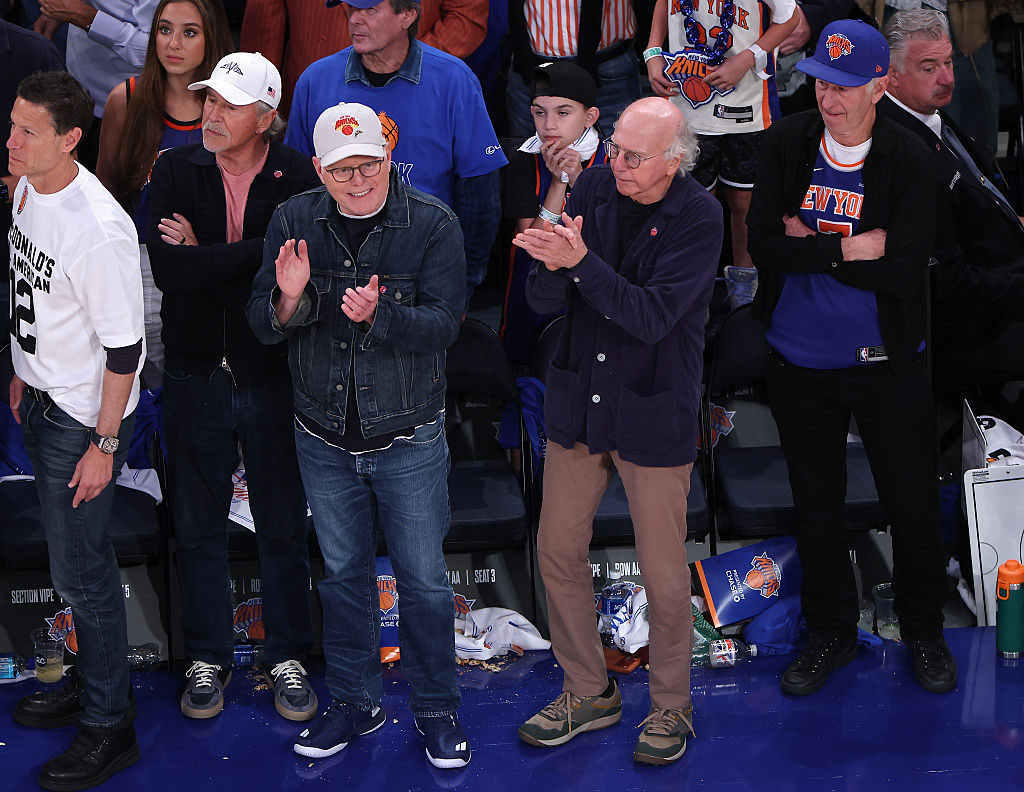
Larry David and John McEnroe react during the fourth quarter in Game Four of the 2026 NBA Finals (Photo by Dustin Satloff/Getty Images)
In front of frenzied fans at Madison Square Garden (MSG), the Knicks came back from a 29-point deficit to win the game by a point. A miracle tip-in by OG Anunoby at the final second sent the MSG fans and New York City in a state of delirium and the Knicks one win away from their first championship in 53 years.
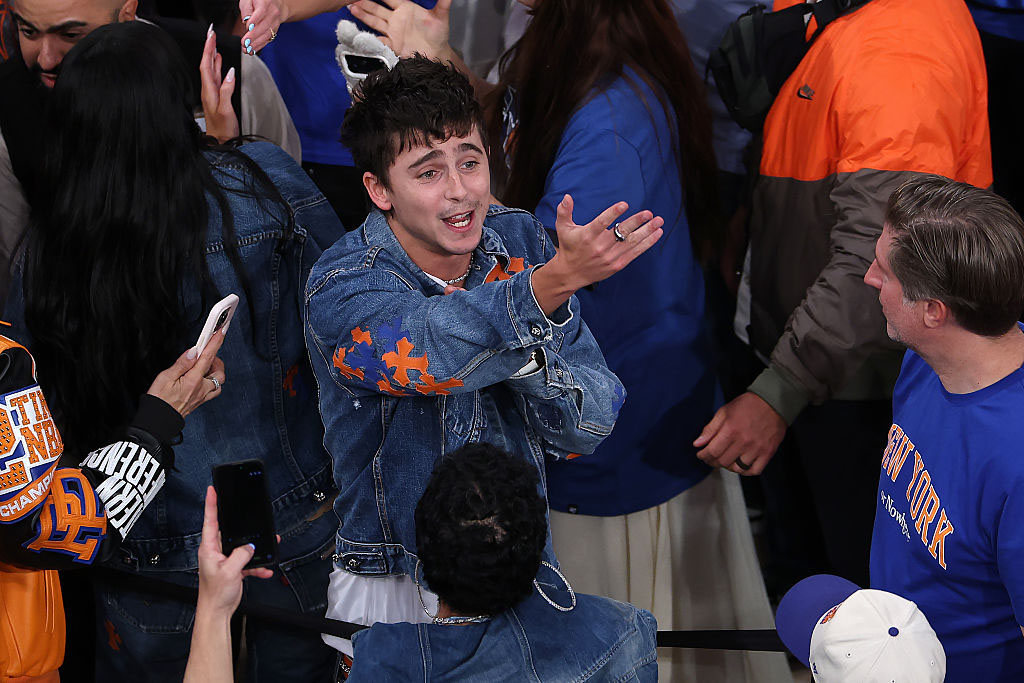
Members of Hollywood royalty with floor seats— Larry David, Jerry Seinfeld, Ben Stiller, Timothee Chalamet, Chris Rock, Adam Sandler, Spike Lee, Taylor Swift and others— seemed to have no problem losing their composure in public. A Youtube clip after the game showed Chalamet beckoning Knicks superstar Jalen Bronson as if he were a kid desperate for an autograph. That’s Chalamet! The same superstar actor who played Bob Dylan!
Timothée Chalamet reacts after Game Four of the 2026 NBA Finals between the San Antonio Spurs and the New York Knicks at Madison Square (Photo by Dustin Satloff/Getty Images)
Sports can make grown-ups unravel.
I’ve had moments watching my beloved Lakers where I got so loud celebrating a win the neighbors were about to call security.
But why?
Why such ecstasy over something seemingly trivial that has nothing to do with my life?
I understand being passionate about things that are personally meaningful— a family wedding, a special birthday, a children’s graduation, my love of America, and so on—but a basketball game full of rich athletes I don’t even know?
How can team sports have such a hold on so many people?
Because I make a habit out of thinking too much, I’ll offer some possible answers.
One, humans crave belonging. Those New Yorkers who are still celebrating on the streets of Manhattan are not just Knicks fans. They belong to a tribe. A tribe with civic pride. The Knicks of New York tribe.
Two, it feels great to have absolute clarity about who wins and loses. Have you noticed how we never know who’s winning wars these days? Take the war in Iran. The mullahs tell us they’re winning, Trump tells us we’re winning, and we’re all dizzy trying to figure out the score.
No such problem with sports. Ask the Spurs.
Third, watching sports can cleanse our primal urge for combat. It’s therapeutic to use phrases like “going to battle” knowing it won’t be a battle with missiles, tanks and drones. In sports, you go to war and people don’t die. Such a deal.
But forget all that. Watching the Knicks win a Finals game in front of the home crowd after being down 29 points was incredibly fun. It was high drama. It was like watching a fantastic movie– pure, unapologetic entertainment.
Of course, a cat on Tik Tok doing back flips can also be entertaining. But that cat can’t electrify the metropolis that never sleeps, or interrupt the sleep of a journalist in Jerusalem worrying about real missiles and the Strait of Hormuz.
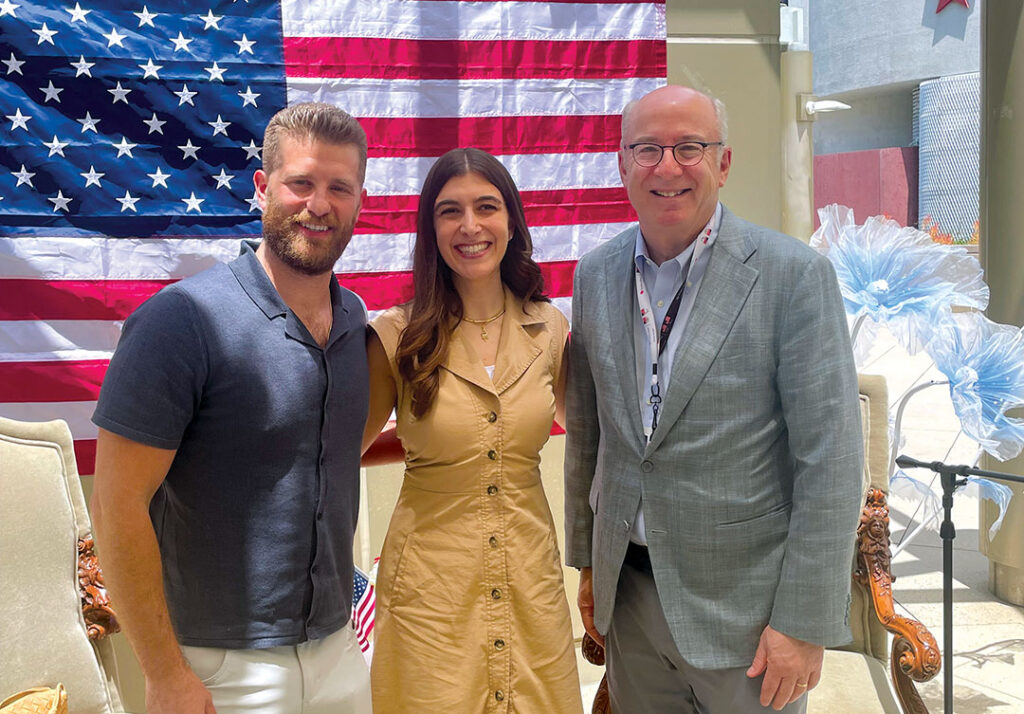
Jonah Platt returned to Cedars-Sinai Medical Center, where he was born 39 years ago and where two of his three children were also born. This time, however, it wasn’t for a baby delivery but for another kind of “delivery” — a conversation about Judaism and what it means to him.
The event, hosted by the hospital’s Jewish Staff for Tradition, Advocacy and Representation (J-STAR), took place on the rooftop of Cedars-Sinai, overlooking Los Angeles. Doctors, nurses and staff gathered on May 28 for an Israeli-style lunch, including cheese and mushroom burekas and a fresh fruit station. For many, it was a welcome pause in the workday — a chance to share a meal while engaging in a conversation about identity, purpose and faith.
This marked J-STAR’s second event overall, with this gathering held in celebration of Jewish American Heritage Month.
Emily Carter, senior major gift officer at Cedars-Sinai, asked Platt – a singer, actor and podcast host – what it means for him to be Jewish. “It’s who I am,” Platt said. “It wraps around how I move through the world and how I identify as a person. I’m a son, father, husband, friend — and I’m a Jew. Those words are tattooed on my arm. It’s a very meaningful legacy to me, both through my immediate family, my parents and grandparents and as a member of this tribe that’s been around for thousands of years.”
In the immediate aftermath of Oct. 7, 2023, Platt became increasingly active as a Jewish advocate online, sharing videos, participating in Q&As and meeting with hostage families. He also stepped into a rapidly evolving public conversation around antisemitism and Jewish identity.
Although he had been engaged in advocacy prior to that moment, he has described Oct. 7 as “the generational occurrence of my lifetime.” In that context, what began as public engagement gradually became more structured. After about six months, he reflected on whether to continue prioritizing acting as before or fully commit to this emerging direction. He ultimately chose to focus his energy on Jewish advocacy and his podcast, “Being Jewish with Jonah Platt.”
In conversation with Carter, Platt emphasized Jewish values and responsibility as a guiding framework that extends beyond formal advocacy into everyday life. “We Jews are told over and over again that we are responsible for everything — for our speech, thoughts, actions, for the widows, orphans, the environment, all of these things,” he said. “And I ask myself: what can I do? If not you, then who?”
That sense of responsibility, he added, is something he actively tries to pass on to his children. In everyday moments such as walking through his neighborhood, he makes a point of picking up litter — not as a statement, but as a habit rooted in example. Over time, he has seen his son begin to do the same.
For Platt, these small gestures reflect a broader understanding of how values are transmitted: not only through teaching, but through observation. Responsibility, in his view, is a lived practice that begins at home and extends outward into the community.
Born and raised in Los Angeles, Platt attended Jewish day school and Camp Ramah. He is the son of producer Marc Platt (“Legally Blonde,” “La La Land”) and former Jewish Federation Board chair Julie Platt. His brother is actor and singer Ben Platt (“Pitch Perfect”). He is married to Courtney Galiano, who converted to Judaism. The couple was married by Rabbi David Wolpe and have three children. Their family life is deeply rooted in Jewish practice and education, with their children attending Jewish day school alongside his nephews.
He spoke with particular pride about watching the younger generation engage with Jewish learning — not only through history and tradition, but also through contemporary cultural expressions such as Israeli music. “I see their enthusiasm when they listen to Israeli songs like ‘Hashem Yitbarach Tamid Ohev Oti’ and Omer Adam’s ‘Tel Aviv,’” Platt said, before breaking into song.
Speaking with The Journal about the broader purpose of the gathering, Carter reflected on how J-STAR has evolved, particularly since Oct. 7. “Shortly after Oct. 7, we came together to be a safe space for Jewish employees and our allies, but also for everybody to feel safe,” she said.
What began as a response to a moment of crisis has developed into an ongoing initiative focused on education, awareness, and community support. J-STAR now organizes programming on Holocaust remembrance, antisemitism and cultural observance, alongside celebratory events such as the rooftop luncheon.
With the J-STAR Board
Carter also noted the hospital’s origins, explaining that Cedars-Sinai was founded by Jewish physicians and community leaders who faced barriers elsewhere and created their own medical institution in Los Angeles. That legacy, she said, continues to inform the hospital’s culture of inclusion and service today.
Alongside its cultural programming, J-STAR also addresses practical needs within the workplace, including kosher food access, religious accommodation and scheduling support for employees observing Jewish holidays. Under the leadership of Rabbi Dr. Jason Weiner, the initiative serves as a resource for staff navigating both cultural and religious concerns. “We are one of the many resources at Cedars-Sinai,” Carter said. “People can come to us with their concerns. We make sure they have kosher food, and we help with understanding schedules for those who need time off for Jewish holidays. We want to take care of patients — but we also want to take care of our staff.”
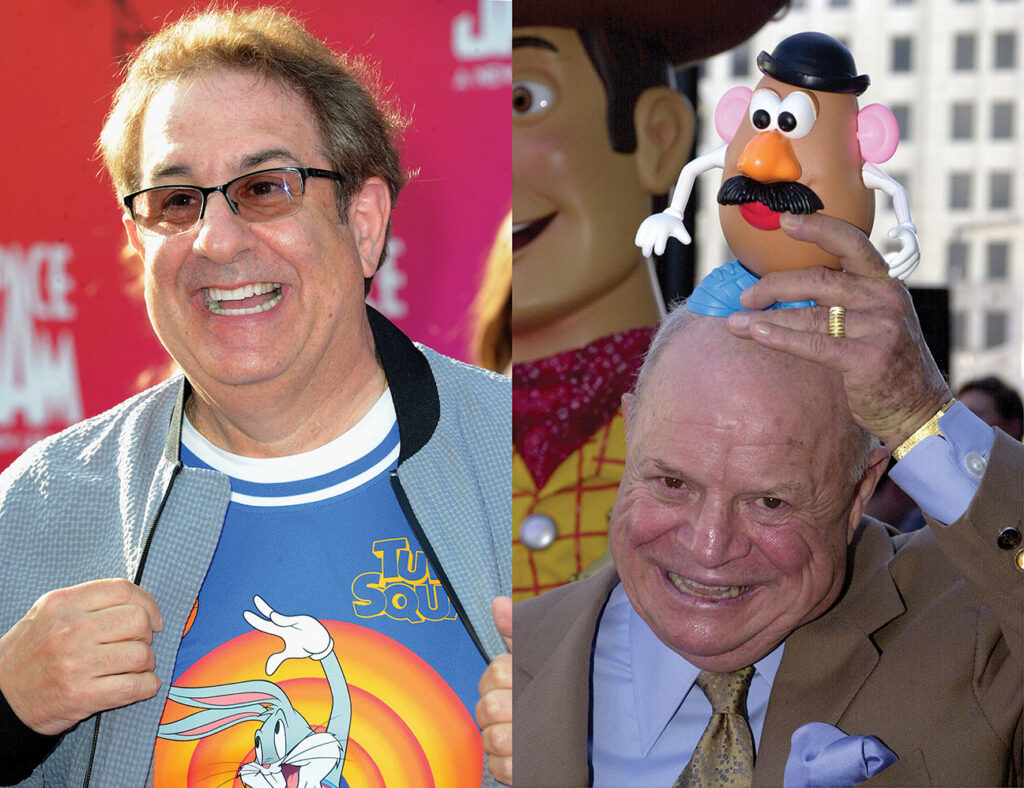
In the first three “Toy Story” films, comedian Don Rickles did the voice of Mr. Potato Head. While “Toy Story 4” was in production, Rickles passed away at age 90. Rickles’ family gave the producers permission to use previously unused audio in a few quick lines in the film.
But now, with “Toy Story 5” set to release on June 19, Mr. Potato Head will be voiced by veteran voice actor Jeff Bergman. It’s not the first time a beloved cartoon character’s voice duties were handed off from one Jewish Hollywood legend to Bergman — since 1990, he’s been the official voice of Bugs Bunny, following the passing of Mel Blanc in 1989.
Bergman’s credits also include George Jetson, Fred Flintstone, Daffy Duck, Sylvester the Cat, Tweety, Foghorn Leghorn, Elmer Fudd, Porky Pig, Yogi Bear and several other Looney Tunes and Hanna-Barbera characters. His work has appeared in “Tiny Toon Adventures,” “Animaniacs,” “Family Guy,” the “Despicable Me” films and nearly 100 animated projects.
“For a career that spans over 43 years for me now in the industry, it’s an honor of a lifetime to be in ‘Toy Story 5,’” Bergman told The Journal. “And then, to step into the role of an iconic character that’s over 30 years old that Don Rickles originated.” Bergman paused for a moment and smiled with a sigh.
Bergman grew up in the Philadelphia suburbs on Warner Bros. and Hanna-Barbera cartoons such as Yogi Bear and Huckleberry Hound, what he calls “the entertainment DNA he grew up with.” He remembers singing The Beatles “I Want to Hold Your Hand” and “She Loves You” with his parents on their RCA Victoria photograph. And he vividly recalls his earliest taste of Rickles’ comedy.
“It was 1968, Don Rickles had just come out with an album called ‘Hello Dummy’ and my parents were getting sloshed listening to that with their neighbors,” Bergman said. “I was at the top of the steps lurking, laughing and not completely understanding all the jokes, but they were laughing.”
Rickles was nicknamed “Mr. Warmth” for his ability to dish comic insults at everyone in the crowd at his live shows.
“So many lines, they’re all in my DNA, but one line that comes to mind is when he says, “Why don’t you go milk a Clydesdale for a half hour?’” Bergman said. “Never could have I imagined that Mr. Potato Head, that I played with and the Don Rickles comedy album that my parents were listening to would someday converge, but we’re talking 58 years ago.”
He had the other toys of the era — an Etch-a-Sketch, a Slinky and Yo-Yos — all future characters in the “Toy Story” films. By the time Bergman reached bar mitzvah age, he had grown out of the toys, and was more interested in singing and performing.
“I loved my bar mitzvah, I loved studying for my Haftorah,” Bergman said. “Part of that is the credit that goes to the Orthodox rabbi who presided at a conservative congregation, Rabbi Maurice Novoseller at Congregation Beth Chaim. I loved singing, I loved all prayers and because we were so close with the rabbi, he gave me so much more to do and to conduct in the service.”
Bergman’s first ever paid performing gig was in a synagogue.
“I was 16 years old, I did 15-20 minutes of standup at a bar mitzvah where the name of the kid that was a bar mitzvah, his last name was Bergman like mine — no relation,” Bergman said. “So it was so funny going to a bar mitzvah and just being surrounded by people you don’t know that have the same last name as you.” Bergman was paid with a $100 bill, which he framed.
During college at the University of Pittsburgh, Bergman attended a lecture by Mel Blanc, then tracked Blanc down at his hotel and introduced himself. Bergman performed Blanc’s characters for Blanc during the meeting. Bergman spent the next decade building up his reputation doing voices in television commercials.
After Blanc’s death, Bergman became the first performer to voice Bugs Bunny after Blanc.
He was quickly accepted by Looney Toons fans. Bergman’s public life as Bugs Bunny had a strange early moment in Pennsylvania.
“Well, I had a funny thing happen to me when it first hit in 1989,” Bergman said. “I was living in Yardley, Pennsylvania at the time and somebody saw me at the grocery store, followed me. I was scared because you know how when you’re walking, you feel a presence behind you. He tapped me on the shoulder and said, ‘What’s up, doc?’ And he gave me a bouquet of carrots. It was very alarming to have that happen. At the same time it was like, ‘Wow, okay, I guess it’s real.’”
He still has that young animation fan inside him when reflecting on iconic Los Angeles animation history locations.
“There was a location where they had the original ‘Termite Terrace’ where the animators would gather and I think sometimes that Mel [Blanc] would go there, but it’s long gone. Even Hanna-Barbera Studios, which was on 3400 Cahuenga Boulevard and I actually worked there and was directed on a project for ‘Jetsons: The Movie’ by Bill Hanna of Hanna-Barbera himself. That was really amazing. That was the holy ground.” The studio left that location in 1998.
Bergman also still looks back at his work with Chuck Jones, who throughout the 1930s-60s created such animated characters as Elmer Fudd, Road Runner, Pepé Le Pew, and Marvin the Martian.
“And I was also directed by Chuck Jones in the ‘Gremlins 2’ title sequence which had Bugs and Daffy,” Bergman said. “And so I spent four or five hours with him, that’s just royalty. He created Daffy Duck and Road Runner and Wile E. Coyote.”
He remembers seeing the original “Toy Story” for the first time in the theater in 1995 with his children. Looking back at that when taking the Mr. Potato Head voice role in “Toy Story 5” he talked about the huge responsibility he feels.
“We very much want to keep the spirit and the essence of that iconic character that Rickles created,” Bergman said. “So whether it’s that or it’s Bugs Bunny, it’s a huge responsibility to fans because you don’t want to do anything to disrupt anyone’s childhood memories. They’re all big shoes to step into.”
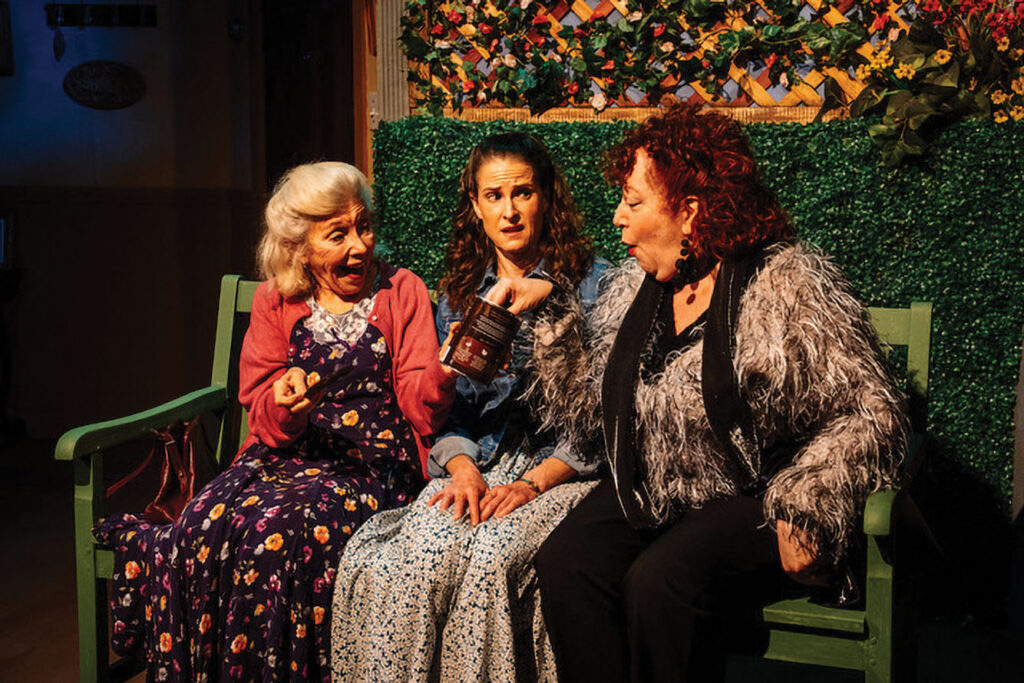
Sitting in the intimate space of Theatre 40 in Beverly Hills alongside my mother, the lights dimmed and Susan Sandler’s “Crossing Delancey” unfolded with a warmth and immediacy that no movie screen could replicate. As the cast brought to life the story of Isabelle Grossman, her Bubbe and the pickle vendor Sam, tears streamed down my face. It wasn’t just the performances, though they were superb, but the profound resonance of Jewish wisdom. In an era dominated by algorithm-driven dopamine hits, fast clips and AI-generated “solutions” to loneliness, this production reminded me why genuine human connection, rooted in tradition and patience, can still move us so deeply.
The play – the source of the hit 1989 movie – centers on Isabelle, a sophisticated young woman navigating life in New York’s book world, who finds herself torn between the glittering, but hollow promise of a literary affair and the grounded affection orchestrated by her grandmother. Bubbe, that force of nature on the Lower East Side, enlists a matchmaker to pair Isabelle with Sam the Pickle man, a man whose hands smell of brine and whose heart overflows with simple, steadfast wisdom marching to the rhythm of a distinctly Jewish tune. Watching the actress embody Bubbe’s irascible yet loving insistence on this courtship, I felt a visceral ache. Her schemes weren’t meddling; they were acts of cultural preservation. Bubbe understands that love isn’t a swipe or a perfectly curated profile but a deliberate crossing of paths, nurtured by family, community and shared values.
This is the Jewish wisdom at the heart of the play: the belief in shidduch, or matchmaking, not as archaic coercion but as a sacred bridge between generations. It echoes centuries of tradition where elders, drawing on lived experience, guide the young toward partners who complement character rather than chase fleeting chemistry. In the performance, Sam’s humble metaphors about pickles and life, his patience, and his unpretentious joy stood in stark contrast to Isabelle’s initial resistance. The live staging amplified this beautifully. The close quarters of Theatre 40 allowed every Yiddish-inflected line, every knowing glance between Bubbe and her friend the matchmaker, to land with intimate power.
In efforts to analyze my tears, I came to the conclusion that I cried because this wisdom of my own yiddishe Bubbe feels so often supplanted today. Our world peddles quick fixes: dating apps that reduce people to metrics, AI companions promising conversation without vulnerability and endless short-form videos that compress complex emotions into 15-second soundbites. Why invest in the slow art of courtship when an algorithm can serve up options instantly? Yet these tools leave many feeling more isolated. Bubbe’s approach, rooted in knowing one’s community, valuing resilience, and trusting time, offers an antidote. It insists that true fulfillment comes from depth, not speed.
My tears also flowed from a deeper, almost paradoxical nostalgia – one that mirrors what many in Gen Z express toward the 1990s, an era they never personally experienced. Born into a hyperconnected world, younger generations binge old camcorder footage, ’90s sitcoms and pre-smartphone films, yearning for a “lost world” of analog authenticity. They romanticize blockbusters, landlines, and unfiltered social interactions precisely because social media has rendered every emotion performative and ephemeral. “Crossing Delancey,” set in the late 80s (and evoking earlier immigrant grit), captures that pre-digital texture: neighborhood pickle barrels, bustling Lower East Side streets and conversations that unfold in real time over shared meals. Bubbe arranging Isabelle’s courtship with Sam mirrors this nostalgia perfectly. It represents a world where relationships weren’t optimized by data but cultivated through persistence and cultural memory. Gen Z, scrolling through filtered highlights, ironically longs for the messiness and sincerity of that pre-soundbite existence — the very sincerity Sam embodies.
For those longing to experience this fantastic play, hurry — “Crossing Delancey” is scheduled to run at Theatre 40 only through June 21st. The intimate venue heightened this effect. Unlike massive Broadway houses, every seat here feels personal, making the audience complicit in the story’s warmth. The direction emphasized the comedy without losing the heart—the Yiddish cadences, the food props, the intergenerational friction—all evoked a living Jewish culture that persists despite assimilation pressures.
In the end, “Crossing Delancey” isn’t anti-modern; it’s pro-human. It affirms that Jewish wisdom—emphasizing menschlichkeit (being a good person), family continuity, and deliberate love—transcends trends. As I left the theater, wiping my eyes, I felt renewed gratitude for traditions that slow us down enough to truly see one another. In a world of AI promises and viral ephemera, Bubbe’s matchmaking reminds us that the best things in life are still worth the crossing.
Lisa Ansell is the Associate Director of the USC Casden Institute and Lecturer of Hebrew Language at Hebrew Union College-Jewish Institute of Religion Los Angeles.
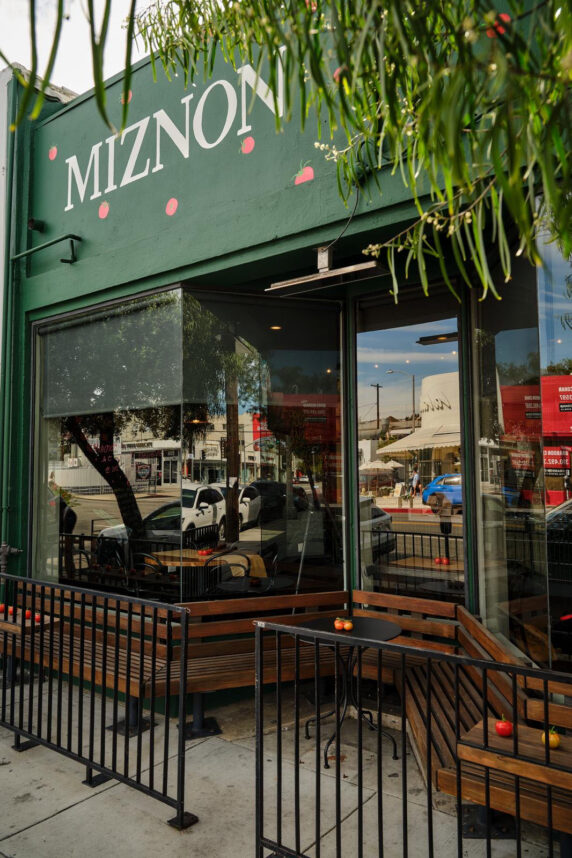
On West Third Street, where restaurants come and go with the rhythm of Los Angeles trends, Miznon didn’t just open, it landed with a kind of immediacy that’s hard to manufacture. Even before the official opening day, the restaurant was packed with diners, filling every seat indoors and outdoors.
The concept, brought to life by Israeli chef Eyal Shani, is deceptively simple: pita as a canvas, filled with everything from lamb kebab and rib-eye minute steak to schnitzel and their signature candy steak, overnight seared brisket, aioli, mustard, pickles, tomato, and red onion. But Miznon’s appeal goes beyond what’s stuffed inside the bread. A whole roasted cauliflower arrives layered with tahini, bronzed and dramatic, a paper bag of blistered green beans with lemon garlic vinaigrette — totally addictive — has quietly become one of the most talked-about dishes on the menu.
Vegetarian? Vegan? No problem. The menu leans just as confidently into plant-based dishes, from a falafel burger and sweet potato caramelized in its own honey to wild savory mushrooms stuffed in pita.
Everything is served on trays, stripped of formality. The message is clear: eat with your hands, lean in and don’t overthink it. In a city that often polishes its dining experiences to a shine, Miznon thrives on something looser, louder and more instinctive — an energy that has turned a humble pita into one of LA’s most compelling bites.
Shani is not your typical Michelin-starred chef. Self-taught and guided more by instinct than formal technique, the Israeli-born culinary force has built a global empire of nearly 50 restaurants, with locations spanning Tel Aviv, Paris, New York, Vienna and beyond. Widely credited with helping define modern Israeli cuisine, Shani is known for a style that borders on poetic — both on the plate and in his words — favoring minimal intervention, pristine seasonal ingredients and bold, elemental flavors.
His approach to food was shaped early on, influenced by his grandfather, an agronomist, during long walks through markets, fields and vineyards. That connection to the land still anchors his cooking today. Beyond the kitchen, Shani is also a prominent television personality, serving as a longtime judge on “MasterChef Israel” and appearing on several food-focused programs. Whether through a perfectly charred cauliflower or a pita filled with just a handful of ingredients, his work continues to redefine how Israeli cuisine is experienced around the world.
Behind Miznon’s Los Angeles expansion are two partners who see the city not just as a market, but as a natural extension of the brand’s spirit. Restaurateur Giancarlo Pagani, founder of Pagani Projects and a managing partner in the Mother Wolf Group, brings deep experience in building and scaling restaurant concepts. Alongside him is Steve Anavim, a longtime commercial real estate broker with more than two decades in Los Angeles, whose connection to the project is as personal as it is professional.
For Anavim, who is married to an Israeli and has family in Israel, the story began years earlier, during a visit to Tel Aviv. Drawn in by Miznon’s energy and simplicity, he found himself returning again and again, captivated by the food, the atmosphere and the idea that something so unpretentious could feel so complete. “I must have gone every chance I had,” he recalled. “I knew back then, I wanted to bring this restaurant to Los Angeles.”
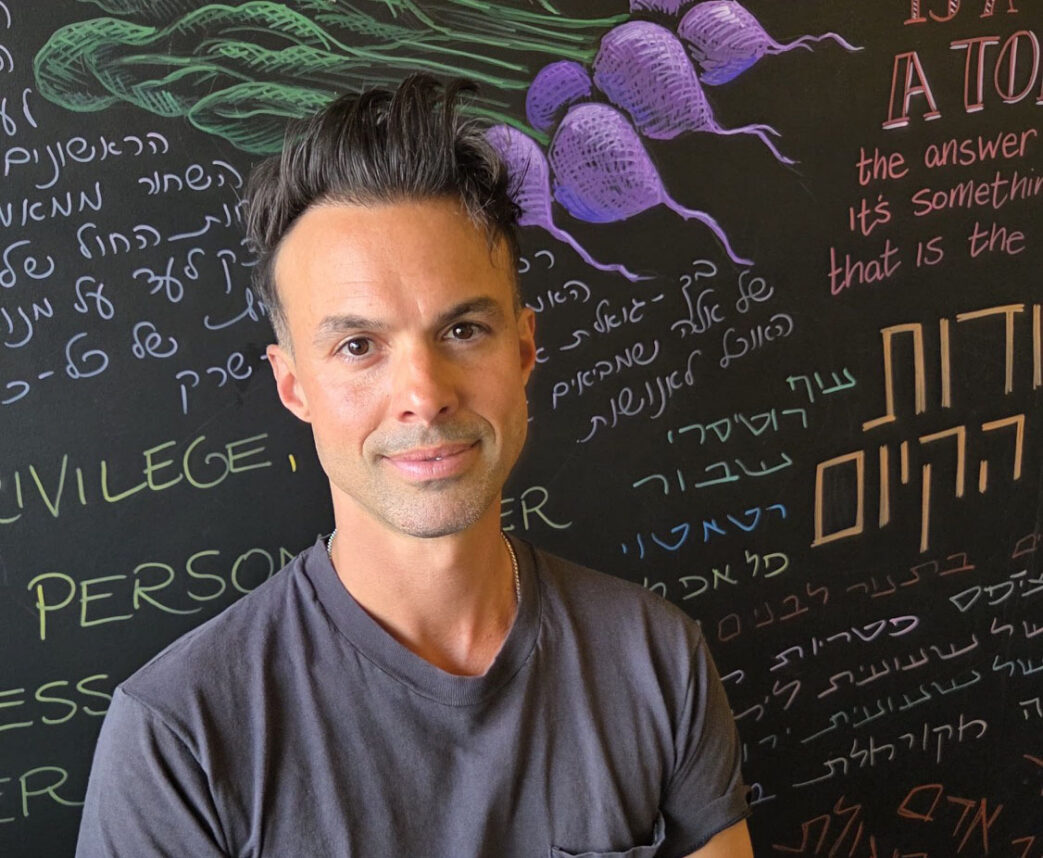
Co-owner Steve Anavim
That vision eventually led him to partner with Pagani — his friend since middle school — to make it happen. Their first step was a modest pop-up inside Grand Central Market in Downtown L.A., which opened in May 2025 and quickly proved the concept’s appeal. “It was successful from the very first week,” Anavim says. “We always planned to grow from there.”
The new West Third Street location opened on March 14 and marks a significant evolution: not just a pita counter, but a full restaurant with a broader menu and a dedicated cocktail program featuring playful, exclusive creations like the Pink Lemon Drop, Miznon Margarita and other inventive blends.
The partners approached Los Angeles as a city of neighborhoods, each with its own rhythm. Their goal, they say, is not to replicate Miznon, but to adapt it — while preserving its defining elements: simplicity, seasonality and the vibrant, open-kitchen energy that invites diners to engage with the food directly.
For Anavim, the confidence was always there. Given Miznon’s global success — from Israel to New York and beyond — he believed Los Angeles would embrace it just as enthusiastically. “At the end of the day, if you bring good food and a good vibe, people will come,” he says. “People here really connect to the flavors.”
The expansion of Miznon in Los Angeles is only part of a larger vision. Next comes Malka —Shani’s full-service, kosher-certified restaurant, set to open in a few months in Culver City.
If Miznon is built on speed, spontaneity and street-level energy, Malka – which means Queen in Hebrew –moves in a more deliberate rhythm. The concept already operates in Tel Aviv, New York, Brooklyn and West Palm Beach. Unlike Miznon’s fast-casual pita-driven format, Malka is a more expansive dining experience rooted in seasonal, ingredient-led cooking and plated dishes that reflect Shani’s signature style of minimal intervention and bold flavor. The menu, which changes regularly based on available produce, features a mix of Israeli and Mediterranean-inspired dishes like whole roasted fish, lamb shoulder cooked until tender, schnitzel stuffed with mashed potatoes, beet carpaccio, hummus-based plates, fresh salads and deeply vegetal dishes such as charred asparagus, freekeh with herbs and lemon and roasted root vegetables. The kitchen is known for its dramatic simplicity — ingredients often arriving touched with little more than olive oil, salt and fire.
For Shani, opening a kosher restaurant is not a departure from his cooking philosophy but a natural extension of it. He has described kosher cuisine as a framework that still allows for creativity and precision, particularly for diners who have long been unable to fully access his food. Rather than viewing dietary laws as a limitation, his approach treats them as a structure that can sharpen focus on ingredients and technique, reinforcing his long-standing emphasis on seasonal produce, simplicity and flavor-driven cooking.