Many Los Angeles rabbis and community leaders were hesitant to publicly share their views on the widely discussed and divisive speech delivered by Rahm Emanuel in Israel. Those who did respond to The Journal offered reactions ranging from praise to criticism.
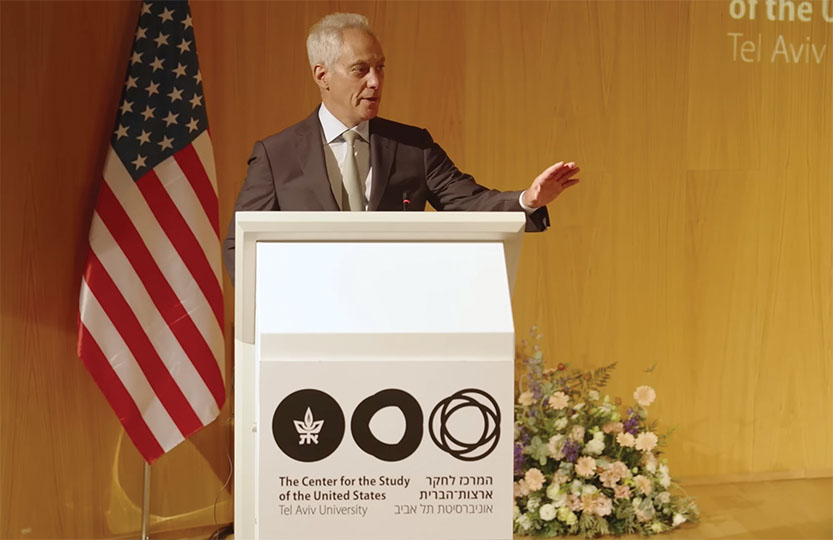
Appearing on July 8 at Tel Aviv University, Emanuel, a veteran Democratic politician who is widely viewed as a potential presidential candidate in 2028, argued that Israel is becoming increasingly isolated on the world stage because of its recent war in Gaza. He strongly criticized the Israeli settler movement and offered a sharp critique of the Netanyahu government, while also expressing empathy for what Israel has endured since Oct. 7.
Emanuel, the former Chicago mayor and White House chief of staff in the Obama administration, has deep family ties to Israel. His father was born in Jerusalem and fought in Israel’s War of Independence and his uncle, a member of the pre-state underground, is buried on Jerusalem’s Mount of Olives.
During his roughly 30-minute speech, he warned that Israel had become a “prisoner of its own tools” and that the American-Israel relationship, although historically strong, was “at a crossroads.”
He did not absolve the Palestinians of responsibility. Citing his time in the Clinton administration, Emanuel recalled multiple missed opportunities for Middle East peace, arguing that Palestinian leaders—first Yasser Arafat and later Mahmoud Abbas—walked away from proposed agreements.
Emanuel proposed what he called a “23-state solution,” one that would involve the world’s 21 Arab states, along with a Palestinian governing authority and Israel, in the effort toward making peace.
Emanuel delivered the speech amid growing debate over Israel’s standing within the Democratic Party and declining support for Israel among younger Americans.
The speech also underscored a reluctance among some Los Angeles Jewish leaders to weigh in publicly about Israel. The Journal reached out to 15 Los Angeles rabbis and community leaders for their reactions to the speech. Five declined to comment, while several others did not respond by deadline.
A rabbi from a major Conservative synagogue said, “Sorry, gonna leave this one alone.”
A rabbi from a major Reform community said he does not comment, in sermons or in print, on “internal Israeli matters, though Emanuel’s speech articulates what he believes are some of the international consequences.”
Among those willing to speak was Stephen Wise Temple Senior Rabbi Yoshi Zweiback.
“What I appreciate in Emanuel is that he never equivocates on Israel’s right to exist,” Zweiback told The Journal. “His father fought in Israel’s War of Independence, and his own middle name is Israel. These days, among people eyeing higher office, that clarity shouldn’t be rare, but it is.”
A regular contributor to The Journal, Zweiback said Emanuel’s criticisms of Israel don’t take away from his long record of supporting the country’s right to exist.
“Zionism means believing the Jewish people have a right to their ancestral homeland, a right history has proven to be an existential need,” Zweiback said. “You can hold that belief and still criticize an Israeli government’s actions.”
Journal editor-in-chief David Suissa, in an opinion column, argued that Emanuel offered “love tough” rather than “tough love,” which was not likely to reach Israelis. While Emanuel began by expressing empathy for Israel’s situation, it was his harsh criticism that dominated, delivering what Suissa described as “more gloom and doom to a nation already on overdose.”
“Whether or not his criticisms and prescriptions have merit, they were undermined by his superficial appreciation of Israel’s shattered state since Oct. 7,” Suissa wrote.
Michael Berenbaum, a Holocaust scholar who has spent decades studying Israel, was among those who welcomed Emanuel’s remarks.
“I think Rahm Emanuel told the Israelis what they needed to hear and what they’ve been unwilling to face,” Berenbaum said in a phone interview. “There have been multiple wars, policies that have not succeeded, pogromists on the West Bank. They’ve lost the American people, and that’s terrible.”
Speaking to The Journal one day after Emanuel delivered his speech, Berenbaum said he was planning to visit Israel this summer and that he has traveled there seven times since Oct. 7.
“Friends of Israel have the obligation to tell Israelis that it’s losing its moral claim,” he said. “It’s time for an honest reckoning.”
Rabbi Brad Artson, the Goldstine Distinguished Scholar at American Jewish University, offered praise. In an email, Artson, former dean of the AJU Ziegler School of Rabbinic Studies, said that as a rabbi, he’s not able to “assess military strategy or hone national policy.”
“But I can speak to worthy goals, lofty enough to advance God’s vision of sanctity, compassion, security and shalom… [And] I would ask all of us to recognize that — agree or disagree with his ideas — Rahm Emanuel loves Israel, loves democracy, seeks peace and has offered a serious new approach that has real possibility,” Artson said.